• Following Us

  • Categories

  • Check out the Archives


  • Awards & Nominations

Star Trek: Voyager – Barge of the Dead (Review)

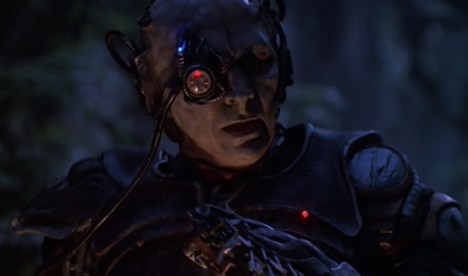
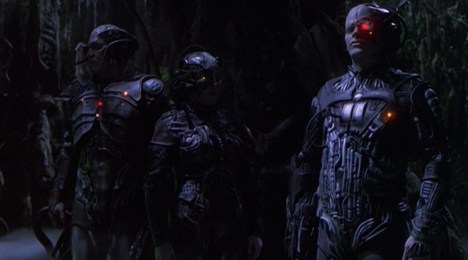
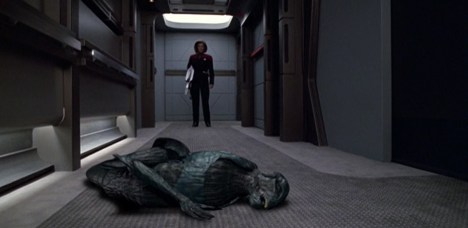
There is some small symmetry in Barge of the Dead.

When Bryan Fuller first pitched to Star Trek, he pitched to Star Trek: Deep Space Nine. The first idea that he sold was The Darkness and the Light, which felt like something approaching a gothic serial killer horror about a deformed killer stalking his victims using the franchise’s hyper-advanced technology. That original idea was heavily re-written by franchise veteran Ronald D. Moore, who also brought a more substantial thematic weight to the story by focusing on themes of violence and retribution.

Barging in.

In contrast, Barge of the Dead is the last television story that Ronald D. Moore would pitch for the franchise, coming at the very end of his time on Star Trek: Voyager. The episode has its roots in an earlier pitch by the writer, the original idea for Soldiers of the Empire. However, Moore would depart the franchise before he could finish work on Barge of the Dead, and so the writing of the script fell to Bryan Fuller. Much like Moore had subtly shifted the emphasis of The Darkness and the Light to his own thematic interests, Fuller embraces his own sensibilities in reworking Barge of the Dead.

Moore had re-written Fuller’s last story, and Fuller would re-write Moore’s last story. There is some sense of poetry in this.
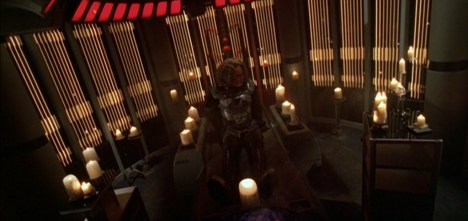
Tom’s idea of a romantic evening certainly needed some work.

Continue reading

Star Trek: Voyager – Survival Instinct (Review)

Survival Instinct marks the beginning and the end of Ronald D. Moore’s involvement with Star Trek: Voyager.

Moore had been one of the most influential writers on Star Trek: The Next Generation and Star Trek: Deep Space Nine. Moore had famously been drafted into the Star Trek franchise with no outside experience; The Bonding was based upon a speculative script that he wrote, and he had been invited to join the staff when The Defector proved that he was not a one-script wonder. Moore had inspired producer Michael Piller to open the franchise to speculative scripts, a decision which led to the recruitment of writers like Bryan Fuller and Rene Echevarria.

Drone warfare.

Moore had consistently pushed the envelope in terms of what Star Trek could be. Several of Moore’s scripts feel like trailblazers, expanding the storytelling language of an established science-fiction franchise; the Klingon-centric script for Sins of the Father, the quieter character drama of Family, the epic scale of Redemption, Part I and Redemption, Part II. Paired with Ira Steven Behr on Deep Space Nine, Moore really pushed the boundaries of what Star Trek could be; Soldiers of the Empire looked at life on a Klingon ship, In the Pale Moonlight stretched (and maybe broke) Star Trek morality.

All of the other writers on Deep Space Nine chose to bow out gracefully with What You Leave Behind, to part ways with the franchise having provided their own unique take on the Star Trek mythos. However, Moore was convinced to migrate across from Deep Space Nine to Voyager. There are any number of reasons why Moore might have chosen to stay when writers like Behr and Echevarria chose to take their exit; Moore was the longest continuous-serving writer on the Star Trek franchise to that point. In terms of second-generation Star Trek, only Rick Berman could have claimed to have a deeper impression.

Armed and dangerous.

Moore arrived on the sixth season of Voyager and immediately looked to make his mark. Like Brannon Braga, Moore had always been an extremely productive Star Trek writer. He was typically credited on six or seven scripts in a season of The Next Generation and Voyager, while also scripting Star Trek: Generations and Star Trek: First Contact. Although not credited on the script, Moore was actively involved in the back-and-forth over the script to Equinox, Part II. He scripted the second episode, Survival Instinct. He was working on the story to third, Barge of the Dead.

And then the unthinkable happened. Like so much of Voyager, Moore’s arrival proved to be something of a false dawn. In early July 1999, Ronald D. Moore left Star Trek. This was within a month of the broadcast of What You Leave Behind, and nearly three months before the premier of the sixth season of Voyager. Even before Moore and Braga elaborated upon the particulars of what had happened, it was clear that something had gone disastrously wrong.

What We Left Behind.

Continue reading

Star Trek: Voyager – Equinox, Part II (Review)

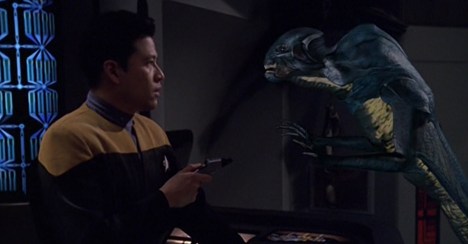
Equinox, Part II works worse than it should.

Equinox, Part II is undercut by three key factors. The most obvious is the premise itself. Equinox, Part I and Equinox, Part II tell a story that is baked into the DNA of Star Trek: Voyager, but there is a sense that the production lacks the will to tell that story. Secondly, Equinox, Part I and Equinox, Part II struggle with consistent characterisation and clear narrative arcs. The third factor is a sense of inevitability, with Equinox, Part I and Equinox, Part II feeling like they reveal nothing insightful about Voyager before concluding, and that the show will no lasting impact.

Fish out of fluidic space.

These three factors squander a lot of raw potential. Equinox, Part II is telling a story that feels essential to Voyager, a story that the franchise arguably should have been telling immediately after Caretaker. This season premiere represents the chance for Voyager to have a full and frank discussion with itself, particularly in the context of its sixth season. Star Trek: Deep Space Nine had concluded at the end of its seventh season. For the first time in its run, Voyager was the only Star Trek series on television. This was the perfect opportunity for introspection.

Equinox, Part II is an episode that fails to deliver upon a fantastic opportunity.

“What are you looking at?”

Continue reading

Deep Space Nine at 25 – The Most Humanist of (Star) Treks

On Earth, there is no poverty, no crime, no war. You look out the window of Starfleet Headquarters and you see paradise. Well, it’s easy to be a saint in paradise. but the Maquis do not live in paradise. Out there in the Demilitarized Zone, all the problems haven’t been solved yet. Out there, there are no saints — just people.

– Benjamin Sisko, The Maquis, Part II

Star Trek: Deep Space Nine is contentious.

Writer Ronald D. Moore has talked about the franchise as the bastard stepchild of the Star Trek franchise. Star Trek: The Next Generation actor Marina Sirtis has described it as little more than a hotel in space and not worthy of the franchise name. While the show was still on the air, Majel Barrett Roddenberry took the time to write a public letter denounced the show and its perceived connection to her husband’s legacy. This argument rages on-line even today, as fans argue about the series’ legacy and its place in the broader canon.

The charges against Deep Space Nine are clear. It is generally regarded as the most cynical of Star Trek spin-off shows, the series most likely to question and interrogate the underlying assumptions of the Star Trek universe. Deep Space Nine was the series that introduced and developed the Maquis, terrorists who splintered off from Starfleet. Deep Space Nine introduced the concept of Section 31, and the idea that Starfleet might be dangerous if left to its own devices. Deep Space Nine devoted its final two seasons to a war arc, a rejection of Roddenberry’s utopia.

However, these arguments are all based upon awkward presuppositions that reveal a lot about the assumptions of Star Trek fandom, and which tend to miss the forest for the trees. Deep Space Nine is a deeply humanist and optimistic piece of television, one has a great deal of faith in its cast and in people. As wary as Deep Space Nine might be about institutions and authority, Deep Space Nine fundamentally believes that people are good and that it is possible to peacefully coexist. The show simply acknowledges that this takes work, but believes it can happen.

Continue reading

New Podcast! Primitive Culture #19 – Star Trek: Voyager, History and Nostalgia

Over the Christmas Break, I had the pleasure of sitting down with the wonderful Duncan Barrett and talking about Star Trek: Voyager. Duncan is a historian, and I’ve had the pleasure of quoting some of his work on the blog in the past. He hosts Primitive Culture, with Tony Black and Clara Cook, a show wherein the hosts discuss certain historical-related items of interest in the Star Trek canon.

Duncan was in Ireland for part of the break, and so we took the opportunity to have a sit down to talk about the unique approach that Voyager had to the ideas of history and nostalgia within the Star Trek canon, how it viewed both the past and the future. We particularly focused on episodes like Distant Origin and Living Witness, along with a broad discussion of particular themes. It was a fun discussion, and you can listen to it below or directly via Primitive Culture‘s homepage on trek.fm.

Deep Space Nine at 25 – The Most Multicultural of (Star) Treks

Star Trek: Deep Space Nine is the first (and perhaps only) multicultural Star Trek.

Ironically, Deep Space Nine is often derided by traditionalist fans for eschewing core Star Trek principles. Deep Space Nine was the first (and only) Star Trek series to unfold on a space station rather than a space ship, boldly sitting rather than boldly going. More than that, Deep Space Nine was the first Star Trek series to embroil the Federation in an active war, notwithstanding the Klingon or Romulan Cold Wars nor the Cardassian Wars that retroactively took place during the early seasons of Star Trek: The Next Generation.

However, in a very real and substantial way, Deep Space Nine was also the Star Trek series that hewed most closely to the humanist principles of Gene Roddenberry’s Star Trek. It could reasonably be argued that Deep Space Nine simply made an effort to interrogate and to explore premises that Roddenberry never properly considered. At its core, Star Trek had always been about embracing the unknown with open arms and about learning that what was different was not always scary or monstrous. Deep Space Nine embraced that.

Deep Space Nine was not a series about a bunch of explorers looking “to boldly go” in any literal sense, but about a bunch of characters struggling to fundamentally understand “new life forms and new civilisations.” More than the other Star Trek series, Deep Space Nine was about embracing other cultures and values, about recognising that differences could enrich as much as divide, and that there was no single “right” way build a better world. Deep Space Nine is an ode to humanism and compassion, embodying many of the virtues other Star Trek shows nod towards.

Continue reading

Deep Space Nine at 25 – The Most Timeless of (Star) Treks

This may be the last time we’re all together. But no matter what the future holds, no matter how far we travel, a part of us – a very important part – will always remain here, on Deep Space Nine.

– Benjamin Sisko, What You Leave Behind

Star Trek: Deep Space Nine turned twenty-five this week.

Deep Space Nine is an important addition to the Star Trek canon in a number of respects. It was the only Star Trek series to air as a secondary series, its entire seven-season run coinciding with the broadcast of other weekly Star Trek series; its first two seasons overlapping with the final two seasons of Star Trek: The Next Generation and Star Trek: Voyager. It was also the last Star Trek series to air in syndication. It was arguably marked the point at which the viewing public lost interest in Star Trek during the nineties, the first Star Trek spin-off to lose its audience over its run.

However, Deep Space Nine was also memorable in other respects. It was the first Star Trek series not to take place on a ship named “Enterprise”, and the first not to take place on a ship at all. It was the first Star Trek series to embrace the possibilities of serialisation. It was the Star Trek cast with both the most diverse core cast and the widest ensemble, with an impressive collection of recurring actors and characters fleshing out the world. It was also arguably the only Star Trek series to truly embrace multiculturalism, with several episodes focusing exclusively on Klingon or Ferengi characters.

Still, the most enduring aspect of Deep Space Nine is how enduring it feels. At twenty-five years old, Deep Space Nine still feels fresh and relevant. It is a series that has a lot to say about the current moment, but it also had a lot to say about the moment before that. Deep Space Nine was undoubtedly a product of its time, but never feels as consciously wedded to its cultural context as the other Star Trek series. Ironically for the only Star Trek series to really engage with the idea of time, and the importance of forward movement through time for its character, Deep Space Nine is strangely timeless.

Continue reading

New Podcast! Standard Orbit #196 – “Star Trek Origins: Season 3”

I was thrilled to be invited to join the great Zach Moore on Standard Orbit, a Star Trek: The Original Series podcast hosted over at Trek FM.

Zach very kindly asked me on to talk about an aspect of the original Star Trek that I thought was overlooked, so I suggested the rather unlikely shadow that the third season of Star Trek casts over the rest of the Star Trek franchise. These episodes have developed a reputation as the worst episodes of the original run, coming at a point when the production team was exhausted, the budget had been cut, and the series was in its death throes. With all of that in mind, it is interesting how many core attributes of the Star Trek franchise can be traced back to these twenty-four (relatively) unloved episodes.

Kirk as a lothario, Klingons as honourable, the Federation as a utopia, the Romulans and the Klingons as entities that have lives outside of the Federation.

Zach was, as ever, a very gracious host. You can hear the full discussion below or visit the episode page here.

Continue reading

Star Trek: Deep Space Nine – Season 7 (Review)

The seventh season of Star Trek: Deep Space Nine is a remarkable accomplishment.

The seventh season is not perfect by any measure. Taken as a whole, it lacks the consistency that made the fifth season one of the best twenty-odd-episode seasons of television ever produced, particularly in a dire mid-season run of episodes that includes Prodigal Daughter, Field of Fire and The Emperor’s New Cloak. The fifth season (and even the sixth) never hit a run of three consecutive episodes that drag that hard. Similarly, there are moments when the production trips over itself during its epic run of ten closing episodes.

Similarly, it lacks the sheer quantity of all-time great episodes that made the sixth season so exciting and compelling, like that opening six-episode arc or Far Beyond the Stars or In the Pale Moonlight. However, the seventh season does quite well for itself; episodes like Treachery, Faith and the Great River, Once More Unto the Breach, The Siege of AR-558, It’s Only a Paper Moon, Chimera, Inter Arma Enim Silent Leges and Tacking Into the Wind are massively underrated and count among the best episode that the franchise ever produced.

However, the seventh season has a very clear sense of direction and purpose. After all seven years is a long time on television. By the time that the other Star Trek series hit that mark, there was a sense of exhaustion creeping in around the edges. The final season of Star Trek: The Next Generation often felt aimless and meandering, the production team waiting to transition to feature films. The final season of Star Trek: Voyager felt similarly worn out, a faded photocopy of an approach that had worked on the previous three seasons.

In sharp contrast, the seventh season of Deep Space Nine knows roughly where it is going. From the opening scenes of Image in the Sand, the production team are cognisant of the fact that the curtain will be coming down at the end of the season. As a result, the seventh season is written with an ending in mind. The writers might not have known that ending from the outset, and were still working on it even during the sprawling final arc at the end of the year, but they knew that it existed and was waiting twenty-six episodes in the future.

As a result, the seventh season of Deep Space Nine has a very strong sense of identity and compelling sense of urgency. These attributes distinguish the season the final years of The Next Generation and Voyager, but also mark it out as one of Deep Space Nine‘s (and the franchise’s) strongest years.

Continue reading

Star Trek: Deep Space Nine – What You Leave Behind (Review)

Ending a television series is always a daunting proposition, even with ten episodes allocated to that purpose.

There are very few “perfect” television finales, very few final episodes that perfectly encapsulate everything that made a television series great. Indeed, many popular television series end with underwhelming finales. Some are even retroactively tarnished by this legacy; The Finale for SeinfeldDaybreak for Battlestar GalacticaThe End for Lost. To its credit, the Star Trek franchise arguably has one perfect finale with All Good Things…, the final episode of Star Trek: The Next Generation.

A touching conclusion…

It might have been greedy to ask for two such perfect finales, especially in such close proximity to one another. What You Leave Behind is not a perfect finale by any measure. It is clumsy in places, it makes bad choices in others. The audience can feel the budgetary constraints on the production team at certain points, and the time constraints on the writing team at others. Star Trek: Deep Space Nine does not end with a “perfect” two-part episode. It ends in a messy fashion.

Still, even if What You Leave Behind is not a perfect television finale, it is a good one. What You Leave Behind doesn’t do everything that it could do, but it does everything that it needs to. While clumsiness and awkwardness hold the episode back from perfection, they exist in such a way as to add to its charm. What You Leave Behind captures the spirit of Deep Space Nine, in its successes and its failures. What You Leave Behind is a finale that speaks to the core essence of its show, to its best and its worst selves in the same breath.

The big goodbye.

The result is a finale that feels satisfying and earned, despite its narrative miscalculations. What You Leave Behind is true to Deep Space Nine, and focuses primarily on trying to pay off seven years of character threads and two years of story. Its gravest mistakes are inherited, the result of decisions made more than a year earlier in episodes like Waltz or The Reckoning that were allowed to fester and grow over the following thirty-odd episodes. Even in its failures, What You Leave Behind is trying to do right by its story.

There is a large gulf in quality between All Good Things… and What You Leave Behind. However, that gap is smaller than the space that separates What You Leave Behind from Turnabout Intruder, Endgame or These Are the Voyages… For all its issues, there is something heartbreaking in What You Leave Behind. There is a sense that this is truly the end of the line, that things have changed and the world keeps right on spinning.

We all need a little space…

Continue reading