• Following Us

  • Categories

  • Check out the Archives


  • Awards & Nominations

Star Trek: Deep Space Nine – Favour the Bold (Review)

With Favour the Bold, the writers begin winding down the ambitious six-episode arc that opens the sixth season of Star Trek: Deep Space Nine.

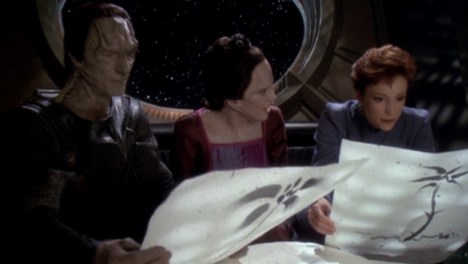
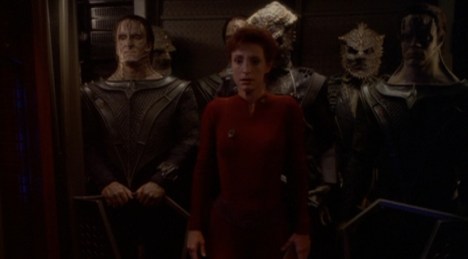
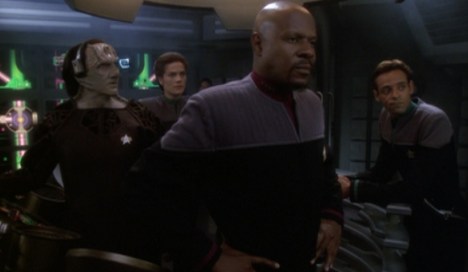
Indeed, Favour the Bold plays almost like the first part of a two-parter nestled at the end of the sprawling six-episode arc that opens the sixth season. At the end of the teaser, Sisko unveils his ambitious plan to Dax, boasting, “We’re going to retake Deep Space Nine.” It is the story that very clearly moves the arc that began with Call to Arms towards its conclusion, manoeuvring the series back towards the familiar status quo in which Captain Benjamin Sisko commands a lone Federation outpost near the distant planet of Bajor.

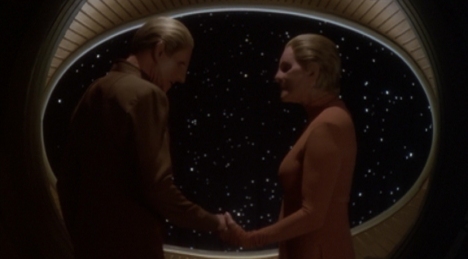
Point man.

Point man.

Favour the Bold is very much about lining up everything for the climax of the arc, moving the pieces into place so that that the dominoes can begin falling as early as possible in Sacrifice of Angels. However, the episode benefits from the fact that a lot of the heavy-lifting has already been done by this point in the arc. Behind the Lines already had Odo betray Kira, Rom get arrested and Damar figure out how best to dismantle those pesky self-replicating mines. That is already a lot of the table-setting for the arc’s epic conclusion, before Favour the Bold even begins.

As such, Favour the Bold has the luxury of beginning with a lot of its work already done and ending at the point where the action truly commences. The result is a surprisingly relaxed penultimate episode for this ambitious arc, one with the freedom to indulge in smaller character-driven scenes and the space in which to breathe.

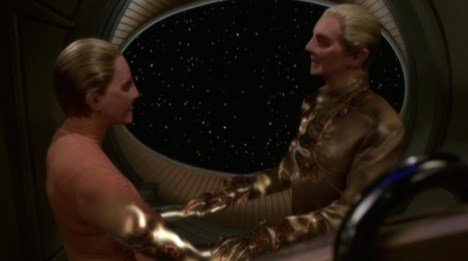
They just need some space.

They just need some space.

Continue reading

Star Trek: Deep Space Nine – Behind the Lines (Review)

Behind the Lines is an exemplary demonstration of Star Trek: Deep Space Nine‘s embrace of serialisation.

More than any other episode in the opening arc of the sixth season, Behind the Lines is an episode that exists in relation to the other episodes around it more than a self-contained unit of narrative. A Time to Stand set the tone for the final two seasons of the show, but its also featured a daring raid on a Dominion facility. Rocks and Shoals was about a ground conflict between Sisko and a Jem’Hadar platoon. Sons and Daughters was about Worf’s long-neglected relationship to Alexander. Favour the Bold and Sacrifice of Angels are an ambitious two-part finale.

Meldmerising...

Meldmerising…

In contrast, Behind the Lines is very much about taking what has already been established and streamlining it in preparation for the bombastic conclusion to this story. Behind the Lines is the episode in which Kira uses her “new resistance” formed in Rocks and Shoals to actually do something, in which Damar finally figures out how to dismantle the minefield that went up in Call to Arms, and in which Odo betrays his friends and colleagues in pursuit of his own gratification. More than any of the episodes around it, Behind the Lines cannot really stand in isolation.

However, it is also a stunningly brilliant piece of storytelling and a reminder of just how skilfully the writing staff on Deep Space Nine had adapted to the demands of serialisation.

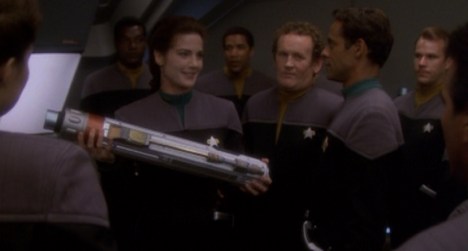
Terror cell.

Terror cell.

Continue reading

Star Trek: Deep Space Nine – Sons and Daughters (Review)

If A Time to Stand and Rocks and Shoals demonstrate the raw potential and ambition of the sixth season of Star Trek: Deep Space Nine, then Sons and Daughters demonstrate its shortcomings.

The fourth and fifth seasons of Deep Space Nine rank among the very best seasons of Star Trek every produced. These two seasons demonstrated a striking level of consistency. There were undoubtedly terrible episodes, like Shattered Mirror and The Muse in the fourth season or The Assignment and Let He Who Is Without Sin… However, these episodes tended to be quite concentrated. Even other episodes that didn’t quite work, like The Sword of Kahless, Sons of Mogh, A Simple Investigation or Ferengi Love Songs, were more bland than outright bad.

Let me be your father figure...

Let me be your father figure…

The sixth and seventh seasons of Deep Space Nine lack that consistency. They are even more ambitious than the two seasons directly prior, pushing harder in bolder new directions and resulting in brilliant television like Waltz, Far Beyond the Stars, In the Pale Moonlight, Treachery, Faith, and the Great River, The Siege of AR-558, It’s Only a Paper Moon, Chimera, Inter Arma Enim Silent Leges and Tacking Into the Wind. The sixth and seventh seasons of Deep Space Nine were breathtaking and highly enjoyable on their own terms.

In fact, there is a very credible argument for ranking the sixth and seventh seasons of Deep Space Nine among the best seasons of the franchise. They represent the last great narrative leap forward until the third season of Star Trek: Enterprise. These two seasons are driven by a desire to take risks and try new things, to make ambitious gambles knowing that they might not pay off. These are certainly virtues to be encouraged, even without that laundry list of spectacular television.

The lost art of parenting.

The lost art of parenting.

However, with that level of ambition, the sixth and seventh seasons were also much more variable in terms of quality. They contained a lot more misfires than the previous two seasons. This is not just the obvious high-profile failures like Profit and Lace or The Emperor’s New Cloak, but also a lot more episodes that disappoint without hitting quite that level of awfulness; One Little Ship, The Reckoning, Time’s Orphan, Prodigal Daughter, Field of Fire, Extreme Measures. There is a sense that the number of bad episodes increases noticeably.

Sons and Daughters is perhaps the first example of this trend. It is an episode that is not soul-destroying terrible, but it simply does not work in the way that it is intended to work. Sons and Daughters is not only the weakest episode of the six-episode opening arc, it is also the first episode to be written by David Weddle and Bradley Thompson as members of the series’ writing staff. The two facts might not be unrelated.

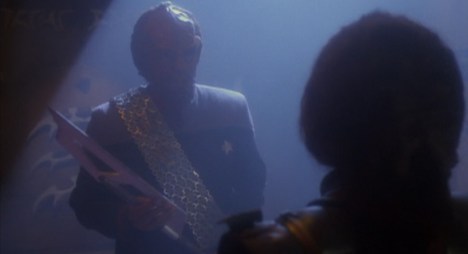
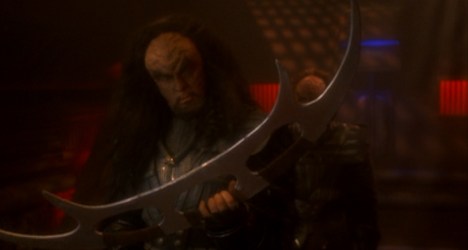
All (Mar)tok tok tok.

All (Mar)tok tok tok.

Continue reading

Star Trek: Deep Space Nine – Rocks and Shoals (Review)

The opening arc of the sixth season of Star Trek: Deep Space Nine is one of the most ambitious storytelling experiments in the history of Star Trek.

To be fair, it is not entirely unique. In some ways, it mirrors the storytelling arc that unfolded across Star Trek II: The Wrath of Khan, Star Trek III: The Search for Spock and Star Trek IV: The Voyage Home. Both Kirk and Sisko are separated from their home and from their first officer and from their iconic command, before eventually finding their way to reunite with both. Obviously, a three-film trilogy is distinct from a six-episode arc, even before talking about the tonal, thematic and plotting differences between those three iconic films.

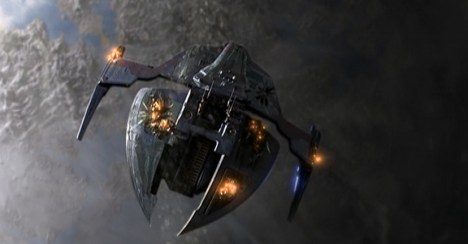
The Jem'Hadar warship that fell to Earth...

The Jem’Hadar warship that fell to Earth…

More than that, the success of the this arc would embolden the production team. They would attempt an even more audacious experiment to close out the seventh season of the series. The sixth season opened with six interconnected stories following the Cardassian reoccupation Terok Nor, building to Sisko’s retaking of the station. The seventh season pushes that even further, with a much more tightly integrated ten-episode arc that attempts to tell a single cohesive story. It is an even bolder creative decision than this arc, committing more strongly to the premise.

Ronald D. Moore’s departure from Star Trek: Voyager early in its sixth season would turn these experiments in serialisation into an evolutionary dead end for the franchise. It would be four years before Rick Berman and Brannon Braga would attempt to a tell a story on that scale. Indeed, faced with declining ratings and the spectre of cancellation, Star Trek: Enterprise attempted what was (on the surface at least) the even more ambitious attempt at a season-long arc across the entirety of the third season.

Winner takes it war...

Between a rock and a hard place.

Still, the six-episode arc that opens the sixth season of Deep Space Nine remains an impressive moment in the history of the franchise. Indeed, contrasted with the sprawling ten-episode arc that closes the series or the season-long arc on Enterprise, it could reasonably be argued that this six-episode stretch does a stronger job of balancing the integrity of individual episodes with the demands of the larger arc. These six episodes are all very strongly connected to one another, with a clear sense of story and character progression, but they also retain their own identities within that.

Rocks and Shoals might be the best example of this, an episode that delicately balances its own storytelling with the needs of the arc as a whole. Rocks and Shoals is at once a great episode in its own right and an essential part of a much larger story.

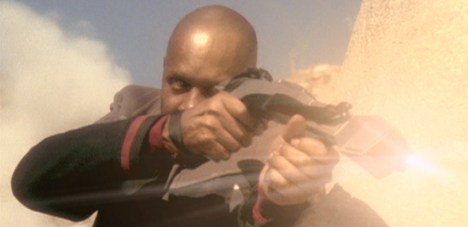
Express elevator to hell.

Express elevator to hell.

Continue reading

Star Trek: Deep Space Nine – A Time to Stand (Review)

And so Star Trek: Deep Space Nine has changed once again.

A Time to Stand represents a new beginning for Deep Space Nine, kicking off an ambitious six-episode arc that effectively sets up both the status quo and the tone for the final two years of the series. To be fair, this version of the show is very clearly the model to which the fourth and fifth seasons had been building. It is not quite a second (or third, or fourth) pilot in the style of The Search, Part I and The Search, Part II or The Way of the Warrior, but it is very clear that Deep Space Nine is entering a new stage of its evolution at the start of its penultimate sequence.

Touching reunion.

Touching reunion.

More than that, this opening six-episode arc very clearly serves to set up and establish themes and ideas that will play out across the series’ remaining episodes; Kira suggests she will support Odo’s decision to return home in Behind the Lines, Damar’s alcoholism and the shame it hides is introduced in Behind the Lines, Sisko talks about the house that he plans to build on Bajor in Favour the Bold, the Prophets promise that a price will be exacted from Sisko in Sacrifice of Angels.

Although the formal declaration of war came at the end of Call to Arms, the sixth season premiere truly ushers in the era of the Dominion War.

New frontier.

New frontier.

Continue reading

Star Trek: Deep Space Nine – Season 5 (Review)

The fifth season of Star Trek: Deep Space Nine is one of the best twenty-odd-episode seasons of television in the history of the medium.

Naturally, some episodes are stronger than others. There are a couple of duds to be found in the twenty-six episodes that make up the broadcast season. This is true of any season that runs for over twenty episodes; the reality of television production means that not every episode can be perfect and that some will inevitably be terrible. This is one of the nicer things about shifts to shorter television seasons; while it means fewer episodes in a given year, it also allows the production team more consistency.

ds9-empoknor12a

So the fifth season has episodes that do not work, to nobody’s surprise. The fourth season had Shattered Mirror and The Muse. The third season of Star Trek: The Next Generation had The Price and Ménage à Troi. The third season of The X-Files had The Blessing Way and Teso Dos Bichos. The second season of Millennium had Sense and Antisense and Siren. These are all great seasons of television, diminished in no way by their failures. The fifth season gets its failures out of the way early, with The Assignment and Let He Who Is Without Sin…

However, the fifth season of Deep Space Nine works so well because it has a very strong sense of internal consistency. As with the fourth season before it, there is a clear sense of where this production team wants to take the series. More than that, there is a very strong sense of harmony to the season. While each of the individual members of the writing staff have their own strengths and interests, they are all working together in pursuit of a common goal. Everybody writing for Deep Space Nine is on the same page as to what the show is about.

ds9-theassignment29a

The result is a season that marches very effectively and very coherently towards a logical and organic end point. A Call to Arms is perhaps the most radical cliffhanger in the history of the Star Trek franchise, sending Gene Roddenberry’s utopia into a two-season-long war while evicting the primary cast from the title location for more than just a single episode. It is to the credit of everybody working on the season that this finale is at once a gripping and subversive addition to the franchise mythology and a perfectly reasonable conclusion to the season.

The fifth season of Deep Space Nine ranks as a spectacular accomplishment.

ds9-trialsandtribbleations26a

Continue reading

Star Trek: Deep Space Nine – Call to Arms (Review)

The release of atomic energy has not created a new problem. It has merely made more urgent the necessity of solving an existing one. One could say that it has affected us quantitatively, not qualitatively. As long as there are sovereign nations possessing great power, war is inevitable. This does not mean that one can know when war will come but only that one is sure that it will come. This was true even before the atomic bomb was made. What has changed is the destructiveness of war.

– Albert Einstein, “Einstein on the Atomic Bomb”, The Atlantic, November 1945

Feels like coming home...

Feels like coming home…

Can war ever be justified? Can war ever be inevitable? Can war ever be necessary?

These are very tough ethical questions, particularly when posed in the abstract. In fact, the vast majority of policy decisions about warfare are rooted in living memory rather than philosophical certainty. It has been repeatedly suggested that Bill Clinton’s reluctance to intervene in Rwanda was a consequence of the spectacular failure in Somalia, and that his eventual intervention in Kosovo was an act of atonement for the moral lapse in Rwanda. This is to say nothing of how Obama’s policy on Syria is shaped by Bush’s actions in Iraq and Afghanistan.

Station keeping.

Station keeping.

The Star Trek universe is a utopia. It is a world where technology has eliminated poverty and hunger. The replicator, the holodeck, the transporter and warp drive are the building blocks of an idealistic future in which mankind seems to have found peace with itself. Dating back to Star Trek: The Motion Picture at the latest, Gene Roddenberry proposed that the franchise represented an idealised future for mankind. It was a world in which nobody ever wanted for anything, in which mankind were free to explore the universe.

This idealism is a cornerstone of the franchise. It is one of the most recognisable and universal aspects of Star Trek. This is a franchise that genuinely believes that mankind can be better than we are today. That is a large part of what makes the show so powerful, particularly in its original context. As the Doomsday Clock ticks closer and closer to midnight, Star Trek is a franchise that seems to argue that mankind has a future worth aspiring toward; a future beyond the end of the world or some corporate dystopia.

A farewell at arms.

A farewell at arms.

The franchise was never particularly interested in exploring how mankind reached that level of enlightenment. Star Trek: Enterprise was nominally a prequel series for the franchise, picking up in the wake of Star Trek: First Contact, but it opened after mankind had eliminated warfare and famine and nationalism. In some ways, the franchise could seem like a rather surreal experiment. If you imagined a world without warfare or without greed or without hunger, maybe people would get along? There is undoubtedly value on this, but it feels simplistic.

In contrast, Star Trek: Deep Space Nine dared to ask tough and uncomfortable question by challenging these assumptions. If these characters did not live in a perfect world, would they still aspire to betterment? If hunger and greed were still a part of everyday life, could mankind still work to improve themselves? If warfare is the inevitable outcome of statesmanship, then how do these twenty-fourth century people retain their values and ideals? These are legitimately tough questions for the franchise to ponder, but Deep Space Nine embraces them.

Terror on Terok Nor.

Terror on Terok Nor.

It is hard to overstate just how shocking Call to Arms was on broadcast. The actual plot mechanics are fairly standard Star Trek season finale stuff. The ominous and mounting sense of dread coursing through the episode evokes The Best of Both Worlds, Part I, the first season-ending cliffhanger from Star Trek: The Next Generation. The decision to have the recurring antagonists hijack the eponymous space station recalls Basics, Part I, the cliffhanger that Star Trek: Voyager broadcast at the end of the previous television season.

However, Call to Arms is more shocking for the one element of the episode that has been building since the first encounter with the Dominion in The Jem’Hadar. It is the beginning of the franchise’s first extended war story. This is bold new territory for the franchise, something that remains controversial to this day.
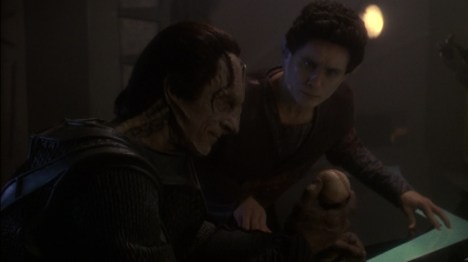
"The ball is in your court."

“The ball is in your court.”

Continue reading

Star Trek: Deep Space Nine – In the Cards (Review)

In the Cards is the perfect penultimate episode to a sensational season of television.

One of the more common observations about Star Trek: Deep Space Nine is that it is the most dour and serious of the Star Trek series. It is the grim and cynical series of the bunch, with many commentators insisting that the series rejects the franchise’s humanist utopia in favour of brutality and nihilism. This criticism is entirely understandable. The series is literally and thematically darker than Star Trek: The Next Generation or Star Trek: Voyager. Even at this point, it is about to embark upon a two-year-long war arc, the longest in the franchise.

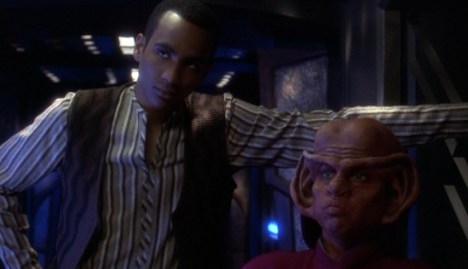
Jake and the Ferengi Man.

Jake and the Ferengi Man.

However, this is also a very reductive reading of Deep Space Nine. The series is more willing to criticise and interrogate the foundations of the Star Trek universe than any of its siblings, but it remains generally positive about the human condition. Governments and power structures should be treated with suspicion, but individuals are generally decent. Positioned right before the beginning of an epic franchise-shattering war, In the Cards is the perfect example of this philosophy. In the Cards elegantly captures the warmth and optimism of Deep Space Nine.

Deep Space Nine is fundamentally the story of a diverse and multicultural community formed of countless disparate people drawn together by fate or chance. In the Cards is a story about how happiness functions in that community, how the bonds between people can make all the difference even as the universe falls into chaos around them. It is also very funny.

Pod person.

Pod person.

Continue reading

Star Trek: Deep Space Nine – Empok Nor (Review)

Empok Nor is effectively a slasher movie.

It is Bryan Fuller’s second story credit for Star Trek: Deep Space Nine, and it shares a number of tonal and thematic similarities with his story for The Darkness and the Light. Both episodes are essentially pitched as serial killer horror movies, in which monsters from the past stalk our lead characters. These are fascinating tonal departures for the Rick Berman era of the Star Trek franchise, even if they feel like the logical extension of early horror-tinged episodes like The Man Trap or Charlie X or The Enemy Within.

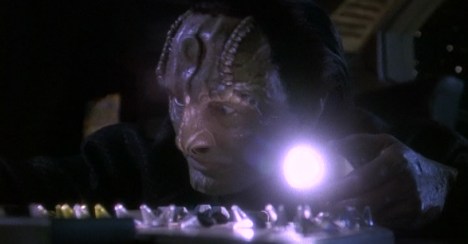
The great game.

The great game.

Empok Nor is not as well developed or as effective as The Darkness and the Light. It lacks the thematic and character-driven punch of that earlier episode, even suffering as a little derivative. While Kira’s efforts to reconcile her past as a terrorist with her current status quo was the driving force of The Darkness and the Light, the contrast between O’Brien as a soldier and O’Brien as an engineer feels a little underdeveloped in Empok Nor. More than that, Empok Nor suffers from casually transforming Garak into a gloating nineties serial killer.

At the same time, there is a cheeky thrill to watching the Deep Space Nine production team try their hand at a particularly trashy and visceral genre, offering jump scares and atmosphere on familiar sets with the lighting turned way down low. Empok Nor is not a standout of this most spectacular of television seasons, but it had its charms.

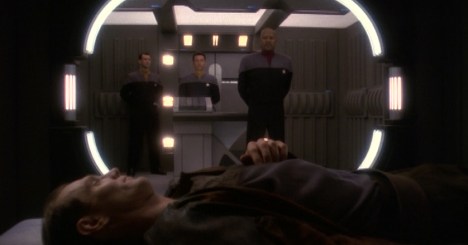
Sleeping beauties.

Sleeping beauties.

Continue reading

Star Trek: Deep Space Nine – Blaze of Glory (Review)

Blaze of Glory is a spectacular piece of television.

It is an episode that serves a very clear plot function in the larger context of Star Trek: Deep Space Nine. It is clearly designed to tidy away some of the dangling loose ends before the show transitions into the Dominion War. Much like Children of Time was really the last “strange Gamma Quadrant phenomenon” episode, Blaze of Glory is the last Maquis episode. It also marks the last appearance of Michael Eddington, a character who has come a long way since his first appearance as the station’s new security officer in The Search, Part I.

Michael Eddington, Noted Brigand.

Michael Eddington, Noted Brigand.

However, even ignoring the fact that Blaze of Glory fulfils these larger obligations in terms of the show’s long-running plot threads, the episode is an engaging and exciting buddy action film that finds Benjamin Sisko paired with one of his most hated adversaries on a dangerous mission into the heart of enemy territory. Ira Steven Behr and Robert Hewitt Wolfe prepare a script laced with wry banter for unlikely action heroes Avery Brooks and Ken Marshall, while Kim Friedman directs the episode as if it were a lost Reagan era Shane Black script.

However, Blaze of Glory also feels very much like Deep Space Nine at its best. It is an episode that celebrates how much these characters can grow and change, while also revelling in the diversity of perspectives that make Deep Space Nine such a compelling show. It is an episode that understands Sisko and Eddington are perhaps more alike than either would concede, but which explores those parallels in a way that never obscures their key differences or their mutual mistrust.

Disarming conversation.

Disarming conversation.

Continue reading