• Following Us

  • Categories

  • Check out the Archives


  • Awards & Nominations

The Adventures of Tintin: The Broken Ear (Review)

To celebrate the release of The Adventures of Tintin: The Secret of the Unicorn in the United States later this month, I’ll be taking a look at some of nineties animated television show. Check back daily!

Note: This is our review of the animated episode, check out our review of the book here.

I have to admit, I was curious about how the animated series would handle some of the more political material Hergé inserted into his work. I admired the way that Cigars of the Pharaoh handled international drug smuggling, but I suspected that broad political satire set in a banana republic might catch some viewers completely off guard. And, to be honest, there’s a lot of other stuff in Hergé’s The Broken Ear that makes it one of the tougher stories to adapt as a cartoon adventure. It’s very close to farce, and while the cartoon acknowledges that this business is a little sillier than usual, it never feels like the episode fully embraces the story it’s trying to tell, instead settling for a fairly generic run-around featuring characters and locales from the origin story.

Spotlight on the fetish...

Continue reading

The Adventures of Tintin: The Blue Lotus (Review)

To celebrate the release of The Adventures of Tintin: The Secret of the Unicorn in the United States later this month, I’ll be taking a look at some of nineties animated television show. Check back daily!

Note: This is our review of the animated episode, check out our review of the book here.

While I think that the early run of stories from Cigars of the Pharaoh were among Hergé’s most impressively pulpy output, populated with opium traders and sinister conspiracies seemingly spanning the globe, I do tend to have rather eclectic taste. For example, I am quite partial to The Black Island and The Shooting Star, two of the oft-malign chapters in The Adventures of Tintin. Similarly, I’ve found myself slightly underwhelmed by widely-praised instalments like The Secret of the Unicorn or The Blue Lotus. It’s not that I think they’re bad (far from it), merely that I feel they aren’t as good. Still, the animated adaptation of Tintin in America managed to construct an engaging little adventure from a disjointed story, so I wonder how this episode will handle its source material?

Shang-hai Noon...

Continue reading

The Adventures of Tintin: Cigars of the Pharaoh (Review)

To celebrate the release of The Adventures of Tintin: The Secret of the Unicorn in the United States later this month, I’ll be taking a look at some of nineties animated television show. Check back daily!

Note: This is our review of the animated episode, check out our review of the book here.

This is more like it. After a single twenty-three minute episode to cover Tintin in America, Cigars of the Pharaoh gets a bit more space. It’s a very faithful take on the classic story, split over two episodes to retain as much as possible. It’s a good thing, too, as I’d argue that Cigars of the Pharaoh is easily one of the best stories Hergé ever wrote, and certainly the first truly classic entry in the series. So it’s great to see the animated series kicking everything into gear.

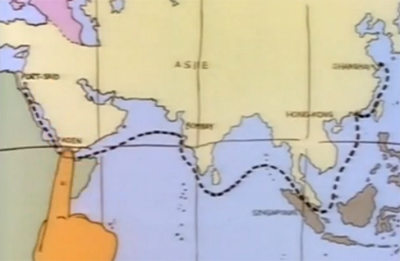
Mapping out the show...

Continue reading

The Adventures of Tintin: Tintin in America (Review)

To celebrate the release of The Adventures of Tintin: The Secret of the Unicorn in the United States later this month, I’ll be taking a look at some of nineties animated television show. Check back daily!

Note: This is our review of the animated episode, check out our review of the book here.

I remember catching a few of the animated Adventure of Tintin when I was smaller, and really enjoying them. They were a series produced to adapt Hergé’s stories into easy-to-digest half-hour instalments for kids. Naturally, the early adventures (Tintin in the Land of the Soviets and Tintin in the Congo) weren’t deemed suitable for this form of adaptation, so the series jumped right in with the third entry in Hergé’s long-running saga. Which is grand, because I started reading The Adventures of Tintin with Tintin in America.

Tintin gets animated!

Continue reading

The Doctor Is In? Is Doctor Who “Too British” For American Audiences?

Well, it’s been about a week since the news broke that David Yates would be directing the new Doctor Who movie, being produced by the BBC, aimed at American audiences. Perhaps Steven Moffat’s rumoured commentary was perfectly apt: it seems that neither the director nor the studio have any idea what exactly they are planning, and the announcement might have been more than a little preemptive. There’s a lot of chatter out there about what this means for the television show, which is rumoured to be running severely over-budget and under pressure from the BBC executives. Because, you know, it’s not like the show makes enough to justify its costs.

I don’t know if this means potential cancellation or a reboot after the fiftieth anniversary, or even if the show and the movie will run alongside in two distinct continuities (and people said Moffat’s “timey-wimey” plots were too complicated!). Being entirely honest, I’m not sure if Yates knows either. However, something does fascinate me about this. Bringing Yates on-board represents a vote of confidence, suggesting that Doctor Who could be somewhere in the region of “Harry Potter” success stateside.

I can’t help but wonder if Doctor Who is simply “too British” for mainstream American audiences, and if launching a movie franchise to appeal to the demographics will be able to keep the core of the character and the show, while courting North American movie-goers.

States of play?

Continue reading

Non-Review Review: Cyrus

Cyrus is a film that it’s hard to work up passion about in either direction. That’s not necessarily a bad thing, to be entirely honest – I don’t actively dislike it or anything like that. It’s just an honest reflection on this attempt to merge the indie “mumblecore” sensibilities with more conventional mainstream movie-making. It’s funny in places, and features a great cast, but it ultimately feels far too self-assured, and more like it’s comfortable with its indie-movie clichés, rather than trying to tell its own story.

Family dysFUNction...

Continue reading

Doctor Who: The Wedding of River Song (Review)

To celebrate the fiftieth anniversary of the longest-running science-fiction show in the world, I’ll be taking weekly looks at some of my own personal favourite stories and arcs, from the old and new series, with a view to encapsulating the sublime, the clever and the fiendishly odd of the BBC’s Doctor Who.

The Wedding of River Song originally aired in 2011.

“I had to die. I didn’t have to die alone.”

– The Doctor

That was a really crammed 45 minutes. If I’m ever looking for an example of how much plotting Steven Moffat can fit into a single regular-sized episode of Doctor Who, I think I only need to look back at The Wedding of River Song. It’s a piece of very smart science-fiction writing, bristling with ideas and tying up quite a lot of the questions that Moffat raised over the course of the last two years, while raising even more.

It’s something that Moffat’s Doctor Who seems to struggle with, balancing the show’s appeal and accessibility with long-term arc-based story telling. It’s a conflict that’s playing out across a variety of television shows, building off the massive success of Lost, and demonstrating that television shows with serialised plot elements can draw (and, for the most part, keep) large audiences.

It’s still a risky gambit for any television show, particularly one like Moffat’s Doctor Who, where the episodes are so few and so far spaced across the television season. Arcs like this run the risk of extending some of the problems with the season as a whole, rather than playing up the individual strengths of the episodes.

Death of the Doctor…

Continue reading

Tinker, Tailor, Soldier, Spy (BBC) (Review)

Let’s not be melodramatic. Control would disapprove.

– Smiley sums it up

It’s odd coming to the BBC’s 1979 adaptation of Tinker, Tailor, Soldier, Spy in the opposite direction of most fans. I’ve never read la Carre’s original novel, and I saw Tomas Alfredson’s movie before watching the miniseries. So my perspective is slightly askew, as if I’m moving in the wrong direction. My viewing of the miniseries is informed more by the 2011 movie than by the book that inspired it. Still, it’s very hard not to be impressed by the television adaptation, which really seems like it pulled out all the stops in translating the story from page to screen, featuring an all-star cast, of which Sir Alec Guinness is only the front man.

Smiley fellow, eh?

Continue reading

Doctor Who: Closing Time (Review)

Look! They gave me a badge with my name on it, in case I forget it… Which is very thoughtful, because that does happen.

– The Doctor shows off his name badge

I have to admit, I liked Closing Time. It wasn’t quite as good as The Lodger, but it was an entertaining diversion at the end of what has been a pretty gloomy run of episodes for Doctor Who. And based on the previews for The Wedding of River Song, it isn’t going to get any lighter next week. I do have to admit, I kinda like the idea of Craig as an almost “stationary” companion – one whose life is constantly interrupted by the return of the Doctor to his relatively quiet existence, something that works quite well in contrast to the relationship between Amy and the Doctor.

It's all under (remote) control...

Continue reading

Doctor Who: The God Complex (Review)

To celebrate the fiftieth anniversary of the longest-running science-fiction show in the world, I’ll be taking weekly looks at some of my own personal favourite stories and arcs, from the old and new series, with a view to encapsulating the sublime, the clever and the fiendishly odd of the BBC’s Doctor Who.

The God Complex originally aired in 2011.

It’s time we saw each other as we really are.

– The Doctor

It really is like the McCoy era all over again, isn’t it? The Impossible Astronaut gave us a scheming and manipulative Doctor. Night Terrors felt like it was drawn from the same cloth as Survival, with the faintest trace of Paradise Towers. Here, we get to revisit the ideas at the heart of The Curse of Fenric. Moffat’s second season has really been about the writer defining his own way of making Doctor Who, following a debut season that followed the same structure as the four years overseen by Russell T. Davies.

Here, Moffat is deconstructing the myth of the Doctor, in a way that draws on and contrasts with Davies’ “the Lonely God”, without going to the excess of “the Time Lord Victorious.” Indeed, with the whole dynamic between the Doctor and Amy drawing on one careless miscalculation the character made, changing a young girl’s life forever, one can’t help but wonder if there was more than a hint of truth in what the Doctor confessed to Amy to break her faith in him. “I took you with me because I was vain,” he tells her, “because I wanted to be adored.”

More than ever, it seems there’s a bit of truth in the Doctor’s admission that, “I’m not a hero.” Russell T. Davies has the Doctor follow a similar trajectory, albeit on a larger scale – episodes like Midnight and The Waters of Mars represented massive failings on the part of the Doctor. Moffat draws on the same sort of idea, but renders the Doctor’s failures much more intimate. It isn’t so much that the Eleventh Doctor fails to save the world or defeat the monster, it’s that he fails the people close to him so frequently and thoroughly.

You can check out any time you like, but you may never leave…

Continue reading