• Following Us

  • Categories

  • Check out the Archives


  • Awards & Nominations

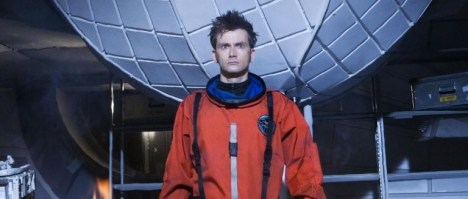
Doctor Who: Flux – Chapter One: The Halloween Apocalypse (Review)

“You know, Yaz. I can’t help but feel like some of this is my fault.”

In the lead-up to the broadcast of Doctor Who: Flux, there was some debate about the marketting of the series.

After all, it seemed like fans knew more about the distant fourteenth season of the revival than they did about the looming thirteenth season. Information about Chibnall’s third season tended to escape into the wild rather than derive from a single coherent source. Former showrunner Steven Moffat seemed to (accidentally) confirm that the Weeping Angels were appearing. Part of the publicity campaign for Flux involved deleting the show’s social media presence. The first trailer was released only three weeks before the premiere. In interviews, Chibnall openly worried about “giving too much away.”
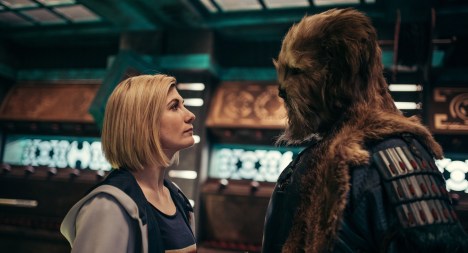
Dogged pursuit.

In some ways, this is typical of the larger Chibnall era. After all, Chibnall took great pride in seeding the phrase “the Timeless Child” in The Ghost Monument, only to eventually pay it off with twenty minutes of expository flashbacks in The Timeless Children. The Chibnall era is very plot-focused, which means that it is paranoid of potential spoilers, and it is reasonable to wonder whether that paranoia makes it harder to sell the show to the general public. For a sprawling six-part epic built around one of the BBC’s flagship properties, Flux seemed to fly in under the radar.

Then again, this makes a certain amount of sense watching The Halloween Apocalypse. The season premiere doesn’t really feel like an episode of television, at least not in the traditional sense. There is a relatively minor self-contained plot within the episode focusing on Karvanista and Dan, which is neatly wrapped up within the episode proper. However, that is just one thread of a story that cuts frantically from one thread to another, introducing a host of set-ups that promise the possibility and the potential of chaos.
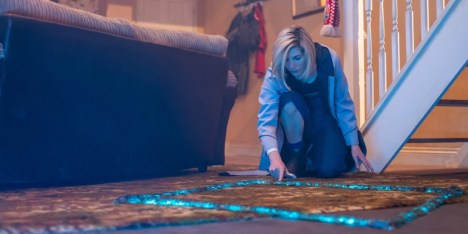
Tracing an outline of the season ahead.

This is itself pure and unfiltered Chris Chibnall. It is the ultimate acceleration and culmination of the style that he adopted in The Woman Who Fell to Earth. Inheriting the series from Russell T. Davies and Steven Moffat, Chibnall was a writer who lacked his predecessors’ skill with character and dialogue. Watching The Woman Who Fell to Earth, it seemed like Chibnall’s solution to this problem was to ensure that there was always something to cut away to – that he could get into and out of scenes quickly, to distract from the fact that his dialogue and characters felt rather generic.

The Halloween Apocalypse takes that idea to its logical extreme. It introduces a variety of disparate and disconnected elements that are presented as a series of mystery boxes, hoping that the audience will be enticed enough to keep watching – the Swarm and his history with the Doctor, the transformed Azure, the mysterious Vinder, Claire who appears to be from the Doctor’s past and/or future, the Sontaran invasion fleet, the mysterious excavations in 1820. None of these elements get any pay-off, or even development. Instead, they are simply spinning plates positioned for the rest of the six-episode arc.

With that in mind, the marketting strategy makes a great deal more sense. Why would Flux need heavy advertising, if the first episode was essentially a fifty-minute trailer?
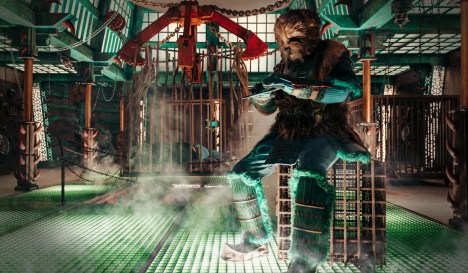
Being a little cagey about spoilers.

Continue reading

New Escapist Column! On Chris Chibnall’s “Doctor Who” Aspiring to Prestige Television…

I published a new In the Frame piece at The Escapist this evening. With Doctor Who: Flux launching this weekend, it seemed like a good excuse to take a look back at Chris Chibnall’s tenure as showrunner.

One of the more interesting recurring aspects of Chris Chibnall’s tenure as showrunner of Doctor Who has been the way in which he has embraced a lot of the narrative and visual language associated with “prestige television” – the anamorphic lenses, the muted colour scheme, the serialisation, the minimalism, the self-seriousness. It’s an approach that is an awkward fit for the show, particularly when the era around it seems so lacking in substance. It feels like an unconvincing attempt to argue that Doctor Who is “serious business.”

You can read the piece here, or click the picture below.

New Podcast! The X-Cast – Season 7, Episode 15 (“En Ami”)

The X-Cast is covering the seventh season of The X-Files. It is a season that arrives at an interesting point in the larger arc of the series, with the creative team trying to both prepare for the end of the show without actually committing to it. En Ami is an interesting episode in that regard.

Creditted to actor William B. Davis, En Ami is an episode focusing on the Cigarette-Smoking Man. It is not the first episode to focus on the character, as Musings of a Cigarette-Smoking Man had aired three seasons earlier. However, like both David Duchovny and Gillian Anderson, Davis seemed to be taking advantage of the show winding down to put his own authorial stamp on the character that he had played since The Pilot. The result is interesting and contradictory, complicated and compelling. It’s messy, but it’s also fascinating.

You can listen to the episode here, or click the link below.

Continue reading

New Escapist Column! On “Ted Lasso” and How We Watch (and Discuss) Television…

I published a new column at The Escapist today. With the end of the second season of Ted Lasso, and with the ongoing discussion around the show, it seemed like a good opportunity to take a look back at the evolving conversation around the series.

The discussion around Ted Lasso has followed an interesting arc. It premiered to lukewarm reviews, that seemed almost grudgingly positive. However, the first season seemed to find its audience in hindsight. Once it was completed, the season drew both serious consideration and enthusiastic praise from a variety of outlets. Many viewers came to the first season as a complete object, a collection of episodes that they could binge at their own pace. In contrast, this growing audience watched the second season week-on-week. It’s interesting to wonder if this shaped the more divisive response to the second season.

You can read the piece here, or click the picture below.

New Escapist Video! “A Marvelous Escape” – What If – “… Ultron Won & The Watcher Broke His Oath?”

With a slew of Marvel Studios productions coming to Disney+ over the next six months, The Escapist has launched a weekly show discussing these series

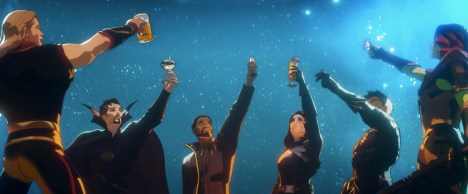
This week, I join KC Nwosu and Amy Campbell to talk about the last two episodes of What If…?, streaming on Disney+.

New Escapist Column! On “What If…?”, and How We Measure What Stories “Matter”…

I published a new In the Frame piece at The Escapist this evening. Because What If…? wrapped its first season last week, it seemed like a good opportunity to take a look at the show.

In particular, What If…? demonstrates one of the tensions within modern pop culture. How does modern pop culture measure the worthy or value of a particular story? Historically, stories have been judged on their own quality, making arguments for their own value. However, with the emergence and evolution of shared universes like the Marvel Cinematic Universe, it increasingly seems like audiences are being told that they should measure the value of a given story by how it “matters” to the continuity of the larger franchise. A story no longer has worth because it is good, but because it promises a return down the line.

You can read the piece here, or click the picture below.

New Podcast! Enterprising Individuals – “Gimme Some Mooney”

I am always thrilled to get a chance to talk about Star Trek with other fans, so I was thrilled at the invitation to join the wonderful Aaron Coker on Enterprising Individuals to talk about That Which Survives. The main feed episode went live last week.

However, our conversation tended to be a bit broader and a bit more wide-reaching than that, so we talked about everything from the recent release of Shang-Chi and the Legend of the Ten Rings to the completion of the Rebuild of Evangelion series. It was a discussion that managed to cover everything from Quibi to workers’ rights to the future of Doctor Who. It was a fun chat, and I hope that you enjoy.

You can listen to the episode here, back episodes of the podcast here, click the link below or even listen directly.

Continue reading

New Escapist Video! “A Marvelous Escape” – What If – “… Killmonger Rescued Tony Stark & Thor Were An Only Child?”

With a slew of Marvel Studios productions coming to Disney+ over the next six months, The Escapist has launched a weekly show discussing these series

This week, I join KC Nwosu and Amy Campbell to talk about the sixth and seventh episodes of What If…?, streaming on Disney+.

New Escapist Column! On Russell T. Davies’ Return to “Doctor Who”…

I published a new column at The Escapist yesterday. With the seismic news that Russell T. Davies would be returning as showrunner of Doctor Who, it seemed worth taking a look at what he might bring.

Davies is, to put it simply, one of the best dramatists working on British television. He is also one of the single most important creative personnel in the history of Doctor Who. While Barry Letts did briefly return as an executive producer, his return is unprecedented. While nobody knows exactly what happened behind the scenes, it seems safe to suggest that his return is a pretty big deal. So the question remains: can Davies save Doctor Who again?

You can read the piece here, or click the picture below.

New Escapist Column! On the Timelessness and Timeliness of “Foundation”…

I published a new In the Frame piece at The Escapist this evening. With the release of the first two episodes of Foundation on Apple TV+, it seemed like a good opportunity to take a look back at Isaac Asimov’s hugely influential science-fiction series.

Foundation casts a long shadow over American science-fiction, its influence felt on projects like Star Wars and Star Trek. However, while it has been adapted as a radio play, the new television show marks the first successful effort to bring the show to screen. What is it that makes Foundation so difficult to adapt? Why has it taken so long for such a foundational text to come to film or television? How is a science-fiction saga that began in the late forties and carried on into the fifties still relevant today?

You can read the piece here, or click the picture below.