• Following Us

  • Categories

  • Check out the Archives


  • Awards & Nominations

The X-Files – Conduit (Review)

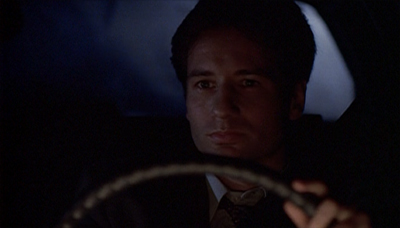
The X-Files is somewhat fascinating as a historical artifact, a prism through which the viewer might explore the United States in that gap of time between the end of the Cold War and the start of the War on Terror. The show serves as something of a travelogue through the American subconscious, a vehicle for the nation’s fear and anxieties. It might be quaint now to look back on the show’s depiction of mobile phones and the internet, but The X-Files offers a snapshot of an America just on the cusp of that technological revolution, when there were still dark shadows and corners of the continent to be probed and explored.

One of the more interesting aspects of The X-Files is the way that it deals with faith in the nineties. Scully’s attempts to reconcile her religious beliefs with a rational approach to the universe are surprisingly insightful and nuanced, but Mulder’s belief system also offers a vehicle to explore the form that faith might take. “I want to believe,” Mulder confesses at the end of Conduit, with the iconic poster turning the sentiment into a motto. It doesn’t matter that Mulder chooses to invest his faith in aliens or conspiracies, The X-Files is still an exploration of what faith meant in the nineties.
Why is Mulder so driven?

Why is Mulder so driven?

Continue reading

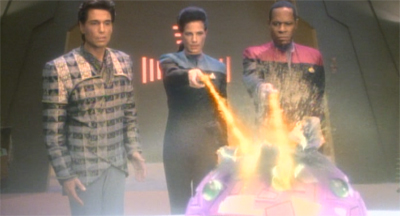
Star Trek: Deep Space Nine – Whispers (Review)

Star Trek: Deep Space Nine is twenty years old this year. To celebrate, I’m taking a look at the first and second seasons. Check back daily for the latest review or retrospective.

You could make a credible argument that each of the first three Star Trek shows beautifully encapsulated their time and place. The original show was the very embodiment of the sixties zeitgeist, providing a channel for commentary and insight into counter-culture and the Vietnam War, and an outlet for various fixations and phobias. Star Trek: The Next Generation was a show that spoke to a version of America which was emerging from the Cold War, a clean and sterile morning for a new America.

Star Trek: Deep Space Nine was positioned somewhat strangely, as the idealism and enthusiasm of the early nineties gave way to paranoia and insecurity. If the hyperreal technicolour production values of the original Star Trek spoke to the energy and enthusiasm sixties, then the drab grey Orwellian design of Deep Space Nine was a reflection of the late nineties.

Whispers is really the first time that the show has pushed its sense of paranoia to the fore, and it confirms that Deep Space Nine will be a show of its time, anchored in the nineties.

It's all a bit askew...

It’s all a bit askew…

Continue reading

The X-Files – Squeeze (Review)

Squeeze is the first “monster of the week” episode of The X-Files, and also the first episode that wasn’t written by creator Chris Carter. Instead, Squeeze came from the word processors of James Wong and Glen Morgan. Wong and Morgan would become a hugely influential (if not always successful) writing duo during the nineties. They’d write some of the best scripts for The X-Files, but they’d also leave (briefly) to run their own short-lived science-fiction drama in Space: Above & Beyond.

After Fox cancelled that show, the pair would briefly return to The X-Files before taking over Chris Carter’s other Fox drama Millennium, for that show’s second season. I’d argue that Wong and Morgan’s Millennium was one of the most inventive and insane seasons of television produced by any network in the nineties, and it’s a shame that Carter would have to re-assume the reins for the show’s third and final season. After that, the pair found considerable success creating the Final Destination film series.

However, all of that was in the future, but you can clearly see their creative talent at work here. Squeeze isn’t just the first episode of The X-Files unrelated to the show’s alien mythology, it is also one of the most memorable episodes ever written, creating a monster so iconic that he would wind up bookending the first season when he returned in Tooms.

Eye see you...

Eye see you…

Continue reading

Star Trek: Deep Space Nine – Armageddon Game (Review)

Star Trek: Deep Space Nine is twenty years old this year. To celebrate, I’m taking a look at the first and second seasons. Check back daily for the latest review or retrospective.

It’s been a while since we’ve had a fairly generic “could have happened on any Star Trek episode of Deep Space Nine. So it’s a lot easier to forgive Armageddon Game its simplicity and lack of nuance. This isn’t a story specific to Deep Space Nine. The basic concept could – rather easily – have been tailored to fit Star Trek: The Next Generation or even Star Trek: Voyager, with two crew members on the run for their lives on an alien world.

Armageddon Game is another story idea from Morgan Grendel, a writer who tends towards extremes. The Inner Light remains one of the best episodes of Star Trek ever produced. The Passenger ranks among the worst episodes of Deep Space Nine ever to make it to the screen. Armageddon Game sits somewhere in the middle.

Talk about chemistry...

Talk about chemistry…

Continue reading

The X-Files – Deep Throat (Review)

Deep Throat was filmed in August 1993, more than a year after the production of The Pilot in March 1993. In a way, Deep Throat feels like the first proper episode of the show’s first season, even carrying the production number 1×01. It cements a lot of the themes and ideas suggested in The Pilot, more firmly establishing arcs and characters. Indeed, The Pilot ended with a glimpse at the massive government conspiracy surrounding encounters with alien life forms, but Deep Throat serves to demonstrate just how deep that conspiracy goes.

The episode builds on countless ideas and conspiracy theories, delving into the popular suggestion that the United States military has been reverse-engineering alien technology for its own purposes. This suggests that Mulder isn’t just dealing with modern interactions between aliens and humanity, he’s digging into something that is rooted far deeper. As the eponymous informant teases him at the end of the episode, “Mr. Mulder, they’ve been here for a very long time.”

The truth is up there...

The truth is up there…

Continue reading

Star Trek: Deep Space Nine – The Alternate (Review)

Star Trek: Deep Space Nine is twenty years old this year. To celebrate, I’m taking a look at the first and second seasons. Check back daily for the latest review or retrospective.

Well, at least the second season of Star Trek: Deep Space Nine is experimental. It might not always pay-off, but there’s a clear sense that the show is trying new things, bending various genres to make them fit within the broad outline of a Star Trek show. Necessary Evil was a fascinating attempt to construct a noir episode, while Rivals was a less-than-successful sit-com in space. The Alternate is very much doing “Star Trek as monster movie”, which is surprisingly fun.

To be fair, it’s not a subgenre new to the franchise. Indeed, the first episode of the original show to air, The Man Trap, was essentially a monster horror in space. Still, The Alternate feels a bit more sinister and dark than  anything that Star Trek: The Next Generation might attempt. (Schisms probably comes closest, but – even then – there’s no sense that the monsters are stalking the starship. They have to abduct their victims to experiment on them.)

More than that, though, The Alternate is also a fascinating exploration of Odo as a character, looking at the relationship that Odo has with his co-workers and how that is rooted in his relationship with the man who claims to be his “father.”

Melting! Melting! Oh what a world!

Melting! Melting! Oh what a world!

Continue reading

The X-Files – Pilot (Review)

The X-Files is twenty years old this year. To celebrate, I’ll be spending Month X looking back at the first season.

There was a time, around the third season, when The X-Files became the show. It had grown from the quirky newcomer of Fox’s prime time line-up, through its status as a cult hit, into a bona fides pop culture touchstone. Looking back now, twenty years after the show first began, it is something entirely different. It’s weird to look back over a long-running television, divorced from the immediacy of broadcast, a sort of “if I knew then what I know now…” sort of thing.

However, looking back at The X-Files, it’s more than just knowing how it ends. It’s more than just knowing about the show’s slow and drawn-out two-year death. It’s more than knowing that the conspiracy plotline kinda (but not quite entirely) makes sense, if you look at it the right way and don’t over-think it. Approaching The X-Files now, twenty years later, is more like opening an old tomb, unlocking a time capsule. The musky smell of the past seems to seep out of the television screen, transporting the viewer to a time that really isn’t that far away, but feels like centuries ago.

The X-Files is, undeniably, a pop culture artefact from the nineties, a show that seems to slot almost perfectly between the end of the Cold War and the start of the War on Terror. It’s an exploration of a version of America that simply doesn’t exist any longer, the long and silent pregnant pause where the United States was the world’s sole unchallenged superpower. The X-Files really embodied that period of time, much like 24 managed to channel the anger and the rage of the post-9/11 era into piece of the zeitgeist.

And, to be fair, you can sense that sort of nineties existential anxiety even as early as The Pilot.

Beam me up...

Beam me up…

Continue reading

Star Trek: Deep Space Nine – Rivals (Review)

Star Trek: Deep Space Nine is twenty years old this year. To celebrate, I’m taking a look at the first and second seasons. Check back daily for the latest review or retrospective.

Rivals doesn’t work. However, while the second season has produced a string of noble failures, Rivals fails for a very simple reason. It’s a comedy episode without any comedy. It’s a guest-star focused episode which centres on a hopelessly miscast Chris Sarandon. Sarandon is an Oscar-nominated actor, and he should be something of a casting coup for the show. This second season has already featured Louise Fletcher, Frank Langella and John Glover – so it seems fair to acknowledge that the casting people were on a bit of a roll.

However, due to a reheated script and Sarandon’s lack of interest or engagement, Rivals winds up feeling stale. There is potential here, but it’s squandered as the writers forget the first rule of a good comedy episode. They forgot to bring the laughs.

I feel a similar way...

I feel a similar way…

Continue reading

Star Trek: Deep Space Nine – Sanctuary (Review)

Star Trek: Deep Space Nine is twenty years old this year. To celebrate, I’m taking a look at the first and second seasons. Check back daily for the latest review or retrospective.

Sanctuary is a very weird little episode, a nice concept with too much padding, reserving its best hook and twist for the final ten minutes, but capping it off with an attempt to soften the harsh blow somewhat. It’s another of those “shows we could only do on Star Trek: Deep Space Nine from the series’ second season, and it’s certainly more interesting and ambitious than Second Sight. However, for all the clever stuff that it does, it feels somewhat oddly structured and paced, as if the writing staff knew there were good ideas wrapped up inside here, but weren’t exactly sure how to get them out.

A blip on the radar...

A blip on the radar…

Continue reading

Star Trek: Deep Space Nine – Second Sight (Review)

Star Trek: Deep Space Nine is twenty years old this year. To celebrate, I’m taking a look at the first and second seasons. Check back daily for the latest review or retrospective.

You know, this the first real Sisko-heavy episode we’ve had since Emissary. He’s the lead, so he’s never too far from the heart of the story, and episodes like Dramatis Personae and Invasive Procedures gave Avery Brooks an opportunity to demonstrate his acting chops (and ability to be just as bad-ass, albeit in a different way, as Kirk and Picard). However, Sisko never really dominates or towers over Star Trek: Deep Space Nine in the same way that Kirk and Picard seemed to anchor their shows. Deep Space Nine is closer to an ensemble show than any other Star Trek series, and characters like Odo and Kira (and even Quark) have received as much (if not more) definition than Sisko, despite the fact he is the lead.

That’s not a bad thing. Over the run of the series, Deep Space Nine would produce a number of classic hours of television centred around Sisko as a character. The Visitor, Far Beyond the Stars, and In the Pale Moonlight are all hours that lean heavily on Brooks and can all be counted among the very best episodes of Star Trek ever produced.

Second Sight, on the other hand, is not.

Burning passion...

Burning passion…

Continue reading