• Following Us

  • Categories

  • Check out the Archives


  • Awards & Nominations

The X-Files (Topps) #20-21 – Family Portrait (Review)

This February and March, we’re taking a trip back in time to review the fourth season of The X-Files and the first season of Millennium.

Kevin J. Anderson is a very experienced hand when it comes to tie-in fiction.

Although Assemblers of Infinity was nominated for a Nebula Award in 1993, Anderson is perhaps best known for his work with licenced properties. He has written a significant number of Star Wars novels. He has published a trio of books set in the world of The X-Files. Indeed, Anderson would even adapt his first novel – Ground Zero – into a comic book miniseries for Topps. When Brian Herbert decided to finish his father’s Dune series, he collaborated with Anderson.

Photo finish...

Photo finish…

So Anderson is very much a safe pair of hands. He is a writer you can trust to construct a functional two-part X-Files story with a logical structure and a solid central premise. Anderson knows how to work within the boundaries of tie-in media, and he knows how to write a solid science-fiction or fantasy story. Pairing him with artist Gordon Purcell makes a great deal of sense, particularly for comic book that is trying hard to cement its place as a good old-fashioned tie-in.

Family Portrait is not exceptional, but it doesn’t try to be. Instead, it is functional. It is more efficient than ambitious, feeling very much like a classic horror comic that just happens to feature Mulder and Scully than a compelling episode of The X-Files in its own right.

Let's see what develops...

Let’s see what develops…

Continue reading

The X-Files – The Field Where I Died (Review)

This February and March, we’re taking a trip back in time to review the fourth season of The X-Files and the first season of Millennium.

Morgan and Wong’s four scripts for the fourth season of The X-Files are utterly unlike any other stories in the show’s nine-season run. Experimental, bold, confrontational; these four stories stretch and pull at The X-Files, as if eager to see just how far the hit show will bend.

The Field Where I Died is probably the weakest of these four episodes, but it is also the most ambitious. It is a script with big ideas and a willingness to commit to those ideas. There is no modesty here, no hesitation. There is a sense that Morgan and Wong are committing wholeheartedly to their themes and their concepts. The Field Where I Died is an episode that rubs quite a lot of people the wrong way, for a number of different reasons; however, the episode never pulls its punches. It never holds back. It never tries to be anything that it is not.

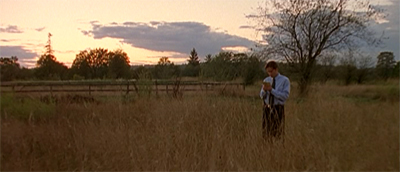
Far afield...

Far afield…

There is a lot to admire here. The Field Where I Died is not an episode with a simply formulaic concept or a conventional structure. It looks and feels completely unlike any other episode of the show. Even when the show touched on similar themes in its final season, the result was radically different. Hellbound is a much more conventional episode than The Field Where I Died. More than Home or Musings of a Cigarette-Smoking Man or Never Again, this is an episode that really seems like an odd fit for The X-Files.

Then again, that may be the beautiful thing about The Field Where I Died, for all its many flaws. It is utterly unlike anything else on television in the nineties. The fact that it can produce an episode of television so unique and incomparable is ultimately what makes The X-Files feel like The X-Files. The fact that The Field Where I Died feels so unconventional and eccentric is precisely what makes it a worthy episode of The X-Files.

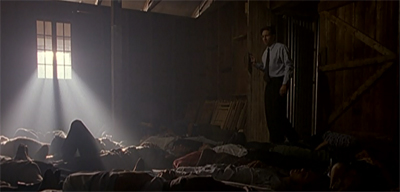
Another roaring success for Mulder...

Another roaring success for Mulder…

Continue reading

Millennium – Gehenna (Review)

This February and March, we’re taking a trip back in time to review the fourth season of The X-Files and the first season of Millennium.

Written by Chris Carter and directed by David Nutter, Gehenna feels very much like a continuation of The Pilot.

More to the point, it feels like a restatement of many of the key themes of The Pilot, an attempt to reinforce many of the core ideas in that first episode, and hint at something larger. In many ways, it is about ensuring that Millennium retains its identity as it transitions from a pilot that had a relatively relaxed schedule and high budget into a weekly (well, eight-day) production schedule. Gehenna is about Carter and Nutter proving that Millennium can do what it wants and needs to do week-in and week-out, while also indicating towards larger threads.

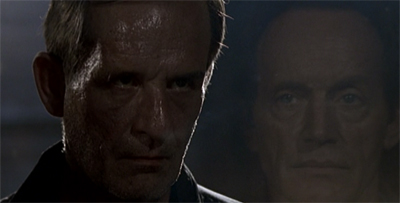
Touching (or, at least, seeing) evil...

Touching (or, at least, seeing) evil…

This isn’t a bad way to approach the first regular episode of a television series. Indeed, Carter had done something similar with The Pilot and Deep Throat on The X-Files, structuring the episodes as a one-two punch of reinforced themes and world-building. Gehenna is very much about convincing the audience that The Pilot was not just a flash in the pan, and that the series has a long clear arc ahead of it. Much like Deep Throat really sketched the outline of the alien conspiracy only hinted at in The Pilot, Gehenna features more than a few nods towards a larger evil at work in Frank’s world.

There are points where Gehenna feels a little bit too forced, and a little bit too eager to restate and repeat the themes and ideas of The Pilot. However, it is an interesting episode that does hint towards the show’s future in a number of interesting ways.

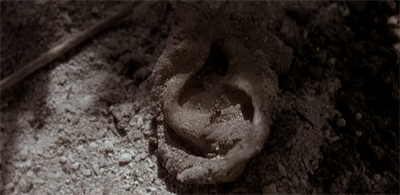
Ear today...

Ear today…

Continue reading

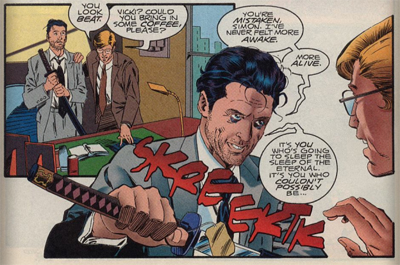
The X-Files (Topps) – The Silent Blade (Review)

This February and March, we’re taking a trip back in time to review the fourth season of The X-Files and the first season of Millennium.

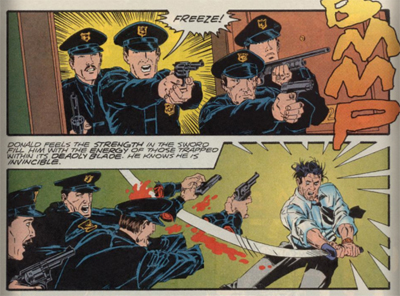
The Silent Blade is filler – one of those short stories that Topps produced as promotional material for wider consumption. In this case, as with The Pit, The Silent Blade was written as a short story to feature in the summer issue of The X-Files Magazine.

Writing a short story is tough. In some respects, writing a nine-page comic strip with a clear beginning, middle and end is harder than plotting a full-length issue or an entire arc. There is only so much space available, particularly when dealing with an exposition-heavy franchise like The X-Files. It can be tough to fit all the necessary ingredients in, let alone to put a novel twist on them. The temptation is to try to do too much with so little.

He won't be drawn on the matter...

He won’t be drawn on the matter…

Writer Stefan Petrucha and artist Charles Adlard had generally done well by their short stories, treating them as light and throwaway. They were not the strongest stories of the run, but they were aware of the limitations of the format and the expectations of the target audience. They were functional pieces of writing, aware of the limitations of the form. John Rozum’s first (and only) abridged X-Files story strains against those limitations.

After all, Rozum’s script for Thin Air had tried to fit too much into a full-length issue, so it makes sense that The Silent Blade is also a little too busy for its own good. This would be the last feature that Topps would produce for The X-Files Magazine, and the last of these sorts of short stories.

You have to do a lot of cutting to make a story this tight...

You have to do a lot of cutting to make a story this tight…

Continue reading

The X-Files – Unruhe (Review)

This February and March, we’re taking a trip back in time to review the fourth season of The X-Files and the first season of Millennium.

Unruhe was the first episode of The X-Files to air on Sunday nights.

The show had vacated its traditional Friday evening slot to make room for Millennium. It had been moved to Sunday evenings. Although the production team were initially quite cautious about the move, it would ultimately pay dividends for the show. The show had already become a mainstream hit, but the Sunday night slot would help to push it into the stratosphere. Airing alongside Fox’s other long-running success story, The Simpsons, the show would secure its highest ratings ever less than six months after moving into its new slot.

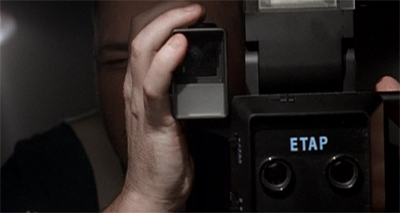
Photo copy?

Photo copy?

Of course, this also draws attention to another interesting facet of Unruhe. This was the first episode of The X-Files to air after Millennium hit the air. Unruhe aired two days after the pilot. The impact of Millennium has already been keenly felt on the fourth season of The X-Files in a number of ways; deadline and production issues hindered Herrenvolk, while James Wong and Glen Morgan had been drafted back to The X-Files to help shore up the fourth season. However, Unruhe seems to directly (and perhaps pointedly) acknowledge Chris Carter’s younger series.

Unruhe is an episode that would probably have been quite at home on Millennium. It is an episode that could easily have been re-worked or re-tooled for Carter’s new show – with only a few minor changes. With its serial offender, fascination with forensic psychology, and its grim reflection on mankind’s capacity for evil, it feels like an story that could comfortably have been told using Frank Black. While it serves to welcome Millennium to the genre neighbourhood, it also seems to suggest that Millennium might be a little redundant.

A walk among the tombstones...

A walk among the tombstones…

Continue reading

Star Trek: Enterprise – Season 1 (Review)

Next year, Star Trek is fifty years old. We have some special stuff planned for that, but – in the meantime – we’re reviewing all of Star Trek: Enterprise this year as something of a prequel to that anniversary. This January, we’re doing the first season. Check back daily for the latest review.

The first season of Star Trek: Enterprise is caught at a crossroads.

On the hand, it needs to be something new and exciting. The first Star Trek show of the new millennium, Enterprise has to find a way of updating the franchise and pushing forward. It has to find a way to challenge audience expectations and demonstrate that – after fourteen consecutive years and twenty-one overlapping seasons – Star Trek still has something fresh and exciting to offer fans. After all, the television landscape had changed significantly since the late eighties. It was time for Star Trek to change with it.

ent-brokenbow3

On the other hand, there’s a clear desire to seek familiar comforts. Star Trek has been on the air consistently for over a decade now. That wouldn’t be the case if the franchise didn’t have its own merits. There’s a sense that the first season of Enterprise is drawn to the idea that it can keep doing what worked before, offering generic Star Trek stories with a new cast and a new theme tune. This is still Star Trek, after all. There’s nothing gained by changing it to the point where it is unrecognisable.

Throughout the first season, these two impulses seem to be at odds with one another, leading to a surreal sense of whiplash. Episodes that feel as unique as Breaking the Ice, Dear Doctor or Shuttlepod One sit alongside generic shows like Civilisation, Sleeping Dogs or Rogue Planet. The show frequently pushes itself in interesting directions, only to pull relent as it approaches the point of committal. The result is a first season that is uneven, but intriguing, one that has great potential – if not necessarily the will to fulfill it.

ent-shockwavepart1m Continue reading

Millennium – Pilot (Review)

This February and March, we’re taking a trip back in time to review the fourth season of The X-Files and the first season of Millennium.

You think you’re protecting me but you make it worse, Frank. You can’t shut the world out for me. You can’t ask me to pretend that I don’t know what you do.

Everyone pretends. We all make believe. These men I help catch – make us.

We’re raising a daughter, Frank. The real world starts to seep in. You can’t stop it.

I want you to make believe that I can.

Fade to Black...

Fade to Black…

Continue reading

Star Trek: Enterprise – Shockwave, Part I (Review)

Next year, Star Trek is fifty years old. We have some special stuff planned for that, but – in the meantime – we’re reviewing all of Star Trek: Enterprise this year as something of a prequel to that anniversary. This January, we’re doing the first season. Check back daily for the latest review.

Re-watching a television show with the benefit hindsight is a particularly intriguing experience. Knowing that certain plot lines or character threads will or won’t pay off can be a liberating experience. While a disappointing ending to a particular story can undermine a lot of what came before, foreknowledge of the inevitable anticlimax allows the viewer to manage their expectations and temper their enthusiasm. It stops the viewer from getting too involved with threads that lead to dead ends, and heightens appreciations for those that pay dividends.

The Temporal Cold War plot on Star Trek: Enterprise never went anywhere. This is rather obvious in hindsight, given that it has been a decade since the end of the show. However, it’s worth acknowledging that many viewers correctly predicted as much on the initial airing of Broken Bow in late 2001. None of the questions raised will be answered, none of the plot threads will be resolved. It will just sit there, nestled snugly in the heart of this Star Trek spin-off, possibly embodying the show’s unfulfilled potential.

Enterprise isn't quite going to make it to seventh (season) heaven...

Enterprise isn’t quite going to make it to seventh (season) heaven…

While the Temporal Cold War lacks a clear resolution, it does provide the impetus for some pretty good storytelling on its own terms. In many respects, the plot works best when it exists as a driving force in the background of an episode – rather than being pushed to the fore. This is probably why Cold Front and Shockwave, Part I work much better than episodes like Shockwave, Part II – episodes that use the Temporal Cold War as a jumping off point to character work and development, rather than an end of itself.

Shockwave, Part I is notable for ending the first season of Enterprise on a cliffhanger. This was the first time that the opening season of a Star Trek had show had closed on a cliffhanger. The other shows closed out their freshman season with open-ended stand-alone stories, with the last episodes in the first seasons of Star Trek: Deep Space Nine and Star Trek: Voyager emphasising how far their cast had come. In contrast, Shockwave, Part I closes the first year of Enterprise on an honest to goodness “to be continued.” And a good one at that.

Seeking a friend at the end of the world...

Seeking a friend at the end of the world…

Continue reading

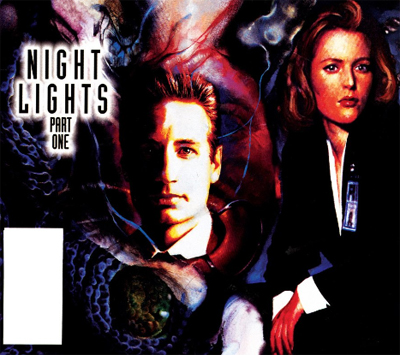
The X-Files (Topps) #18-19 – Night Lights (Review)

This February and March, we’re taking a trip back in time to review the fourth season of The X-Files and the first season of Millennium.

With Night Lights, incoming X-Files writer John Rozum teams up with veteran X-Files artist Charles Adlard. While Stefan Petrucha’s involvement in the line was pretty much finished, pending the release of Afterflight, Adlard would work as part of the book’s rotating art team for a while longer.

Thin Air made it quite clear that Rozum was going to be writing a more traditional X-Files comic book than his predecessor. Stefan Petrucha seemed happy to stretch the series as far as possible, to tease out big ideas about The X-Files and to play with the show’s sacred cows. The result was always intriguing, even if it sometimes went a little beyond what readers would have expected from a comic book based on The X-Files.

We will be gods, on night lights...

We will be gods, on night lights…

Rozum’s stories tend to be a bit more straightforward. They are very much conventional X-Files stories. They hue closer to the standard formula, and feature a whole host of expected ingredients. Thin Air was a very conventional and fairly rote X-Files story, particularly following on from stories like Falling or Home of the Brave. Rozum appeared to have some teething troubles, particularly when it came to pacing and characterisation.

While Night Lights feels a little too jumbled and confused to really work, it does seem a lot more confident and assured. The comic has a host of good ideas, and moves considerably smoother than Thin Air did. In fact, there is a rather brilliant idea nestled at the heart of the story. Rozum just buries it a little too well.

Keep watching the skies...

Keep watching the skies…

Continue reading

The X-Files – Teliko (Review)

This February and March, we’re taking a trip back in time to review the fourth season of The X-Files and the first season of Millennium.

The very premise of Teliko is something that should probably have big flashing warning lights around it.

Teliko is an episode about an immigrant from Burkina Faso who celebrates his arrival by murdering within the African-American community. As such, it is the kind of story that the production team has to be very careful in handling. It could easily become a horrendously xenophobic anti-immigration story, a warning about the dangers of opening the borders to foreigners from cultures that are different to our own. And that is even before the episode decides to have the monstrous murderers turn his African-American victims white.

Top drawer...

Top drawer…

Writer Howard Gordon has navigated this sort of minefield before. Fresh Bones was a voodoo story set within a Haitian refugee camp. As such, it came with many of the same sorts of latent issues. It would be very easy to put a foot wrong, to turn the story into a collection of unpleasant and reactionary stereotypes that painted the foreign as inherently and undeniably horrific. Gordon’s script for Fresh Bones cleverly side-stepped a lot of these problems, becoming one of the strongest scripts of the second season.

While Teliko makes a conscious effort to avoid these potential hurdles, it isn’t quite as quick on its feet.

It's okay. Everybody gets a little airsick.

It’s okay. Everybody gets a little airsick.

Continue reading