• Following Us

  • Categories

  • Check out the Archives


  • Awards & Nominations

New Escapist Column! The “Hiatus” After “The Rise of Skywalker”…

I published a new In the Frame piece at Escapist Magazine last night, looking at what follows Star Wars: Episode IX – The Rise of Skywalker.

Disney have announced that there will be a three-year gap between The Rise of Skywalker and the franchise’s next theatrical release. However, is this really a hiatus? In the nineties and even into the twenty-first century, franchises like Batman and X-Men routinely went three or four years between new releases. Each of the original Star Wars films were separated by three years. It perhaps speaks to the heightened nature of modern franchise production that the idea of going three years without a Star Wars film feels like a really long time – even with The Mandalorian on the air.

You can read the piece here, or click the picture below.

“Can You Help Him?” The Millennial Malaise of “The Phantom Menace”…

It is almost a cliché to say it, but 1999 was an amazing year for movies.

No, really.

Of course, everything is subjective and different people have very different tastes, but there was something special about that year. There were traditional crowd-pleasers like The Green Mile and The Cider House Rules. There were young poppy disruptors like Go! or Run Lola Run. There were formative films from era-defining directors like The Sixth Sense, Magnolia or Election. There were epoch-defining hits like The Matrix or Fight Club. There was a wave of teen movies serving an underserved audience like Cruel Intentions, 10 Things I Hate About You or The Virgin Suicides.

And there was Star Wars: Episode I – The Phantom Menace. It was comfortably the most anticipated movie of the year, to the point that its teaser trailer became a cinematic event that arguably inflated the box office of Meet Joe Black. It seemed perfectly timed. The generation of fans who had grown up with Star Wars were now old enough to have their own families, with which they might share the experience. The public’s appetite had been whetted by theatrical re-releases of the original films to prove that there was still a hunger out there for the franchise.
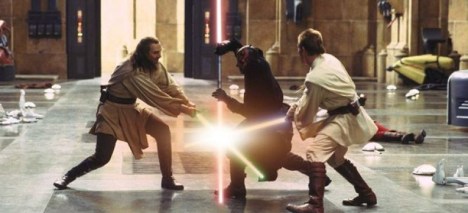
Not quite a duel in the franchise crown.

However, The Phantom Menace is very rarely discussed in the context of the cinematic marvel of 1999, despite being crowned the year’s box office champion. There are plenty of reasons for that, of course. Most obviously, it wasn’t very good. Perhaps more importantly, it aggressively upset the established fanbase who promptly made very silly statements about how George Lucas had “raped their childhood” by continuing to make films that weren’t to their specifications. As such, The Phantom Menace is primarily notably as a failure and disappointment, which it undoubtedly is.

That said, there is something very interesting happening beneath the surface of The Phantom Menace, and something that perhaps merits discussion in the specific context of its original release. The Phantom Menace was the only Star Wars film to be released in the nineties, serving as both the cornerstone and the capstone of what Star Wars looked like during the decade. The films that would follow were shaped by the concerns of their own era, warped and informed by the War on Terror. However, in hindsight, The Phantom Menace is very much a 1999 movie, through and through.

Anakin, not Anakin’t.

Continue reading

Non-Review Review: Jumanji – The Next Level

Jumanji: The Next Level is a deeply weird and uneven film, but one that works much better than it really should.

To be fair, a lot of the more serious problems with The Next Level are the problems that face many blockbuster sequels. The film scales upwards from its predecessor, Jumanji: Welcome to the Jungle. Given than Welcome to the Jungle was already somewhat overstuffed, The Next Level is bursting at the seams. Not only does the film bring back the entire primary cast from the previous film and bulk up the material for characters in supporting roles, it also adds at least three new major actors to the cast and attempts to maintain the same setpiece-driven pacing that kept Welcome to the Jungle moving.

Game on.

However, this doesn’t capture just how weird The Next Level allows itself to become. The film’s final act features one of the most bizarre emotional pivots in recent memory – a plot resolution that includes a terminal cancer diagnosis, a flying horse and Awkwafina doing her best impression of Danny DeVito. This isn’t even the primary plot. This is the pay-off to a secondary storyline that has, by this point in the narrative, been pushed into the background. None of this should work. Truth be told, it doesn’t really work. However, it is strangely committed. The Next Level never wavers as its plot leads to these strange places.

Like Welcome to the Jungle before it, The Next Level benefits from a propulsive approach to storytelling. To dwell on any of its plot points or character beats or emotional pay-offs would invite madness, and so the film never really does. The Next Level never settles down long enough to let the audience really appreciate how surreal or unusual its framing of these conventional tropes actually is, because there’s always something more to see or to do. The result is a messy and convoluted piece of blockbuster cinema that openly frays at the edges (and throughout), while holding together better than it should.

Solid as The Rock.

Continue reading

New Escapist Column! The Incredible Expansiveness of “Star Wars”…

I published a new In the Frame piece at Escapist Magazine this evening, getting ready for the release of Star Wars: Episode IX – The Rise of Skywalker.

One of the most interesting and compelling aspects of the larger Star Wars mythos has always been its expansive nature, the extremely detailed world that George Lucas created to tell a very simple story. That complexity allows for imagination to run wild, for fans to populate that world with their own readings and speculation. However, there’s also an underlying tension at play; in that it exists as part of a marketing machine, it leads to the clutter of the prequels, and it occasionally leads fans to get over-invested with their version of these characters.

You can read the piece here, or click the picture below.

New Escapist Column! “Charlie’s Angels” and the Franchise-ification of Everything…

I published a new In the Frame piece at Escapist Magazine a little while back, looking at the recent Charlie’s Angels film.

Elizabeth Banks’ Charlie’s Angels is a mess of a film, one that struggles with a variety of problems. Its biggest problems are tonal, with the movie unsure of exactly how it wants to pitch itself: is it a gritty reboot or a campy adventure? There’s a tension at the heart of the film, one which traps it between past and future. Banks clearly wants to reinvent Charlie’s Angels, but she’s also unable to escape the franchise’s history. This is an interesting push-and-pull, one that arguably illustrates the tension of modern franchise film-making.

Most obviously, is it really necessary for a campy seventies sexy spy series to have a “canon”, and is it really necessary for a cinematic adaptation to be beholden to that “canon”? You can read the piece here, or click the picture below.

New Escapist Column! “Knives Out” and the Suggestion that the Rich are Not So Sharp…

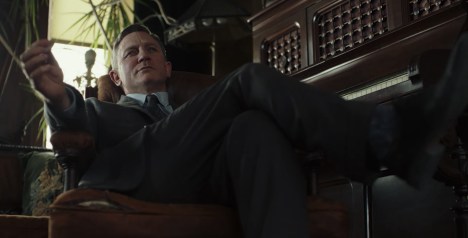
I published a new In the Frame piece at Escapist Magazine this evening. This one covers something that I’ve wanted to talk about for a little while, which is the interesting aspect of this year’s recurring theme of class warfare that runs through works as diverse as Joker, HustlersReady or Not, Succession, Parasite and Knives Out.

To be fair, it is not unusual to see this sort of tension playing out on the big screen. After all, American cinema has long been fascinated by working class con men and hucksters getting one over on the wealthy establishment. However, what distinguishes the recent crop of media exploring this theme is the recurring suggestion that the wealthy are not especially sharp. Historically, the rich have been portrayed as canny and suave – often dangerous adversaries because of their ruthlessness and relentlessness. What is interesting about the class warfare dimension of this year’s films is the way in which money and success often seem to have coddled the wealthy leaving them surprisingly naive and foolish despite their arrogance and privilege.

You can read the piece here, or click the picture below.

Non-Review Review: Just Mercy

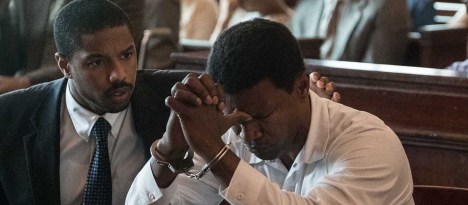
Just Mercy feels like a timely and relevant update to the classic death row prestige picture.

The bulk of Just Mercy unfolds over six years, between 1987 and 1993. This roughly overlaps with a cinematic interest in this subject matter in the late eighties and into the nineties. Mississippi Burning and A Time to Kill looked at the racially-charged dimension of criminal justice in the American South, released in 1988 and 1996 respectively. Dead Man Walking and The Chamber tackled anxieties around the death penalty in 1995 and 1996. Indeed, Just Mercy feels like something of a companion piece to these explorations of the American criminal justice system.

Courting public opinion.

These sorts of films have become increasingly rare in recent years, largely driven by changes in the market. The death of the mid-budget movie has had a major impact on these sorts of projects, with the most recent major examples being films like The Hurricane in 1999 and The Life of David Gale in 2003. These sorts of projects have largely migrated to television and arguably podcasts, developed as limited series like The Night Of or Now They See Us. As such, it’s rare to see a film like this receiving that sort of awards push.

However, what is truly interesting about Just Mercy is the way in which it doesn’t just revive the starry prestige criminal justice drama, it also modernises it. Just Mercy might be set against the backdrop of the late eighties and early nineties, but it feels undeniably current in how it approaches that familiar subject matter.

Conviction.

Continue reading

New Escapist Column! “No Time to Die” and that Missing Killer Instinct…

So the trailer for No Time to Die, the new James Bond movie, dropped yesterday.

I wrote a bit about my reaction to it at Escapist Magazine, primarily how I was a little underwhelmed by how generic it all felt. It lacked the strong statement of purpose that defined the trailers for movies like GoldenEye, Casino Royale and Skyfall. It seems to be designed to assure audiences that all the required plot elements are in place, but it never actually makes any strong statements about what the movie is supposed to be.

You can read the piece here, or click the picture below.

Non-Review Review: 1917

1917 is a stunning technical accomplishment.

Effectively hybridising Dunkirk and Birdman or (The Unexpected Virtue of Ignorance), 1917 is a war movie that is shot in such a way as to suggest a single extended take. Of course, the audience understand that it isn’t really a single take any more than Rope was a single take, and 1917 underscores this sense of unreality by compressing time and space on this epic adventure across the front lines of the First World War. The illusory nature of that long-take style is the entire point of the exercise.

Out in the (Scho)field.

1917 does suffer slightly in narrative terms. From a storytelling perspective, 1917 is a big collection of familiar war movie tropes. Indeed, 1917 ultimately serves to illustrate just how bold and compelling Dunkirk was in its approach to this familiar narrative template. All of the clichés and archetypes that were stripped out of Dunkirk have been inserted back into 1917, which repeatedly leans on genre shorthand to make its points about the folly of war and the senselessness of such carnage.

However, the beauty of 1917 lies not in the story that it is telling, but in the way that it tells that story. In its best moments, 1917 is haunting, nightmarish and ethereal. 1917 works best when it steers clear of the genre’s stock dialogue and characterisation, and instead aims for something much more primal and evocative.

Barbed comments.

Continue reading

Non-Review Review: The Lighthouse

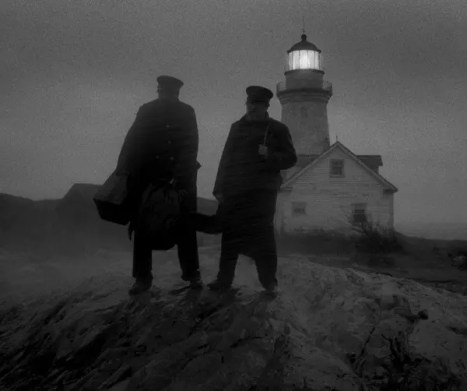
The Lighthouse is a striking, evocative, psychedelic horror. It is also about twenty minutes too long.

Director Robert Eggers made a striking impression with The Witch. Indeed, there’s a clear set of throughlines connecting The Lighthouse to The Witch. Both are fundamentally period pieces about characters who find themselves in extremely isolated conditions, with the unsettling implication that something vague and ominous is lurking in the darkness just beyond the candle light. Both are also highly formal pieces, with Eggers embracing a consciously heightened aesthetic to create a sense of unreality within his film.

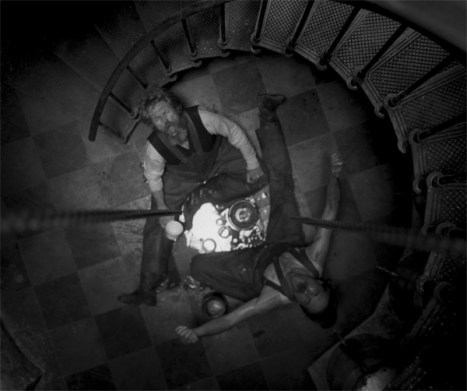
Downward spiral.

However, The Lighthouse stands apart from The Witch in the particulars of its exploration of isolation. After all, The Witch was a story about a young woman who moved into the rural countryside with her entire nuclear family. In contrast, the experience in The Lighthouse is much more intense. It is the story of a young man who finds himself offered a (relatively) high-paying position on a remote rock to work as an assistant to a veteran lighthouse keeper. The two men are strangers when they start to work together, and may remain strangers throughout.

The Lighthouse becomes a study of the descent into madness, the collapse of civility, and the horrors of living with a terrible room mate.

Solid as a rock.

Continue reading