• Following Us

  • Categories

  • Check out the Archives


  • Awards & Nominations

Non-Review Review: Kajillionaire

Kajillionaire is “quirky”, in a manner that is typical of the modern American independent film.

Miranda July’s third feature-length film operates on its own distinct wavelength, populated by eccentric and exaggerated characters who exist in a world caught in a twilight zone between the mundane and the surreal. Kajillionaire has a distinct sensibility, which it signals as early as a shot of its leading trio trying awkwardly to evade the landlord desperately seeking overdue rent. Kajillionaire operates at a level of heightened reality that immediately gives it a “marmite” flavour.

However, if the viewer can get past the abundance of quirk, there’s a lot to enjoy in Kajillionaire‘s study of emotional dysfunction. Kajillionaire is a con artist movie about a family living on the margins, but one that doesn’t seem particularly interested in the art of the con. Veteran hustlers Robert and Theresa are well removed from the smooth operators of films like Dirty Rotten Scoundrels, Matchstick Men or The Brothers Bloom. Instead, they are a mess of contradictions and maladaptations.

Kajillionaire works largely due to its wry sense of humour, which manages to offset a lot of what might otherwise be suffocating quirkiness. It also benefits greatly from a set of impressive performances. Debra Winger and Richard Jenkins do good work as Robert and Theresa, but the film belongs to Evan Rachel Wood as their daughter Old Dolio and Gina Rodriguez as Melanie, the character who quickly gets swept up in their hijinks.

Continue reading

New Escapist Video! On How the “Star Wars” Sequels Didn’t Need a Plan, “The Rise of Skywalker” Needed a Vision…

So, as I have mentioned before, I am launching a new video series as a companion piece to In the Frame at The Escapist. The video will typically launch with the Monday article, and be released on the magazine’s YouTube channel the following week.

With that in mind, here is last week’s episode, covering the frequent argument that Disney needed a “plan” for the sequel trilogy, when in fact Star Wars: Episode IX – The Rise of Skywalker just needed a vision. You can watch the pilot video here, and read the companion article here.


New Escapist Column! On the Joker’s Attempts to Hijack “The Dark Knight”…

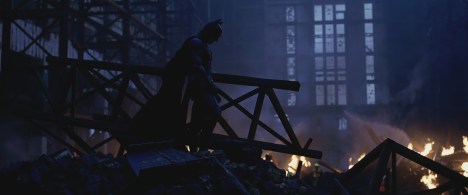
I published a new In the Frame piece at The Escapist this evening. Because the Monday column is now published with a companion video, we thought it might be worth trying something a bit more visual than usual. Because TENET is still in wide release, we thought it might be interesting to try something visual that was related to Christopher Nolan.

The Dark Knight is an interesting film for a number of reasons. Interestingly, it is the rare Christopher Nolan movie that is almost entirely linear. Nolan’s other films tend to jump around a lot in time, but The Dark Knight progresses quite clearly from beginning to end. This is interesting, because it serves to provide an interesting and compelling contrast to the Joker. Because The Dark Knight is so linear, there’s an interesting tension as the Joker struggles to take control of the narrative and bend the view to his perspective. Sometimes in a very literal manner.

You can read the piece here, or click the picture below.

New Podcast! The Escapist Movie Podcast – “Enola Holmes, WandaVision and Antebellum Spoilers”

The Escapist have launched a movie podcast, and I was thrilled to join Jack Packard and Bob Chipman for the fifth episode, primarily discussing Enola Holmes, the first trailer for WandaVision and a spoiler-filled discussion Antebellum.

You can listen to the episode here, back episodes of the podcast here, click the link below or even listen directly.

Non-Review Review: The Boys in the Band

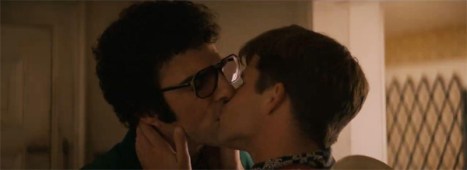
The Boys in the Band is not only a cinematic adaptation of a classic play, it is a cinematic adaptation of a particular staging of a classic play.

The Boys in the Band is a film designed to capture a snapshot of the 2018 Broadway run of Mart Crowley’s iconic 1968 off-Broadway play. It is directed by Joe Mantello, who is perhaps best know for his theatre work including Wicked and the fiftieth anniversary revival of The Boys in the Band that forms the basis of this filmed version. The film reunites the entire ensemble of that staging, including actors like Jim Parsons, Zachary Quinto and Matt Bomer.

Banding together.

In some ways, Hamilton feels like the obvious point of comparison here. The goal is not just to bring a beloved play to the screen, but to capture the particular energy of a particular staging of that beloved play. However, while Hamilton leaned into its attempts to recreate the Broadway experience for an audience watching at home, The Boys in the Band is a much more traditional cinematic adaptation of a theatrical staging. It is a film, but it is a film that feels particularly “stagey.” It recalls a particular brand of awards fare, like Doubt or Fences.

This is perhaps the biggest issue with this adaptation of The Boys in the Band. With the exception of a few framing scenes set outside the apartment at the beginning and the end of the story, The Boys in the Band doesn’t feel like a reimagining so much as a restaging. Then again, it’s debatable to what extent this is a problem. Mantello’s approach to the material is straightforward rather than showy, putting his faith in the script – which was reworked by Crowley shortly before his death with writer Ned Martel – and in the cast, trusting them to carry the film.

Not-so-midnight-cowboy.

This largely works. The Boys in the Band is a fascinating snapshot of a cultural moment. Crowley’s play was famously one of the first pieces of mainstream pop art to focus on a large a diverse cast of gay characters, arriving before the AIDS crisis and before Stonewall. While the play has remained constant in all of those years, the world around it has changed. Its fortunes have ebbed and flowed, while the text seems to remain vital and relevant – it always seemed to say something to the moment, even if that something made critics uneasy.

The Boys in the Band is a welcome reminder that there is nothing inherently wrong with a theatrical approach to cinematic stagings of beloved plays. The Boys in the Band may not pop off the screen in the way that Hamilton does, engaging as much with the audience’s experience of the show as with the content of the show itself. Instead, The Boys in the Band serves largely as a showcase for its actors and for its source material, proof that there is a lot to be said for locking a bunch of talented cast in a confined space with a good script.

Drinking it all in…

Continue reading

Non-Review Review: The Trial of the Chicago 7

The Trial of the Chicago 7 is Aaron Sorkin’s second feature film as director, following on from Molly’s Game.

However, the project originated with Steven Spielberg. The finished film includes the Dreamworks logo. Watching the movie, it feels like Sorkin is channeling Spielberg, particularly with the film’s delicate balance of historical accuracy and its relatively heartening final act. Indeed, The Trial of the Chicago 7 feels like something of a companion piece to Spielberg’s most recent film, The Post. It is another movie about the troubled transition from the flawed utopian idealism of the sixties to the brutal political cynicism of the seventies.

Cycles of mistrust.

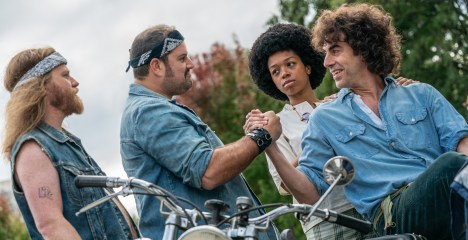
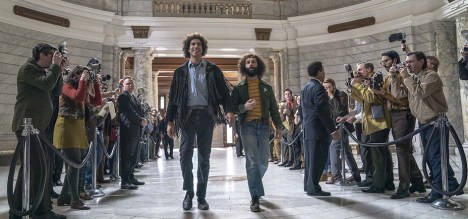
In many ways, The Trial of the Chicago 7 appeals to Sorkin’s strengths as a writer. After all, Sorkin rose to prominence as the writer of A Few Good Men, another court room drama. The basic premise of The Trial of the Chicago 7 involves placing a bunch of similar-but-distinct characters in a locked room together and focusing on the group dynamics, which provides a lot of space for Sorkin to demonstrate his skill with dialogue and characterisation. There’s a lot of clever detail and definition between the protagonists in The Trial of the Chicago 7.

To be fair, The Trial of the Chicago 7 suffers slightly from being a little heavy-handed in places. As with Spielberg and The Post, Sorkin is very much aware of the movie’s contemporary resonance and occasionally leans into it a little too eagerly. Beyond that, the depiction of events from the eponymous trial can occasionally seem a little episodic and haphazard. Still, there’s a lot to recommend The Trial of the Chicago 7, particular as an old-fashioned example of an ensemble historical drama.

Courting controversy.

Continue reading

New Article! On the Hidden World of “John Wick”…

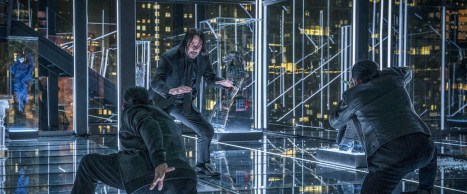
I was thrilled to contribute to the latest issue of Pretty Deadly Films, the new online film magazine being published by Film in Dublin. This third edition of the magazine is dedicated to John Wick, so I thought it might be interesting to look at the hidden world of John Wick.

In some ways, John Wick positions itself as a successor to The Matrix. It is directed by two stuntmen who worked on the series and stars Keanu Reeves. Laurence Fishburne joined the ensemble in the second film. It is also a film about hidden subcultures and secret worlds, which positions it as a successor to similar films from the late nineties in which the real world is an illusion – Dark City, The Truman Show, The Thirteenth Floor. However, what distinguishes the hidden world of John Wick from those earlier films is a profound cynicism. To know the truth is to be trapped by it.

You can read the issue here, browse back issues of the magazine here or click the picture below.

“I Never Kid About Money”: Marty Goes Mainstream With “The Colour of Money”…

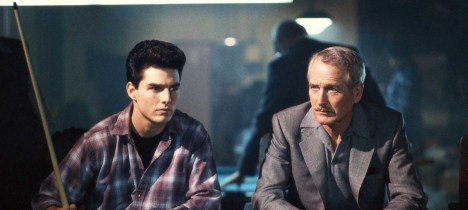
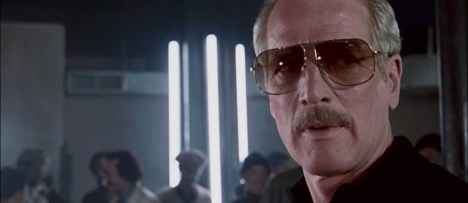
The podcast that I co-host, The 250, continued our belated Summer of Scorsese last week with a look at Goodfellas. Next week, we’ll looking at Casino. It is a fun and broad discussion that is well worth your time, but the season ends up largely avoiding Scorsese’s output during the 1980s. So I thought it might be worth taking a look back at The Colour of Money.

For Martin Scorsese, the eighties come sandwiched between two masterpieces: Raging Bull and Goodfellas.

These are two of the quintessential Martin Scorsese movies. They are frequently ranked among the best movies that Scorsese has made, and often included in lists of the best movies ever made. Indeed, there’s a famous Hollywood myth that director Brian de Palma reacted to a screening of Goodfellas by involking Raging Bull, proclaiming, “You made the best movie of the eighties and, God damn it, we’re barely into the nineties and you’ve already made the best movie of this decade, too!”

With that in mind, there’s a tendency of overlook Scorsese’s work during the eighties – to treat it as something equivalent to a cinematic lost decade largely defined by the failure of King of Comedy and the controversy over The Last Temptation of Christ. This is understandable, but it is also unfair. Indeed, recent years have seen a welcome push to reassess Martin Scorsese’s tumultuous journey through the era of excess.

Scorsese’s eighties might not have been the best decade or most productive decade in his filmography, but they were instructive. They were a time of growth and evolution for the filmmaker, a point at which the director seemed to finally figure out how to reconcile the movies that he wanted to make with movies that studios wanted to finance. Although often overlooked and ignored in this context, The Colour of Money is perhaps the most instructive of Scorsese’s films from this period.

Continue reading

New Escapist Video! On the Childish Wonder of “Black Panther”…

So, as I have mentioned before, I am launching a new video series as a companion piece to In the Frame at The Escapist. The video will typically launch with the Monday article, and be released on the magazine’s YouTube channel the following week.

With that in mind, here is last week’s episode, covering Ryan Coogler’s use of childish wonder in Black Panther. You can watch the pilot video here, and read the companion article here.

New Escapist Column! On the Planning of Disney’s “Star Wars” Sequel Trilogy…

I published a new In the Frame piece at The Escapist this evening. Because the news cycle around Star Wars: Episode IX – The Rise of Skywalker never dies, it seemed like an appropriate time to look at the famous refrain that Disney needed a “plan” for their Star Wars sequel trilogy.

In truth, this is at best a simple solution to a complex problem. After all, fans have hardly proven themselves willing to offer movies the benefit of the doubt because they were “planned” in advance. The Star Wars prequel trilogy was not greeted with any greater warmth or understanding because George Lucas knew where he was going. Instead, the problem is that The Rise of Skywalker needed a strong vision of what it wanted to be and what it wanted to say.

You can read the piece here, or click the picture below.