• Following Us

  • Categories

  • Check out the Archives


  • Awards & Nominations

Non-Review Review: Ice Age – Collision Course

Film franchises are delicate things. There comes a point at which certain concepts feel played out, at which familiar characters seem tired as they go through the proverbial motions. Over time, it can feel like a film franchise has done just about everything. It becomes harder and harder to generate conflict, to motivate the characters to action, to come up with credible stakes.

The art of franchise escalation is fine. It is more nuanced than most will readily acknowledge. Coming up with an organic reasons for an ensemble to reteam and embark on a new adventure can be tough enough after the original film, but it becomes a little exhausting by time that the fourth film rolls around. There is a point where even enlisting the audience feels like an insurmountable challenge.

Over the moon...

Over the moon…

However, there are film franchises that do manage to do this. After all, the Marvel Cinematic Universe is comprised of over a dozen franchise films. The James Bond series is more than twenty films long, but it still periodically finds a new groove. It is not impossible for a film franchise to find new and exciting possibilities past its third entry. Even earlier this year, Creed is testament to the appeal of a new approach.

On the other hand, Ice Age: Collision Course is a film that opens with beloved squirrel Scrat hijacking a space ship while chasing his nut and setting an asteroid on a collision course with our protagonists.

Men and women of mist-ery...

Men and women of mist-ery…

Continue reading

Non-Review Review: Independence Day – Resurgence

Independence Day: Resurgence is the very limit case of nineties nostalgia.

This is true in a very real sense. The film is released two decades after the massive success of the original film, which came to theatres in 1996 offering unprecedented and awe-inspiring destruction on a previously unimaginable scale. Independence Day changed the public’s expectations for blockbusters, reworking the scale of apocalyptic destruction that could populate big summer releases. However, as much fun (and as well loved) as the film was, nobody was really clamouring for a sequel.

Jazzy Jeff, without the Fresh Prince.

Jazzy Jeff, without the Fresh Prince.

However, there is another truth about nineties nostalgia buried within this belated and bloated sequel. The nineties were a different time. They were a time at which Franci Fukuyami could make a semi-credible case that the United States stood at the end of history. The Cold War was over. The War on Terror had yet to begin. The Twin Towers still stood, and most Americans were oblivious to the existence of Osama Bin Laden or al-Qaeda. The economy was reasonably prosperous. Politics were relatively stable.

It is, of course, too easy to let nostalgia paint the nineties as some sort of “golden age.” There were horrific conflicts unfolding in Africa and Eastern Europe. There were clear shifts in American political rhetoric that paved the way for the current political climate. Paranoia and conspiracy theory were working their way into mainstream political discourse. However, the nineties were a time of much lower anxiety for most Americans, and time of peace rather than perpetual existential warfare.
Maps to the stars.

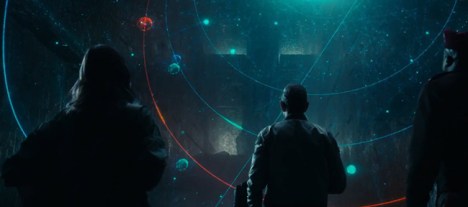
Maps to the stars.

As a result, Independence Day had a radically different context in the summer of 1996 than it would in the summer of 2016. In 1996, the destruction of the White House and the Empire State Building could be treated as ridiculous escapism rather than traumatic repetition. The narrative of American individualism and exceptionalism was oddly endearing in the midst of a period of sustained global stability rather than an era of resurgent (and violent) political nationalism.

Even in terms of entertainment, the original Independence Day arrived at a point where it was enough for a blockbuster to be a blockbuster, where thematic resonance and political commentary were optional extras that were tolerated so long as they didn’t get in the way of the explosions. Independence Day was released at a point where it was enough for a movie to be “dumb fun” without carrying a deeper message. Without the internet to pick films apart and pour over their subtext, it was a lot easier to just release an unassuming spectacle.

Over the moon about it.

Over the moon about it.

More than that, the sheer practical limitations of filming a blockbuster helped to rein in a lot of potential excesses of a film on this scale. While there was always computer-generated special effects, a heavy reliance on practical models and practical effects tended to dictate both the scripting and the direction of the film. Although Independence Day was an ode to heightened spectacle, there were limits to that spectacle. There was only so much of the aliens that could be shown, there were moments where things couldn’t be exploding.

In short, Independence Day was very much the perfect movie for 1996. In its own way, Independence Day: Resurgence is an ode to that. It is also a reminder that this is no longer 1996.

Not quite the Gold(blum) standard.

Not quite the Gold(blum) standard.

Continue reading

Non-Review Review: Elvis and Nixon

Elvis and Nixon is a larger than life account of a larger than life meeting between two unlikely legendary figures.

Much has been made of the fact that neither Kevin Spacey nor Michael Shannon bear much resemblance to Richard Milhous Nixon or Elvis Aaron Presley. In fact, the film even makes a point of mentioning it. After a weird encounter at the White House gate, one security guard concedes of Elvis, “He’s taller than I thought.” Of course he is; Michael Shannon is noticeably (about ten centimetres) taller than his character. Indeed, the lack of physical resemblance between the actors and the subjects seems to be the point.

"Yeah, I suppose he KINDA looks like he from an angle."

“Yeah, I suppose he KINDA looks like he from an angle.”

After all, many of the best cinematic Nixons look rather unlike the nation’s thirty-seventh president. Anthony Hopkins and Frank Langella picked up Oscar nominations despite the fact that there was no risk of confusion. The same is true of Dan Hedaya, even if he never picked up an Oscar nomination. Both Richard Nixon and Elvis Presley exist as larger-than-life figures in the American popular consciousness more than distinct individuals; both are recognisable archetypes who seem to speak to the nation’s cultural memory more than its specific history.

Elvis and Nixon realises and embraces this. The film is gleefully and archly ahistorical, to the point that this becomes the point. It is not so much that the line between reality and fiction blurs for director Liza Johnson, it’s that the boundary never existed in the first place. There is no record of what actually happened during the thirty minute conversation, but that’s probably for the best. Nothing could be quite as fun as the mismatched odd couple comedy of Elvis and Nixon.

Photo finish...

Photo finish…

Continue reading

Non-Review Review: The Conjuring 2

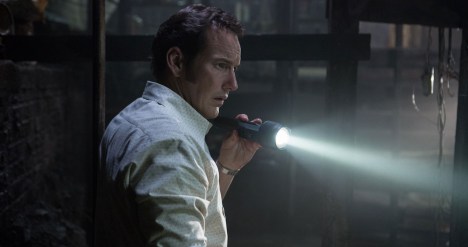
The Conjuring 2 is effectively a tentpole horror.

It is very much a horror film, with James Wan demonstrating all the skill and technique that he had honed over years working in the genre. There some wonderful slow pans and creepy camera movements that emphasise negative space, some very effective use of timing and mounting dread, and a palpable sense of menace. There are jump scares and slow scares, and enough false alarms to keep the audience on the edge of their seats. The Conjuring 2 is in many ways an old-school archetypal horror film.

He ain't afraid of no ghost...

He ain’t afraid of no ghost…

However, there is something interesting happening in the background. The Conjuring 2 might have all the basic ingredients of a horror movie, but they are assembled in the style of a tentpole blockbuster. To be fair, the big summer release date is a bit of a clue, as is the climax that features a sweeping race-against-time as the heroes try to desperately make it back from the train station. Indeed, The Conjuring already launched something of a shared horror universe with the spin-off Annabelle.

In some respects, The Conjuring 2 feels like something of a mash-up, reflecting contemporary pop culture’s fascination with mashing existing concepts together to form intriguing cocktails. What is really surprising about the film is how well it works.

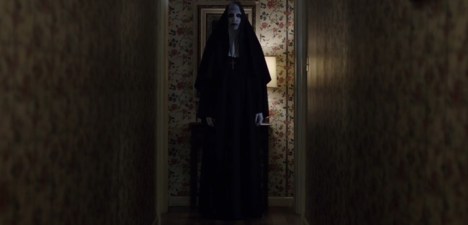
"I'm sorry, you wouldn't happen to be able to direct me to the Marilyn Manson concert, would you?"

“I’m sorry, you wouldn’t happen to be able to direct me to the Marilyn Manson concert, would you?”

Continue reading

Non-Review Review: Teenage Mutant Ninja Turtles – Out of the Shadows

There is something extraordinarily cynical about Teenage Mutant Ninja Turtles: Out of the Shadows.

The issue is not that movie refuses to make sense. The issue is not that its characters are (at best) archetypes and (at worst) plot functions. The issue is not that the script is at once thin on detail and heavy on exposition. The issue is not that the direction is clunky and unfocused, lacking basic technique and cluttering up would should be fairly standard set pieces. The issue is not even that the computer-generated imagery is ropey in places, with a lot of detail on the four turtles but great difficulty bringing Splinter to life.

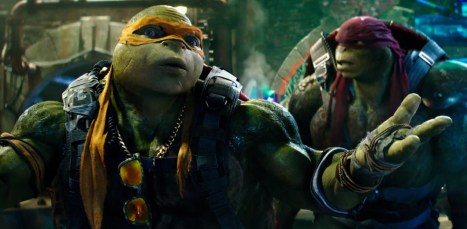
I like Mike.

I like Mike.

The issue is that the move is completely unapologetic about any of these issues. It is not that the movie abandons plot logic to focus on character dynamics, or that it ignores character development in order to get to impressive set pieces. The clunky expository dialogue is not countered by witty banter or knowing irony. There is a sense that Out of the Shadows is a film comfortable with its own shoddiness. It isn’t that the film tries and fails, it is that the film barely tries at all. There is a leaden and lifeless quality to it all.

The issue is not that Out of the Shadows is a stupid dumb action movie, because stupid dumb action movies can be great fun on their own merits. The issues is that Out of the Shadows assumes that its audience is just as dumb as it is.

Turtle power.

Turtle power.

Continue reading

Non-Review Review: Me Before You

Me Before You works better than it really should.

There are points at which this romance dips into mandolin melodrama and gets lost in pop music montage, perhaps even over-extending itself through a series of almost episodic adventures. However, the film largely works. A lot of that is down to its willingness to address a potentially problematic theme head-on, investing its central characters with a sense of agency and dynamism that powers the film. However, a lot of that is down to the charm and strength of its two leads, particularly Emilia Clarke.

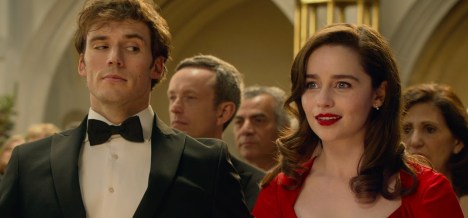
"Tom Hiddleston thinks he's got this sewn up," think both leads simultaneously.

“Tom Hiddleston thinks he’s got this sewn up,” think both leads simultaneously.

Continue reading

Non-Review Review: The Nice Guys

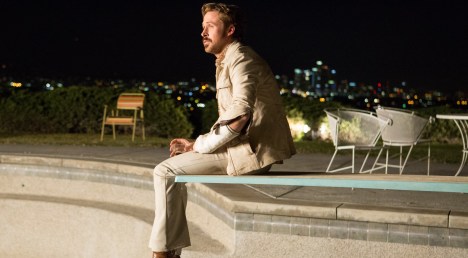
The Nice Guys is a superb piece of work, a retro seventies buddy action comedy with charm to spare.

The Nice Guys is dripping with period detail. The opening tracking shot swoops behind the iconic “Hollywood” sign, still trapped in a state of decay. The characters wear brightly coloured suits. The soundtrack is populated by recognisable disco and funk songs. There are repeated references to President Richard Nixon. Characters smoke like troopers and drive around in open-top convertibles while somehow managing an unhealthy combination of sideburns, stubble and moustaches. In short, the film is set in the seventies, and the audience won’t forget it.

Cigarette-Smoking Man.

Cigarette-Smoking Man.

However, The Nice Guys has a much deeper retro charm. It harks back to the sort of buddy action films that have become a rarity these days, the story of two lovable klutzes who wander into a life-or-death mystery that gradually unravels over the course of two hours. The stakes are charmingly low-key; there is no city destroyed, no threat on a planetary scale. The characters are broadly drawn archetypes, but neither have be chosen or fated. There are at most a couple of lives resting on their shoulders, their own included.

The Nice Guy harks back to a very nineties buddy action comedy aesthetic, demonstrating a nostalgia that is more than skin deep, but which is nonetheless endearing.

Board to death.

Board to death.

Continue reading

Non-Review Review: Money Monster

Money Monster works better as a heightened thriller than as righteous social commentary.

There is a lot to recommend Money Monster, beginning with the basic premise. Lee Gates is the fast-talking abrasive host of a hyper-masculine financial television show, who finds one Friday afternoon broadcast hijacked by a disgruntled investor who followed his advice. Tensions quickly escalate, as Gates finds himself trying to stay alive while also unravelling a thread of conspiracy and deceit that seems to tie the financial markets together. Gates and his assailant find themselves part of an unlikely team-up to blow this corruption wide open.

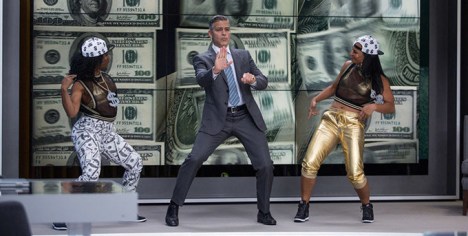
Money talks. It can also dance.

Money talks.
It can also dance.

Money Monster hinges on the combination of Jodie Foster’s direction and the cast’s charm. George Clooney remains one of the most charismatic performers on the planet, and there is a reason that Julia Roberts was one of the most successful lead actors of the nineties. While Clooney and Roberts add star power to the film, Foster benefits from casting Jack O’Connell as the irate-investor-turned-would-be-suicide-bomber. While performers like Dominic West and Giancarlo Esposito are horribly underused, they do add gravity to the film.

Jodie Foster is smart enough to keep the film moving. Even as a high-concept thriller, Money Monster is absurd. The characters frequently act irrationally. The plot never feels like an organic series of rippling consequences, with the author’s hand consistently visible. It is a movie that hinges on contrivance, with Foster working very hard to prevent the audience from catching their breath long enough to question the logic of what is unfolding on-screen. In some respects then, it has more in common with the world of high finance than it would care to admit.

Taking stock.

Taking stock.

Continue reading

Non-Review Review: X-Men – Apocalypse

X-Men: Apocalypse is a retro superhero blockbuster, and not just because it happens to be set in the eighties.

At this stage, the X-Men franchise is practically a warhorse of superhero cinema. Although Blade tends to get overlooked in discussions of the current superhero boom, it is fair to trace the current deluge of superhero films back to the twin releases of Bryan Singer’s X-Men and Sam Raimi’s Spider-Man. Without those two films, released more than a decade-and-a-half ago, the current blockbuster landscape would look a lot different. Those films changed audience expectations and demonstrated what could be done with the format.

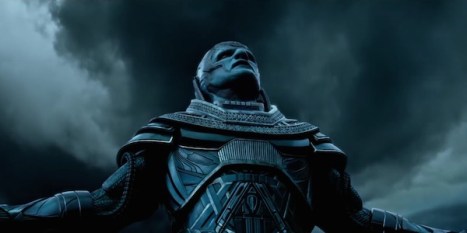
xmenapocalypse1

“Shoot me from a low angle to make me seem huge. I’m talking real ‘Triumph of the Will’, here.” (Special Guest Caption by Ed Azad.)

There have two big screen reboots of Spider-Man in the intervening years, with both Andrew Garfield and Tom Holland stepping into the red booties vacated by Tobey Maguire. In contrast, the Hugh Jackman and Patrick Stewart are still playing the iconic roles they established more than fifteen years ago, with X-Men: Days of Future Past straining to reconcile the original cast with the replacements who appeared in X-Men: First Class. However, in the intervening years, superhero cinema has changed dramatically.

In many respects, Apocalypse feels like the X-Men is playing catch-up with the generation of superhero blockbusters that arrived it its wake, taking the opportunity to do its own big “rock ’em, sock ’em” apocalyptic superhero team-up showdown of the kind that has never really featured in the franchise. Apocalypse finds the X-Men franchise embracing a particular style of superhero brawler typified by The Avengers back in 2012. Ironically, the genre itself has moved on, leaving the entire exercise feeling a little quaint.

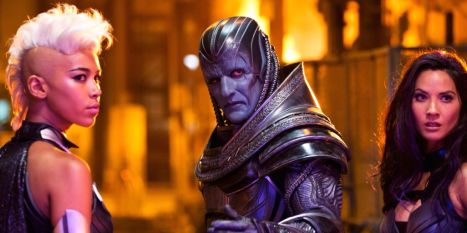
xmenapocalypse

“It was acceptable in the eighties.” (Special Guest Caption by Ed Azad.)

Continue reading

Non-Review Review: Angry Birds

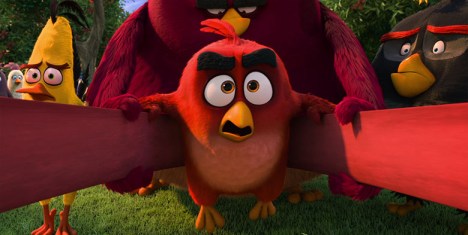
The Angry Birds Movie is an enjoyable animation experience.

Adapted from the famous touch-screen game, a favourite of phone users everywhere, The Angry Birds Movie has a fairly thin premise that can successfully distilled into its two-word title. Set on an island populated by flightless birds, the film follows the adventures of the series’ distinctive red character as he struggles to contain his rage and anger in a culture built around peace and harmony. The plot, such as it is, is driven by first contact between the feathered inhabitants and the mysterious green-skinned visitors from “the world of the pigs.”

All fired up.

All fired up.

Video game adaptations can be tricky, particularly when it comes to adapting a video game that lacks a strong internal narrative. After all, very few players could claim to be emotionally invested in the skilful (and joyful) application of physics that made the original game so popular. Trying to construct a world around the stylistic affectations of a plotless video game can lead to all manner of convoluted nonsense; one need only look at Street Fighter or Super Mario Brothers to see the dangers of adapting a plotless video game.

The strength of The Angry Birds Movie is in how the films luxuriates in its plotlessness, embracing the arbitrary nature of its internal logic. The Angry Birds Movie is more concerned with being witty and energetic than in being cohesive or making sense. Given that it is a movie about cartoon birds propelling themselves like missiles towards a group of egg-snatching pigs that manages be both charming and funny, it seems like the prudent choice.

Bite-sized fun.

Bite-sized fun.

Continue reading