Early in Star Trek Beyond, James Tiberius Kirk states that he doesn’t celebrate birthdays.
This is, of itself, a knowing reference to Star Trek II: The Wrath of Khan. Fans will recognise the nod immediately, as Doctor Leonard McCoy stops by for a birthday drink to reflect on what growing up actually means. It is one of several knowing homages that populate the film, acknowledgements of the franchise’s legacy and longevity. However, there is also a sense of truth to Kirk’s confusion. How exactly do you mark a milestone like a fiftieth anniversary, particularly for a cultural behemoth like the Star Trek franchise.
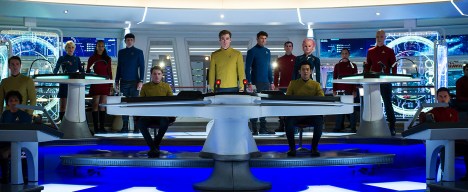
Bridge commander.
This is a question that will need to be asked with increasing frequency in this era of belated sequels and franchise reboots and recycled properties. The current entertainment ecosystem means that more and more franchises are living to ripe old ages, intellectual properties that need to mark the milestones as they pass. Indeed, the fiftieth anniversary of the Star Trek franchise comes only three years after the fiftieth anniversary of a revived Doctor Who. That was one year after James Bond hit his fifty years on screen with Skyfall.
This is to say nothing of the anniversaries that fall either side of that big five-oh. Characters like Batman and Superman are over seventy-five years old. Films like Jurassic Park and Independence Day are over twenty. These are milestones. It seems appropriate that we treat these milestones as anniversaries or birthdays, given how multimedia has come to treat intellectual property as a living thing – something growing and cultivated, something engaging with the changing world around it and with its own history.
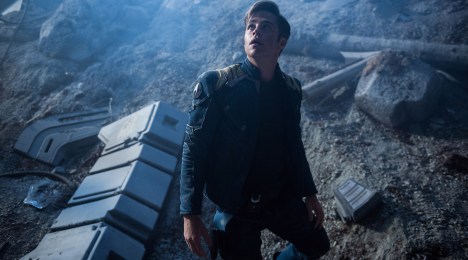
Down to Earth.
So, how exactly do you celebrate a fiftieth anniversary for a franchise? Do you make a big occasion of it? Do you launch a thematic meditation on its core values? Do you deconstruct it so that you might reconstruct it? Do you add to the mythos? Do you revel in the continuity? Do you simply try to offer a reminder of what fans loved about the property in the first place? It is a delicate balancing act, and Star Trek Beyond struggles with it. It tries very hard to be all of these things and more, to the point that it can feel both overstuffed and underwhelming.
To be fair, there is a sense that Star Trek Beyond is somewhat hobbled by its format. Star Trek is a franchise that has always thrived on television more than in film. Various critics and producers and franchise veterans have argued repeatedly that Star Trek is a franchise that lives on television, that as exciting as the films might be that they are ultimately as supplemental as a mid-episode log update. The essence of Star Trek is in the continuity of a week-to-week television show, something that by its nature cannot be replicated in a film franchise with a new installment every few years.
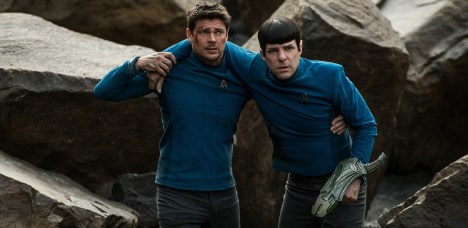
He ain’t heavy, he’s my Vulcan.
In some respects, this handicaps Star Trek Beyond. The film strains to be all things to all people. Director Justin Lin, working along with writers Simon Pegg and Doug Jung, packs the script with heavy thematic dialogue and loving references to the franchise’s history. Star Trek Beyond is packed with deep (and loving) cuts from the franchise’s fifty-year history, but the two-hour runtime and the demands of blockbuster storytelling serve to hem in these elements of the narratives.
In contrast, Star Trek Beyond works best when it is content to be its own thing, when it is willing to go its own way and take advantage of its own unique position in the larger Star Trek canon. A seemingly minor revelation about the personal life of Hikaru Sulu services to be one of the most progressive creative decisions that the franchise has made in twenty years, a credit to the entire production team. In terms of storytelling, the reboot has been lucky to benefit from a phenomenal cast, and Star Trek Beyond really works when it trusts them to carry the weight.

“Check it out, Chekov…”
Star Trek Beyond opens with Kirk reflecting on the strain of command and the weight of his obligations, perhaps reflecting the weight that the production team must feel given the demands placed upon them by fandom expectations. This is a film that finds itself wrestling and grappling with fifty years of what has effectively become an American mythology, a set of iconography and imagery familiar to people who have never even watched a full episode. That is a lot for a single film to bear, and it is to the credit of the production team that they invite that upon themselves.
At the same time, the sequences in which Star Trek Beyond takes flight are those at which it feels confident enough to move under its own power. Perhaps that is the best way to mark the franchise’s fiftieth anniversary, celebrating what makes this iteration of the franchise unique and pushing it boldly forward instead of looking backwards. Continue reading →
Filed under: Non-Review Reviews | 48 Comments »



























 the m0vie blog