• Following Us

  • Categories

  • Check out the Archives


  • Awards & Nominations

Non-Review Review: The Disaster Artist

The Disaster Artist opens by professing its love for its subject, the enigmatic Tommy Wiseau.

A variety of talking heads, primarily comedians, make a reasonable case for The Room as a beloved cult classic. The segment is short, but it sets the tone for a lot of what follows. The Disaster Artist doesn’t exactly obscure the (infamous) difficulties experienced during the production of that cult classic, mostly caused by the fragile ego and highly strung creative force behind the movie. However, there is also a sense that The Disaster Artist has an abiding affection for its subject, a sincere appreciation for the sheer force of Tommy Wiseau’s will.

Wiseau guy.

The Disaster Artist is ultimately a heartwarming tale about an outsider overcoming nearly impossible odds (which are not helped by the temperament of the outsider himself) to realise his dreams. Tommy Wiseau comes to Hollywood and decides to make something of himself, despite being told that he has no talent and no charisma, and that the best he could hope for would be to be cast as a “malevolent presence.” Wiseau proves all of his doubters wrong by shepherding his vision through a disastrous production cycle and releasing a cult classic.

It just so happens that Wiseau’s vision is absolutely terrible.

Edge of your seat stuff.

Continue reading

Non-Review Review: The Shape of Water

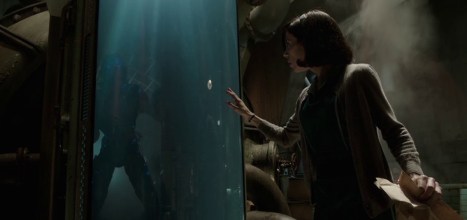
The Shape of Water is a beautiful emerald fairy tale, told from the fringes.

Set in the early sixties, against the backdrop of “the last days of a fair prince’s reign”, The Shape of Water promises to regale audience members with the story of “the princess without a voice” and “the monster who tried to end it all.” However the most striking aspect of The Shape of Water is in how it chooses to focus its magical story. The Shape of Water is a story largely about those who are silenced on the margins, right down to its decision to cast Sally Hawkins as protagonist Elisa Esposito, a mute cleaner working in a secret government lab.

He’s in a glass case of emotion.

The Shape of Water is very much an exploration of the concept of “the other”, of the lives of those who exist outside the confines of “normal” society. The film’s central antagonist is a happily married white American man, who finds himself set against a collection of misfits and outcasts; a mute orphan, a black cleaning lady, a gay designer, an immigrant scientist, and a monstrosity pulled from the depths of the Amazon river. Coasting from the conservative fifties, Colonel Richard Strickland faces the threat that everything he accepts as granted might be washed away.

The Shape of Water suffers from some minor pacing problems in its romantic adventure, but these are minor issues in a haunting and enchanting piece of work.

The Creature from the Black Ops Department.

Continue reading

Non-Review Review: Three Billboards Outside Ebbing, Missouri

“All this anger. It only begets more anger.”

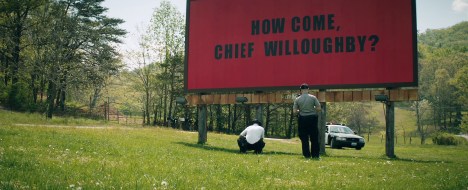
Ironically enough, given the title, the anger in Three Billboards Outside Ebbing, Missouri never seems to ebb. Martin McDonagh’s small town black comedy drama is a parable about grief that metastasises into all-consuming rage. Fire is a recurring fixation for Three Billboards Outside Ebbing, Missouri, a potent metaphor for both the scorched earth left behind by trauma and the tendency of such anger to swallow up everything in its path. Three Billboards Outside Ebbing, Missouri is a cautionary fable.

Reading the signs.

Three Billboards Outside Ebbing, Missouri benefits from a number of different factors. McDonagh’s script is smart and well-constructed, wry in the right places and emotional when it counts, imbuing the characters and their surroundings with an organic and lived-in quality that enriches the story built around them. The locations are atmospheric and effective, creating a sense of place that extends beyond mere geography. The cast is fantastic, particularly supporting turns from Woody Harrelson and Sam Rockwell.

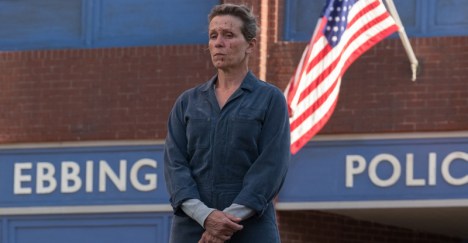
However, Frances McDormand is the engine that drives Three Billboards Outside Ebbing, Missouri. While the film features several set pieces built around fire, the hottest flame burns at the heart of the central character. As enraged mother Mildred Hayes, McDormand captures the energy and the depth of a woman raging against a system that let her down, an unjust world that denies her closure, and her own sense of guilt and responsibility.

Ebbing and flowing.

Continue reading

Non-Review Review: Brigsby Bear

Brigsby Bear is a sweet, if slightly uneven, ode to the act of reclaiming problematic art.

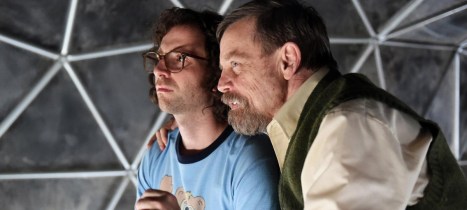
The concept of Brigsby Bear is simple. James Pope is a twenty-something-year-old manchild who has grown sheltered from the outside world, living with his parents in a converted shelter locked away from the world. James’ only interaction with the outside world is through the internet, where he maintains contact with fans of the only show still broadcast on the airwaves, the eponymous anthropomorphised bear.

Bearing his soul.

However, one day James discovers that this is all an elaborate lie, that the world does not work the way that he thought it did. Brigsby Bear is positioned at the centre of this betrayal, with James discovering that the show was never what it appeared to be. As James struggles to come to terms with the reality of his situation, he finds himself struggling to make peace with the bear at the centre of these amateurish and endearing morality plays.

Brigsby Bear suffers from tonal issues, struggling to balance the darkness at its core with the whimsy on its surface. However, the movie plays as a compelling study of trauma and recovery, of the power of fannish obsession, and the art of taking back art that has been tainted or undermined by subsequent revelations. Indeed, Brigsby Bear is arguably more relevant now than it was when it was produced.

“Disney are really going to extremes to stop me leaking details on The Last Jedi.”

Continue reading

Non-Review Review: Justice League

The Parademons, the monstrous zombie bugs at the heart of Justice League, smell fear. It is a lucky thing that they don’ smell desperation, because otherwise they’d eat the movie alive.

Justice League is not a movie so much as a two-hour attempt at atonement. It is an extended apology from Warner Brothers to the most vocal internet denizens, an obvious attempt to backpedal away from the controversial and divisive (and provocative) attempts to jump-start their shared comic book universe with Man of Steel and Batman vs. Superman. Richard Donner’s Superman inspired audiences to believe that a man could fly; Justice League serves as evidence that a film franchise can grovel.

The Just Us League.

Justice League is contrite and submissive. Anything resembling a jagged edge has been carefully sanded down, anything resembling a unique identity stripped from the film. Justice League has listened to the internet’s overblown criticisms of Man of Steel and Batman vs. Superman, and decided that the best response is to offer something generic and appeasing. Justice League has the feeling of a studio mandated checklist captured on celluloid, a list comprised primarily of “don’t”s; don’t run over two hours, don’t be so dark, don’t be pretentious, don’t be political.

The result is a movie that feels defined by what it isn’t, an empty space much larger than that created by the absence of Superman. It is a movie without any ambition or any personality. It wants so desperately to be loved, but ultimate feels hollow.

Out of their League.

Continue reading

Non-Review Review: Daddy’s Home 2

Daddy’s Home 2 is awkward and broad, with too few laughs and too much dead air.

As the title suggests, Daddy’s Home 2 is the sequel to the similarly uninspired Daddy’s Home, in which Will Ferrell finds himself competing for the affection of his stepchildren with their biological father, played by Mark Wahlberg. Daddy’s Home 2 seeks to add some extra excitement into the mix by bringing another generation into the mix; John Lithgow joins the cast as father to Will Ferrell’s character, while Mel Gibson is cast in the role of withholding parent to Mark Wahlberg’s emotionally stunted adult.

Bad dads.

Daddy’s Home 2 largely tries to coast on the charm of these four male leads, bouncing scenarios and concepts off them. Some of these jokes are diverting, but Daddy’s Home 2 is largely free from big belly laughs. Outside of a couple of very effective set pieces, Daddy’s Home 2 sets itself the bar of “reasonably diverting.” The film occasionally stumbles past that, but there is never a sense of Daddy’s Home 2 has been honed or crafted. Even at ninety-six minutes, the movie feels bloated and over-extended.

Daddy’s Home 2 tries to paper over its weaknesses with an emphasis on the charm of its four leading performers, most shamelessly in its final act when Will Ferrell all but addresses the audience directly as he sings the praises of the cinema as a communal experience in which people might be alone with everybody. Daddy’s Home 2 is a film that never pushes itself too hard, content to wallow in its own mediocrity.

It’s not that funny.

Continue reading

Non-Review Review: Suburbicon

Suburbicon is a disjointed mess of a feature film. It is a gonzo black comedy that never quite coalesces, but sustains itself with enough energy that it never completely falls apart.

Suburbicon is a bizarre hybrid. Watching the movie, one gets a sense that the film has been stitched together from two core stories. Indeed, this was very much the case; the central plot of Suburbicon was original written by the Coen Brothers as a grotesque comedy of murder and mayhem, while the movie’s prominent subplot was grafted on later by director George Clooney and collaborator Grant Heslov to add a sense of social realism to this late fifties Americana. These two elements never quite cohere, which means Suburbicon never feels truly focused.

Stress testing.

There is a telling moment around half-way through the film, when an insurance investigator has stopped by the family residence at the heart of the story. Investigating a suspicious claim, the gentleman is clearly fishing. “In the end,” he reflects philosophically, “it all comes down to one word.” Without any elaboration, he allows his mind to wonder and the conversation to drift. He only returns to that  train of thought when guided by his interviewee. “What is it?” they ask. He is lost. “What?” They clarify, “The word?” The investigator takes a moment to get back on track.

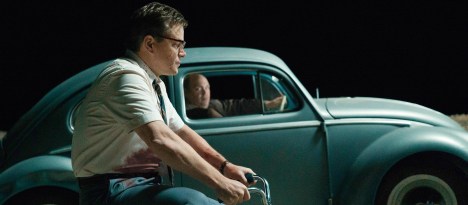
That small conversational aside captures what is most appealing and most infuriating about Suburbicon, a movie that lacks a strong core and finds itself caught between two very different stories without any strong focus on either. Suburbicon is never boring, packed with strange turns and driven by a pitch black sense of humour. However, it never seems entire sure of what it is.

Cycles of violence.

Continue reading

Non-Review Review: Murder on the Orient Express (2017)

Murder on the Orient Express feels like a very conscious effort to disprove the notion that “they don’t make them like this any more.”

Lead actor and director Kenneth Branagh clearly relishes the opportunity to create a decidedly retro murder mystery. Murder on the Orient Express might contain a handful of action scenes and copious amounts of computer-generated imagery, but Branagh is very clearly channelling a more classical style of film making. Released in early November, Murder on the Orient Express has the look and the texture of an old-fashioned Christmas television treat; a fantastic ensemble reenacting a classic murder mystery on lavish sets with heightened melodrama.

Like a train in the night…
Or, you know, the day.

Branagh’s imitation is affectionate, but it is also laboured. Murder on the Orient Express feels like a nostalgic homage to the old ensemble-driven melodramas that were a dime-a-dozen, but there is something uncanny about it. Early in the film, the Belgian detective Hercule Poirot deduces that a fellow passenger is a dealer in forgeries, passing off unconvincing copies as historic artifacts. There is a sense that Branagh is attempting something similar, trying to construct something with the texture of a more classic piece of cinema, but without any of the spirit or the energy.

Murder on the Orient Express is charming and engaging, its enthusiasm for its premise and setting infectious in places. However, it also as lifeless as the corpse at the centre of the mystery.

Cold case.

Continue reading

Non-Review Review: The Killing of a Sacred Deer

The Killing of a Sacred Deer is cold, clinical and Kubrick. Perhaps too much so in places. It is also mesmerising and haunting.

“Do you understand?” Martin asks a confused Steven towards the climax. “It’s a metaphor. My example. It’s metaphorical.” As one might expect from director Yorgos Lanthimos, The Killing of a Sacred Deer is very much couched in symbolism and metaphor. As the title implies, a reference casually suggested by a minor character quite late in the film, The Killing of a Sacred Deer might be best understood as a modern update of Iphigenia in Aulis, the tragedy of the Greek general Agamemnon who was forced to sacrifice his daughter to a vengeful god.

The man upstairs.

However, that is an incomplete prism through which The Killing of a Sacred Deer might be understood. The tale of a patriarch faced with an impossible choice to protect his family from a sinister outside force, The Killing of a Sacred Deer is a study of masculinity and responsibility. The film is an interrogation of sex and power through a surreal lens, skewed through psychological horror and pitch black comedy. The Killing of a Sacred Deer is never entirely abstract, but it is very rarely literal. It exists in a surreal and uncomfortable space that enhances the audience’s unease.

The Killing of a Sacred Deer is an uncanny piece of cinema, an ethereal moral fable that lingers long after its resolution.

Putting the matter to bed.

Continue reading

Non-Review Review: The Florida Project

The Florida Project is a beautifully made and deeply condescending film.

Director Sean Baker beautifully captures the sense of listlessness that defines an unlikely community of Tampa residents clustered in the motels that adorn the Strip. Painted in bright colours and christened with familiar-but-non-copyright-infringing names like “Futureworld” or “Magic Castle”, these motels come to embody a purgatory for residents of the area who live in spaces originally designed to accommodate tourists. These characters live in the shadow of Disneyland, but never seem to arrive.

Somewhere over the rainbow.

The Florida Project is an impressive piece of work from a technical standpoint. Baker assembles an impressive cast, drawing out a quiet and moving performance from Willem Dafoe and establishing relative newcomer Brooklynn Prince as a face to watch. Baker’s compositions are impressive, lots of static shots that provide a sense of scale for the characters who seem tiny in comparison to the themed gift shops and giant motels that threaten to swallow them whole. In particular, Alexis Zabe’s cinematography beautifully captures this sun-drenched limbo.

However, there is a patronising cynicism at the heart of The Florida Project, and its portrayal of childhood poverty. The Florida Project is candid in its exploration of the horrors of poverty, of characters who have been failed by all the institutions around them desperately trying to stay afloat. However, it is also very calculated in how it chooses to present family life in the midst of these failures and compromises. The Florida Project tries to mesh a romantic and wistful sketch of childhood with a brutal depiction of live on the margins, and the rest feels disingenuous at best.

Wilderness years.

Continue reading