• Following Us

  • Categories

  • Check out the Archives


  • Awards & Nominations

The Spirit Archives, Vol. 5 (Review/Retrospective)

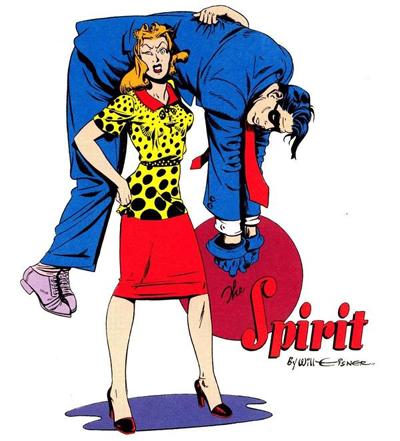
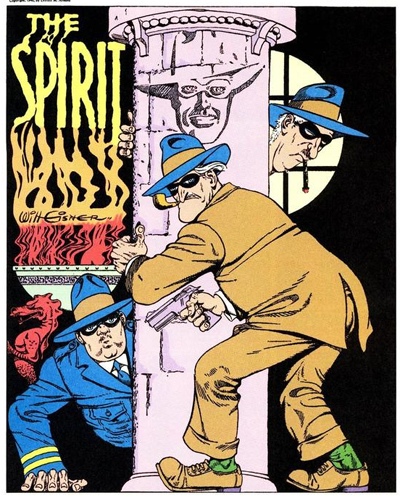
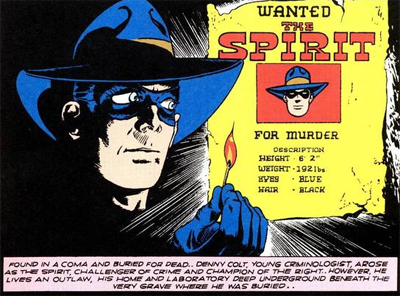
With The Spirit Archives, Vol. 5, we get our first real taste of what The Spirit looks like without Will Eisner. I’ve always felt like The Spirit belonged to Eisner in a way that very few iconic American comic book characters belong to a particular creator. The Spirit belonged to Eisner in the same way that The Adventures of Tintin belonged to Hergé. I am fond of Darwyn Cooke’s revival of the character, and there’s something interesting about the Kitchen Sink anthology series, but those exist mainly as curiosities or companion pieces to Eisner’s work on the character.

In many ways, this stretch of strips, published by Eisner’s staff and colleagues during his army service, feels the same sort of way. It’s more of a historical curiosity than an end to itself.
Lighten up…

Continue reading

The Spirit Archives, Vol. 4 (Review/Retrospective)

As with the previous collection, the War looms large in The Spirit Archives, Vol. 4. While Eisner had been keenly following events in Europe from the start of the strip, things really come to a head here. These are the strips for the six months following the attack on Pearl Harbour, and – understandable – there’s a strong patriot undertone to everything here. Eisner would eventually put his patriotism into action when he was drafted, leaving his character in the hands of his staff – who dutifully kept the comic warm for him during his term of service. While Eisner’s early work on the strip isn’t quite as good as the work that would follow, and the shadow of the Second World War dominates, these are still fascinating stories told by a master storyteller.

Carrying on, naturally…

Continue reading

The Spirit Archives, Vol. 3 (Review/Retrospective)

Join us the December as we take a dive into the weird and wonderful Will Eisner Spirit Archives, the DC collections of the comic strip that helped define the medium.

At this point The Spirit had survived a year. That first year had seen Eisner establish the strip, lay down many of the rules that would define the comic for the rest of its impressive twelve-year run as a regular fixture in the Sunday papers. This third volume is hardly the most essential in the twenty-six volume set, but there’s a sense of confidence in the stories the Eisner is telling and how he is telling them. The strip arguably wouldn’t hit its stride until after Eisner left for the war, and came back with a broader range of experience, but one can see the roots of that later success even in these (relatively) early adventures.

We'll always have Damascus...

We’ll always have Damascus…

Continue reading

The Spirit Archives, Vol. 2 (Review/Retrospective)

Join us the December as we take a dive into the weird and wonderful Will Eisner Spirit Archives, the DC collections of the comic strip that helped define the medium.

With this second collection of six months worth of strips, we can see Eisner’s vision of The Spirit really cement itself, as well as the true beginnings of the more experimental work that the writer and artist would do with the newspaper strip. While a lot of people would argue that Eisner truly hit his stride in the postwar era of The Spirit, I think we can see him beginning to truly hone his craft here, and can get a sense of an artist slowly testing the horizons of an eight-page newspaper comic strip. It might not be his best work on the title, but it’s still fascinating stuff.

Accept no substitutes…

Continue reading

The Spirit Archives, Vol. 1 (Review/Retrospective)

Join us the December as we take a dive into the weird and wonderful Will Eisner Spirit Archives, the DC collections of the comic strip that helped define the medium.

It’s hard to overstate the impact that Will Eisner had on comic books as a medium. The writer, entrepreneur and artist is known as “the father of the graphic novel”, with A Contract With God regard as one of te very first examples of the format. Eisner made massive in-roads into developing comics as a medium that merited discussion and attention, trying frantically to break out of the ghetto where the artform is so frequently trapped. While he has made countless pivotal contributions, arguably Eisner’s largest and most influential body of work can be found in The Spirit, the weekly comic strip that the author syndicated across America. Packaged with any number of respected newspapers, it was among the most widely-read comic strips in the country, but it also allowed Eisner the freedom to expand and develop his craft.

DC have collected the bulk of the character’s history in a series of their superb “Archive Editions”, from the first strip published through to Eisner’s last work on the title (with a supplementary volume published by Dark Horse). Here, in the first volume, we can see the artist honing his craft and developing the series into one of the most important in comic book history.

That’s his name!

Continue reading

Infinite Crisis (Review/Retrospective)

This month I’m taking a look at DC’s massive “Infinite Crisis” Event. Although it was all published in one massive omnibus, I’ll be breaking down the lead-in to the series to tackle each thread individually, culminating in a review of the event itself. Check back for more.

Infinite Crisis is a fantastic concept with a somewhat muddled execution. The idea of reflecting on the way the DC Universe has evolved since Crisis on Infinite Earths is a fascinating hook for an event miniseries, and writer Geoff Johns does an effective job of exploring how times have changed. However, the original Crisis on Infinite Earths had a tendency to seem too vast and too all-encompassing for its own good, randomly jumping between a cast of hundreds lost in a maelstrom. Given that Marv Wolfman had twelve issues to tell that story, and still occasionally ended up a little confused, it seems a little unfair for Geoff Johns to attempt a similar effort in only seven issues.

There are times when Infinite Crisis feels less like one cohesive story and more like a series of vignettes based around a theme. That doesn’t mean there isn’t a lot of interesting stuff going on here – or that Johns doesn’t have something compelling to say about modern superhero comics – it just means that Infinite Crisis is a bit of a mess. A bold and ambitious mess, but a mess nevertheless.

A smashing success?

Continue reading

Infinite Crisis: Justice League – Crisis of Conscience (Review)

This month I’m taking a look at DC’s massive “Infinite Crisis” Event. Although it was all published in one massive omnibus, I’ll be breaking down the lead-in to the series to tackle each thread individually, culminating in a review of the event itself. Check back for more.

Crisis of Conscience exists of something of a bridge between Identity Crisis and Infinite Crisis. Of course, other tie-ins (like Villains United) have already explored that fertile ground, but Crisis of Conscience is very much about exploring the implications of that earlier crisis crossover. After all, how can the heroes trust one another, or themselves, when they’ve been tampering and playing with memory and personality. Ultimately, Crisis of Conscience doesn’t necessarily resolve anything. It really just lines up all the final pieces before we jump into Infinite Crisis proper. However, it’s an interesting exploration of just how far these characters have come since the innocence of the Silver Age.

Holding out for a hero…

Continue reading

Infinite Crisis: Rann-Thanagar War (Review)

This month I’m taking a look at DC’s massive “Infinite Crisis” Event. Although it was all published in one massive omnibus, I’ll be breaking down the lead-in to the series to tackle each thread individually, culminating in a review of the event itself. Check back for more.

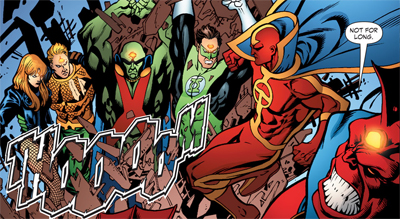
I’ve always been a fan of the “hokey science-fiction” corner of the DC Universe. Adam Strange is perhaps my second-favourite Silver Age DC hero (behind the Flash). I loved Alan Moore’s trip to the stars during his Swamp Thing run. While many thought that Stars my Destination, the penultimate mega-arc of James Robinson’s Starman, went on far too long, I loved every page. Geoff Johns’ Green Lantern is one of my favourite modern comic book runs. I confess all this so that my bias is upfront, when I admit that Rann-Thanagar War is one of my favourite Infinite Crisis tie-ins, even though it’s one of those least directly connected to the event itself.

All the Strange, Strange heroes…

Continue reading

Infinite Crisis: Day of Vengeance (Review)

This month I’m taking a look at DC’s massive “Infinite Crisis” Event. Although it was all published in one massive omnibus, I’ll be breaking down the lead-in to the series to tackle each thread individually, culminating in a review of the event itself. Check back for more.

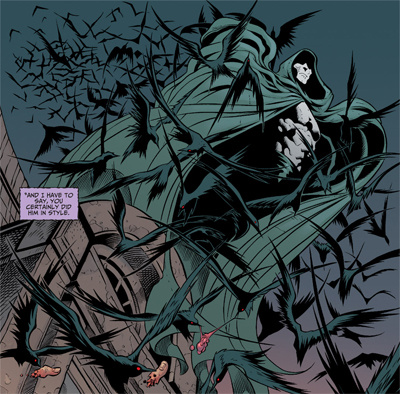
It seems like, within the last decade or so, DC has had a great deal of difficulty organising its “magic and mystic” books. DC generally provided a nice home for books like Alan Moore’s Swamp Thing or John Ostrander’s Spectre, but it seemed like there wasn’t really an abundance of successful magic-themed books in the early part of the new millennium. DC would consciously attempt to remedy this with their “dark” line as part of the “new 52” relaunch, but Day of Vengeance feels like something of an awkward earlier attempt to streamline that corner of the shared universe and to prepare it for some sort of creative relaunch.

One for sorrow, two for joy… What for a few dozen?

Continue reading

Adam Strange: Planet Heist (Review/Retrospective)

This month I’m taking a look at DC’s massive “Infinite Crisis” Event. Although it was all published in one massive omnibus, I’ll be breaking down the lead-in to the series to tackle each thread individually, culminating in a review of the event itself. Check back for more.

Note: Although technically not a lead-in, and not included in the Omnibus, Planet Heist leads directly to Rann-Thanagar War, so I thought I’d take a look at it. Also, it’s a pretty damn fine series.

I’ve always had a soft spot for Adam Strange. Along with The Flash, Strange’s adventures in Mystery in Space are among my favourite of DC’s Silver Age comic books. (That would suggest a fondness for Carmine Infantino, who – his Batman work aside – is certainly a favourite of mine.) I’m boggled that DC has never managed to make more of Strange than they have. A delightful science-fiction concept, blending John Carter of Mars with a fifties ray-gun aesthetic, it seems ripe for pulpy exploitation. In fact, before Marvel announced Guardians of the Galaxy, I figured that Strange might prove DC’s best big screen hope of distinguishing themselves from Marvel.

Andy Diggle and Pascal Ferry’s Planet Heist is a delightful eight-issue miniseries featuring the character, updating him for a new era. I can’t help but feel a little sad that the pair didn’t extend the miniseries into a run, and that Adam Strange remains a neglected character in the DC pantheon.

All the Strange, Strange people…

Continue reading