• Following Us

  • Categories

  • Check out the Archives


  • Awards & Nominations

Star Trek: Enterprise – Silent Enemy (Review)

Next year, Star Trek is fifty years old. We have some special stuff planned for that, but – in the meantime – we’re reviewing all of Star Trek: Enterprise this year as something of a prequel to that anniversary. This January, we’re doing the first season. Check back daily for the latest review.

Silent Enemy is very much a game of two halves.

It’s an episode that suffers from the decision to incorporate two radically different plots into a single episode. In many respects, it’s a show that suffers from Star Trek: Enterprise‘s decidedly old-fashioned storytelling aesthetic: the sense that most hours of Star Trek need to have two plots running through them for pacing and structural reasons. This storytelling technique is a decidedly outdated approach to television, reflecting the narrative conservatism at play in the first season of the show.
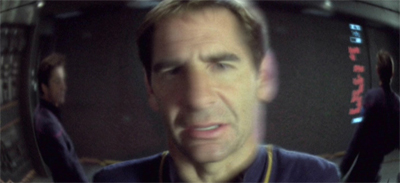
We come in peace...

We come in peace…

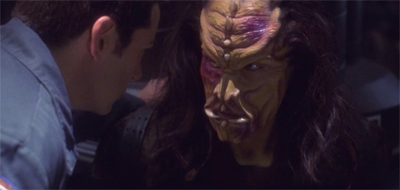
Silent Enemy is built around two plots. The primary plot sees the ship coming into conflict with a bunch of strange predatory aliens who do not respond to attempts for contact, and who grow increasingly belligerent over the course of the episode. Archer and his crew find themselves facing an opponent far stronger and more aggressive than they are. It’s a pretty bleak, pretty heavy plotline. Inevitably, the show decided to pair it with something a bit more light-hearted, so we get Hoshi trying to figure out what Reed’s favourite food is that Chef can bake him a super-special birthday cake.

While the combination of plotlines isn’t the worst in the history of the franchise – the episode doesn’t feel like Frankenstein’s monster in the same way that Life Support does, for example – it’s still rather incongruous. Silent Enemy is an episode weakened by the decision to combine these two into a single story; the desire to offset the doom of the “Enterprise under siege” story with something a bit more easy-going and comedic.

Alien aliens...

Alien aliens…

Continue reading

Non-Review Review: The Kingsman

The creators of The Kingsman either really love or really hate the classic Roger Moore Bond films. Probably both.

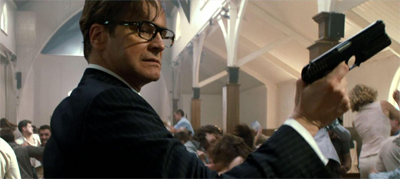
Another creative collaboration between Matthew Vaughn, Jane Goldman and Mark Millar, The Kingsman is just as juvenile, crass and ultimately charming as Kick-Ass. There is a sense of mischievous and cheeky fun to this classic spy film homage. It is effectively an update of those seventies and eighties spy films with a more cynical and self-aware attitude. There is a sense that The Kingsman is simply more transparent than its inspirations in its infectiously juvenile and borderline offensive sensibilities.

Sound and Firthy...

Sound and Firthy…

It is hard to tell how much of this homage is genuine nostalgic affection, and how much is witty subversion. The Kingsman is a spy film that not only uses outdated (and occasionally insensitive) spy movie tropes, it practically revels in them. Although the third act occasionally feels a little too mean-spirited in its riff on classic Bond sensibilities, The Kingsman has enough boundless energy and raw enthusiasm to keep the audience watching. The script is well-observed and the direction is tight. A superb central cast helps to anchor the film.

The Kingsman is an odd beast. It is that rare homage that seems quite likely to shock and offend many fans that otherwise share its nostalgic inclinations. However, those willing to be a bit more adventurous will find much to love in this updated spy caper.

Matthew Vaughn's fingerprints are all over this...

Matthew Vaughn’s fingerprints are all over this…

Continue reading

Star Trek: Enterprise – Cold Front (Review)

Next year, Star Trek is fifty years old. We have some special stuff planned for that, but – in the meantime – we’re reviewing all of Star Trek: Enterprise this year as something of a prequel to that anniversary. This January, we’re doing the first season. Check back daily for the latest review.

It is customary, these days, for television shows to map out their mythologies years in advance. Depending on when you ask him, executive producer Bryan Fuller boasts of having a six- or seven-year plan for Hannibal, despite the fact that the show spends each cancellation period on the bubble line for NBC. Indeed, the move away from the standard television pilot format means that shows are encouraged to have long-form plots and arcs mapped out.

However, that isn’t always the case. The X-Files was very much made up as it went along, with little real thought put into how the show’s sprawling alien mythology hung together beyond the immediate future. Even heavily serialised shows like Lost or 24 were plotted as they went along, with plans radically changing as the show evolved. Unlike film, where you (mostly) need a finished story before you start filming, television is a medium where you don’t really need an ending in mind as you begin telling the story.

There's a lot on the (time) line...

There’s a lot on the (time) line…

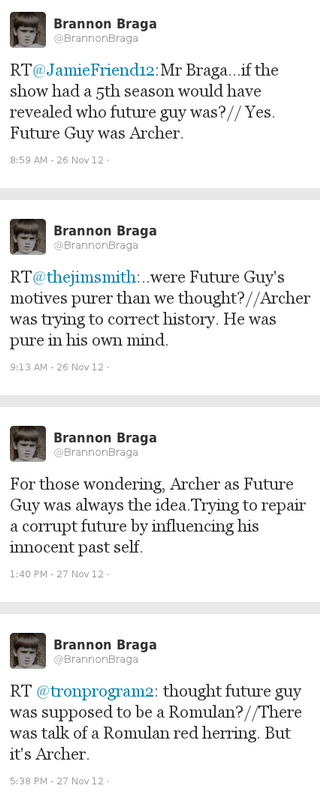
So it really shouldn’t be a surprise that Star Trek: Enterprise introduced the idea of the “Temporal Cold War” without any real idea of how the story was meant to develop or conclude. Although structured as something of a serialised arc among a (mostly) episodic couple of seasons, the Temporal Cold War is something that makes very little sense in the context of the show. Even years after the fact, the Temporal Cold War is a mystery, with Brannon Braga casually dropping the reveal that, well… Archer did it.

Of course, that plot development doesn’t make a lot of sense… but that’s par for the course. It is very hard to tie the various Enterprise time travel episodes together into a logical and cohesive narrative. Cold Front doesn’t even bother to answer questions immediately relevant to its own narrative, let alone hint at logical future developments for the series’ recurring time-travel plot line. It’s a story that seldom makes sense within individual episodes, let alone when they are strung together.

In space, all warriors are (temporal) cold warriors...

In space, all warriors are (temporal) cold warriors…

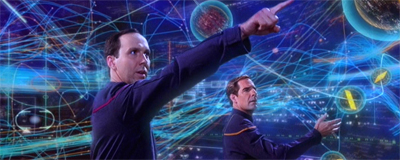
And yet, despite that, Cold Front is a pretty great episode. Part of that is down to the Temporal Cold War plot line, with Cold Front introducing a welcome sense of ambiguity to the conflict and selling the idea that Archer has wandered into something much larger than he can comprehend. On an otherwise quiet mission, Enterprise finds itself embroiled in a conflict between two forces that Archer does not fully understand, as if the ship and its crew have found themselves engaged on one front of a war in heaven.

However, Cold Front works just as well with the elements that exist outside the Temporal Cold War. As with Breaking the Ice, the episode plays like a regular day on board the Enterprise, as Archer and his crew find themselves welcoming religious pilgrims on board and making friendly first contact as they gather to watch some beautiful interstellar phenomenon. It’s an episode that draws attention to the quiet wonder and majesty of deep space exploration, elegantly and effectively.

Hang on in there...

Hang on in there…

Continue reading

Star Trek: Enterprise – Fortunate Son (Review)

Next year, Star Trek is fifty years old. We have some special stuff planned for that, but – in the meantime – we’re reviewing all of Star Trek: Enterprise this year as something of a prequel to that anniversary. This January, we’re doing the first season. Check back daily for the latest review.

Fortunate Son is a solid premise ruined by an overly simplistic execution.

One of the more interesting aspects of Star Trek: Enterprise is a chance to return to the pioneering spirit of the original Star Trek. It’s an excuse to imagine what the early years of humanity’s exploration of space must have looked like. More than any other spin-off except Star Trek: Deep Space Nine, this show lends itself to world-building and expansion. What does space look like before the Federation was established? How was it regulated before a gigantic conglomeration of space-faring races decided to impose their own laws and rules upon the spaceways?

Well, that sucked the air out of the room...

Well, that sucked the air out of the room…

Broken Bow made a big deal about how the Enterprise was the first human ship capable of travelling at warp five. In essence, it is the beginning of the Star Trek franchise as fans know it. The speed that engine brings and the distance the ship can cover serve as a gateway to the wider Star Trek universe. So, logically, if Enterprise is the first step in that direction, the ship must be emerging into a universe that looks radically different – a culture that is very distinct from that depicted on the other Star Trek spin-offs. With slower engines, fewer ships, less known about the universe, this should be an entirely different world.

Fortunate Son touches on this idea a little bit, throwing Archer into conflict with the crew of a long-haul space freighter over intergalactic piracy. The problem with the episode is that it feels very much like Archer is arguing from a position grounded in the Star Trek franchise as it is yet to develop, rather than the current status quo. In his debates with Ryan, Archer gets to be right for two contrived reasons: Ryan is written as an idiot; and Archer’s philosophy applies to the status quo of over five hundred other episodes.

Beaten to the punch...

Beaten to the punch…

Continue reading

Star Trek: Enterprise – Civilisation (Review)

Next year, Star Trek is fifty years old. We have some special stuff planned for that, but – in the meantime – we’re reviewing all of Star Trek: Enterprise this year as something of a prequel to that anniversary. This January, we’re doing the first season. Check back daily for the latest review.

After Breaking the Ice hinted at what Star Trek: Enterprise might become, Civilisation is an episode that nudges the show right back into its comfort zone. It’s an episode of Star Trek that feels like it could have been produced for Star Trek: The Next Generation or Star Trek: Voyager, with only a minimum amount of change to the script. However, what is strangest about Civilisation is the way that it feels like a rather direct throwback to the very classic Star Trek show, serving as a tale about our hot-blooded captain fighting evil imperialist adversaries and seducing sexy alien space babes.

Of course, there’s a sense that this sense of regression is exactly what the show is aspiring towards. After all, Archer was advertised as “Captain Kirk’s childhood hero”, and it makes sense for the show to play with the classic Star Trek tropes that are regarded so affectionately by popular culture. Unfortunately, Civilisation lacks the spark and wit necessary to make such a pulpy homage work, instead feeling too much like a dull retread.

David Ickes was right!

David Icke was right!

Continue reading

Star Trek: Enterprise – Breaking the Ice (Review)

Next year, Star Trek is fifty years old. We have some special stuff planned for that, but – in the meantime – we’re reviewing all of Star Trek: Enterprise this year as something of a prequel to that anniversary. This January, we’re doing the first season. Check back daily for the latest review.

Breaking the Ice is the first episode of the first season of Star Trek: Enterprise not to reserve a “story by” credit for Rick Berman and Brannon Braga. (Although – in the To Boldly Go documentary – Braga has suggested that at least some of the episode came from his own ideas.)

It is instead credited solely to the writing team of Maria & Andre Jacquemetton. A husband-and-wife writing team, the duo have a long history of writing for television. Before they worked on Enterprise, their credits included Baywatch Nights. However, they are probably more notable for the work that they did after Enterprise, working as executive producers and writers on Mad Men. The duo have won WGA awards for their contributions to Mad Men and been nominated for Emmys.

Guess who's coming to dinner...

Guess who’s coming to dinner…

It is very easy to take the pedigree of the writers on Star Trek for granted. After all, Ronald D. Moore went from a Star Trek: The Next Generation fan with a spec script to the showrunner on the rebooted Battlestar Galactica. Bryan Fuller went from a workhorse on the Star Trek: Voyager staff to a television auteur with work on Dead Like Me, Pushing Up Daisies and Hannibal. Brannon Braga has been prolific since his departure from the franchise, while Ira Steven Behr and René Echevarria have worked consistently in genre television.

It is tempting to claim that Enterprise was something of a formative experience for the Jacquemettons, but that would be disingenuous. Despite writing the show’s first script without a credit to Berman and Braga, the duo were not around long enough to make an impression on the show. They departed at the end of the first season, along with most of the writing staff. Indeed, the most significant influence that Enterprise had on their career was probably the fact that they used to discuss the idea for Mad Men with creator Matt Weiner while they were working on this show.

They're cracking up out there...

They’re cracking up out there…

Still, while hardly a demonstration that Jacquemettons were a creative force to be reckoned with, Breaking the Ice is a solid little episode. It ranks as the strongest episode of Enterprise since the pilot. In many respects, it recalls the Prime Factors/State of Flux duology from the first season of Voyager. It is a flawed episode that has no shortage of ambition, offering a taste of what could make its show unique in the Star Trek pantheon.

It is an episode that celebrates everything that makes Enterprise unique as compared to the other Star Trek shows, taking a great deal of pleasure in things that the audience had come to take for granted in the franchise. It’s a quiet character piece, where what little plot exists is pushed very much to the background, and which offers a much more nuanced view of human/Vulcan relations than Strange New World or The Andorian Incident.

Those Vulcans are cold so-and-sos...

Those Vulcans are cold so-and-sos…

Continue reading

Star Trek: Enterprise – The Andorian Incident (Review)

Next year, Star Trek is fifty years old. We have some special stuff planned for that, but – in the meantime – we’re reviewing all of Star Trek: Enterprise this year as something of a prequel to that anniversary. This January, we’re doing the first season. Check back daily for the latest review.

The Andorian Incident is a strange little episode. On the surface, it’s a fairly standard and competently-executed hostage thriller. However, that only scratches the surface. The Andorian Incident is an episode that promises so much more, teasing the potential of Star Trek: Enterprise to evolve into perhaps the most “Star Trek-y of Star Trek shows”, exploring the foundation of the United Federation of Planets and how mankind really found its place in the wider cosmos, building a intergalactic confederation build on peace and tolerance.

The Andorian Incident seems more like a statement of intent from the show, which is a crucial part of any first season.

A bolt from the blue...

A bolt from the blue…

Continue reading

Doctor Who: Series Eight (or Thirty-Four) (Review/Retrospective)

You asked me if you’re a good man and the answer is, I don’t know. But I think you try to be and I think that’s probably the point.

Peter Capaldi’s first season of Doctor Who is astonishingly linear.

That feels like a very weird thing to type, but it’s true. Executive producer Steven Moffat backed away from the ambitious structural experiments that defined the two previous seasons, pushing the show back towards a fairly conventional and logical structure. Between Deep Breath and Death in Heaven, there was a clear logical progression. The season did not begin at the end like The Impossible Astronaut did, or end at the beginning like The Name of the Doctor.

doctorwho-deepbreath2

Instead, things progressed cleanly and logically. Character arcs evolved in a very clear and structured way; themes built organically; the season’s central mysteries had little to do with the intricacies of time travel and more to do with guessing the nature of the returning threat. The result was perhaps the most accessible and linear season of Doctor Who since Steven Moffat’s first year as executive producer. In fact, it was the first season not to be split since Steven Moffat’s first season as executive producer.

To be fair, it is easy to see why such an approach was taken. While Peter Capaldi might be one of the most high profile and most successful actors to ever take on the lead role, changing the lead actor on successful television show is always a risky proposition; it is impossible to be too careful in managing the transition. The actor’s first season in the role is an endearing effort; a rather safe first half of the season giving way to a more adventurous and playful second half. While the season has a few flaws, it is hard to consider it anything but a massive success.

doctorwho-intothedalek17

Continue reading

Star Trek: Enterprise – Terra Nova (Review)

Next year, Star Trek is fifty years old. We have some special stuff planned for that, but – in the meantime – we’re reviewing all of Star Trek: Enterprise this year as something of a prequel to that anniversary. This January, we’re doing the first season. Check back daily for the latest review.

Terra Nova is a rather unfortunate fifth episode for Star Trek: Enterprise. The show is in its first season, so there are bound to be mistakes and missteps along the way. However, Unexpected and Terra Nova provide a one-two punch of unfortunate back-to-back episodes, shows that aren’t just the result of an uncertain creative time stumbling while trying to find their groove. Like Unexpected directly before it, Terra Nova is an episode that is toxic from the ground up.

It is, in short, precisely the kind of story that you don’t want to tell about mankind’s first adventures into the cosmos. While the episode very much evokes the mood and style of classic Star Trek, it also inherits all the franchise’s worst colonial impulses. This is an episode that belongs alongside the more ill-judged entries in the first season of Star Trek: The Next Generation, like The Last Outpost or Lonely Among Us.

He's got faith, faith of the heart...

He’s got faith, faith of the heart…

Terra Nova takes a fascinating starting point – something very intrinsically tied to the premise of Enterprise – and twists it into a show about our human protagonists dealing with silly off-world people. Those silly off-world people happen to be humans, who need to be reminded of their humanity, in such a way that our protagonists can feel proud and superior about how advanced and sophisticated they are. Those silly humans who have “gone native” could really learn a lot from our super-advanced heroes.

Terra Nova feels like an episode that sets Star Trek back fourteen years, proof that some of the worst aspects of Roddenberry’s vision of the franchise have endured surprisingly well.

On yer bike, Reed...

On yer bike, Reed…

Continue reading

Star Trek – Assignment: Earth (IDW, 2008) (Review)

The first Star Trek pilot, The Cage, was produced in 1964. To celebrate its fiftieth anniversary, this December we are reviewing the second season of the original Star Trek show. You can check out our first season reviews here. Check back daily for the latest review.

John Byrne’s five-issue Assignment: Earth miniseries is fascinating, because it is perhaps the closest that fans will ever come to getting an actual series spinning out of the episode Assignment: Earth. Of course, the second season finalé had been planned as a backdoor pilot for a new television show, but it never quite materialised. Understandably, Gary Seven tends to appear in spin-off material as a guest star or supporting player. Assignment: Earth focuses on the adventures of Supervisor 194 on his own terms.

Coupled with Byrne’s decidedly old-school done-in-one storytelling structure, Assignment: Earth manages to tell four separate stories featuring Gary Seven and Roberta Lincoln doing what they do in the late sixties and into the seventies. A series of unique and episodic adventures delivered on a regular, Assignment: Earth comes quite close to capturing the feel of a television show. Taking the television episode as his starting point, John Byrne manages to pitch a series of adventures that feel like they might hint at the direction the show could have gone.

Sensors detect a spin-off!

Sensors detect a spin-off!

While the Assignment: Earth miniseries is ultimately disposable and largely forgettable, it is an interesting experiment. By their nature, prose novels like The Eugenics Wars can only focus on a single plot starring the character. Using his fairly compressed approach to comic book storytelling, Byrne can tell five different stories in rapid succession, each with a clear beginning, middle and end. While these stories are inevitably written from the vantage point of 2008, they still feel like they might offer a glimpse at what the show might have looked like.

In many respects, Byrne is hampered by his source material. While the writer and artist has a bit of fun with the concept, a lot of Assignment: Earth ultimately feels a little dry and a little heavy-handed. Despite all the nods towards relevance and social commentary, Assignment: Earth lacks the spirit of adventure and excitement that a television show like this would need in the longer term.

"You'll have fifty percent less Nixon to kick around!"

“You’ll have fifty percent less Nixon to kick around!”

Continue reading