• Following Us

  • Categories

  • Check out the Archives


  • Awards & Nominations

Star Trek: Deep Space Nine – Hard Time (Review)

This February and March, we’re taking a look at the 1995 to 1996 season of Star Trek, including Star Trek: Deep Space Nine and Star Trek: Voyager. Check back daily Tuesday through Friday for the latest review.

Hard Time is a fantastic (and vastly underrated) episode of Star Trek: Deep Space Nine.

The episode tends to get overlooked in discussions about the fourth season of Deep Space Nine, perhaps owing to the high average quality of the season or the fact that it arrives in the middle of what is admittedly the season’s weakest run of episodes. However, in spite of all that, Hard Time is an exemplary piece of Deep Space Nine. It is certainly the best of the series’ “O’Brien must suffer” episodes, and a showcase for Star Trek veteran Colm Meaney. In its exploration of trauma and recovery, and cycles of violence, it taps into the heart of the show.

Not phased in the slightest...

Not phased in the slightest…

That said, Hard Time arrives at a point where Deep Space Nine is nudging closer and closer to serialisation. The show has begun to embrace long-form storytelling, as evidenced by the ripple effect of the changes to the status quo in The Way of the Warrior and the way that little plot threads weave through the season. The show has not yet reached the point at which it can structure six- or ten-episode arcs, but it is getting close. Deep Space Nine is clearly moving towards what is (for Star Trek at least) a fairly novel style of television storytelling.

As such, Hard Time is particularly striking for the fact that it is a purely episodic adventure. The episode puts Miles O’Brien through hell, having him struggle with post-traumatic stress disorder while trying to reintegrate into society. This is the kind of plot that feels more suited to a long-running mini-arc than Worf and Dax’s arguments about the relative merits of bladed weapons or Worf’s decision to move to the Defiant. Instead, O’Brien’s trauma is dealt with over the course of a single episode. Hard Time plays as a defence of the tradition television episode structure.

Growing the beard...

Growing the beard…

Continue reading

Daredevil – A Cold Day in Hell’s Kitchen (Review)

This month, we’re doing daily reviews of the second season of Daredevil. Check back daily for the latest review.

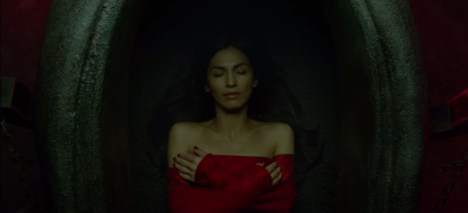
And so we reach the end of the second season of Daredevil.

Except it is very clearly not the end. “This is not the end,” Elektra whispers as she lies dying in Matt’s arms. Although Elektra has hardly been the most honest or reliable character across the run of the season, she seems to be telling the truth. While the first season of Daredevil made a point to square away most of its characters and plot points at the end of the run, the second season consciously leaves things dangling. Nelson and Murdock has been dissolved. Elektra’s body has been stolen. The Hand are not defeated.

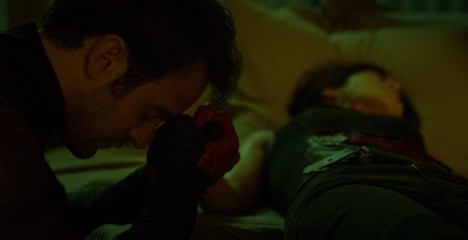
The dead only quickly decay...

The dead only quickly decay…

The first season ended in a relatively tidy fashion, with only a few oblique hints towards what the future might hold. The most significant of these loose ends, Wilson Fisk being taken to a holding cell, was consciously put on the backburner when the second season began. Although the second season would pick up on that storythread, it would not do so until the cliffhanger of Guilty as Sin leading into Seven Minutes in Heaven. There was a sense that the audience could have left Matt Murdock there and been happy. At least until The Defenders.

The end of the second season is much more ambiguous. There is no sense that anything is being left anywhere for an extended period of time. Whether those dangling plot threads will be addressed in a hypothetical third season of Daredevil or during The Defenders, it is clear that audiences are being kept on a hook.

"John Luther and James Bond both recommended this, so I thought I'd be foolish not to give it go..."

“John Luther and James Bond both recommended this, so I thought I’d be foolish not to give it go…”

Continue reading

Star Trek: Deep Space Nine – Rules of Engagement (Review)

This February and March, we’re taking a look at the 1995 to 1996 season of Star Trek, including Star Trek: Deep Space Nine and Star Trek: Voyager. Check back daily Tuesday through Friday for the latest review.

Rules of Engagement is that old Star Trek standard: the trial episode.

The franchise has never really had a lot of luck with the format over the years. The Menagerie, Part I and The Menagerie, Part II were primarily of interest for the way that they repurposed The Cage and offered viewers a glimpse of an alternate kind of Star Trek. Later in that same first season, Court Martial was a disjointed and uneven (and even illogical) story. Later series did not fare much better; neither A Matter of Perspective nor Dax nor Ex Post Facto could be considered highlights of their seasons or their shows or the wider franchise.

Worf really doesn't understand the proper way to lodge an objection...

Worf really doesn’t understand the proper way to lodge an objection…

However, The Measure of a Man remains the exception that proves the rule. Not only a strong episode of itself, it stands as one of the best episodes in the history of the franchise. More than that, it represented a turning point in the history of Star Trek: The Next Generation; it is perfectly reasonable to point to The Measure of a Man as the moment that The Next Generation finally delivered on its potential after almost two seasons of struggling to find a unique voice. It seems entirely possible that the franchise has been chasing that high ever since.

Unfortunately, Rules of Engagement is an example of the rule rather than the exception. It is a misguided and clumsy episode that has a number of interesting ideas that fail to coalesce into a satisfying whole.

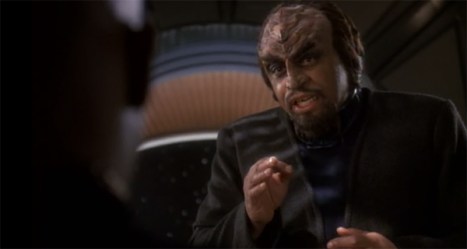
Klingon lawyered up... Kl'awyered up, if you will.

Klingon lawyered up…
Kl’awyered up, if you will.

Continue reading

Daredevil – The Dark at the End of the Tunnel (Review)

This month, we’re doing daily reviews of the second season of Daredevil. Check back daily for the latest review.

Adaptation is a tricky business.

One of the more interesting aspects of the comic book movie boom that occurred in the years following Blade (although really kicking into gear with X-Men and Spider-Man) has been the discussion over narrative fidelity. It seems like a comic book adaptation is no longer truly judged on its own merits, but weighed against how faithfully it recreates its source material. It is not enough to produce a good superhero film, it is expected that most contemporary production teams should produce a good superhero adaptation.

Trinity.

Trinity.

This would have seemed ridiculous during the nineties. After all, Tim Burton’s Batman and Batman Returns stand as two of the most successful superhero films of the decade, and they are arguably better described as “Tim Burton films” than “Batman films.” There was a point at which Tim Burton was planning to direct his own Superman film that would have been (very) loosely inspired by The Death and Return of Superman written by Kevin Smith and starring Nicolas Cage, a giant spider, and some polar bears.

Largely driven by the success of the Marvel Studios business model, however, it seems that contemporary superhero films and television shows are expected to show their work and to emphasise their connection to the source material.

"Let's turn this town into a warzone. A Punisher: Warzone."

“Let’s turn this town into a warzone. A Punisher: Warzone.”

Continue reading

Daredevil – .380 (Review)

This month, we’re doing daily reviews of the second season of Daredevil. Check back daily for the latest review.

One of the strongest things that the second season of Daredevil has going for it is the three-act structure.

Pacing and structure can be concerns for Netflix television shows. After all, the distributor works on a completely different model than most television broadcasters. Instead of releasing a series on a week-to-week basis across a period of several months, Netflix releases all of a season at the exact same moment. As such, the focus and goals of a Netflix series are different from that a series developed through more traditional means. Netflix shows are consciously designed to be “binged” rather than to be digested in hour-long chunks.
He's the devil, that one.

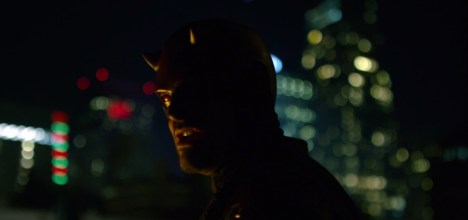
He’s the devil, that one.

In some ways, this has seen the erosion of the episode as a functional unit of storytelling. If an episode of a regular television drama simply does not work, then the audience is left with a bad taste in their mouth for a week. If an episode of a Netflix drama does not work, the next episode is right there. In fact, Netflix makes it even easier by automatically moving the viewer to the next episode, meaning it takes more effort not to watch the next episode than it does to just keep going. With that in mind, an individual episode not working is not a deal-breaker.

In some respects, it is disappointing that Netflix has yet to truly embrace the potential of the streaming model. Storytelling that would be unthinkable in a weekly model are easier to work around when it comes to binging. In terms of playing with narrative formating, Aziz Anasari’s Master of None is probably the most ambitious of the “Netflix original” shows; the series bounces between its arc-based storytelling and more standalone pieces. In most cases, Netflix shows only really exploit the potential of the model when it comes to serialising their story.
Frank interrogates The Usual Suspects.

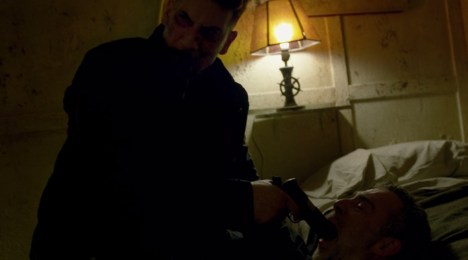
Frank interrogates The Usual Suspects.

That said, there is still some division between how streaming affects the plotting of comedies as compared to dramas. Comedies like The Unbreakable Kimmy Schmidt and Bojack Horseman seem to adopt a more conservative episodic approach to their episode-to-episode plotting; given that The Unbreakable Kimmy Schmidt was moved to Netflix rather late in its production cycle, this makes in a certain amount of sense. Nevertheless, it would appear that the streaming model tends to lean towards a “single story told over [number] hours” approach to drama.

This is not inherently a good thing. One of the bigger issues with streaming dramas remains the attachment to classic television formal conventions, whether it is a set runtime or a predetermined number of episode. Not every story needs to be thirteen episodes, especially not on a streaming service. There is a question as to whether shows like Mad Dogs and Jessica Jones might have been better served with a shorter order. There is also a sense that the demand of telling a single story over a set number of hours leads to stalling and repeating.
Just a regular guy, talkin' about love and punishing.

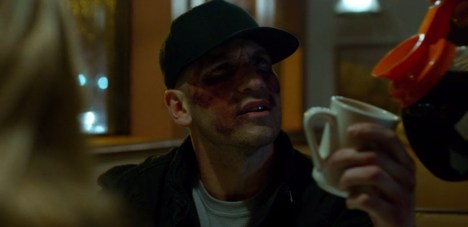
Just a regular guy, talkin’ about love and punishing.

While a fantastically ambitious show in terms of storytelling and themes, Jessica Jones had an unfortunate habit of running around in circles in order to reach that thirteen-episode count. Early episodes like AKA Crush Syndrome and AKA It’s Called Whiskey wasted a lot of time on how to knock Kilgrave out. Kilgrave himself was introduced twice in both AKA Crush Syndrome and AKA It’s Called Whiskey. Kilgrave was captured and escaped no less than three times over the season, in AKA The Sandwich Saved Me, AKA Sin Bin and AKA 1,000 Cuts.

In many ways, Daredevil is a conventional piece of television drama. Part of that is down to structuring. Daredevil has a stronger sense of episodic storytelling than many contemporary streaming dramas. Within the second seasons, episodes like Guilty as Sin and Seven Minutes in Heaven are held together by internal themes like the idea of perpetual war as it links the season’s two plots and whether various characters are trapped within prisons of their own makings. Care is taken to ensure that something is accomplished between the start and end of a given episode.
Guy talk.

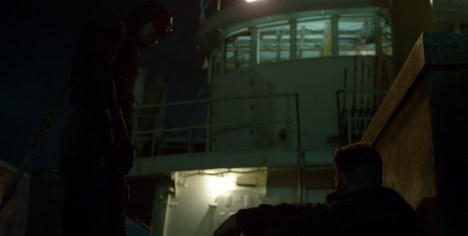
Guy talk.

More than that, the second season takes the idea further and very clearly structures itself into conventional three-act design. The first act introduces Frank Castle and pit him against Matt Murdock, running from Bang to Penny and Dime. The second act introduces Elektra and focuses on Frank Castle’s trial and incarceration, running from Kinbaku to Seven Minutes in Heaven. The third act completes Frank’s origin story while pitting Matt and Elektra against the hand, from The Man in the Box to A Cold Day in Hell’s Kitchen. The structure is very clear.

Unfortunately, .380 marks the point at which that structure begins to fall apart.
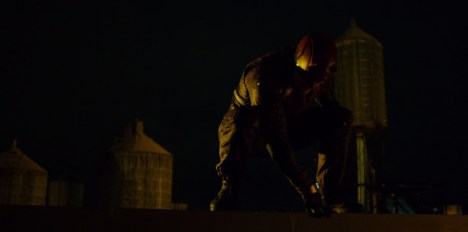
There's going to be hell to pay...

There’s going to be hell to pay…

Continue reading

Daredevil – The Man in the Box (Review)

This month, we’re doing daily reviews of the second season of Daredevil. Check back daily for the latest review.

Throughout the second season of Daredevil, major characters debate the nature of Frank Castle.

In Bang, Frank Castle is introduced as a force of nature; he is presented akin to an old horror movie monster. In New York’s Finest, Frank tries to argue his case with Matt; Frank suggests that he simply offers a more permanent variation of the justice that Matt dispense. Indeed, Regrets Only seems to suggest that Karen has a more sympathetic perspective on Frank; Foggy dismisses him as obviously insane. In Semper Fidelis, Matt and Karen argue about whether Frank could be considered a hero.

"You should put that on a t-shirt or something."

“You should put that on a t-shirt or something.”

As the second season of Daredevil marches on, the series continues to offer excuses and justifications for what Frank does. The show goes out of its way to avoid any potentially challenging read of Frank Castle, tying everything neatly back to the death of his family. Guilty as Sin implies that Frank is a victim of “sympathetic storming” that keeps the death of his family constantly fresh in his mind. Seven Minutes in Heaven makes it clear that Frank still has a lot killing to do to avenge his family. Frank is presented as a brutal avenger, rather than a violent serial killer.

However, as the second season of Daredevil enters its final act, the show tips its hand. The Man in the Box makes it clear that Frank Castle is not an anti-villain. He is not even an anti-hero. Frank Castle is a straight-up hero. As the show moves into its final stretch, it becomes clear that the production team have crafted a thirteen-episode superhero origin story for Frank Castle. That gets to the root of the problems in his characterisation.

Sai.

Sai.

Continue reading

Daredevil – Seven Minutes in Heaven (Review)

This month, we’re doing daily reviews of the second season of Daredevil. Check back daily for the latest review.

The relationship between the first and second seasons of Daredevil is quite complicated.

There is an obvious reason for this. The show’s production team changed between the first and second season, with the role of executive producer shifting from Steven DeKnight to Marco Ramirez and Doug Petrie. As a result, there is a clear change in emphasis and storytelling style; much like there was a shift from the two episodes overseen by Drew Goddard at the start of the first season to the later episodes overseen by DeKnight. Different producers bring a different perspective to their material. It is only natural.

"None of you seem to understand. I'm not locked in here with you... you're locked in here with me!"

“None of you seem to understand. I’m not locked in here with you… you’re locked in here with me!”

So there are major differences in the content and themes of the first and second season. Recurring elements that had been important to DeKnight are shuffled in the background to afford attention to aspects that intrigue Petrie and Ramirez. Matt’s Catholicism is less important than it was; Matt’s career as a lawyer is more central than it had been. Even the structural emphasis of the season shifts. DeKnight put Matt Murdock and Wilson Fisk on a collision course. Petrie and Ramirez prefer to have their characters running in parallel.

That said, there are moments when the first season bubbles through. There are strange thematic links that pop up from time to time, but are truncated or brushed aside. More striking, however, is how closely Ramirez and Petrie hew to the structural elements of the first season. In many ways, this is not surprising. One of the most consistently intriguing aspects of the second season is the energy that it expends on structure rather than plot or character. That is particularly true with Seven Minutes in Heaven.

A Punishing schedule...

Orange is the new dead.

Continue reading

Star Trek: Voyager – Innocence (Review)

This February and March, we’re taking a look at the 1995 to 1996 season of Star Trek, including Star Trek: Deep Space Nine and Star Trek: Voyager. Check back daily for the latest review.

One of the remarkable things about the first two seasons of Star Trek: Voyager is the way that they seem to hark back to the aesthetic of classic Star Trek.

There is a palpable goofiness to some of the ideas in the second season that feels very much in keeping with the mood and tone of the classic sixties series. There’s a surprising amount of high-concept science-fiction allegory running through the first two seasons of the show, with the writer playing with concepts not too far removed from the space!Romans of Bread and Circuses or the half-black half-white allegories of Let That Be Your Last Battlefield. There are points where Voyager seems to drift away from literalism and wander into sci-fi wackiness.

Kids these days...

Kids these days…

There were elements of this to be found in the first season, with Caretaker awkwardly literalising the franchise’s wild west metaphor by having Janeway’s first planetfall occur on a desert world with a primitive aggressive population. The Kazon and the Vidiians seemed like they escaped from pulpy science-fiction serials, with the show even going so far as to present the Vidiians as body horror space nazis in episodes like Phage and Faces. This is to say nothing of the Cold War paranoia of Cathexis or the primary colour atomic anxiety of Time and Again.

However, this tendency really kicked into high gear during the second season, with the crews’ dreams conspiring to kill them in Persistence of Vision, Chakotay meeting his people’s space!gods (er… “sky spirits”) in Tattoo, Voyager embroiling itself in a “robotic war” in Prototype and Paris “evolving” into a salamander in Threshold. There was a sense that the show was embracing the sort of high-concept sci-fi weirdness that Star Trek: The Next Generation had spent so much of its run trying to avoid, and had only really embraced in its final years.

Bennet, we hardly knew ye.

Bennet, we hardly knew ye.

That is particularly apparent in this stretch of episodes towards the end of the second season. Innocence has a species that ages backwards, enjoying a simple allegory without getting too caught up in the internal logic of the situation. The Thaw is arguably a much greater visual tribute to the style and tone of the original Star Trek than Flashback could ever claim to be. Tuvix is a classic transporter accident story, reversing The Enemy Within. These pulpy elements of Voyager would never quite go away, but they would never be as pronounced as they were in the first two years.

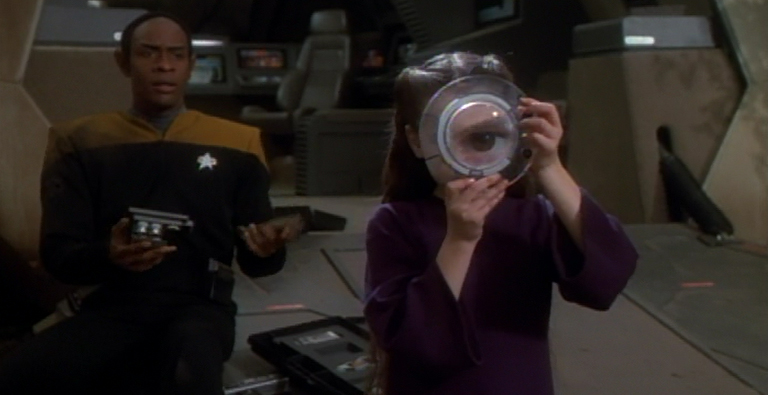
Innocence is a weird and goofy little story that works best as a modern fairy tale. It is arguably proof that the Star Trek franchise probably works better as metaphorical allegory than straight-up science-fiction.

Eye see...

Eye see…

Continue reading

Daredevil – Guilty as Sin (Review)

This month, we’re doing daily reviews of the second season of Daredevil. Check back daily for the latest review.

Part of what is so infuriating about the second season of Daredevil is that fact that there is a lot of good material here.

The issue is nothing as simple as saying “good ideas, terrible execution”, or anything as trite. There are good ideas that are executed well and bad ideas that are handled with a surprisingly deft touch; there are also good ideas that are needlessly squandered and bad ideas that turn out to be exactly as terrible as they initially appear. It isn’t even that there are clearly discernible unambiguous flaws. Everything is a mix. For all the issues with the writing of the Punisher and Elektra, Jon Bernthal and Elodie Yung do great work with the material afforded to them.

Let us pray...

Let us pray…

The second season of Daredevil is very much a curate’s egg of a television season. There are good bits and bad bits. There is breathtaking ambition and incredible miscalculation in equal measure. The series is not entirely a failure, but it is far from a success. With Guilty as Sin, the show clumsily repositions itself as a morality play about the conflict between good and evil within the soul as Elektra Natchios. However, there is a similar conflict brewing at the heart of the show.

Even in the season’s strongest moments, there are clear weaknesses shining through. Even in the season’s weakest moments, its strongest elements are frequently in play.

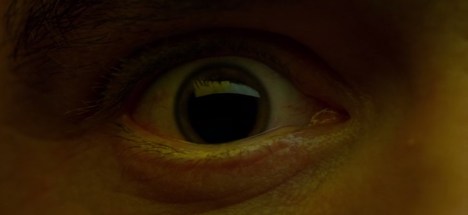
Eye see.

Eye see.

Continue reading

Star Trek: Voyager – Deadlock (Review)

This February and March, we’re taking a look at the 1995 to 1996 season of Star Trek, including Star Trek: Deep Space Nine and Star Trek: Voyager. Check back daily for the latest review.

In some ways, Deadlock is Star Trek: Voyager‘s original sin.

Of course, Deadlock is good. It is really good. It is a well-constructed piece of television that moves with an incredible momentum; it gathers speed and builds towards a suitably epic finalé. In many ways, Deadlock is one of the strongest episodes from the first two seasons of Voyager. There is a credible argument to be made that Deadlock belongs on any list of “best Voyager episodes ever”, thanks to the potent combination of Brannon Braga’s high-concept script and David Livingston’s dynamic direction.

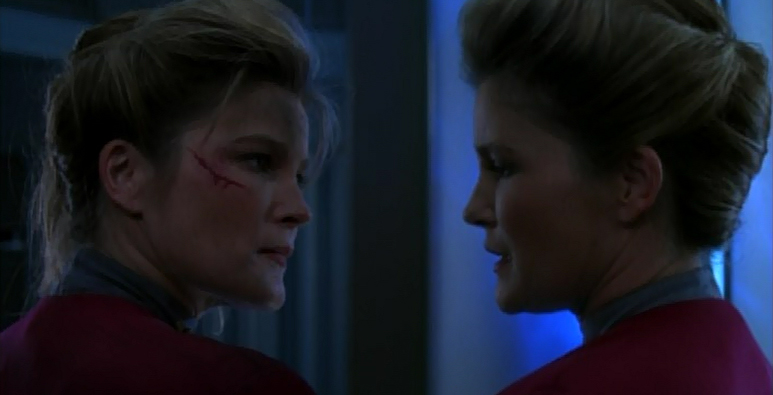
Janeway²...

Janeway²…

At the same time, it is hard not to look at Deadlock in retrospect and see the shape of things to come. It is, perhaps, the ultimate “reset” button episode; it provides a clear template for later “blow up Voyager and kill Janeway” episodes like Year of Hell or Timeless. The trick works very well once; it loses any real impact when it is repeated several times over the course of the show’s run. More than that, the episode feels somewhat generic. Due to the nature of the high-concept premise, there is little room for detail specific to Voyager.

It seems that the end of the second season set the course for the next five years of Voyager. The production team had tried to tell an experimental story specific to Voyager with Investigations, only to fail spectacularly; it would be the last time that the show attempted anything so bold. In contrast, the production team managed to construct a fantastic episode around a generic premise in Deadlock, perhaps indicating that the future of the show lay in that direction. It is easy to see why that production team opted for safe and generic ahead of ambitious and experimental.

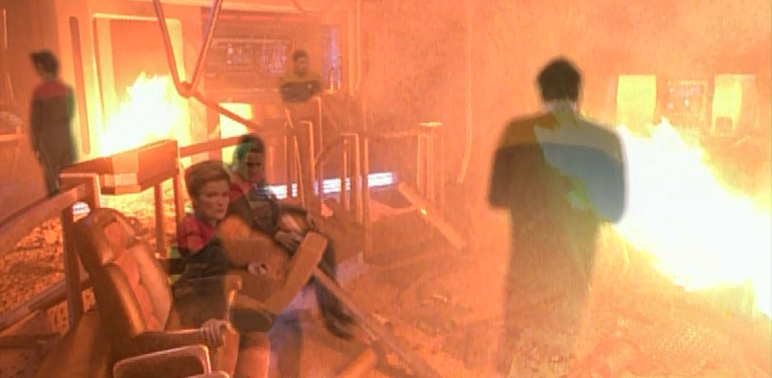
Ghost stories...

Ghost stories…

Continue reading