• Following Us

  • Categories

  • Check out the Archives


  • Awards & Nominations

Star Trek – The Savage Curtain (Review)

This July and August, we’re celebrating the release of Star Trek Beyond by taking a look back at the third season of the original Star Trek. Check back every Monday, Wednesday and Friday for the latest update.

Gene Roddenberry returns to Star Trek, to put the show to rest.

Two of the final three episodes of this third season originated with Roddenberry, putting paid to the idea that the veteran executive producer was entirely absent from the year. Roddenberry had departed the show at the start of the season, after issuing NBC with an ultimatum regarding the scheduling of his series. He had moved out of the Star Trek production offices and across the lot to develop his own projects. The standard narrative of the third season suggests that Roddenberry was no longer around to keep the show on the rails.
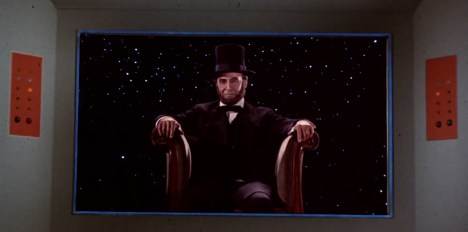
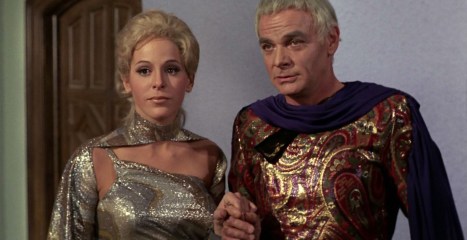
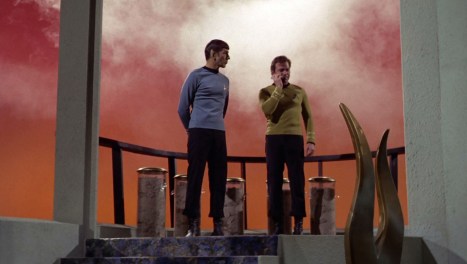
Holy space!Lincoln...!

Holy space!Lincoln…!

This is untrue, in a number of respects. Roddenberry was involved in the production of the third season, just not as actively as he had been. He was responsible for commissioning and championing a number of early third season episodes inherited by Fred Freiberger, including Elaan of Troyius and The Paradise Syndrome. He had even used his remaining leverage to shamelessly try to shoehorn merchandise into Spock’s Brain and Is There in Truth No Beauty? He was also drawing an executive producer salary and nabbed two late-season production slots.

Of course, this argument also relies on the assumption that Roddenberry understood Star Trek better than anybody else. Roddenberry had created Star Trek, but he was not the singular vision behind it. Writers like Dorothy Fontana and producers like Gene L. Coon were as responsible for shaping the show as Roddenberry in many respects. Roddenberry might have talked a good game, but he was also a producer who believed that The Omega Glory would have made a good pilot for the show.
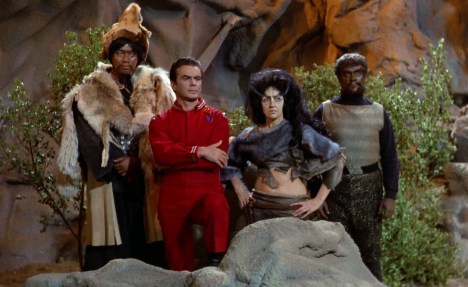
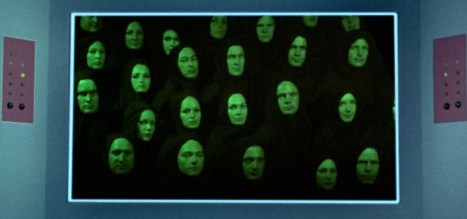
Legion of Doom!

Legion of Doom!

If anything, there is something faintly damning about Gene Roddenberry’s triumphant return to the series at the end of its third year. Neither The Savage Curtain nor Turnabout Intruder are good episodes. In fact, the best thing that can be said about Roddenberry’s two final contributions is that The Savage Curtain probably isn’t quite as bad as And the Children Shall Lead or The Way to Eden. Still, both episodes feel regressive and awkward. Roddenberry’s writing is a reminder of just how far the show had come in the care of other producers.

However, at least The Savage Curtain is memorable.
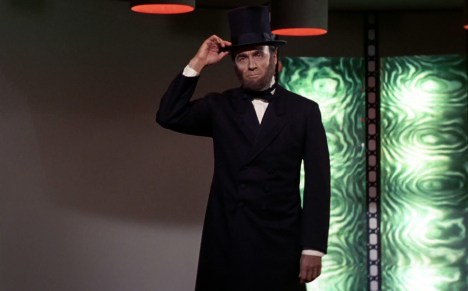
Topping it all off.

Topping it all off.

Continue reading

Star Trek – Requiem for Methuselah (Review)

This July and August, we’re celebrating the release of Star Trek Beyond by taking a look back at the third season of the original Star Trek. Check back every Monday, Wednesday and Friday for the latest update.

Requiem for Methuselah is a surprisingly quiet episode.

The basic premise of the episode suggests sound and fury. The crew of the Enterprise have been infected by a deadly illness. McCoy speculates that there are only four hours in which to save the crew. Desperately searching for a cure, Kirk leads an away team down to a planet rich in the necessary minerals. When a man claiming to be the planet’s sole inhabitant refuses to allow Kirk access to the mineral, there is a tense stand-off; Kirk threatens to have the Enterprise obliterate the man and take the compound by force.

"You know, falling in love with the surrogate daughter of the man who can save my ship might not be the best tactical move here. Particularly since I've known her all of two hours."

“You know, falling in love with the surrogate daughter of the man who can save my ship might not be the best tactical move here. Particularly since I’ve known her all of two hours.”

Despite this rather high-stakes set up, the rest of Requiem for Methuselah is rather low-key. Despite his initial hostility to the uninvited guests, the mysterious stranger invites Kirk and the away team to his home. The episode spares the audience the sight of crew members sick and dying, with Scotty and Uhura (and a “skeleton crew”) doing a respectable job of holding down the fort as the end approaches. Even when the first couple of attempts to manufacture a cure fall flat, McCoy and his colleagues remain professional and dignified through to the end.

In a way, this would seem to capture the tone of this stretch of the third season.

Our man Flint.

Our man Flint.

Continue reading

Non-Review Review: Anthropoid

“Concentrate on the details.”

The phrase is repeated in Anthropoid, and it speaks to the aesthetic of Sean Ellis’ tense Second World War assassination thriller. Ellis is very much fascinated with the details. This is reflected in the standard clandestine war movie fare; the reliance on maps and the maintaining of schedules, the decoding of messages and the construction of weapons. However, it is also reflected in Ellis’ directorial choices, with an emphasis on tight claustrophobic shots and meticulous care to ensure what the audience can or cannot see at any given moment.

Wet work.

Wet work.

The result is an engaging entry in the subgenre, a familiar story elevated by the craft on display. Ellis very skilfully and successfully ramps up the tension over the film’s two-hour runtime, mainly by keeping in complete control of the frame. Anthropoid is distinguished from other undercover war movies through the sheer scale of paranoia and dread that Ellis manages to generate, leading to a spectacular (and sustained) pay-off in the film’s third act. As its protagonists argue, the details are key.

There a few minor problems. Ellis is over-reliant on shaky camera work to keep the audience off-balance, a technique that is occasionally disorienting in a literal rather than a figurative sense. There are also moments when Anthropoid drifts away from its gritty grounding into easy visual metaphors and stock war movie tropes; crushed symbols of innocence trampled underfoot and a soaring triumphant score over silent scenes of carnage. However, these are the exception rather than the rule. As long as Anthropoid focuses on the details, it never loses track of itself.

Driving ambition.

Driving ambition.

Continue reading

Star Trek – The Way to Eden (Review)

This July and August, we’re celebrating the release of Star Trek Beyond by taking a look back at the third season of the original Star Trek. Check back every Monday, Wednesday and Friday for the latest update.

Like any television, or any piece of popular culture, Star Trek is a product of its time.

That does not mean that the show speaks only to its time or that it has no relevance beyond that moment in time, but in means that the series is very much anchored in the zeitgeist of the late sixties. Sometimes that influence is obscured by advances in the intervening years, like the fascination with the novelty of transplant surgery that played out in the background of Spock’s Brain. Sometimes that tangible connection is more like ambient background noise than direct influence, as with the sense of apocalyptic dread that permeates the third season as a whole.

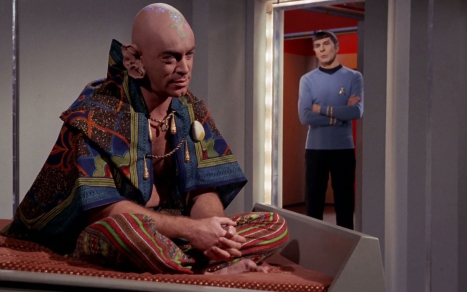
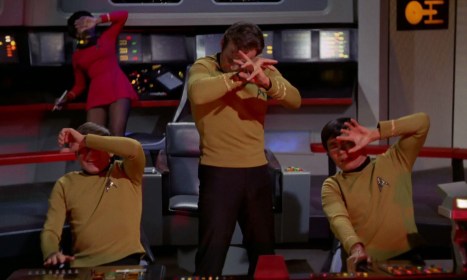
"You reach?"

“You reach?”

Sometimes, however, it is impossible to look upon Star Trek as anything other than a product of the late sixties. Let That Be Your Last Battlefield was undeniably a product of 1968, with its anxiety about civil strife and civil rights, its somewhat reductive metaphor for race relations and its general production aesthetic. However, that is nothing compared to The Way to Eden, which might be the most flamboyantly and stereotypically sixties episode of the entire original run.

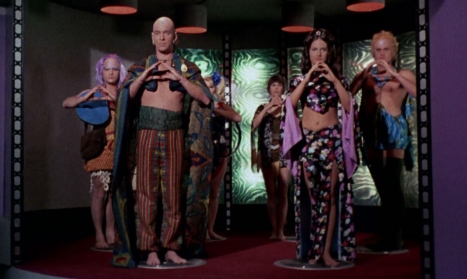
The Way to Eden is the episode that opens with a bunch of space!hippies staging a sit-in in the Enterprise transporter room and escalates from there.

Trippy hippie shakedown.

Trippy hippie shakedown.

Continue reading

Star Trek – The Cloud Minders (Review)

This July and August, we’re celebrating the release of Star Trek Beyond by taking a look back at the third season of the original Star Trek. Check back every Monday, Wednesday and Friday for the latest update.

The Cloud Minders is another reminder of the third season’s unique ability to produce memorable Star Trek.

There is something about the third season of Star Trek that draws fandom’s imagination to it. The general consensus is that the season is a disappointment filled with lacklustre episodes, questionable characterisation and crippling cutbacks. Nevertheless, the third season is also the source of a lot of the franchise’s core iconography like the Klingon D7 cruiser introduced in Elaan of Troyius or the IDIC in Is There in Truth No Beauty? That is to say nothing of the little curiosities sprinkled across the season.

Above all else.

Above all else.

Garth of Izar and Axanar are one such example, tied to the clumsy and awkward Whom Gods Destroy. Nevertheless, the concept of the “Battle of Axanar” was enough to launch a high-profile fan film that would become a flashpoint for twenty-first century fan productions. Indeed, there has even been speculation that Garth of Izar might be the commanding officer (although not the protagonist) in Bryan Fuller’s Star Trek: Discovery. This is not bad for concepts tied to an episode of which nobody seems particularly fond.

The same is arguably true of The Cloud Minders. It is a very clumsy and flawed piece of television, with a number of sizable script-related issues. However, it also has a number of very memorable visuals and ideas that have allowed it to take on an oversized place in the cultural memory of Star Trek.

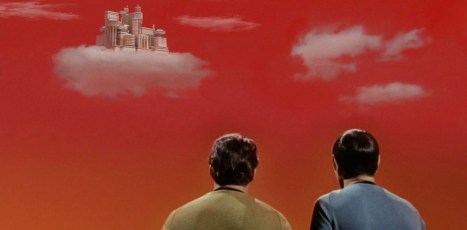
Clouded judgement...

Clouded judgement…

Continue reading

Non-Review Review: Sausage Party

Perhaps the most charming thing about Sausage Party is that it exists in the first place.

After all, a computer-generated animated movie about foul-mouthed hyper-violent and aggressively sexual anthropomorphised food products was always going to be something of a tough sell. More than that, there was always a risk that the film’s best joke could not sustain the necessary ninety-minute runtime. “Let’s do an R-rated comedy animated in the style of a Dreamworks or Pixar film!” is very wry, but it seems like the kind of idea that brews in the early hours of the morning at a wild party and is promptly forgotten.

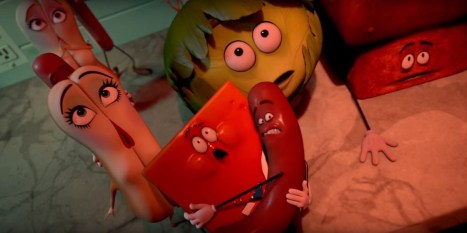
Food for thought...

Food for thought…

At one point in Sausage Party, the heroic hotdog Frank encounters a group of ancient foodstuffs hiding out in the liquor aisle of the shopping market that he calls home. These old and experience foodstuffs recall how they carefully cultivated and curated the mythology of the supermarket, building a religion that treated consumers as “gods” and which encouraged the store’s food and drink to dream of being “chosen.” There is even a hymn that the food sings every morning. A wisened old liquor bottle explains that this whole plan was the result of a massive stoner session.

In some ways, Sausage Party feels like it had a similar genesis, beginning with a goofy joke among friends that escalated and evolved into a surprisingly fleshed-out and developed world. Sausage Party works remarkably well given that it is essentially one very clever joke spread across ninety minutes, padded out with healthy doses of absurdity and puns. While the movie can occasionally feel a little indulgent and meandering, that charm carries it a long way. Sausage Party is one extended gag, but it is just about funny enough to pull it off.

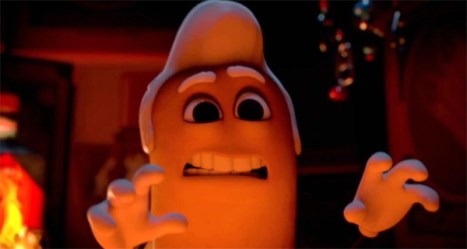
Sweet mother of mercy...

Sweet mother of mercy…

Continue reading

Star Trek – The Lights of Zetar (Review)

This July and August, we’re celebrating the release of Star Trek Beyond by taking a look back at the third season of the original Star Trek. Check back every Monday, Wednesday and Friday for the latest update.

The Lights of Zetar is another third season ghost story.

The third season of Star Trek is populated with these weird stories about long-dead souls refusing to pass on. There is Kirk’s haunting of the Enterprise in The Tholian Web, the dead world of Scalos in Wink of an Eye, the replicas of the long-dead Losira in That Which Survives, the title character in Requiem for Methuselah, the escapes into the past in All Our Yesterdays. It is almost as though the third season is working through its anxieties, a season television trapped between two cancellations.

Flash of inspiration.

Flash of inspiration.

The Light of Zetar features yet more death and destruction. The mangled bodies inside the Memory Alpha facility, contorted over the furniture. The lone survivor, screaming in agony. The eponymous spectral apparition that “cannot be a phenomenon of nature.” The inhabitants of Zetar, rendered non-corporeal through the destruction of their world, refusing to acknowledge that they have truly been dead for thousands upon thousands years. The argument that Mira Romaine must sacrifice herself so that the Zetar might live.

More than a ghost story, The Lights of Zetar is an exorcism story.

More like Memory Omega.

More like Memory Omega.

Continue reading

Seventies Heaven – The Shifting Gaze of Cultural Nostalgia

Nostalgia is a funny thing.

It is infinitely more complex than most people will allow. By its very nature, it is highly fungible, intertwined with concepts like memory and politics in a way that does not always make it easy to parse. Nostalgia hits in waves, but those waves do not always hit at the same time with the same intensity. Nostalgia is not a single monolithic concept, it pulls and pushes from moment to moment. What is the nostalgia of the moment? The eighties nostalgia of Stranger Things? The nineties nostalgia of Independence Day: Resurgence?

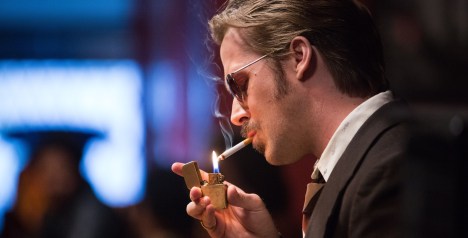
theniceguys2

Trying to define a pattern in pop culture’s nostalgia is like trying to read the tea leaves, falling somewhere between a conversational art and outright hucksterism.  Still, one of the more interesting – and least discussed – aspects of the grand nostalgia industrial complex is the state of transition. Big waves become little waves, emphasis shifts, focus goes elsewhere. One of the more interesting shifts in nostalgia over the past couple of years has been a transition from a strong sixties nostalgia into something altogether more seventies.

It is a rather weird sight to behold, as if watching the popular image of one decade fade into the popular image of the other.

elvisandnixon8

Continue reading

Non-Review Review: War Dogs

At one point in the movie War Dogs, manipulative sociopath Efraim Diveroli presents his naive business partner David Packouz with a gift.

It is a sequence that is as illustrative of War Dogs as it is key for Efraim. The gift in question is a golden hand grenade, a gesture of tremendous subtlety on the part of the film and its secondary lead. See, Efraim and David are self-described gun runners. More than that, they are ostentatious over-the-top gun runners with no sense of tact and the bare minimum of business sense. What better way for Efraim to convey this to David (and for the film to convey it to the audience) than through the gift of a gold-plated hand grenade.

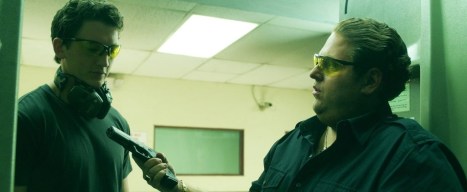
"Quick question: do we HAVE to be framed with these picture of Bush and Cheney? I mean, I think people get it."

“Quick question: do we HAVE to be framed with these picture of Bush and Cheney? I mean, I think people get it.”

However, the kicker comes in the inscription that Efraim has engraved on the bottom of the ridiculous gift. “The world is yours,” the grenade seems to promise its owner. It is, of course, a line from Scarface. It is, in fact, a line from both versions of Scarface. It is the bitterly ironic sentiment that closes out the film, an encapsulation of the greed and hubris that led the two gangster protagonists their downfall. Conveyed through advertising, it was also a stinging commentary on the American Dream. It was the height of irony, a cynical sting at the end of a moral fable.

There is a sense that Efraim does not necessarily understand irony. Having watched War Dogs, it is not entirely clear that the film does either.

Cool gun runnings.

Cool gun runnings.

Continue reading

Star Trek – The Mark of Gideon (Review)

This July and August, we’re celebrating the release of Star Trek Beyond by taking a look back at the third season of the original Star Trek. Check back every Monday, Wednesday and Friday for the latest update.

The Mark of Gideon is in many ways a direct counterpoint to Whom Gods Destroy.

Both The Mark of Gideon and Whom Gods Destroy have what might charitably be described as “major logic problems.” Both episodes were produced on a tiny budget, with those constraints bleeding through into almost every frame of the finished production. Both stories engage with the idea of utopianism as an essential ingredient in Star Trek storytelling. Both episodes are very much third season episodes, in terms of production and construction and storytelling.

Viewing screen on.

Viewing screen on.

However, Whom Gods Destroy manages to turn all of these elements into an ambitious mess. Although far from the strongest episode of the season, or even a half-decent episode of television, there is an endearing charm to Whom Gods Destroy that carries the episode far further than it should. In contrast, The Mark of Gideon is dead at arrival. It is an episode with a striking premise and set-up that has no idea where to go from that starting point and so meanders limply and lifelessly through forty-five minutes of television.

It also offers a pretty reprehensible vision of the franchise’s utopia.

This is an accurate representation of the third season's viewing figures.

This is an accurate representation of the third season’s viewing figures.

Continue reading