• Following Us

  • Categories

  • Check out the Archives


  • Awards & Nominations

New Podcast! The X-Cast – Season 5, Episode 20 (“The End”)

It’s season finale time on The X-Cast, so it was a privilege to be invited back on to talk about the fifth season finale The End. And it was a delight to join Tony Black for that discussion.

The end of the fifth season was the end of an era for The X-Files. The series would light up the multiplex over the summer with The X-Files: Fight the Future, and would return to the airwaves later that year as a changed show, with the production team having moved from Vancouver to Los Angeles. It was a transition that fundamentally altered the core dynamics of the show, and remains highly contested to this day. The End would be the last episode of The X-Files to be produced in Vancouver until My Struggle I, and a large part of the episode is about bidding a fond farewell to the show’s extended family in that area.

Appropriately enough, it seems like this episode marks a similar turning point for The X-Cast. I was caught completely off-guard by it, so I’ll let you listen and year for yourself. You can listen to the episode here, or click the link below.
Continue reading

Non-Review Review: Black Christmas (2019)

Black Christmas is an interesting misfire.

There’s something inherently clever about using the familiar template of a slasher movie to engage with the idea of toxic masculinity and the horrors of campus culture. Sophia Takal and April Wolfe certainly have a lot to say, and producer Jason Blum deserves a great deal of credit for positioning a film like this as part of the larger “social thriller” milieu that includes films like The Invisible Man or Get Out or Us. There’s a lot bubbling through Black Christmas, and it’s great to see a slasher film dabbling in these ideas.

Take a bow.

The biggest problem with Black Christmas is that it simply doesn’t work as a horror film. In terms of basic narrative mechanics and pacing, Black Christmas is a mess. The film suffers from many of the same structural problems that haunt so many disposable horror movies; the characters are thinly sketched, the film’s slow build-up feels a little too slow and its climactic confrontations feel a little too rushed and its internal logic is close to non-existent. These problems are compounded by the fact that actually positioning this movie as a remake creates an extra level of extraction.

Black Christmas has good ideas, but is somewhat lacking in the execution.

Don’t choke.

Continue reading

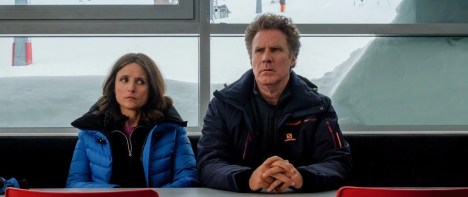
Non-Review Review: Downhill

Earlier this year, Parasite became the first non-English language film to win the Best Picture Oscar.

This was a landmark moment for the Academy Awards and for mainstream American cinema in general. It was significant enough in cultural terms to merit a racist dog-whistle from the President of the United States. It also suggested that it was possible for foreign films to make over the “one inch barrier of subtitles.” The film’s box office returns were impressive, and its cultural footprint quite sizable. Parasite seemed to make its own strong argument for the viability of foreign-language films in the English-language market place.

Passing each other on the down-slope of a marriage…

Downhill makes a similar argument, albeit in much less compelling terms. The indie cringe comedy is an adaptation of Ruben Östlund’s breakout foreign language sensation Force Majeure, premised on the idea that there are audience members who might be drawn to the basic premise of the original film, but alienated by the subtitles. Indeed, Östlund himself seems to have acknowledged this, moving on to more English-language-friendly pastures with The Square, a film with a lot of dialogue in English and starring actors like Dominic West and Elizabeth Moss.

Downhill makes its own argument for the necessity of Force Majeure, by demonstrating just how much can get lost in translation.

Cold reception.

Continue reading

New Escapist Column! On How We’re Still Talking About “Batman vs. Superman” Four Years Later…

I published a new In the Frame piece at Escapist Magazine on Monday. Given that last week was the fourth anniversary of Batman vs. Superman, it felt like an appropriate subject to tackle.

I continue to find myself fascinated by Batman vs. Superman, and I’m clearly not the only one. The film still generates a lot of chatter and attention among movie fans and superhero genre fans, particular when a lot of the discussion around other superhero film from the same period – like X-Men: Apocalypse or Fantastic Four – have faded from cultural memory. Indeed, Justice League is arguably only lingers in the memory because of the continuity fascination with what an actual sequel to Batman vs. Superman might look like.

In an era where so much pop culture is transient and disposable, there’s something endearing in the capacity of a film as odd and abrasive as Batman vs. Superman to linger in the public consciousness. You can read the piece here, or click the picture below.

New Escapist Column! On “Star Trek: Picard” and Parental Failure…

I published a new piece at Escapist Magazine yesterday evening. Given that Star Trek: Picard just wrapped up its first season, I had some thoughts expanding on my discussion of Et in Arcadia Ego, Part II on Make It So.

The first season of Picard is undeniably messy and awkward. The pacing is a little off in places, and it pulls several of its most powerful punches. However, at the heart of the series is a story that simmers through a lot of contemporary pop culture, from Star Wars: Episode IX – The Rise of Skywalker to Bad Boys for Life, the idea of a failed parent trying to redeem themselves through their child. It’s a fascinating inversion of the Campbellian archetype embodied by Star Wars, the quintessential story about a son come to terms with his relationship to his father. Stories like Picard invert that dynamic, and look at the responsibilities that parents owe to their children to provide them with a better world.

You can read the piece here, or click the picture below.

175. Contratiempo (The Invisible Guest) – This Just In (#245)

Hosted by Andrew Quinn and Darren Mooney, and this week with special guest Aine O’Connor, The 250 is a (mostly) weekly trip through some of the best (and worst) movies ever made, as voted for by Internet Movie Database Users.

This time, Oriol Paulo’s Contratiempo.

On the eve of his trial for a murder that he insists he didn’t commit, Barcelona business man Adrián Doria meets with trial expert Virginia Goodman. Virginia is there to help Doria explain how he might have woken up in a locked hotel room with the body of his mistress, but no memory of what happened. As the two pry further end further into the case, they become locked in a battle of wits that snakes and turns, where nothing is as it appears to be.

At time of recording, it was ranked 245th on the list of the best movies of all time on the Internet Movie Database.

Continue reading

New Podcast! Make It So – Season 1, Episode 10 (“Et in Arcadia Ego, Part II”)

I binged Star Trek: Picard over the course of the previous week, and so was thrilled to join the wonderful Kurt North on Make It So: A Star Trek Universe Podcast to discuss the first season finale, Et in Arcadia Ego, Part II.

I have somewhat complicated feelings about Picard. There are parts of it that I love, and parts of it that I am a bit more skeptical about. One of the joys of coming into the podcast to discuss the season finale was getting the chance to talk about the season as a whole, given how its various arcs were set up and how they paid off. It’s a nice, broad and comprehensive discussion of a sprawling, ambitious and complicated conclusion to the larger season. I feel really bad that I talked as long as I did on the episode, but there was a lot to dissect and discuss. For all the criticisms of Picard as shallow or superficial, there’s clearly a lot of meat on the bones.

Anyway, it was a huge honour to be invited on, and I hope you enjoy. You can listen to the episode here, or click the link below.

New Escapist Column! On the Underrated Appeal of “Iron Man 3″…

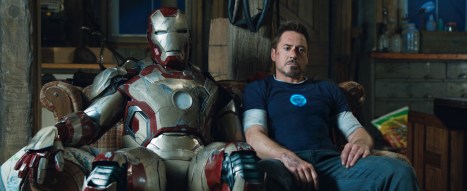
I published a new In the Frame piece at Escapist Magazine this evening. Given some online debates raging last week, I thought it was worth taking a look back at Iron Man 3.

Iron Man 3 remains a fascinating film, seven years after its release. What is particularly interesting is how fan and general audience opinions are polarised on it. This is not a coincidence. What audiences and critics love about Iron Man 3 is what alienates fans. Iron Man 3 is the rare film in the Marvel Cinematic Universe that seems conflicted about superheroes as they exist in contemporary pop culture, and anxious about the implications of approaching them as an expression of the military-industrial complex. The result is the relatively rare Marvel Studios film that is genuinely and engagingly introspective, willing to ask play with expectations and ask questions about the genre’s place in the contemporary pop cultural landscape.

You can read the piece here, or click the picture below.

Non-Review Review: Lady and the Tramp (2019)

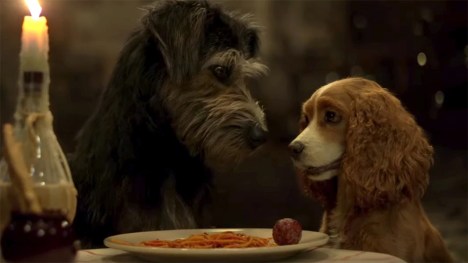
Lady and the Tramp represents a new frontier for Disney’s reimaginings of their animated classics.

The studio has had great success adapting those older films for younger audiences with a hybrid of live action and computer-generated remakes, with Aladdin and The Lion King ranking among the highest grossing movies of last year. Mulan looked like it might have been on course to continue the trend, and the studio is working away on a new version of The Little Mermaid. However, what makes Lady and the Tramp so interesting is that it is not going to be one of those theatrical blockbusters. Instead, it was released directly on Disney+, the company’s streaming service.

A completely identical meatball game.

There are two ways of looking at this. Disney might have been hoping to give Disney+ a bit of a boost by offering an exclusive brand-name and star-driven family-friendly film. Alternatively, the studio might have accepted that Lady and the Tramp was never a viable theatrical release to begin with, whether because it didn’t scratch the right nostalgic itch or because of the quality of the adaptation simply wasn’t up to snuff. In reality, it seems like a combination of the two factors.

Lady and the Tramp is fairly standard as these adaptations go. It is hurt by the push to verisimilitude and by the decision to expand a tight animated story into a bloated live action one. It is also very visually, aurally and tonally flat. It’s a film that seems built around the ethos of “just enough”, often feeling like a television movie that has somehow earned a theatrical special effects budget. Lady and the Tramp is not the worst of the Disney live action adaptations, but it may be the most lifeless.

No far horizons.

Continue reading

Non-Review Review: The Way Back

The Way Back is a paint-by-numbers redemption narrative, anchored in a tremendous central performance from Ben Affleck and enriched by its keen observations.

The basic plot of The Way Back will be familiar to most audience members. Jack is an alcoholic construction worker who is struggling to hold his life together. He has learned to do just enough to remain functional, but not so much that the people around him haven’t noticed his struggles. Jack stubbornly refuses any assistance offer by his family or by his ex-wife, believing that he has found something resembling an equilibrium. His addiction has pushed him into a slow and noticeable decline, but he has yet to implode.

He’s Backfleck.

Almost entirely by chance, Jack finds himself drafted back to his old high school, emotionally blackmailed into coaching their basketball team. Jack had played basketball as a teenager, but gave up on the sport in much the same way that he has recently withdrawn from the world around him. Inevitably, through his coaching, Jack finds himself connected with the lovable misfits that he takes under his wing. Jack guides these young men towards sporting glory, helping them (and himself) to find purpose in what they are doing.

It is all very conventional. There are very few surprises in The Way Back, which feels almost like one of those well-executed manoeuvres that Jack has his team execute out of the court. Everything lines up, all the pieces are moved with purpose, and the end result is never really in doubt. However, The Way Back elevates this well-worn formula with two secret weapons. Most obviously, Affleck finds an intersection of his traditional movie-star charisma with the baggage of his star persona. More subtly, the film is willing to just observe its characters, to let them be themselves.

Team works.

Continue reading