• Following Us

  • Categories

  • Check out the Archives


  • Awards & Nominations

Non-Review Review: 2 Fast 2 Furious

I’m rewatching The Fast and the Furious for a separate project, as solidarity with fellow film critic Jay Coyle for his “Cinema of Experience” project to look at the changing face of cinema in the twenty-first century. He’ll be writing up his account of how the experience of watching movies has changed in the past twenty-or-so years, but I found my rewatch of The Fast and the Furious interesting enough to write a longer-form review of it.

The Fast and Furious franchise exists somewhere in the space between The Fast and the Furious and 2 Fast 2 Furious, but is never quite caught on camera.

The Fast and the Furious is a late nineties undercover urban western about lawlessness in turn-of-the-millennium Los Angeles, of the dead end of the American Dream where young men (and occasional women) drive fast cars in circles to nowhere in particular, living their lives “one quarter mile at a time” without any purpose or any escape. It is a moral quagmire, a tribal wasteland in which law and order mean nothing. The film centres on a police officer sent to infiltrate this world of fast cars, who ultimately cannot bring his target to justice – because there is no justice in this empty and nihilistic world.

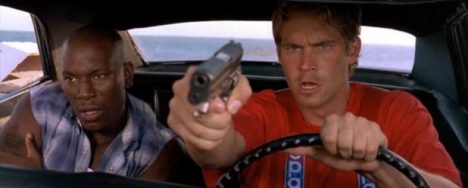
2 Fast 2 Furious is effectively a soft Miami Vice reboot. It is a bright and colourful thriller which follows former undercover police officer Brian O’Conner and his old friend Ramone Pierce as they are tasked to infiltrate a drug kingpin’s organisation in Miami. It is a much more conventional and delineated film, and also a much less existential. There are clearly defined good guys and bad guys, and O’Conner has absolutely no ethical objection to bringing in this particular criminal. The film is also appreciably brighter, both be virtue of its heavily saturated surroundings and by an increased emphasis on neon.

Watching 2 Fast 2 Furious, there’s a real sense that the production team had no idea what a hypothetical sequel to The Fast and the Furious would look like, only that it should exist… and maybe it should have some cars in it. Indeed, 2 Fast 2 Furious is pointedly at its most ridiculous when the script is forced to shoe-horn the “obligatory racing bits” into a conventional “undercover Miami drug bust movie.” There’s a weird disconnect between the two films, that goes beyond the absence of Vin Diesel.
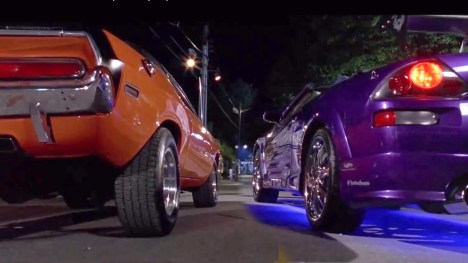
Even with Paul Walker present and few small continuity references, there’s little to tether 2 Fast 2 Furious to The Fast and the Furious. It recalls the sort of old-fashioned Hollywood cynicism that produced sequels like Die Hard with a Vengeance, when familiar characters would be clumsily bolted on to a completely unrelated script to create a new franchise installment. Of course, with Dom Toretto in the wind, 2 Fast 2 Furious doesn’t even really have that many familiar characters to anchor it. Brian O’Conner was never going to be the franchise’s breakout character, after all. 2 Fast 2 Furious only has the name.

In some ways, the spark that would drive the Fast and Furious franchise is found in neither The Fast and the Furious nor 2 Fast 2 Furious. After all, the later blockbuster installments of the franchise feel like a completely different breed than either film; espionage-style superhero films involving the fate of the world. That spark is found in the gap between The Fast and the Furious nor 2 Fast 2 Furious, in the cynical idea that just about any kind of movie can be a Fast and Furious movie if you stick enough cars in it.
Continue reading

Star Trek: Voyager – The Haunting of Deck Twelve (Review)

It seems strange that Neelix was not a larger part of Star Trek: Voyager.

To be fair, Neelix never disappeared into the ensemble to the same degree as characters like Chakotay, Kim and Tuvok. However, the series often struggled with how best to approach the character and how to make him work. It is notable that the production team went to the effort of writing Neelix off the show shortly before the seventh season finale, sending him to live with a colony of (very far from home) Talaxians in Homestead and consigning him to a cameo in Endgame. The character was often just there, his role hazy and undefined.

A Briefing With Death!
Errr, I mean, Neelix.

Of course, there were reasons for this. Neelix had been drafted on to the crew as an expert on the Delta Quadrant in Caretaker, and it made sense that this role would become increasingly redundant as time went on. By Fair Trade, Neelix was largely redundant, his knowledge exhausted. More than that, the early seasons of Voyager anchored Neelix’s character development to an abusive relationship with two-year-old. The toxicity of Neelix’s relationship with Kes in episodes like PhageTwisted and Parturition made it hard to invest in Neelix as a character worthy of attention or effort.

However, across the seven seasons of Voyager, there is a strange sense that Neelix is perhaps the single character most perfectly adapted to Voyager. He is the character who has developed in the direction that is perhaps most compatible with what Voyager has become, both in how it tells its stories and what it uses those stories to talk about. More than any other character on Voyager, Neelix is the character with the deepest roots in Delta Quadrant history and the character who is most firmly committed to oral traditions of storytelling, both recurring motifs within Voyager.

Smoke and mirrors.

Continue reading

Non-Review Review: Mission – Impossible: Fallout

Mission: Impossible – Fallout has the best third act of any blockbuster in years.

To be fair, the first two acts are highly enjoyable on their own terms, with writer and director Christopher McQuarrie building and maintaining momentum across the film’s near-two-and-a-half hour runtime. As expected of the franchise, Fallout is peppered with memorable set pieces that push the plot along with an endearing commitment to in-camera action set-ups, impressive stunt choreography and ambitious imagination; skydiving through a thunderstorm, a brutal bathroom brawl, a daring mid-movie motorcade abduction, a three-dimensional topographical pursuit.

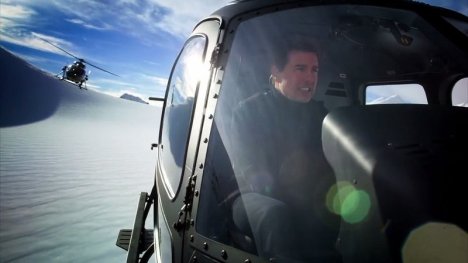
Snow escape.

While all of these elements work well, with the bathroom brawl in particular serving as a worth addition to the franchise’s set piece canon, the final act of Fallout is a masterclass in blockbuster film-making. It is a genuinely dizzying piece of spectacle, a soaring accomplishment that manages to ratchet up the suspense for the better part of forty minutes, making excellent use of an ensemble in close geographic proximity but in very different situations. McQuarrie skilfully understands the rhythm and the tempo of the scene, crosscutting beautifully between the various strands to sustain the tension.

Fallout is not the best film in the Mission: Impossible franchise; it isn’t quite the all-rounder that Mission: Impossible III was, and it lacks the gleefully demented sustained adrenaline rush of Mission: Impossible – Ghost Protocol. However, it is a testament to the remarkable and sustained quality of the franchise, and the best movie of the summer to this point.

Just dive right in…

Continue reading

Non-Review Review: The Fast and the Furious

I’m rewatching The Fast and the Furious for a separate project, as solidarity with fellow film critic Jay Coyle for his “Cinema of Experience” project to look at the changing face of cinema in the twenty-first century. He’ll be writing up his account of how the experience of watching movies has changed in the past twenty-or-so years, but I found my rewatch of The Fast and the Furious interesting enough to write a longer-form review of it.

The Fast and the Furious is a curious piece of work, especially in the light of everything that followed.

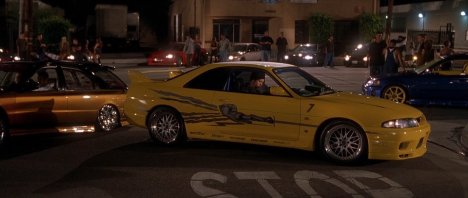
From the opening scene through to the climactic setpiece, The Fast and the Furious is very much framed as an urban western, a tale of conflicted masculinity within an urban wasteland that might as well be lawless. Street racers serve as traffic cops at one point, blocking civilian cars from the predetermined race track without any interference from actual law enforcement. Towards the end, Dom Torreto seeks to evade the law by outrunning a train to a train crossing, one of the classic high-stakes western set pieces.

More than that, the introduction of Dom Torreto in The Fast and the Furious is very much meant to evoke the introduction of a western protagonist. He is first seen from obscured angles, glimpsed from behind and through a wire mesh. His presence is felt at a distance, an island of calm in a chaotic world. Torreto is introduced as an outlaw who seeks peace in a world that is constantly at war. This is perhaps a canny approach from a scripting and directorial perspective, acknowledging Vin Deisel’s strengths as a screen presence. Torreto’s first act is to break up a street fight outside the little restaurant stall operated by his sister.

Released in June 2001, The Fast and the Furious is one of the last action films of the nineties. It is a snapshot of a nation still paranoid about street gangs and boy racers, of urban decay and social collapse, of the apocalyptic notion that Los Angeles is the final frontier of the nation’s westward expansion. Explored in hindsight, these were perhaps more innocent times.

Continue reading

New Podcast! The X-Cast – Stefan Petrucha on The X-Files Topps Comics (Season 2 & 3)

This was fun.

I occasionally guest on The X-Cast with Tony Black, discussing The X-Files. I’ve been very proud to be part of the show’s discussion of individual episodes and also to participate in its ambitious beginning-to-end podwatch. However, this episode is particularly exciting for me, because it’s an interview that I managed to organise with Stefan Petrucha.

Petrucha was the first writer to work on the X-Files tie-in comic books published by Topps, and he wrote the book through the second half of the second season and through most of the third, before departing the book. Working with artist Charles Adlard, Petrucha crafted some of the most ambitious and most exciting tie-in comics ever. Highlights include A Dismembrance of Things Past, Silent Cities of the Mind, Feelings of Unreality, Falling and Home of the Brave.

These were stories that were very much in the mould of what was being published by writers like Grant Morrison and Neil Gaiman over at the Vertigo imprint at DC comics around the same time, bold and ambitious narratives tackling big existential ideas within a genre framework. In some ways, the comic seemed to signal where the series would go in its fourth year; trepanning, militias, existential questions about overlapping realities.

I’m very happy with the interview, and very thankful for Stefan’s generosity with his time. You can check it out here, click the link below, or just play it from this post.

Continue reading

Non-Review Review: Searching…

Searching… is an interesting fusion. It blends the innovative narrative style of Unfriended with the more convention cinematic language of thrillers like Kiss the Girls.

This cocktail is at once welcome and overdue. Unfriended was one of those rare genuinely innovative pieces of mainstream cinema; in form, if not necessarily in function. Unfriended built from a premise that was both incredibly simple and also formally daring, telling a fairly standard supernatural teenage revenge story entirely through a computer desktop. As with Searching…, all of Unfriended unfolded within a computer screen.

Windows ’95 into the soul…

In hindsight, it is surprising that it has taken other genres so long to embrace that formal experiment. Cinema has a long history of eagerly coopting the language and experiments of horror for more prestigious and high-brow fare. Consider, for example, how quickly other genres coopted the “found footage” revolution of the early twenty-first century for action movies, thrillers, comedies, and even monster movies and superhero films. (Then again, that embrace of the “found footage” aesthetic may have caught on for reasons beyond the success of The Blair Witch Project.)

Searching… takes the basic formal conceit of Unfriended and applies it to a more conventional genre film. The result is an abduction thriller told exclusively through screens, through video streams, search histories, web cameras and screenshots. It’s a provocative premise, effectively turning the bigger screen into a smaller one and changing the rules of how the audience processes the imagery in front of them. However, Searching… clearly aspires to bridge the gap between screens big and small.

She needs to screen her fans better.

Continue reading

Star Trek: Voyager – Life Line (Review)

Life Line brings Star Trek: Voyager‘s daddy issues to the fore.

Voyager always existed in the shadow of Star Trek: The Next Generation, never quite breaking free in the way that Star Trek: Deep Space Nine managed to do. Voyager always felt shaped by and indebted to The Next Generation, always longing to affirm its heritage. Barclay appeared in Projections. Riker made a cameo in Death Wish. Geordi popped up in Timeless. Deanna Troi paid a visit in Pathfinder. The Ferengi from The Price popped up in False Profits. Q was a recurring character. The Borg were a recurring threat.

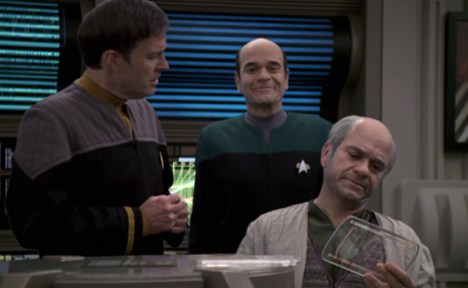
All my holo-children.

Voyager always saw itself as the spiritual successor to The Next Generation, the rightful heir to what was at the time the crown jewel in this iconic science-fiction franchise. However, this aspiration was not borne out in any quantifiable sense. The reviews for Voyager were decidedly more guarded than they had been for The Next Generation. The ratings were appreciably lower. The cultural impact was greatly diminished. If Voyager had positioned itself as the next in line to the throne, it was a disappointment by any measure.

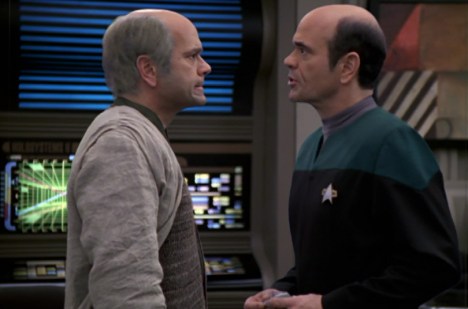
The sixth season of Voyager is keenly focused on the idea of memory and legacy. It often feels like the series is reflecting on its legacy, cognisant of the fact that the end is rapidly approaching. Indeed, this preoccupation with mortality plays out even within Life Line, which is an episodes that finds the EMH journeying back to the Alpha Quadrant in order to save the life of his dying creator. Doctor Lewis Zimmerman was a pioneer when Voyager launched almost six years earlier; now, he is a bitter and disillusioned old man wasting away in seclusion.

Father yet to go.

There is something very pointed in this, in the idea of a son returning home to a dying father, to be met with disappointment and disdain. There is a funereal tone running through sixth season episodes like Barge of the Dead, Dragon’s Teeth, One Small Step, Blink of an Eye, Muse and Fury. It feels like Voyager is confronting the fact that it has declined over the slow withering death of the larger Star Trek franchise. The end is near, and Voyager has presided over it. Fury went so far as to request a do-over on the entire run of the series, resetting six years of continuity.

Life Line touches on these ideas, allowing one member of the regular cast to journey home and to try to make peace with a deeply disappointed father figure.

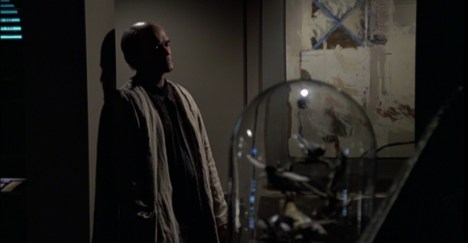
Creator hate.

Continue reading

88. Back to the Future (#44)

Hosted by Andrew Quinn and Darren Mooney, and this week with special guest Kieran Gillen, The 250 is a (mostly) weekly trip through some of the best (and worst) movies ever made, as voted for by Internet Movie Database Users. New episodes are released every Saturday at 6pm GMT, with the occasional bonus episode thrown in.

This time, Robert Zemeckis’ Back to the Future.

Marty McFly is just a regular teenager, until he finds himself thrown back in time to the mid-fifties. Accidentally disrupting the first meeting of his parents, Marty must reunite their teenage selves before he is erased from existence.

At time of recording, it was ranked the 44th best movie of all-time on the Internet Movie Database.

Continue reading

Non-Review Review: Skyscraper

Hollywood never really gives up on a genre that it loves, even when it might appear that the audience has moved on.

The perpetual reinvention of the western is one example, a genre that is constantly updated in terms of style and substance to reflect the times. The western has been reinvented and reimagined countless times over the past few decades, whether by combining it with other genres or by examining its underlying assumptions. The western survives in movies like The Hateful EightThe RevenantBone Tomahawk; films that are very clearly westerns even if audiences from the genre’s peak would struggle to recognise them.

Hanging on in there.

Disaster films are another example of Hollywood’s perpetual reinvention of a genre that has fallen out of style. While by no means as ubiquitous as they once were, disaster films still pop up from time to time. The attempts to update the disaster film often take the form of hybridisation, of tying the trappings of the genre into a more marketable template. In the nineties, Independence Day cleverly wed the disaster movie to an alien invasion narrative. More recently, Patriots’ Day tied the structure and rhythms of the disaster movie into a counter-terrorism epic.

Skyscraper hits upon what might be the ultimate genre fusion for the disaster movie template. At the very least, it feels like an inevitable hybrid in the modern cinematic climate. At its core, Skyscraper essentially asks… “what if a disaster movie, but also a superhero film?

The bed Rock of a stable marriage.

Continue reading

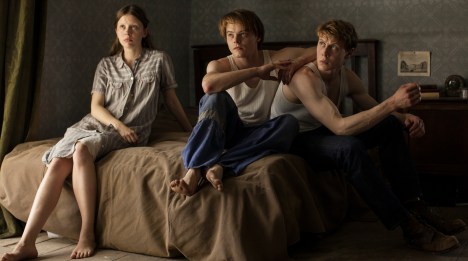
Non-Review Review: The Secret of Marrowbone

The Secret of Marrowbone is an interesting premise, albeit one told in the clumsiest manner possible.

The basic story is sound. The film has all the trappings of a gothic eastern seaboard horror, even borrowing several of its cues from the work of Edgar Allan Poe. There is a secretive family living in a rundown house, with a dark secret involving betrayal and violence. The central family, with the delightfully gothic name of “Marrowbone” have journeyed from England to the United States in the hope of a clean break, a fresh start. “No more memories,” the characters repeatedly assure one another. However, this is a ghost story. What are ghost stories but stories about memory?

Putting their secrets to bed.

However, the execution is severely underwhelming. The Secret of Marrowbone is a film with an incredibly tonal dissonance. Writer and director Sergio G. Sánchez veers wildly from gothic Jungian horror to exaggerated fifties melodrama and back again, the whiplash heightened by Fernando Velázquez’s heavy-handed score and Xavi Giménez’s inconsitantly saturated cinematography. The Secret of Marrowbone is half a semi-competent horror movie and half an overwrought trashy soap opera, neither element meshing cleanly with the other.

The result is dizzying and disorienting, but probably not in the way that Sánchez intended.

All Jacked up with nowhere to go.

Continue reading