• Following Us

  • Categories

  • Check out the Archives


  • Awards & Nominations

Harsh Realm (Review)

This November, we’re taking a trip back in time to review the seventh season of The X-Files and the first (and only) season of Harsh Realm.

Harsh Realm seems destined to be a curiosity in the career of Chris Carter.

Sure, other projects would fail. Millennium had lasted three seasons, but its audience had been in decline since the second episode was broadcast. The Lone Gunmen would fold after only half a season. However, nothing was quite as sudden and brutal as the failure of Harsh Realm. The show did not even make it to half a season. It was cancelled by the network during the production of its ninth episode, after only three episodes had aired. The six unaired episodes were shunted over to FX, where they could be broadcast away from the media spotlight.

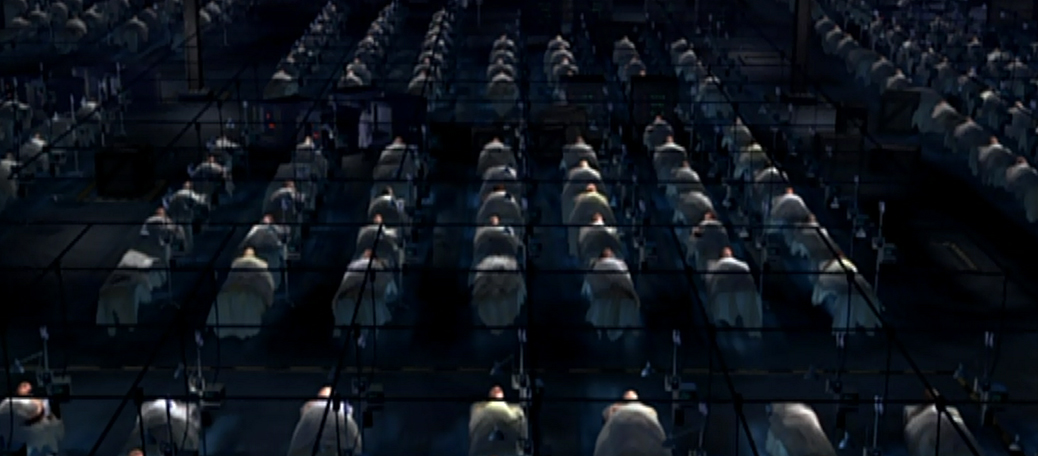
harshrealm-pilot34

This might not have been such a big deal if it wasn’t the first project developed by Chris Carter as part of his new contract at Fox, if it hadn’t been hyped up and analysed and debated. Harsh Realm was one of the most talked about new dramatic shows of 1999, and so its death was not a quiet or dignified affair. The cancellation became something of a public spectacle. Most of the attention fell on Fox Chief of Programming Doug Herzog, who seemed to be out of his depth running a major network.

Inevitably, though, some of the attention was focused on Chris Carter. Harsh Realm was a spectacular commercial failure for Carter, and one which raised questions about whether Carter and his production team were ready to face the twenty-first century.

harshrealm-leviathan5

Continue reading

The X-Files – Requiem (Review)

This September, we’re taking a trip back in time to review the seventh season of The X-Files and the first (and only) season of Harsh Realm.

As with a lot of the seventh season, Requiem is an oddity.

It is an episode that exists in a weird limbo state, carefully designed and calibrated so that it might serve two – if not three – very different purposes. Requiem was written and filmed at a point where nobody knew what was going to happen next. Requiem could have been either a season or a series finalé; it could have been the last episode of the seventh season, the last episode of the series before the launch of a movie franchise, or even just the last episode ever. That is a lot of weight to put on a single episode.

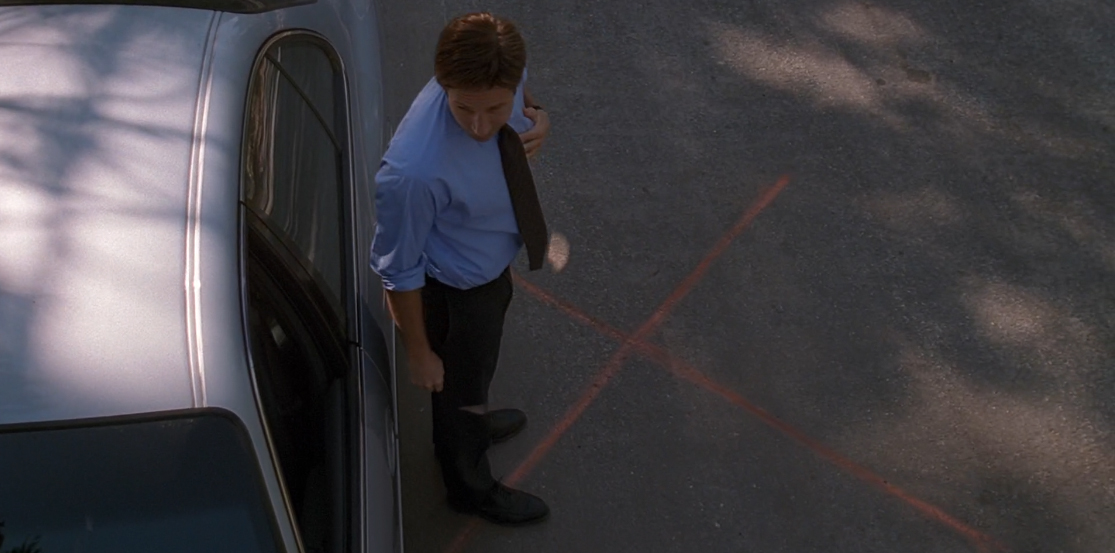
"X" marks the spot where it all began...

“X” marks the spot where it all began…

In essence, Requiem existed in a state of ambiguity and flux. It was never entirely sure what Requiem would be when Chris Carter wrote it or when Kim Manners directed it. Requiem had to be designed to be fluid and malleable; it had to support any context that might be heaped upon it in the editing suite or on broadcast. Stories like Jose Chung’s “From Outer Space” and Bad Blood had explored the blurred boundaries of reality and perception; Requiem is perhaps that idea applied to the show itself.

Chris Carter could tell you what happened in Requiem as it went through production. He could explain plot details and character motivation; he could outline the chain of events that bind Requiem together. However, it was impossible for anybody working on Requiem to actually assert what the episode was until three days before the episode aired. Until that point, Requiem was a shadow or a blur, just waiting for some larger context to bring it into proper focus.

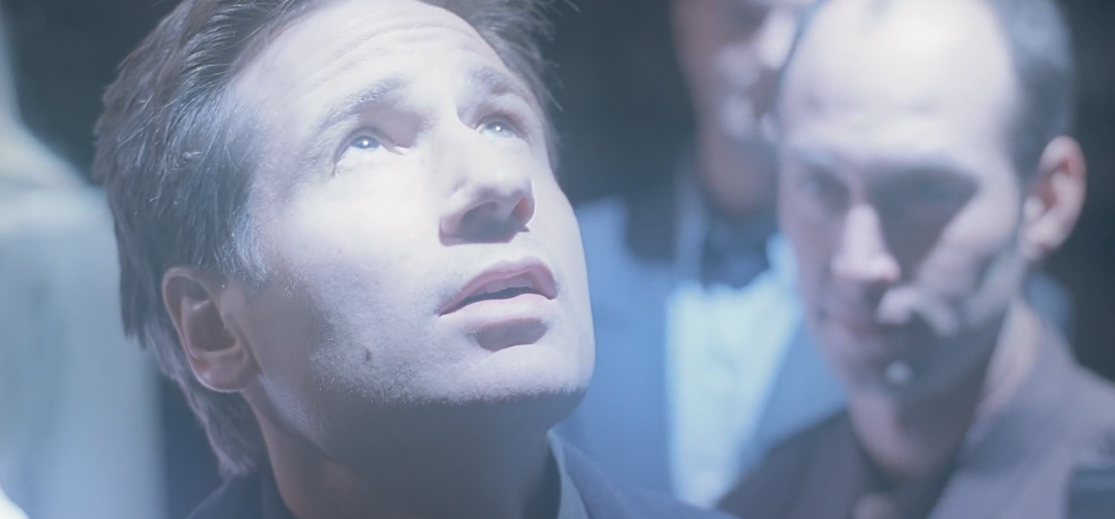
Things are looking up...

Things are looking up…

Continue reading

Non-Review Review: Mississippi Grind

Mississippi Grind is an intimate and thoughtful character study, featuring two superb central performances from Ben Mendelsohn and Ryan Reynolds. Written and directed by the team of Anna Boden and Ryan Fleck, Mississippi Grind finds two gamblers winding their way down the eponymous river in the hopes of winning big at a poker game in New Orleans. “Like Huck Finn,” compulsive gambler Gerry insists when the idea first comes to him. It seems an appropriate comparison, given the themes of the film.

Never pushing its meditations on the American Dream too hard, and never labouring its points too heavily, Mississippi Grind achieves an honesty that borders on the profound. More than that, it captures both the romance and the desperation of that one last bet – the inability to settle for “enough” and the insistence that there is always everything to be won, even if it means that everything can be lost.

Meet me in St. Louis...

Meet me in St. Louis…

Continue reading

Harsh Realm – Camera Obscura (Review)

This November, we’re taking a trip back in time to review the seventh season of The X-Files and the first (and only) season of Harsh Realm.

And so, with Camera Obscura, it seems that Harsh Realm comes to an end

The show had been developed as a television series for the new millennium; all involved had great plans for it. Fox had made no secret of the fact that they planned for Harsh Realm to take pride of place in their schedule going forward. The assumption was that it would replace The X-Files after that juggernaut was retired. There was a lot of hype around the development, a lot of excitement about the new show from producer Chris Carter. Harsh Realm was to be the first of many new shows developed by the producer as part of a highly lucrative contract with Fox.

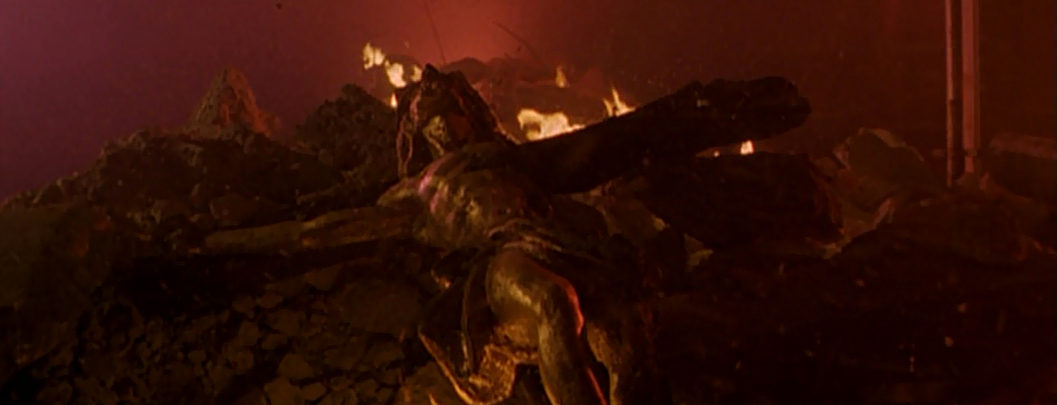
Burning down the House (of God)...

Burning down the House (of God)…

Sadly, it did not work out that way. Harsh Realm had premiered to low ratings. Fox shuffled it off the schedule after only three episodes, which seemed a knee-jerk response given the talent involved in the show’s production. The six remaining episodes were locked away from the light of day, relegated to premiering on FX at the tail end of that season of television. For all that everybody involved had hoped that Harsh Realm would be a breakout hit, it ended up little more than a footnote.

Here, it dies. After nine episodes aired across two channels over seven months, the curtain comes down on Harsh Realm. It ends not with a bang, but a whimper.

Time for reflection...

Time for reflection…

Continue reading

Doctor Who: Before the Flood (Review)

“Prentis! He’s alive.”

“No, he’s just not dead yet.”

– Bennett and the Doctor understand how this whole base under siege thing works

There is an argument to be made that Before the Flood is just too damn clever for its own good.

Under the Lake was a very conventional and familiar “base under siege” story, the kind of tense confined thriller that Doctor Who did so well. However, Before the Flood does more than simply extend that premise by another forty-five minutes. Instead, it gets decidedly playful. This is a nice twist on the structure of the season, a season built around multiple interlocking two-part episodes. Taking advantage of the break between Under the Lake and Before the Flood, writer Toby Whithouse shifts the episode’s genre along with its setting.

A Fisher (King) in the face of reality itself...

A Fisher (King) in the face of reality itself…

The teaser sets the tone, with the Doctor addressing the audience directly. In fact, one suspects that google searches on the phrase “bootstrap paradox” jumped dramatically at around 8:27pm BST, 10th October 2015. Although the episode’s closing sequence suggests that the Doctor might plausibly be addressing Clara, the framing makes it quite clear that he is talking through the television to the viewers at home. As if to emphasise this little detail, the Doctor’s wailing electric guitar plays into the opening credits; in case the show needed to be more self-aware.

However, Before the Flood is never entirely sure how much of this self-awareness is genuine cleverness and just how much of it is necessary structuring.

Flood of ideas...

Flood of ideas…

Continue reading

Non-Review Review: Pan

There is something delightfully off-kilter about Pan, to the point that it seems almost surprising that it got made.

After all, Peter Pan doesn’t seem to need an origin story. All the core ingredients are included in the original stories that J.M. Barrie wrote at the start of the twentieth century, allowing generations of other writers to improvise and elaborate around a rather robust blueprint. Steven Spielberg hit on an interesting idea in theory (if not necessarily execution) in Hook, producing a sequel imagining what might happen if the boy who never grew up… actually grew up. However, there does not seem to be an equivalently interesting hook into a prequel story.

Don't be so harsh, Blackbeard...

Don’t be so harsh, Blackbeard…

Indeed, there is very little in Pan that connects it to its source material, beyond a few overlapping names and sly in-jokes. Captain Blackbeard meditates on Neverland as the realm of death, alluding to the historical context of the stories, but the film is absolutely fascinated by the concept of death in Neverland. James Hook might be taunted with a “tick tock” and dangle his hand in crocodile-infested waters, but the film has very little interesting to say about his relationship with Peter Pan beyond falling back on the trope of suggesting that they were once friends.

However, there is something fascinating about the execution of Pan. Even if the script doesn’t hold together, and the film often seems like two-hours of punk pop candy floss, there is an endearingly gonzo quality to the film that makes its complete refusal to work all the more interesting.

Sheets to the wind...

Sheets to the wind…

Continue reading

The X-Files – Je Souhaite (Review)

This September, we’re taking a trip back in time to review the seventh season of The X-Files and the first (and only) season of Harsh Realm.

The late seventh season has something of a twilight quality to it.

Even the show’s production staff are unsure whether the show will be coming back for an eighth season, so every episode takes on a special significance. Could this episode be “the last time that…”? Is Brand X the last time that the show does a traditional monster of the week? Is Hollywood A.D. the last time that David Duchovny writes and/or directs? Is Fight Club the last time that Chris Carter writes a non-mythology episode? Is Je Souhaite the last time that Mulder and Scully just investigate a weird standalone case together? There is a weight to it all.
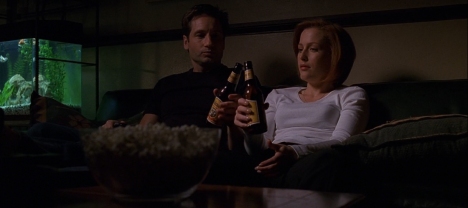
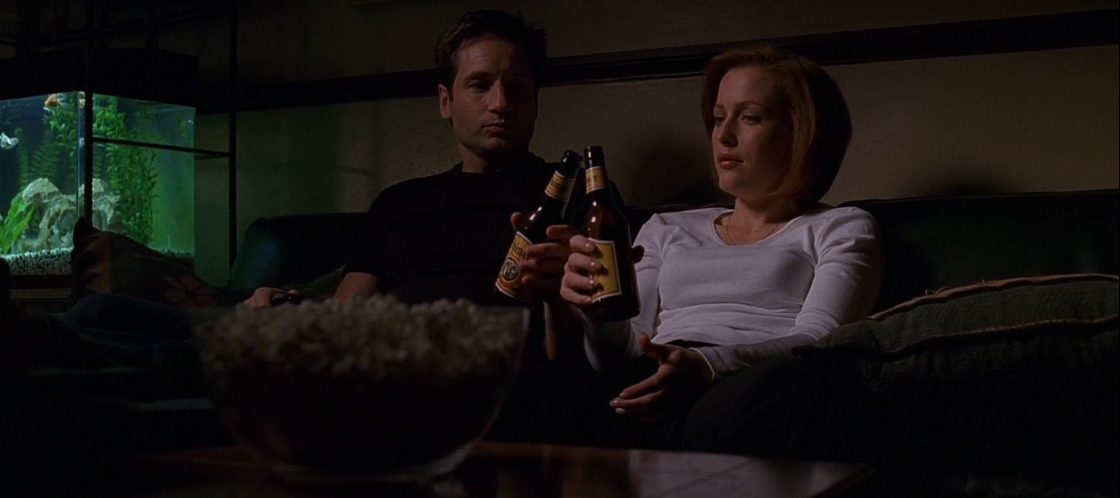
"I'll drink to that."

“I’ll drink to that.”

Of course, the show would come back for an eighth season. There would be lots of traditional monster of the week stories after Brand X. David Duchovny would enjoy another story and directorial credit after Hollywood A.D. Chris Carter would get to write non-mythology episodes after Fight Club, and even get to direct a much more successful whimsical adventure. Mulder and Scully would get to hang out together in the late eighth season and even at the very end of the ninth. In a very real way, this is not the end.

However, in an equally real way, this is the end. It has become hyperbole to suggest that something “… will never be the same again.” Even The X-Files has reinvented itself at least twice by this point, at the start of the third and sixth seasons. However, it is also perfectly reasonable to argue that The X-Files actually will never be the same again. The show changes on a very fundamental level after this point, with Je Souhaite serving as the very last glimpse of the show as it was. In many ways, this is the end of the road.
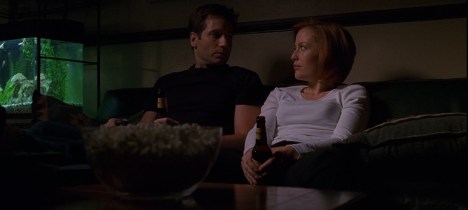
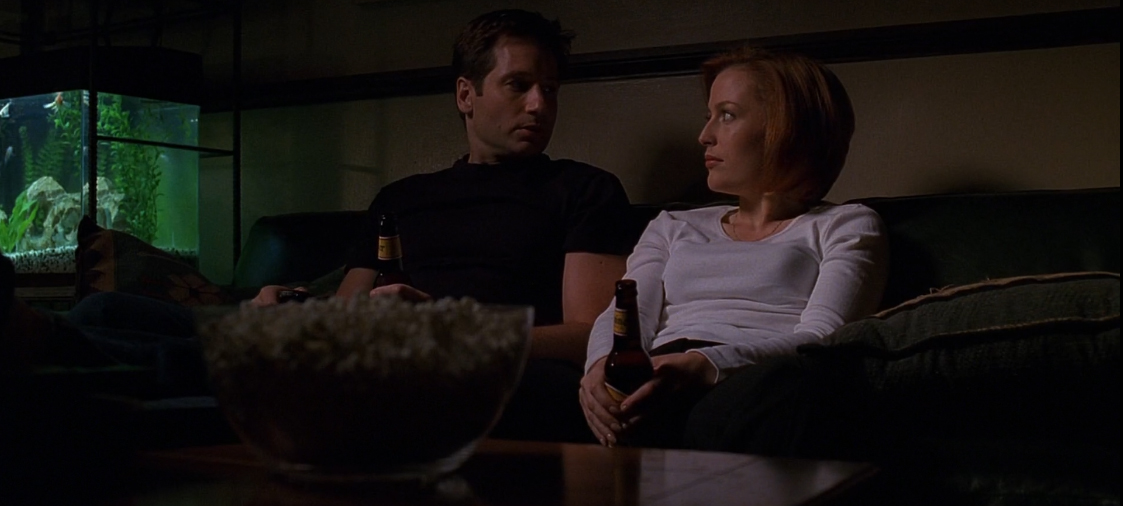
"So... meet up in about fifteen years?"

“So… meet up in about fifteen years?”

Gilligan would get to write and direct another episode of The X-Files before the show finally came to an end. In fact, there are a few thematic similarities between Je Souhaite and Sunshine Days, with both stories serving as affectionate and romantic finalés to Vince Gilligan’s version of The X-Files. There are still two full seasons ahead. Indeed, it is interesting to wonder what it would be like had Je Souhaite come earlier in the season, or even during the sixth season; it would be a light and fun episode, but would have the same heft and weight?

However, there is something different about Je Souhaite. In hindsight, it feels like a snapshot of an extended (seven-year-long) moment coming to end; it is a picture in an photo album that captures Mulder and Scully right on the edge of a transition. It is innocuous, yet profound. It is a picture of college friends sharing a drink at the end of the last term, unaware (or silently aware) of how things will change in the coming months. It is a picture of friends just hanging out before one gets married or has children.
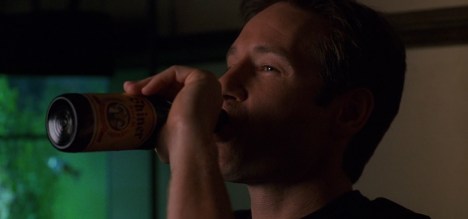
"I am outta here!"

“I am outta here!”

Of course, Mulder and Scully see each other after this point; there is the second half of season eight and the revival hanging in the future. (To say nothing of The X-Files: I Want to Believe or the comics.) College buddies still hang out. People with families maintain friendships. Still, those dynamics change. They are never quite the same. Not better, not worse. Just different. As weird as it is to describe an episode where Mulder encounters a genie as “the point before things got weird”, that’s exactly what Je Souhaite feels like.

What is most striking about Je Souhaite is how much the episode accepts that reality. It is not morose or melancholy; it is practically celebratory. Instead of eulogising the good times, it decides to have a good time. There is something very sweet about that.
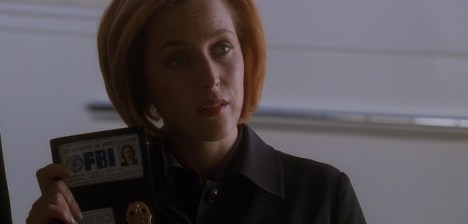
"I'm still here for two seasons..."

“I’m still here for two seasons…”

Continue reading

Non-Review Review: Macbeth

Justin Kurzel understands Macbeth.

A lot of Shakespeare’s work is viewed through the lens of cultural importance, and quite rightly. His plays codified a phenomenal amount of the English language in use today, incorporation and amalgamating words and phrases that people use without even thinking. Shakespeare codified drama and storytelling in the English language, to the point where any number of his plays can be cited as the defining example of particular styles of dramaturgy. There is no other figure who can cast such a shadow over English-language culture.

A Field in Scotland...

A Field in Scotland…

However, the tendency to treat Shakespeare’s works as priceless artefacts – an attitude engrained by the (rightful) reverence they receive and the way that they are taught in schools – is to miss the vitality and excitement of his work. Shakespeare might have endured as the defining wordsmith of the English-language, but before that he was just a really popular writer with an incredibly populist touch. His plays existed as spectacle before they became holy relics. The jokes played to the galleries packed with punters wanting both high and low culture.

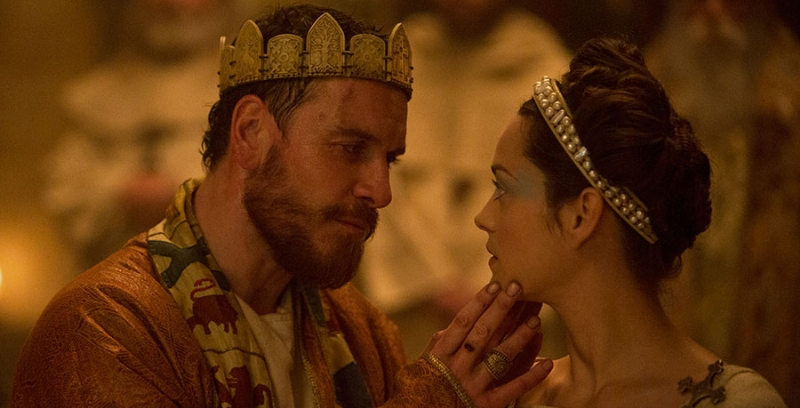
As much as Macbeth might be a searing and insightful exploration of the relationship between violence and masculine identity, it was also pure unadulterated pulp. Justin Kurzel plays up this pulpy spectacle, crafting a version of Macbeth that anchors apocalyptic horror in two amazing central performances. Macbeth is a joyous and horrific piece of cinema, brutal and beautiful in a way that befits its source material.

Oh I just can't wait to be king...

Oh I just can’t wait to be king…

Continue reading

Harsh Realm – Cincinnati (Review)

This November, we’re taking a trip back in time to review the seventh season of The X-Files and the first (and only) season of Harsh Realm.

Cincinnati finally gives Terry O’Quinn something to do.

Despite the fact that O’Quinn is credited as a series regular on Harsh Realm, he has appeared about as frequently in the first nine episodes as he did during the equivalent episodes of Millennium. With his “and…” credit at the end of the opening title sequence, it felt like O’Quinn might be forgotten by the show. His face might appear on posters and propaganda, but he was not going to play a particularly dynamic role in the events of the first season. After all, Hobbes is trying to assassinate Santiago; there are reasons why the writers would want to keep them separate.

Walk softly, but carry a big stick...

Walk softly, but carry a big stick…

Nevertheless, Cincinnati is a story that unfolds from Santiago’s perspective. Hobbes and Pinochio play a major part in unfolding events, but they largely reacting. The bulk of Cincinnati concerns a conflict between Santiago’s forces and the Native American population of Ohio. When a military strike goes horribly wrong, Santiago is forced to survive on his own terms. He infiltrates the eponymous city and sets about furthering his own agenda with ruthless efficiency.

A lot of Cincinnati is pure nonsense; the plot is barely held together by contrivance and coincidence, hinging on a final twist that manages to be both obvious and completely unearned. At the same time, it is hard to hate an episode that is carried by Terry O’Quinn and offers the actor a chance to sink his teeth into a juicy part.

It's all in ruins...

It’s all in ruins…

Continue reading

The X-Files – Fight Club (Review)

This September, we’re taking a trip back in time to review the seventh season of The X-Files and the first (and only) season of Harsh Realm.

Fight Club is an unpleasant episode of The X-Files.

It’s not “unpleasant” in a good way, like (arguably) Signs and Wonders or (definitely) Theef. It is “unpleasant” in a way that feels ill-judged and tone-deaf. Following on the charm and whimsy of Hollywood A.D., the script for Fight Club seems packed with forced charm and staged whimsy. At its most basic level, Fight Club is a comedy episode that simply isn’t funny. More than that, it’s an episode that isn’t particularly funny or clever to begin with, but then spends forty-five minutes insisting upon its own wit.

"Some of us are looking at the stars..."

“Some of us are looking at the stars…”

There is also a sense of unpleasantness about the themes and content of the episode in the context of the late seventh season. After all, it is no secret that the production team were facing considerable internal and external pressure. These pressures included a lawsuit involving the show’s lead actor and the show’s creator (not to mention the show’s network) and the fact that everybody on the production team was waiting for David Duchovny to determine if they would have a job the following season.

With all of this going on in the background, maybe an episode the implicitly features the show’s two lead actors knocking the stuffing out of each other for no good reason is not the best idea in the world.

"Hm..."

“Hm…”

Continue reading