• Following Us

  • Categories

  • Check out the Archives


  • Awards & Nominations

The X-Files – Emily (Review)

This May and June, we’re taking a trip back in time to review the fifth season of The X-Files and the second season of Millennium.

The biggest problems with Emily can be summed up in five words:

“… and then Mulder showed up.”

Sorry, Mulder.

Sorry, Mulder.

Continue reading

The X-Files: Season One (Topps) #4 – Conduit (Review)

This May and June, we’re taking a trip back in time to review the fifth season of The X-Files and the second season of Millennium.

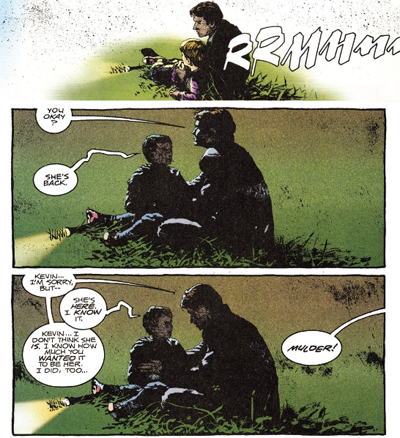
Conduit is an interesting choice for a Season One comic.

It is the last of the first season mythology episodes to be adapted by Roy Thomas as part of the Season One brand. The Pilot and Deep Throat had launched both The X-Files and the mythology, but Conduit was really the show that emphasised that The X-Files would be returning to the idea of alien abduction quite frequently in the months and years ahead. Conduit paved the way for later first season episodes like Fallen Angel or E.B.E. Neither Fallen Angel nor E.B.E. were ever adapted for the Topps Season One range. Neither was solicited when the line was cancelled.

Myth-making...

Myth-making…

At the same time, Conduit is an episode that has not dated particularly well. As the fourth episode of the first season, it was quite effective at spelling out who Mulder was and how the abduction of Samantha motivated him to do what it was that he was doing. It was not subtle or nuanced character development, but there was a certain blunt appeal to it. Viewers had only just been introduced to Fox Mulder, so it was perfectly reasonable to bludgeon them over the head with his motivation and his back story.

However, the show has marched on. Mulder has developed and grown into a multifaceted character. Samantha will always be an essential part of his character arc, but she is no longer the only motivating factor. Indeed, David Duchovny even improvised a line into Oubliette that criticised Scully for behaving like Samantha was the only motivating factor in Mulder’s life. As such, it feels strange to go back to Conduit after all this time, and to see a very basic and early take on Mulder’s character. It underscores how far the show has come.

Far afield...

Far afield…

Continue reading

The X-Files – Christmas Carol (Review)

This May and June, we’re taking a trip back in time to review the fifth season of The X-Files and the second season of Millennium.

Part of the challenge of the fourth and fifth seasons is watching The X-Files adapt the speed of its mythology.

The mythology has a very clear momentum in the first three seasons. For all that Chris Carter and his writers loved teasing out new questions, there was a clear sense of momentum and movement. The show had gone from a series about an isolated alien abduction in The Pilot to a series with a date set for the alien colonisation of Earth in Talitha Cumi. For all that the series was accused of being ambiguous and mysterious, there was a sense that it was at least going somewhere.

And so this is Christmas...

And so this is Christmas…

Things changed during the fourth season, most likely as the prospect of The X-Files: Fight the Future loomed in the future. It was clear that Fox would not allow Carter to set an end date on the television show before transitioning to feature films, and that the series would have to stretch beyond Carter’s original roadmap for it. All of a sudden, the mythology started stalling. The fourth season’s mythology had no clear direction in which to go, as evidenced by the fact that the decision to give Scully cancer in Leonard Betts was an eleventh hour decision with no long-term planning.

The fifth season’s mythology comes with its own particular set of problems. The movie had been written during the fourth season and filmed during the gap between the fourth and fifth seasons. This is quite evident in the way that the movie carries over abandoned elements of the fourth season mythology like the bees, who do not register at all in the fifth season. However, this also meant that the end point of the fifth season was essentially set in stone for the production team. The End would have to lead into Fight the Future, no matter what happened in the intervening nineteen episodes.

Picture perfect...

Picture perfect…

This means a lot of things for the fifth season. It means that the fifth season is stuck with the “Mulder as a skeptic… sort of” setup until Fight the Future, even if the show generally ignores it as much as it can. It also means that the mythology episodes probably should not contain any earth-shattering revelations or introduce any major character who were not already written into the film. Although Patient X and The Red and the Black effectively throw out these constraints almost completely, Christmas Carol and Emily try to adhere to them.

The result is a mythology episode that adheres rather closely to the successful approach adopted by Tempus Fugit and Max, a story that takes the backdrop of what the show has already revealed about the conspiracy and then uses that as a setting in which it can tell a decidedly more intimate and personal story.

It's a Scully family Christmas...

It’s a Scully family Christmas…

Continue reading

The X-Files – The Post-Modern Prometheus (Review)

This May and June, we’re taking a trip back in time to review the fifth season of The X-Files and the second season of Millennium.

The Post-Modern Prometheus is a decidedly strange little episode.

As the title suggests, it is a stunningly indulgent piece of television. Written and directed by Chris Carter, The Post-Modern Prometheus is an off-beat adventure shot in black-and-white, stylistically referencing everything from James Whale’s Frankenstein to the work of Cher to the iconic dance sequence from Risky Business. The script is chocked full of literary and cinematic references, stitching them together in a way that suggests the monster alluded to in the title of the episode.

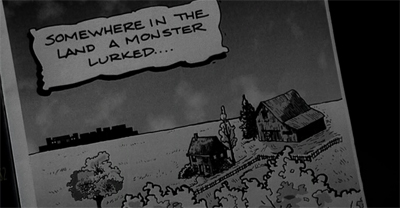
Once upon a time...

Once upon a time…

There are more than a few moments of awkwardness in the script. As with Small Potatoes, there seems something a little awkward about a comedy episode that treats a serial rapist as the jumping-off point for a wacky comedy adventure. (“This is a very serious crime,” Mulder asserts at one point, but the script never seems too bothered by it.) There is something quite knee-jerk and reactionary about how The Post-Modern Prometheus plays into the stereotype of scientific development and research as morally questionable by default.

And, yet, despite these fairly sizable problems, there is a lot to love here. It has been suggested that Carter considers The Post-Modern Prometheus as a deeply personal work – it is not hard to see why. The Post-Modern Prometheus is a story obsessed with the act of creating – whether through biological reproduction or scientific experimentation or even by way of storytelling. It is an episode engaging with a story that has long since slipped out of the control of its creator, and which is free to evolve and develop in infinite directions.

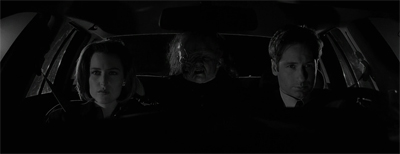
Drivin' to Memphis...

Drivin’ to Memphis…

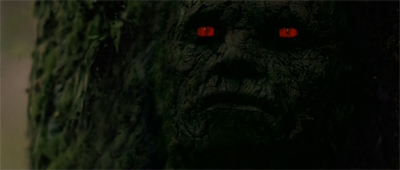
There is a joy and energy to The Post-Modern Prometheus that almost compensates for the more unpleasant aspects of the script. There is a lot of fun to be had here, whether listening to the creature singing along with Cher or simply watching Mulder and Scully dance as they provide a monster with a (literal) storybook ending. There is a sense that The Post-Modern Prometheus was written almost entirely without cynicism, an incredible celebration of Chris Carter’s own thoughts on storytelling and mythmaking.

The Post-Modern Prometheus is perhaps too deeply flawed to be the classic that it desperately wants to be, but it is a fascinating and bold piece of nineties television that demonstrates just how much enthusiasm and verve The X-Files could bring to proceedings when it wanted to.

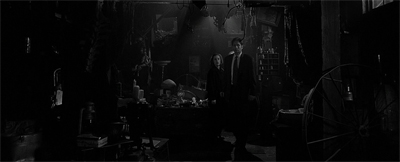
It is never a happy mob...

Basement dwellers…

Continue reading

The X-Files (Topps) #34 – Skybuster (Review)

This May and June, we’re taking a trip back in time to review the fifth season of The X-Files and the second season of Millennium.

There is an interesting divide in John Rozum’s work on The X-Files.

Half the time, it seems like Rozum is writing classic EC horror stories that just happen to feature Mulder and Scully. There are stretches of his work on the title where it seems like the stories might easily have been found in the desk drawer of some classic editor, tweaked and altered slightly so as to update them forty years, and published with the addition of Mulder and Scully. Stories like Silver Lining, Donor and Soma comfortably fit this classic pulpy horror mould. There’s nothing wrong with this approach, although it is quite striking.

Death from above!

Death from above!

When Rozum does write a story that feels particular to The X-Files, it often feels a little disconnected from the season unfolding around it. Scripts like Be Prepared, Remote Control and N.D.E. feel like they hark back to the first season of the show. The characterisation is familiar, if simplistic; shades of the mythology is present, but underdeveloped; there is a very traditional approach to big paranormal ideas like the Wendigo or “remote viewing.” It feels like these comics make a solid companion piece to the Season One comics written by Roy Thomas.

Skybuster is a pretty perfect example of this style of storytelling, offering an environmental parable about the arrogance of mankind’s tampering with nature.

Quoth the raven...

Quoth the raven…

Continue reading

The X-Files – Detour (Review)

This May and June, we’re taking a trip back in time to review the fifth season of The X-Files and the second season of Millennium.

Detour is a wonderfully traditional little episode in the middle of a somewhat eccentric season.

Although it lacks the off-kilter improvisational madness that drove much of the fourth season, the fifth season of The X-Files is a rather strange beast. With The X-Files: Fight the Future already filmed, the show was somewhat limited in what it could and couldn’t do in the fifth season – preventing the series from doing anything as dramatic as throwing Memento Mori into the middle of the run. Nevertheless, the fifth season features a variety of experimental and off-format episodes. Stephen King and William Gibson contribute scripts while Darren McGavin pops in as a guest star.

The woods are alive...

The woods are alive…

Detour was broadcast between Unusual Suspects and The Post-Modern Prometheus. Unusual Suspects was an episode headlined by the Lone Gunmen, while The Post-Modern Prometheus was broadcast in black-and-white as an homage to James Whale’s feature film adaptation of Frankenstein. As such, Detour feels like a rather conventional and old-fashioned episode, with Mulder and Scully encountering something strange in a rural setting, getting trapped in the wilderness, and encountering a monster threatened by the expansion of civilisation.

The beauty of Detour is that the episode’s decidedly traditional aesthetic feels out of place and almost novel amid all the off-format episodes surrounding it. Detour represents something of a literal detour – away from the more eccentric episodes of the season and towards something more familiar and safe. This allows Detour to have the best of both worlds – it feels at once traditional and quintessential, but also distinct from everything happening around it. Detour is a refreshingly old-fashioned episode of The X-Files, a reminder of just how much fun the show could have in its comfort zone.

Back to nature...

Back to basics…

Continue reading

Millennium – Jose Chung’s “Doomsday Defense” (Review)

This May and June, we’re taking a trip back in time to review the fifth season of The X-Files and the second season of Millennium.

Well, all’s well that ends well. Though that’s easy for Shakespeare to say – he’ll be around for another millennium. But what of our own millennium? Will it all end well? No one of course can know, but that of course doesn’t stop anyone from guessing. And the nature of these predictions always revolve around the usual suspects: salvation and/or self–satisfaction. With that in mind, I humbly add my own prophecy of what the dawn of the new millennium shall bring forth: one thousand more years of the same, old crap.

– Jose Chung

The write stuff...

The write stuff…

Continue reading

Non-Review Review: Tomorrowland

Tomorrowland encapsulates a number of recurring themes in American mainstream science-fiction,

In many respects, it harks to sixties utopianism. Tomorrowland positions itself as a spiritual companion piece to films like Star Trek or X-Men: First Class or Interstellar. Although most of the film is set in the present day, its retro futurism is firmly anchored fifty years in the past. An early flashback takes place in the 1964 World’s Fair. Space flight is explicitly described as the “new frontier”, recalling Kennedy’s famous speech. Tomorrowland is absolutely fascinated with the idea of organised space flight as a beacon calling mankind forward.

Field of dreams...

Field of dreams…

It almost seems like, to paraphrase George W. Bush, “The future was better yesterday.” There is a paradoxical nostalgia to Tomorrowland, which feels like a desperate plea for the modern generation to abandon their own visions of the future and embrace those of their predecessors. It is a fascinating conflict at the heart of the film, and not necessarily one that writer Brad Bird and Damon Lindelof comfortably resolve. There are aspects of Tomorrowland that do feel distinctly uncomfortable and contradictory.

At the same time, it feels like a genuine and heartfelt criticism of the tendency towards the apocalyptic in mainstream fiction – an impassioned and aggressive urge to embrace a more hopeful and optimistic future. Tomorrowland has its heart in the right place, but it occasionally gets a little lost.

Going against the grain...

Going against the grain…

Continue reading

The X-Files: Season One (Topps) #3 – Squeeze (Review)

This May and June, we’re taking a trip back in time to review the fifth season of The X-Files and the second season of Millennium.

There is an argument to be made that this is the perfect time to feel all nostalgic. The X-Files is one of the biggest shows on television, sitting just outside the top ten as it entered its fifth season. The climax of the fourth season generated a national conversation, something that very few season-ending cliffhangers can do. The X-Files: Fight the Future was filmed in the summer of 1997 and primed for release in the summer of 1998. If there was ever a time to look backwards and dig into the show’s history, this is it. However, Season One feels like a flawed exercise.

There are a lot of problems here that contribute to the sense that Season One is not everything that it could be; the price is a little too high, there’s no new content to justify the nostalgia, and the show was becoming more easily available on home media as Season One was being released. The relaxed release schedule meant that Season One (and, presumably, any follow-ups) would never keep pace with the show, let alone catch up. At nine issues a year, the comic would fall further behind the show, even allowing for the decision to cherry-pick episodes.

In a tight spot...

In a tight spot…

However, the adaptation of Squeeze demonstrates perhaps the biggest problem with the Season One line. While writer Roy Thomas was working from Glen Morgan and James Wong’s original script for Squeeze, and artist Val Mayerick can reference the finished episode, there is undeniably something missing from this adaptation. There is some part of Squeeze that is not replicable in the classic four-colour design, a vital part of The X-Files that seems lost in translation and seems to identify Season One as an inferior imitation.

Quite simply, Season One does not have access to David Duchovny and Gillian Anderson.

Closing in to seal your Tooms...

Closing in to seal your Tooms…

Continue reading

The X-Files – Unusual Suspects (Review)

This May and June, we’re taking a trip back in time to review the fifth season of The X-Files and the second season of Millennium.

On the surface, Unusual Suspects looks like quite a clean little episode.

It is an obvious production save – a story thrown together when it became clear that David Duchnovny and Gillian Anderson’s commitments to The X-Files: Fight the Future meant that they would not be available to film even the shortened order of twenty episodes in the fifth season. Although Unusual Suspects aired as the third episode of the season, it was actually the first produced. With limited availability to David Duchovny, Unusual Suspects was constructed as an episode that could be built around a member (or members) of the supporting cast.
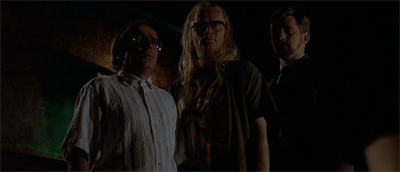
Hero shot!

Hero shot!

Five seasons in, this is not a radical concept. While Mulder and Scully are still very much the heart of the show, the supporting cast has been developed to the point where the show can turn over an episode to somebody who isn’t Mulder or Scully. The fourth season offered a glimpse of the (possible) secret history of the Cigarette-Smoking Man in Musings of a Cigarette-Smoking Man and allowed Walter Skinner to act out his own morality play in Zero Sum. After these two characters, the Lone Gunmen were likely candidates for their own episode.

As such, Unusual Suspects also works quite well as “ground zero” for the eventual development of The Lone Gunmen during the eighth season of The X-Files. It is the episode that demonstrated that the trio could carry their own story with their eccentric little dynamic, while still being engaging and exciting. Given how The Lone Gunmen turned out, a particularly cynical commentator might suggest that Unusual Suspects very much over-sold the appeal. Nevertheless, Unusual Suspects is a logical and clear step forward in the evolution of the Lone Gunman.
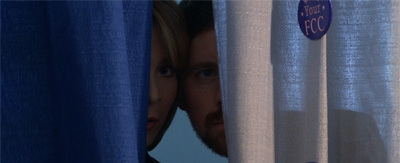
Peering through the curtain...

Peering through the curtain…

And yet, for all that these are the aspects of Unusual Suspects that generate discussion and debate, they are not the heart of the episode. What is most interesting about Unusual Suspects is the way that it allows writer Vince Gilligan to brush up against the show’s central mythology, albeit only fleetingly. Gilligan is fond of arguing that Memento Mori was his only credit on a mythology episode, but that sells Unusual Suspects rather short. Although it does not dabble directly with “black oil” or “alien bounty hunters”, it does allow Gilligan to play with the show’s big central story thread.

Unusual Suspects is not just positioned by Gilligan as the “secret origin” of the Lone Gunmen. The episode is decidedly more ambitious than all that. Without directly acknowledging it, and without explicitly coming out and saying it, Unusual Suspects presents itself as the roots of the show itself. Although nowhere near as boldly and triumphantly subversive as Jose Chung’s “From Outer Space” or Musings of a Cigarette-Smoking Man, the episode allows Gilligan to offer his own sly (and slightly stinging) commentary on the show’s central mythology.

Tonight we're gonna party like it's 1989.

Tonight we’re gonna party like it’s 1989.

Continue reading