• Following Us

  • Categories

  • Check out the Archives


  • Awards & Nominations

Non-Review Review: Brick Mansions

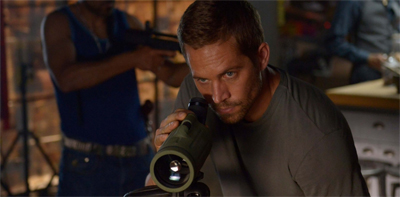
Brick Mansions is an incredibly stupid film. It’s a movie that doesn’t make any real sense. It hinges on a series of set-ups and reversals that don’t even hold together while watching the movie. Anybody expecting an action movie that makes any semblance of sense is probably best advised to look elsewhere. And yet, despite this, there’s a point where the sheer unrelenting absurdity of Brick Mansions becomes fun in a grindhouse “this is probably great fun at 2am” sort of way.

At its heart, Brick Mansions feels like a throwback to a very particular style of eighties science-fiction cinema. It’s an action movie with the faintest trace of a social conscience that really exists just to justify ridiculous plot developments and excuse a central story that makes absolutely no sense. Lacking the awareness or intelligence that defined the best of the socially-conscious eighties science-fiction action films, Brick Mansions feels a lot like the kind of guilty pleasure that eats up the airwaves at the most unsocial broadcast hours.

You don't need that to make out the plot holes...

You don’t need that to make out the plot holes…

Continue reading

Todd McFarlane’s Run on Spider-Man (Review/Retrospective)

This April, to celebrate the release of The Amazing Spider-Man 2, we are taking a look at some classic and modern comics featuring Spider-Man (and friends). Check back daily for the latest review.

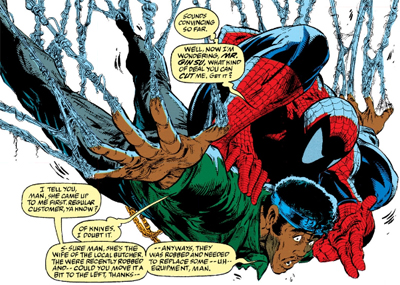
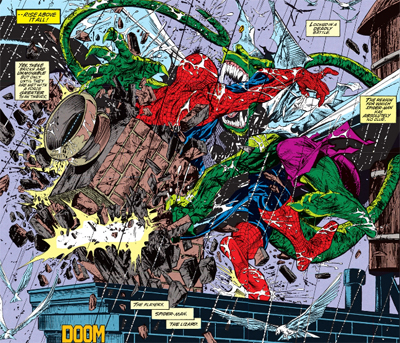
Todd McFarlane is undoubtedly one of the best artists ever to work on Spider-Man. His take on the character is iconic and influential. He really captures the sense of Spider-Man as a character who should be unnerving or disturbing – a character who is part insect, whose limbs are able to bend and contort in ways that would seem unnatural to a casual observer. His run on The Amazing Spider-Man with writer David Michelinie is one of the most underrated Spider-Man comics ever produced.

McFarlane was working at Marvel around the time that the company was investing more power in its artists. More and more, artists were becoming more essential to the creative process – whether credited as “plotters” or “writers.” Jim Lee was wresting control of the X-Men franchise from veteran writer Chris Claremont. Rob Liefeld was writing and drawing on his popular X-Force, launched from New Mutants.

Holding it together...

Holding it together…

In this context, it made sense to allow Todd McFarlane to branch out and write his own Spider-Man title. Launched to run alongside The Amazing Spider-Man, McFarlane’s adjectiveless Spider-Man remains one of the comic book success stories of the nineties, selling 2.5 million copied on initial release. It remains one of the best selling comic books of all time, with the original artwork recently selling for over $675,000.

As with many of its contemporary artist-drive series, McFarlane’s Spider-Man is a compelling read. It’s a glimpse inside the mindset of the comic book industry, a snapshot of trends that were still developing. McFarlane’s writing might be a little over-cooked, his plotting a little weak and he may not have the strongest sense of theme or structure. However, McFarlane’s artwork is absolutely spectacular, and there’s something very fascinating about McFarlane’s attempt to write Spider-Man as a horror comic starring the iconic web-slinger.

A sting in the tale...

A sting in the tale…

Continue reading

Non-Review Review: Pompeii

Pompeii is a cliché love story nested inside a cheesy b-movie sitting inside a good old-fashioned disaster movie. None of these elements are entirely successful – in fact, there are points where the love story is downright painful – but Paul W.S. Anderson manages to construct a reliably pulpy (if entirely predictable) action adventure. While by no means exceptional – it’s a mess from both a plotting and a thematic perspective – Pompeii does look as sound quite nice. As with a lot of Anderson’s films, there’s a sense that the director is more interested in his action sequences than the characters trapped inside them.

Setting the town alight...

Setting the town alight…

Continue reading

Spider-Man: Chapter One (Review/Retrospective)

This April, to celebrate the release of The Amazing Spider-Man 2, we are taking a look at some classic and modern comics featuring Spider-Man (and friends). Check back daily for the latest review.

Spider-Man: Chapter One is a strange little comic. In context, it makes a great deal of sense. Spider-Man has always been one of Marvel’s most popular and iconic comic book heroes. In the late nineties, the comic book industry was trying to figure out how to push forward, following the sales explosion and implosion of the mid-nineties. With superheroes like Spider-Man and the X-Men primed for a transition to the big screen, revisiting the early days of these heroes made a great deal of sense.

And John Byrne was the logical choice for a book like this. Byrne was a unique talent. He had enjoyed incredibly successful runs on Uncanny X-Men and The Fantastic Four at Marvel. More than that, though, he had already overseen the successful relaunch of another classic character. In the wake of DC’s universe-altering line-wide Crisis on Infinite Earths, John Byrne had been the writer who re-drafted Superman’s origin as part of the Man of Steel miniseries in 1986.

Boundless enthusiasm...

Boundless enthusiasm…

And so, Marvel gave us Spider-Man: Chapter One. The comic was a reimagining of the earliest days of the wall-crawling superhero, spanning thirteen issues and covering many of the character’s earliest encounters with his classic foes. John Byrne was writing the script and providing the artwork for the comics, which seemed primed to introduced Spider-Man to a whole new generation of readers, giving audiences a back-to-basics take on Spider-Man that was fresh and accessible.

At least, that was the idea. In actuality, Spider-Man: Chapter One feels like a massive miscalculation on just about everybody’s part. It seems to be aiming for some middle ground between Kurt Busiek and Pat Olliffe’s contemporary Untold Tales of Spider-Man and Brian Michael Bendis’ pending Ultimate Spider-Man. It seems like Byrne is never sure whether he’s simply re-telling the classic Stan Lee and Steve Ditko run on The Amazing Spider-Man with a few bells and whistles, or trying to make it his own.

You are about to enter... the Spidey zone...

You are about to enter… the Spidey zone…

Continue reading

Non-Review Review: The Amazing Spider-Man II

What is remarkable about Marc Webb’s The Amazing Spider-Man II is how much it resembles a comic book. Not a particular comic book – although there are numerous shout-outs to iconic Spider-Man moments, right down to the choice of costuming – but in general terms. It isn’t that Marc Webb tries to construct his film to evoke the look and feel of a comic book – this isn’t Ang Lee’s Hulk; in fact, Webb seems much more comfortable here than he was with The Amazing Spider-Man, making a movie that feels more playful and relaxed within its medium.

Instead, The Amazing Spider-Man II borrows the structure of a comic book. It offers its own story, but that story isn’t constructed particularly tightly. Instead, the story seems to have been fashioned as part of a greater – as if part of a larger serialised narrative that has yet to take form. It’s quite distinct from the approach taken with Marvel’s Cinematic Universe, where the films feel more like blocks that fit together. Instead, this feels more like the second chapter in a larger story, without being dissolved completely into the larger narrative.

The Amazing Spider-Man II has its own themes and motifs, and it documents a pretty epic selection of events, but the emphasis isn’t so much on this one encounter as what this encounter says about its hero. It’s much more interested in what these events tell us about our hero than it is in documenting a single self-contained story. It’s a novel (and somewhat bold) attempt at a serialised superhero narrative, and the results are absolutely fascinating.

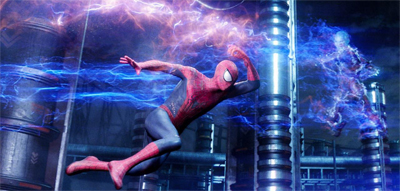
Electro-fying!

Electro-fying!

Note: This is a spoiler-filled review of The Amazing Spider-Man II. You can find a spoiler-lite version here. Continue reading for more in-depth thoughts on the film, with the knowledge that absolutely everything is up for discussion. Continue at your own peril!

Continue reading

Spider-Men (Review/Retrospective)

This April, to celebrate the release of The Amazing Spider-Man 2, we are taking a look at some classic and modern comics featuring Spider-Man (and friends). Check back daily for the latest review.

Spider-Men feels very light. It is the first official crossover between the mainstream Marvel Universe and the Ultimate Universe, something that readers had been promised would never happen. However, despite the fact that this is a big event that has been more than a decade in the making – something rumoured since the earliest days of Ultimate Spider-Man – Spider-Men feels decidedly low-key.

It’s pretty much a collection of vignettes rather than a compelling story in its own right, allowing Bendis to run through a checklist of material to smooth the transition between ultimate!Peter Parker and his successor, Miles Morales.

"Well, this is awkward..."

“Well, this is awkward…”

Continue reading

Mark Waid, Chris Samnee, Paolo Rivera et al’s Run on Daredevil (Vol. 3) (Review/Retrospective)

This April, to celebrate the release of The Amazing Spider-Man 2, we are taking a look at some classic and modern comics featuring Spider-Man (and friends). Check back daily for the latest review.

Daredevil had been one of the most consistently reliable books at a major comic book publisher over the last decade or so. Under creative teams from Kevin Smith to David Mack to Brian Michael Bendis to Ed Brubaker, the gritty street level superhero has enduring a whole host of twists and shifts that have made the book a compelling read. Indeed, the only real problem with the run was that Andy Diggle couldn’t quite stick the landing and so we ended up closing out that incredibly run with a bland and generic crossover like Shadowland.

Still, Daredevil remains an exciting book – a comic that affords the writers and artists a bit more freedom than they’d enjoy working on a more high-profile or major character. When Spider-Man’s identity was revealed by J. Michael Straczynski during Civil War, the publisher almost immediately hit a reset button in the form of One More Day to tidy up everything. When Brian Michael Bendis revealed Matthew Murdock’s secret identity to the world, there was no attempt to stuff the genie back in the bottle. That radical shift remained in play for the rest of Ed Brubaker and Andy Diggle’s run, casting a shadow over Mark Waid’s as well.
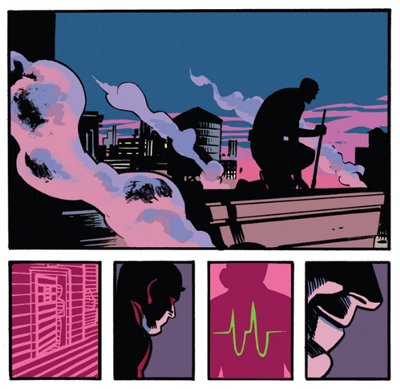
The big smoke...

The big smoke…

However, reading Andy Diggle’s Daredevil, it’s easy to get a sense that the character was suffocating under the influence of Frank Miller. Frank Miller and Klaus Jansen enjoyed a character-defining run in the mid-eighties. For Miller, it paved the way to The Dark Knight Returns, and it really shook the foundations of the superhero genre. Suddenly superheroes weren’t infallible; suddenly fights could get genuinely dirty; suddenly dressing up in a silly costume to fight crime was treated as something that might be deemed a little eccentric.

This had a dramatic impact across the superhero genre. At the same time, however, it really defined the character of Daredevil. In his year years, Daredevil often seemed like a cheap knock-off of Spider-Man; an imitation of a far more popular hero. With the work of Frank Miller, Matthew Murdock become more conflicted and more complex. He became a hero who could make mistakes, a hero who didn’t have the best judgement, a hero who could fail. This pushed the character of Daredevil more towards gritty urban crime and film noir conventions, and further away from superhero conventions.
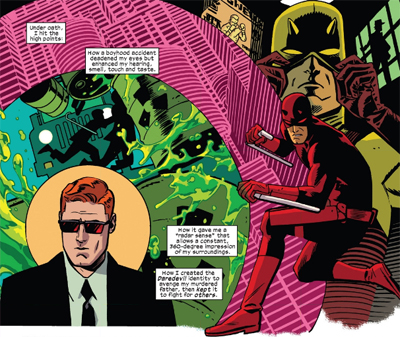
Radar love...

Radar love…

Decades after Born Again, writers are still drawing on that iconic take on Matthew Murdock. The Kingpin is still considered one of the – if not the – greatest foe of the Man Without Fear. Kevin Smith killed off Karen Page, the character who betrayed Matthew Murdock in Born Again. Brian Michael Bendis wrote a story featuring the character who planted the bomb in Born Again, two decades after that story was published. Miller cast a long shadow over the character. One of the (many) problems with Andy Diggle’s Daredevil was the way that it demonstrating that riffing on Frank Miller was getting old.

And so, Mark Waid’s run on Daredevil is absolutely fascinating. It’s a clear departure from the grounded urban realism that came to define the character, often feeling like an attempt to reconnect with the character’s Silver Age roots. Brought to life by some of the best artists in the business, the run just pops off the page. At the same time, Waid doesn’t ignore or avoid or overlook what has come before. He just seems to realise that there are other ways of approaching the character.
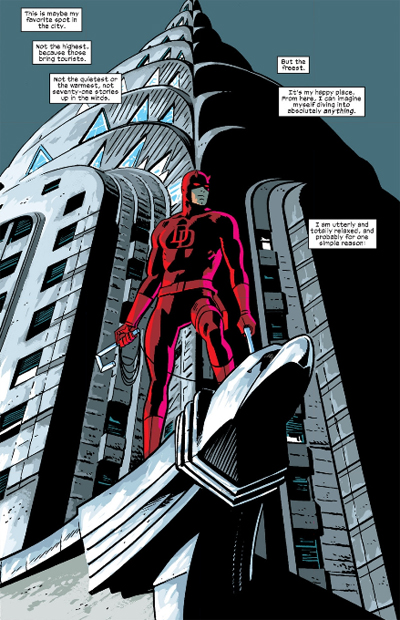
On top of the world...

On top of the world…

Continue reading

Non-Review Review: Tarzan (2013)

Tarzan is a mess. The core tale of a boy raised by apes who struggles to reconnect with his human heritage will always have resonance – the character has endured much more successfully than Edgar Rice Borroughs’ other pulp hero, John Carter. However, this motion-capture adaptation feels like it spends more time pandering and condescending than it does trying to tell an interesting or engaging story.

All the “big” Tarzan moments are hit with the enthusiasm of checking off a list (from “me, Tarzan — you, Jane” to “ooo-ee-ooo-ee-ooo-ee-ooo!”), but there is a staggering lack of trust in the idea of Tarzan to carry a Tarzan movie. Tarzan is a family film that very heavily talks down to its audience – a family constructed around the idea that children aren’t smart enough to follow basic narrative structures. So not only is the plot incredibly one-dimensional, predictable and linear, it is repeatedly and patronisingly explained to the audience.

I am Tarzan, hear me roar!

I am Tarzan, hear me roar!

The last decade has seen an explosion in family-friendly movies that don’t talk down to the younger members of the audience. They recognise that children are not idiots and are capable of following basic plot structures and recognising archetypes. Generally speaking, the success of classic Pixar speaks to the idea that children are shrewder than most animators would have conceded. The strong family films of the last few years have followed suit, realising that kids don’t just want bright colours and snazzy animation – they want the same thing any viewer wants, a good story well told.

Tarzan feels like something on an unnecessary hold-over. The movie looks fairly good – even if the motion capture isn’t cutting edge, the 3D is rendered very well; even if the environments outside the jungle look like levels from a videogame, the jungle itself feels vibrant. However, the script isn’t even willing to stand aside and let the visuals carry the story. The result is a patronising and condescending mess that feels like it is talking down to an audience that it grossly under-estimates.

Bird song...

Bird song…

Continue reading

Ultimate Spider-Man – The Death of Spider-Man Omnibus (Review/Retrospective)

This April, to celebrate the release of The Amazing Spider-Man 2, we are taking a look at some classic and modern comics featuring Spider-Man (and friends). Check back daily for the latest review.

It’s amazing how much can change in a decade or so. When it launched, Marvel’s Ultimate Universe was an incredibly fresh playground for some of the top creators working in comic books. It was an opportunity to relaunch iconic characters without the baggage of continuity – to allow creators to tell stories unburdened by decades of history and back story. It was something fresh and exciting, classic characters boiled down their purest essence.

This approach worked, particularly when juxtaposed against a wider Marvel Universe populated with characters that had drifted away from their roots a bit. Modern storytelling conventions, popular writers and artists, and easy of access all made the Ultimate Universe a very exciting place to be. The early years of the Ultimate Universe offer some of the best gateways into comic books for anybody looking to branch into the medium.

At your service...

At your service…

However, things change. Over time, the Ultimate universe lost a bit of its sheen. This was partially due to the way that the comics built up their own tangled continuity over the years that followed – it was soon as difficult to jump into an Ultimate comic book as it was to jump into the mainstream Marvel universe. At the same time, storytelling in the mainstream Marvel universe adjusted to incorporate the aspects that had made the Ultimate Universe so popular.

So the Ultimate Universe wound down a bit, with the decline assisted by some very questionable creative choices. Allowing Jeph Loeb to kill off most of the cast in Ultimatum was a bit of a miscalculation, and it seemed like titles like Ultimate Fantastic Four and Ultimate X-Men became a bit messy and less focused than they had been. There was a sense of redundancy to the entire Ultimate line. Relaunches followed, with a number of attempts to re-brand and re-energise the Ultimate line.

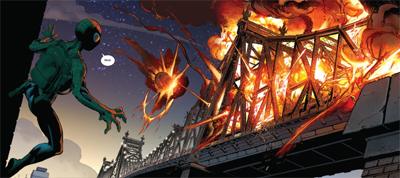
A bridge to nowhere...

A bridge to nowhere…

With all of this going on, a bold decision was made. The Ultimate Universe was introduced as a place populated with very boiled-down and iconic takes on the famous characters, as if offering readers a glimpse at the very essence of these heroes. However, as times began to change, the editors became a bit more willing to experiment – to try new things. Having served its purpose as an accessible alternative to the mainstream Marvel Universe, it became the place where Marvel could try new things, things impossible in the mainstream universe.

And so the comic attempted a variety of new approaches. Mutants were no longer quirks of evolution, but the result of government experiments gone horribly wrong. The X-Men became a bunch of teenage runaways. Reed Richards became a large-scale supervillain. However, perhaps the most audacious approach taken to the Ultimate Universe was the decision to kill off Peter Parker, with the original Ultimate Spider-Man creative team of Brian Michael Bendis and Mark Bagley conspiring to close the book on this version of Spider-Man.

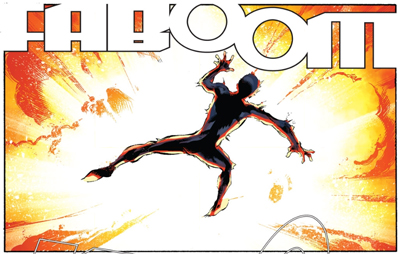
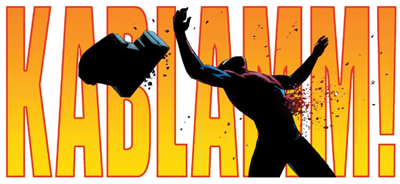
Everything blows up in his face...

Everything blows up in his face…

Continue reading

The Amazing Spider-Man – Grim Hunt (Review)

This April, to celebrate the release of The Amazing Spider-Man 2, we are taking a look at some classic and modern comics featuring Spider-Man (and friends). Check back daily for the latest review.

Although not technically part of The Gauntlet, Grim Hunt serves as a climax to eight months of stories in The Amazing Spider-Man. It comes at the end of what has been a pretty tough slog for the wall-crawling web-slinging superhero, after a string of pyrrhic victories and out-and-out losses. In essence, Grim Hunt is the culmination of all the plot threads running through The Gauntlet, as the sinister plot against the iconic superhero enters its end game.

It also comes towards the end of the Brand New Day era of The Amazing Spider-Man, only two story arcs before regular writer Dan Slott would take over the series for the next stage of the character’s development. Brand New Day was a controversial era for Spider-Man fans, building off a clumsy continuity reset in One More Day and trying to balance the weight of the character’s history against bold new directions.

As such, Grim Hunt also serves as something of a meditation on the history of The Amazing Spider-Man, a reflection on editorial attitudes to continuity and character development – an astonishingly self-aware and reflexive story arc that feels like a commentary on the character and the way that comic book storytelling tends to work.

A shot in the arm...

A shot in the arm…

Continue reading