• Following Us

  • Categories

  • Check out the Archives


  • Awards & Nominations

Star Trek/X-Men: Star TreX (Review)

This January and February, we’ll be finishing up our look at the second season of Star Trek: The Next Generation and moving on to the third year of the show, both recently and lovingly remastered for high definition. Check back daily for the latest review.

We’ll be supplementing our coverage of the episodes with some additional materials – mainly novels and comics and films. This is one such entry.

Being honest, I’m surprised that it took this long for one of the comic book publishers working with a Star Trek license to come up with the idea of crossing over Star Trek with one of their comic book properties. After all, Barbara Hambly’s Ishmael crossed the franchise over with Here Come the Brides, another piece of cult sixties television. Crossing Star Trek over with a decidedly pulpy comic book franchise was really the next logical step.

Indeed, while DC Comics would eventually get involved in the publication of a crossover with The Legion of Superheroes, I remain surprised that they never tried to cross the franchise over with Green Lantern while they were publishing monthly Star Trek comic books. Both franchises are products of a sixties outlook on space travel and on America’s post-war role in the wider world (and, well, universe), and they’d be tailor-made to fit together.

However, it wasn’t until Marvel managed to secure the Star Trek license in 1996 that our heroes had their first encounter with a proper superhero franchise.

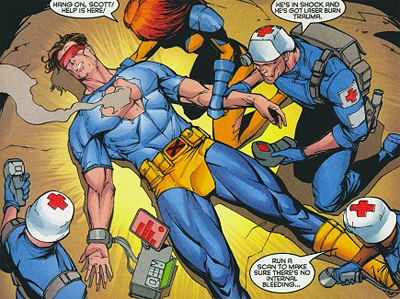
X-over...

X-over…

Continue reading

Doctor Who: The Beast Below (Review)

To celebrate the fiftieth anniversary of the longest-running science-fiction show in the world, I’ll be taking weekly looks at some of my own personal favourite stories and arcs, from the old and new series, with a view to encapsulating the sublime, the clever and the fiendishly odd of the BBC’s Doctor Who.

The Beast Below originally aired in 2010.

What are you going to do?

What I always do. Stay out of trouble. Badly.

So is this how it works, Doctor? You never interfere in the affairs of other peoples or planets, unless there’s children crying?

Yes.

– Amy and the Doctor reiterate the way things work

Steven Moffat’s first season producing Doctor Who owes a conscious debt to the rigid structure of the seasons produced by Russell T. Davies. There’s an opening episode in contemporary Britain, followed by one episode visiting the past, one visiting the future. There are three two-parters – the season finalé, a “monster”-driven two-parter and a more atmospheric and moody piece. There’s even a brief spell in the middle of the season where Moffat spices up the TARDIS dynamic by adding in a temporary companion.

This approach worked quite well. It’s worth noting that Moffat’s first season was the only point following the departure of Russell T. Davies that Doctor Who was able to deliver thirteen episodes of the show on thirteen consecutive weeks. It struck something of a happy middle between Davies’ more episodic approach to the show that the more arc-driven storytelling favoured by Moffat. Still, there are moments when it seems like this approach isn’t quite the perfect fit, with Moffat’s voice struggling to fit into the structure established by Davies.

Essentially Steven Moffat’s impression of Russell T. Davies’ update of Andrew Cartmel’s social allegory stories, The Beast Below is an interesting – if slightly unsuccessful – experiment. Moffat’s second season would feature much more effective attempts to evoke the Cartmel era of the classic show, without the sense that Moffat was trying a little too hard to emulate his predecessor.

The space in-between...

The space in-between…

Continue reading

Watch! X-Men – Days of Future Past Trailer!

The trailer for X-Men: Days of Future Past has arrived. Check it out below.

X-Men: Operation Zero Tolerance (Review/Retrospective)

To celebrate the release of The Wolverine this month, we’re taking a look at some classic and modern X-Men and Wolverine comics. I’m also writing a series of reviews of the classic X-Men television show at comicbuzz every weekday, so feel free to check those out.

Operation Zero Tolerance is very much an artefact of the nineties. It’s a big bombastic X-Men romp, one that manages to hit on a lot of the key themes and ideas of the franchise (making them resonate with the public mood), while still seeming loud and simply and incredibly hollow. After all, it’s a comic about the prejudice facing a minority in the nineties, with repeated references to the Holocaust. “Zero tolerance?” Senator Robert Kelly asks towards the end of the event. “Isn’t that what the Nazis had for the Jews in the last World War?” The villain, Bastion, is presented as a “wannabe Hitler.”

Operation Zero Tolerance is, in a word, blunt. With so many of the high-profile comics of the nineties, from both Marvel and DC, “subtlety” is an alien concept. This is an X-Men comic where racial intolerance and prejudice are expressed through nothing short of attempted genocide. On the one hand, it’s very clearly the mutant prejudice idea pushed to its logical extreme. On the other hand, the notion of the United States government even passively condoning an attempted genocide feels like it robs the franchise of the social relevance which had made it so compelling and intriguing.

Still, the event’s impact is quite obvious. It’s hard not to see Operation Zero Tolerance as the driving influence on the entire X-Men franchise from House of M through to Second Coming.

Chances of survival are Slim...

Chances of survival are Slim…

Continue reading

Jason Aaron’s Run on Wolverine & The X-Men – #1-8, 17 (Review/Retrospective)

To celebrate the release of The Wolverine later in the month, we’re taking a look at some classic X-Men and Wolverine comics every Monday, Wednesday and Friday here. I’m also writing a series of reviews of the classic X-Men television show at comicbuzz every weekday, so feel free to check those out.

Superhero comic books have had a somewhat rocky relationship with the concept of “growing up” since the mid-eighties. Books like The Dark Knight Returns and Watchmen proved that it was possible to craft mature tales with incredible depth using these icons. However, it seemed like the industry learnt all the wrong lessons from the success of Frank Miller and Alan Moore. For the past couple of decades, it seems like the ideal for superhero comics is grim and nihilistic nonsense, that “maturity” is measured in blood and bodycount.

There was a sense that the comic book industry was afraid of being seen as childish or unsophisticated, which created an ironic situation where the industry’s immaturity was on show in its fixation with adult material. “When I was ten,” C.S. Lewis once mused, “I read fairy tales in secret and would have been ashamed if I had been found doing so. Now that I am fifty I read them openly. When I became a man I put away childish things, including the fear of childishness and the desire to be very grown up.”

Jason Aaron’s Wolverine and the X-Men feels like it subscribes to this philosophy. It’s an incredibly silly and  goofy piece of work, revelling in the clichés of the superhero genre, but it’s also a surprisingly sincere and intelligent one.

It's a bit of a gamble...

It’s a bit of a gamble…

Continue reading

Roy Thomas & Werner Roth’s X-Men – X-Men Omnibus, Vol. 1-2 (Review/Retrospective)

To celebrate the release of The Wolverine later in the month, we’re taking a look at some classic X-Men and Wolverine comics every Monday, Wednesday and Friday here. I’m also writing a series of reviews of the classic X-Men television show at comicbuzz every weekday, so feel free to check those out.

The X-Men were not, to put it frankly, a comic book franchise that hit the ground running. Despite the considerable talent involved in their first nineteen issues, the comic struggled to find its own niche, unsure of just how far it dared to venture from the standard superhero template, and how confined it was by the whole “mutant superhero” bit. Writer Roy Thomas was tapped to take over the book when Stan Lee left.

Thomas is one of the underrated Silver Age writers. His work on The Avengers, spanning more than a half-a-decade, is arguably more influential and definitive than Lee’s original run on the title. He is responsible for The Kree-Skrull War, which remains one of the stronger early Avengers stories. He would work on X-Men twice before the book was finally cancelled. His second run, with Neal Adams pencilling, is arguably a lot stronger than his work here, which feels a little muddled and unfocused.

To be fair to Thomas, it’s quite clear that he recognised that the X-Men needed a shake-up and to find their own voice distinct from the initial run written by Lee and Kirby. Unfortunately, Thomas doesn’t seem entirely sure of what that voice is.

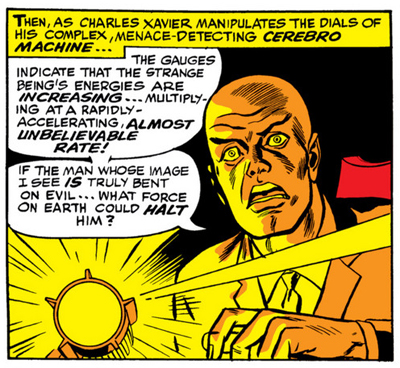
Lighten up, Charles!

Lighten up, Charles!

Continue reading

Look! First X-Men: Days of Future Past Posters!

The Wolverine isn’t out yet, but we’ve already got the first posters for next year’s X-Men: Days of Future Past. They’re a massive improvement over the wonderfully dodgy “face in the crotch!” posters that teased the superb X-Men: First Class. It’s a rather wonderful concept, combining the older and young versions of two of the franchise’s most iconic characters. Starring Sir Patrick McAvoy! Sir Ian Fassbender!

Although I’m wary of the incredibly vast cast that Bryan Singer has assembled, I am a giddy X-Men fan, so I’m quite looking forward to the adaptation of the wonderful Chris Claremont and John Byrne story. (I recent did a review of the animated adaptation of the story over at comicbuzz.com, for those wanting a sneak peek at what might be in store.) I really like these posters, and I suspect a trailer might not be too far away.

xmen-daysoffuturepast xmen-daysoffuturepast1

Stan Lee & Jack Kirby’s X-Men – X-Men Omnibus, Vol. 1 (Review/Retrospective)

To celebrate the release of The Wolverine later in the month, we’re taking a look at some classic X-Men and Wolverine comics every Monday, Wednesday and Friday here. I’m also writing a series of reviews of the classic X-Men television show at comicbuzz every weekday, so feel free to check those out.

Stan Lee and Jack Kirby are the architects of the shared Marvel Universe. The pair collaborated on titles like The Fantastic Four, The Avengers and Thor – helping reinvent American comic books during the sixties. The comics redefined what superheroes could be, honing in on the changing sensibilities of the era. However, not every series was a run-away success. Not every idea worked from the very first issue.

The X-Men are one of the most iconic bunch of superheroes in existence. They have had everything from blockbuster films to celebrated cartoon shows. However, they had a rocky start. The book limped along through its first years of publication, never quite connecting with its audience. Indeed, the book almost died a quiet death in the early seventies, before writer Len Wein and artist Dave Cockrum revived the team for a relaunched Giant-Sized X-Men. After that, Wein handed the book over to Chris Claremont, who really defined the book and its characters during an extended run on the title.

Reading these early issues, from Lee and Kirby, it’s quite clear that the X-Men aren’t working. There’s a lot of stilted awkwardness to the stories, as Lee and Kirby try to find a compelling hook for the team. They come quite close – it’s surprising how close at times – but it’s easy to see why the premise took so long to catch on.

To me, my X-Men!

To me, my X-Men!

Continue reading

Non-Review Review: The Wolverine

The Wolverine is pretty far from a perfect film. In the era following The Dark Knight, we’ve come to expect more ambition from our superhero blockbusters; tighter plots; well-drawn character arcs and motivations for more than just our heroes. In a summer where some have fallen just short of working within this new paradigm (Man of Steel) and others have succeeded (Iron Man 3), The Wolverine feels like a conscious throwback. It’s a nineties action movie masquerading as a superhero blockbuster. Had it been released in 2007, it would have been well-received.

And yet, there’s something quite fascinating and compelling about The Wolverine, despite the noticeable problems with the script’s third act. Director James Mangold struggles to keep things under control for as long as possible, Hugh Jackman still has a wonderful charm in the eponymous role, and The Wolverine has a fascinating thematic through-line and an approach to inter-movie continuity which is intriguing and strangely satisfying.

The Wolverine falls short of greatness, but it’s still a fun and enjoyable ride.

"You lookin' at me, bub?"

“You lookin’ at me, bub?”

Continue reading

X-Force Omnibus by Rob Liefeld & Fabian Nicieza, Vol. 1 (Review/Retrospective)

To celebrate the release of The Wolverine later in the month, we’re taking a look at some classic X-Men and Wolverine comics every Monday, Wednesday and Friday here. I’m also writing a series of reviews of the classic X-Men television show at comicbuzz every weekday, so feel free to check those out.

Rob Liefeld has become something of a polarising force in comic books. The artist was a driving force in the industry in the nineties. Along with creators like Todd McFarlane and Jim Lee, Liefeld really helped turn comic books into an artist-driven medium during that decade. (Rather pointedly, X-Force #1 credits Liefeld as responsible for “everything but…” the specific tasks dolled out to other contributors.) The artist became a celebrity in his own right. He got his own Levi commercial. He famously sketched while speeding inside a car.

Liefeld has arguably become more a symbol than a creator. His heavily involvement in the second year of DC’s “new 52” reboot really solidified the impression that former Marvel head honcho and current DC editor-in-chief Bob Harras was trying to channel the nineties comic book market. (The fact the line has been heavily emphasising contributions by Jim Lee and Greg Capullo, other nineties superstars, really underscores the notion.)

It’s hard to look at X-Force without seeing it as a hugely symbolic work. This is really one of the comics which defined the nineties – arguably even more than Jim Lee’s X-Men or The Death and Return of Superman. If you wanted a glimpse into the mindset of American mainstream comics in the nineties, X-Force is the perfect glimpse.

Welcome to the nineties!

Welcome to the nineties!

Continue reading