• Following Us

  • Categories

  • Check out the Archives


  • Awards & Nominations

The X-Files – Emily (Review)

This May and June, we’re taking a trip back in time to review the fifth season of The X-Files and the second season of Millennium.

The biggest problems with Emily can be summed up in five words:

“… and then Mulder showed up.”

Sorry, Mulder.

Sorry, Mulder.

Continue reading

The X-Files – Christmas Carol (Review)

This May and June, we’re taking a trip back in time to review the fifth season of The X-Files and the second season of Millennium.

Part of the challenge of the fourth and fifth seasons is watching The X-Files adapt the speed of its mythology.

The mythology has a very clear momentum in the first three seasons. For all that Chris Carter and his writers loved teasing out new questions, there was a clear sense of momentum and movement. The show had gone from a series about an isolated alien abduction in The Pilot to a series with a date set for the alien colonisation of Earth in Talitha Cumi. For all that the series was accused of being ambiguous and mysterious, there was a sense that it was at least going somewhere.
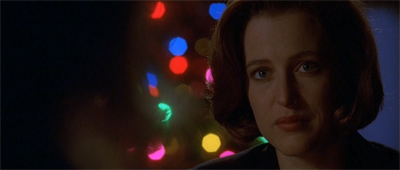
And so this is Christmas...

And so this is Christmas…

Things changed during the fourth season, most likely as the prospect of The X-Files: Fight the Future loomed in the future. It was clear that Fox would not allow Carter to set an end date on the television show before transitioning to feature films, and that the series would have to stretch beyond Carter’s original roadmap for it. All of a sudden, the mythology started stalling. The fourth season’s mythology had no clear direction in which to go, as evidenced by the fact that the decision to give Scully cancer in Leonard Betts was an eleventh hour decision with no long-term planning.

The fifth season’s mythology comes with its own particular set of problems. The movie had been written during the fourth season and filmed during the gap between the fourth and fifth seasons. This is quite evident in the way that the movie carries over abandoned elements of the fourth season mythology like the bees, who do not register at all in the fifth season. However, this also meant that the end point of the fifth season was essentially set in stone for the production team. The End would have to lead into Fight the Future, no matter what happened in the intervening nineteen episodes.

Picture perfect...

Picture perfect…

This means a lot of things for the fifth season. It means that the fifth season is stuck with the “Mulder as a skeptic… sort of” setup until Fight the Future, even if the show generally ignores it as much as it can. It also means that the mythology episodes probably should not contain any earth-shattering revelations or introduce any major character who were not already written into the film. Although Patient X and The Red and the Black effectively throw out these constraints almost completely, Christmas Carol and Emily try to adhere to them.

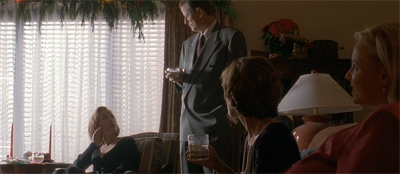
The result is a mythology episode that adheres rather closely to the successful approach adopted by Tempus Fugit and Max, a story that takes the backdrop of what the show has already revealed about the conspiracy and then uses that as a setting in which it can tell a decidedly more intimate and personal story.
It's a Scully family Christmas...

It’s a Scully family Christmas…

Continue reading

The X-Files – The Post-Modern Prometheus (Review)

This May and June, we’re taking a trip back in time to review the fifth season of The X-Files and the second season of Millennium.

The Post-Modern Prometheus is a decidedly strange little episode.

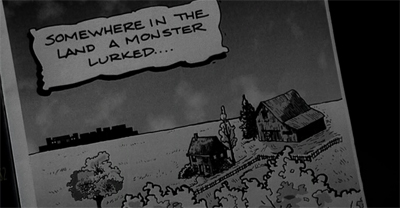
As the title suggests, it is a stunningly indulgent piece of television. Written and directed by Chris Carter, The Post-Modern Prometheus is an off-beat adventure shot in black-and-white, stylistically referencing everything from James Whale’s Frankenstein to the work of Cher to the iconic dance sequence from Risky Business. The script is chocked full of literary and cinematic references, stitching them together in a way that suggests the monster alluded to in the title of the episode.

Once upon a time...

Once upon a time…

There are more than a few moments of awkwardness in the script. As with Small Potatoes, there seems something a little awkward about a comedy episode that treats a serial rapist as the jumping-off point for a wacky comedy adventure. (“This is a very serious crime,” Mulder asserts at one point, but the script never seems too bothered by it.) There is something quite knee-jerk and reactionary about how The Post-Modern Prometheus plays into the stereotype of scientific development and research as morally questionable by default.

And, yet, despite these fairly sizable problems, there is a lot to love here. It has been suggested that Carter considers The Post-Modern Prometheus as a deeply personal work – it is not hard to see why. The Post-Modern Prometheus is a story obsessed with the act of creating – whether through biological reproduction or scientific experimentation or even by way of storytelling. It is an episode engaging with a story that has long since slipped out of the control of its creator, and which is free to evolve and develop in infinite directions.

Drivin' to Memphis...

Drivin’ to Memphis…

There is a joy and energy to The Post-Modern Prometheus that almost compensates for the more unpleasant aspects of the script. There is a lot of fun to be had here, whether listening to the creature singing along with Cher or simply watching Mulder and Scully dance as they provide a monster with a (literal) storybook ending. There is a sense that The Post-Modern Prometheus was written almost entirely without cynicism, an incredible celebration of Chris Carter’s own thoughts on storytelling and mythmaking.

The Post-Modern Prometheus is perhaps too deeply flawed to be the classic that it desperately wants to be, but it is a fascinating and bold piece of nineties television that demonstrates just how much enthusiasm and verve The X-Files could bring to proceedings when it wanted to.

It is never a happy mob...

Basement dwellers…

Continue reading

The X-Files (Topps) #34 – Skybuster (Review)

This May and June, we’re taking a trip back in time to review the fifth season of The X-Files and the second season of Millennium.

There is an interesting divide in John Rozum’s work on The X-Files.

Half the time, it seems like Rozum is writing classic EC horror stories that just happen to feature Mulder and Scully. There are stretches of his work on the title where it seems like the stories might easily have been found in the desk drawer of some classic editor, tweaked and altered slightly so as to update them forty years, and published with the addition of Mulder and Scully. Stories like Silver Lining, Donor and Soma comfortably fit this classic pulpy horror mould. There’s nothing wrong with this approach, although it is quite striking.

Death from above!

Death from above!

When Rozum does write a story that feels particular to The X-Files, it often feels a little disconnected from the season unfolding around it. Scripts like Be Prepared, Remote Control and N.D.E. feel like they hark back to the first season of the show. The characterisation is familiar, if simplistic; shades of the mythology is present, but underdeveloped; there is a very traditional approach to big paranormal ideas like the Wendigo or “remote viewing.” It feels like these comics make a solid companion piece to the Season One comics written by Roy Thomas.

Skybuster is a pretty perfect example of this style of storytelling, offering an environmental parable about the arrogance of mankind’s tampering with nature.

Quoth the raven...

Quoth the raven…

Continue reading

The X-Files: Season One (Topps) #3 – Squeeze (Review)

This May and June, we’re taking a trip back in time to review the fifth season of The X-Files and the second season of Millennium.

There is an argument to be made that this is the perfect time to feel all nostalgic. The X-Files is one of the biggest shows on television, sitting just outside the top ten as it entered its fifth season. The climax of the fourth season generated a national conversation, something that very few season-ending cliffhangers can do. The X-Files: Fight the Future was filmed in the summer of 1997 and primed for release in the summer of 1998. If there was ever a time to look backwards and dig into the show’s history, this is it. However, Season One feels like a flawed exercise.

There are a lot of problems here that contribute to the sense that Season One is not everything that it could be; the price is a little too high, there’s no new content to justify the nostalgia, and the show was becoming more easily available on home media as Season One was being released. The relaxed release schedule meant that Season One (and, presumably, any follow-ups) would never keep pace with the show, let alone catch up. At nine issues a year, the comic would fall further behind the show, even allowing for the decision to cherry-pick episodes.

In a tight spot...

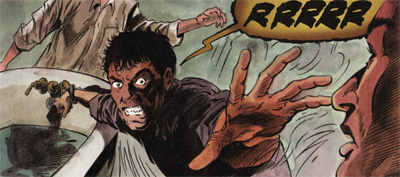
In a tight spot…

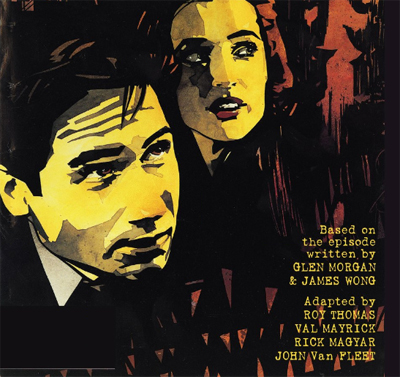
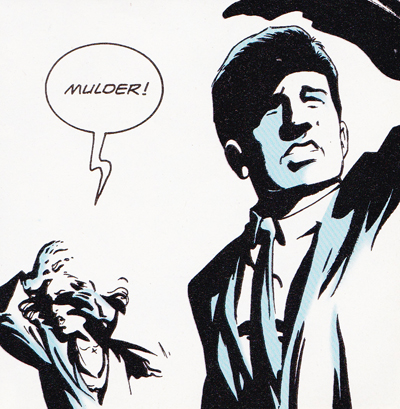
However, the adaptation of Squeeze demonstrates perhaps the biggest problem with the Season One line. While writer Roy Thomas was working from Glen Morgan and James Wong’s original script for Squeeze, and artist Val Mayerick can reference the finished episode, there is undeniably something missing from this adaptation. There is some part of Squeeze that is not replicable in the classic four-colour design, a vital part of The X-Files that seems lost in translation and seems to identify Season One as an inferior imitation.

Quite simply, Season One does not have access to David Duchovny and Gillian Anderson.

Closing in to seal your Tooms...

Closing in to seal your Tooms…

Continue reading

The X-Files (Topps) #33 – Soma (Review)

This May and June, we’re taking a trip back in time to review the fifth season of The X-Files and the second season of Millennium.

Soma is a done-in-one story that fits quite comfortably with the rest of John Rozum’s work on The X-Files.

Indeed, like a lot of Rozum’s output, Soma feels like a story recovered from a fifties horror comic. It is a very traditional ghost story hinging on a number of absurd contrivances and building to a suitably impressive climax. This is not a low-key supernatural thriller – it features vengeful smoke demons who materialise in front of countless witness and almost murder Mulder and Scully at the climax. Despite the insistence on the final page that it was too smoky to see anything, Soma feels a little too loud and campy for the world of The X-Files.

Burnt out...

Burnt out…

The script is very familiar. In many ways, Soma plays like an update of the script to Donor. It is another supernatural “beyond the grave” revenge story, similar in tone to first season episodes like Young at Heart or Lazarus or Born Again. As with Donor, the malicious spirit is a husband who plots a horrific revenge on a wife who disregarded his dying wishes. However, while Donor had an enjoyable pulpy charm to sustain it as an unwilling organ donor attempted to reclaim his harvested organs, Soma feels just a little bit too mean-spirited and malicious in tone.

Soma is a functional and efficient X-Files comic, but one that feels just a little bit too rote and familiar for its own good.

Burning love...

Burning love…

Continue reading

The X-Files – Redux II (Review)

This May and June, we’re taking a trip back in time to review the fifth season of The X-Files and the second season of Millennium.

Redux II would be a lot better if the audience believed anything that the episode was saying.

In fact, Redux II would be a lot better if it seemed like the show itself believed anything that the episode was saying.

"Hm. That resolution is unsatisfying. Deeply unsatisfying."

“Hm. That resolution is unsatisfying. Deeply unsatisfying.”

Continue reading

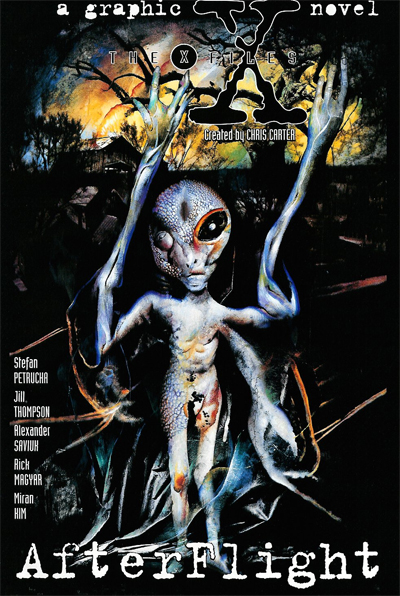
The X-Files (Topps) – Afterflight (Review)

This May and June, we’re taking a trip back in time to review the fifth season of The X-Files and the second season of Millennium.

And so we reach the end of Stefan Petrucha’s work on The X-Files.

It is quite a delayed end. Petrucha had originally written Afterflight three months before Home of the Brave, his last script for the monthly tie-in comic book. It was published fifteen months after the publication of Home of the Brave. That meant a year and a half had passed between Petrucha finished and Topps actually publishing it. The delay was rooted in disagreements with Ten Thirteen over the artwork. Still, Afterflight offers just a hint of closure to the sixteen-issue (and more) run that launched Topps’ licensed X-Files comic book line.

The truth is up there...

The truth is up there…

Afterflight is a mournful little comic, a story that takes a lot of the core themes of Petrucha’s X-Files work and distills them down to a single story. Interviewed about his work, Petrucha contended that his writing for The X-Files primarily meditated on themes of “memory, the self and what is reality.” All of these ideas are brought to the fore in Afterflight, a comic that offers a similar thematic resolution to Home of the Brave, suggesting the faintest hint of hope can be found beyond the world of men.

Afterflight is a beautiful piece of work, and a suitable conclusion to a fantastic run.

Aliens among us...

Aliens among us…

Continue reading

The X-Files – Redux I (Review)

This May and June, we’re taking a trip back in time to review the fifth season of The X-Files and the second season of Millennium.

Redux I hits on the same problem that haunted The Blessing Way. It is very hard to structure a three-parter that bridges two seasons of television. The biggest problem is the second episode, which has the unfortunate position of having to serve as a season premiere while carrying the baggage from the last season finalé and remaining unable to resolve anything. So the episode inevitably becomes an exercise in spinning wheels as the show saves all of its potential resolutions for the third episode.

A particular cynical commentator might suggest that Redux I plays as Chris Carter’s twisted take on Aaron Sorkin. Sorkin is famous for his sequences of characters walking through corridors while trading witty banter – a very nice way of keeping physical movement in the midst of largely dialogue-driven plots. This would become a defining feature of The West Wing, the show that Sorkin would launch in September 1999. Redux I seems to prefigure the style, albeit with a twist. There is lots of walking through corridors as characters talk to themselves in monologue.

"Wow, and I though my filing system was bad..."

“Wow, and I thought my filing system was bad…”

Redux I plays as a collection of voice-over monologues transposed over sequences of Mulder wandering through corridors in the Pentagon. One immediately wonders how the Department of Defence could have staged such a complex and convincing hoax against the American people when they cannot find one lost FBI agent inside the Pentagon. The drab setting makes for a shockingly dull episode; the majesty of the Yukon Mountains is lost, replaced by long sequences of grey walls and red doors.

Redux I has more than a few interesting ideas, but its structure is a mess. Sitting between Gethsemane and Redux II, the episode has no clear sense of purpose or momentum; no drive or ambition or excitement.

Don't worry, it could still make sense...

Don’t worry, it could still make sense…

Continue reading

Millennium – The Curse of Frank Black (Review)

This May and June, we’re taking a trip back in time to review the fifth season of The X-Files and the second season of Millennium.

The Curse of Frank Black is a phenomenal piece of television, and an episode that demonstrates the raw potential of the approach that Glen Morgan and James Wong have adopted towards Millennium, making the show feel (simultaneously and paradoxically) more intimate and more epic. It is a show about the end of the world, but where the end of the world can be conveyed through the late night wandering of an old man on Halloween. It is a superb piece of work on just about every level.

The Curse of Frank Black is, in a many ways, the perfect encapsulation of many of the themes and ideas that Morgan and Wong have played with over the years. It is constructed in the style of a classic horror film, but is driven by character. As with Scully in Beyond the Sea, Mulder in One Breath, and McQueen in The Angriest Angel, Frank Black finds himself facing an existential crisis at the darkest moment of his life. What will Frank do when faced with the most horrific of possibilities?

millennium-thecurseoffrankblack22

What does anybody do when they are confronted with the end of their world? Morgan and Wong are fond of putting their characters through the metaphorical crucible, seeing what happens when the foundations are eroded and the support framework is taken away. The Curse of Frank Black suggests that there are only two possible options when the world falls to pieces: either you stand safely on your side of the line and watch it happen, or you pick up a bucket of water and start cleaning up.

It is a simple choice, an elegant metaphor, and it sits at the heart of The Curse of Frank Black.

millennium-thecurseoffrankblack15

Continue reading