• Following Us

  • Categories

  • Check out the Archives


  • Awards & Nominations

Millennium – Roosters (Review)

This May and June, we’re taking a trip back in time to review the fifth season of The X-Files and the second season of Millennium.

Then Peter remembered the word Jesus had spoken: “Before the rooster crows, you will disown me three times.” And he went outside and wept bitterly.

– Matthew 26:72

Everything is in runes...

Everything is in runes…

Continue reading

The X-Files (Topps) – Ground Zero #1-4 (Review)

This May and June, we’re taking a trip back in time to review the fifth season of The X-Files and the second season of Millennium.

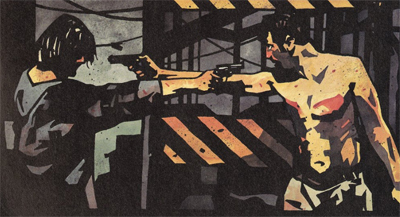
Ground Zero offers an indication of just how much success Topps was enjoying with their line of licensed X-Files comic books.

The monthly series was still being published, and Season One was on a bimonthly schedule. Both books had stable creative teams, and there was no indication that they were likely to wrap up any time soon. Of course, Topps would pull of the comic book market in late 1998, but there was no indication that they considered their X-Files line to be anything other than a complete success. As such, it made sense to expand the line. After all, the company had already used the brand to sell annuals and digests.

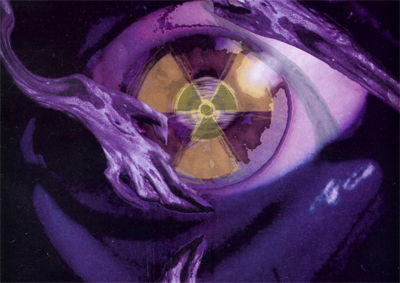
Eye see all...

Eye see all…

However, there was reportedly a considerable amount of friction between Topps and Ten Thirteen over the comic book line. Ten Thirteen was reportedly quite firm in what they would and would not allow to be published. Writers John Rozum and Stefan Petrucha have talked about how difficult it was to get their scripts published for the monthly series. It seems that Topps was eager to work around these restrictions. It is telling that neither Season One nor Ground Zero were original concepts; they were adaptations of ideas and stories Ten Thirteen had already approved.

Ground Zero is written by veteran tie-in author Kevin J. Anderson. Anderson had already written a number of popular X-Files tie-in books and had provided a fill-in arc on the monthly comic book with Family Portrait. The artwork for Ground Zero is provided by Gordon Purcell, one of the best likeness artists in the business. Publishing a four-issue adaptation of a tie-in novel is the very definition of a “safe” choice to expand the line, and only illustrates some of the wasted opportunities towards the end of Topps’ stewardship of the license.

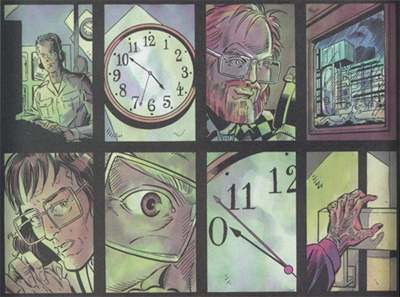
Doomsday clock...

Doomsday clock…

Continue reading

The X-Files – Bad Blood (Review)

This May and June, we’re taking a trip back in time to review the fifth season of The X-Files and the second season of Millennium.

Despite a notable absence of Darin Morgan, Bad Blood makes a much more convincing case for Vince Gilligan as the heir apparent to Darin Morgan than Small Potatoes did at the end of the fourth season.

Bad Blood finds Gilligan touching on some of the same broad ideas as Small Potatoes – how Mulder is perceived and how he perceives himself, a sly awareness of the show’s tropes and conventions. However, Bad Blood feels a lot more honed and focused than Small Potatoes. It felt like Small Potatoes only got to the meat of the story it wanted to tell in its final third, while Bad Blood is shrewd enough to put its core concepts front-and-centre. While Bad Blood has the same broad humour of Small Potatoes, it feels a lot more convincing when it comes to characters.

The tooth is out there...

The tooth is out there…

It could be argued that Gilligan drew quite heavily on the work of Darin Morgan in some of his scripts. There is no shame in this. After all, Darin Morgan is perhaps the most widely-praised writer to work on The X-Files. In this context, Bad Blood is something of a spiritual successor to Jose Chung’s “From Outer Space.” Gilligan’s script is not quite as structurally or philosophically ambitious as Darin Morgan’s final credited script for the series, but it does hit on the same fundamental idea that truth is an inherently subjective construct.

Bad Blood is essentially an episode that is not only about how Mulder and Scully see each other, but how they see themselves.

Mulder knows what's at stake...

Mulder knows what’s at stake…

Continue reading

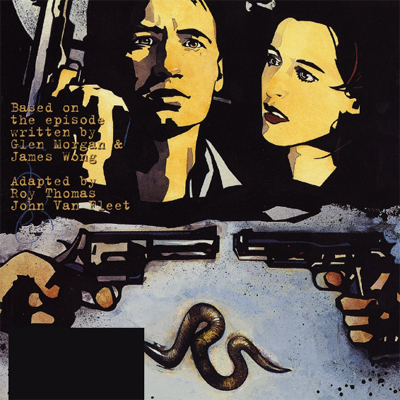
The X-Files: Season One (Topps) #5 – Ice (Review)

This May and June, we’re taking a trip back in time to review the fifth season of The X-Files and the second season of Millennium.

With Ice, Season One jumps ahead a bit.

It is hard to blame them. The first four episodes of the first season are relatively solid, outlining the heart of The X-Files and conveying everything the audience really needed to know at this point. However, the first season gets a little bit rocky after Conduit. Episodes like The Jersey Devil and Shadows are unlikely to top anybody’s list of favourite X-Files episodes. Ghost in the Machine is somewhat underrated, but it is hardly a world-beater either. So it makes sense to skip ahead to probably the most highly-regarded episode in the first half of the first season.

Worming its way into your heart...

Worming its way into your heart…

Ice is a classic installment of The X-Files. Like Squeeze, it is an episode that tends to lodge itself in the popular memory. It is hard to verify such things in any objective fashion, but it is an episode that many casual fans reference or point to whenever the show is mentioned. It has just the right balance of memorable imagery and distinctive hooks, brought to life in a haunting and atmospheric fashion. It would have been crazy for Roy Thomas’ adaptations of the Season One episodes to skip over this particular episode, and it makes sense to jump right to it.

Then again, there is also a pretty clear precedent for this.

This is not who we are...

This is not who we are…

Continue reading

The X-Files – Kill Switch (Review)

This May and June, we’re taking a trip back in time to review the fifth season of The X-Files and the second season of Millennium.

On the surface of it, William Gibson seems a strange fit for The X-Files.

He certainly seems like a more eccentric choice than Stephen King. King was a writer famed for his horror stories, with a fascination for small-town life and an interest in guilt as a legacy of American history. On paper, King should have been the perfect “special guest writer” for the show, able to churn out a script that would resonate perfectly with the larger themes of The X-Files while still sitting comfortably within his own oeuvre. While Chinga is not a bad episode, it is not an exceptional episode by any measure. It feels perfectly adequate.

Well, that's going in the DVD menu.

Well, that’s going in the DVD menu.

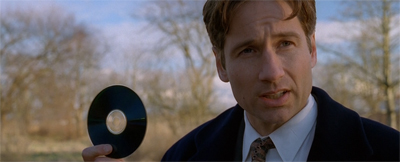
As such, Kill Switch seems like a story that could go horribly wrong. Gibson is a writer most famous for his work in defining and popularising “cyberpunk”, a science-fiction subgenre that is far removed from the horror trappings generally associated with The X-Files. Gibson was a writer who tended to explore the possible future development of cyberspace and associated issues, while Carter worked very hard to anchor The X-Files in the now. Gibson’s stories seemed to take place in the not-too-distant future; Carter grounded The X-Files in a very particular now.

However, Kill Switch works. It works phenomenally well. It is an episode that feels markedly different from everything else around it, while still feeling like it belongs to The X-Files. The clash of styles is evident in Kill Switch, as writers William Gibson and Thomas Maddox find themselves adapting their themes and ideas to a completely different aesthetic. That is perhaps part of appeal. While Chinga made it look quite easy to construct a solid Stephen King story that was also a solid episode of The X-Files, Kill Switch is nowhere near as smooth. This is a different beast. And it is glorious.

"Woah, woah, woah. What happened to floppies?"

“Woah, woah, woah. What happened to floppies?”

Continue reading

The X-Files (Topps) #37 – The Face of Extinction (Review)

This May and June, we’re taking a trip back in time to review the fifth season of The X-Files and the second season of Millennium.

Suspension of disbelief is a curiously fickle thing.

It is a concept that generates considerable debate in its function and application. After all, the normal mode of fiction generally accepts that fiction is… well, fictional. There is no real belief to shatter, because there is an innate understanding between artist and audience that a work of art should be interpreted as a representation of reality rather than a piece of reality. Even in the case of “true stories”, audiences will willingly and readily accept alterations and adjustments designed to streamline the story in question.

Ramming speed...

Ramming speed…

After all, the concept of “suspension of disbelief” is quite firmly disengaged from the concept of reality. The old cliché about “truth being stranger than fiction” illustrates the distinction. The real world (and the stories of the people who inhabit it) are full of coincidences and contrivances that audiences would consider to be lazy writing or poor construction if they appeared in a work of fiction. Nevertheless, while “suspension of disbelief” might be more complex than its three-word nature would suggest, it is a useful philosophy.

What “breaks” a work of fiction? At what point does the artist – whether intentionally or otherwise – push the audience out of the story? What causes a double take to occur or a quizzical eyebrow to raise? What story developments prompt angry sighs or bitter grumbling? There is no hard and fast answer. The line will always be arbitrary, varying from audience member to audience member. Everybody has different expectations when it comes to art, and so that threshold is distinct for every person.

"Don't worry, Scully! Stay right there... I'm going to get my camera."

“Don’t worry, Scully! Stay right there… I’m going to get my camera.”

Sometimes people can agree on where the line falls on a certain work, but everybody has their limits. There are some people who embrace perceived absurdities or inconsistencies or incongruities in their stories; there are some people who simple do not consider those absurdities or inconsistencies or incongruities to exist at all. One of the great things about The X-Files as a television show is the sense of adventure and excitement that the premise generates. It is highly flexible, allowing for almost anything.

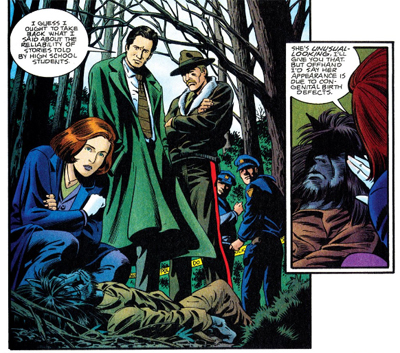
At the same time, it seems quite clear that writer John Rozum and artist Alex Saviuk find themselves charging head-first towards that highly arbitrary and high flexible boundary with The Face of Extinction, a story about a secret race of intelligent goat people who have lived alongside human civilisation for millennia and who also (conveniently) speak perfect English. It is a rather absurd concept, and one that seems at odds with the relatively grounded style of the first five seasons of The X-Files.

Beastly.

Beastly.

Continue reading

The X-Files – Chinga (Review)

This May and June, we’re taking a trip back in time to review the fifth season of The X-Files and the second season of Millennium.

Chinga is the episode of The X-Files that was written by Stephen King.

That is a pretty big deal. Stephen King is one of the most influential American writers of the twentieth and twenty-first centuries. He is a writer who has enjoyed tremendous commercial success, but who has also balanced that popularity with considerable respect of critics and academics. His work has permeated popular cultured, and sparked all sorts of analysis and exploration. While no creator of that calibre works without at least some small level of backlash, King is one of the most successful American writers by any measure.

Play time!

Play time!

Writing about King in A Century of Great Suspense Stories, Jeffery Deaver argued that the author “helped free the popular name from the shackles of simple genre writing. He is a master of masters.” As such, he should be quite a comfortable fit for The X-Files. Even aside from any stylistic sensibilities that he might share with the series, King is a creator who manages to consistently producer work that might be dismissed as “genre”, but manages to compete with more prestigious and high-profiler literature.

The X-Files did something similar in the nineties. It was a show that frequently dabbled in cult genres – it was a show that dealt with horror and science-fiction themes on a regular basis. However, thanks to the craftsmanship of those involved, The X-Files was frequently able to compete with more “serious” fare at the major awards ceremonies. Chris Carter worked very hard to prevent the show from being relegated to the horror or science-fiction “ghetto.” It was a show that could slide to high-brow to low-brow over a single act; that was part of what made it so fun.

A bloody disaster...

A bloody disaster…

So landing King was very much a coup for The X-Files. He was one of the best-selling and most prolific American writers of the nineties, with his name all over a wealth of media. All that Chinga really needs to do is exist. It would be next to impossible for Chinga to be anything but “that episode of The X-Files written by Stephen King.” Indeed, it seems almost unreasonable to expect anything more from it. The hype on Chinga was unbelievable – as one might expect from a television show that had bagged one of the most popular fiction writers around.

Chinga is a very flawed piece of television, an episode that feels too much like an early draft than a fully-developed concept. The styles of Chris Carter and Stephen King blend reasonably well, but there is a sense that neither is pushing the other out of their comfort zone. Chinga is a pretty average piece of television, a pretty average Stephen King story, and a pretty average episode of The X-Files. While not necessarily a catastrophic failure, it is hardly a fantastic success.

"Yeah, I'm sure this vacation will be completely uneventful!"

“Yeah, I’m sure this vacation will be completely uneventful!”

Continue reading

The X-Files – Schizogeny (Review)

This May and June, we’re taking a trip back in time to review the fifth season of The X-Files and the second season of Millennium.

Schizogeny has a pretty terrible reputation among some (or even most) fans of The X-Files.

During The A.V. Club’s coverage of the show’s fifth season, Todd VanDerWerff suggested that it “just might be the very worst episode of The X-Files.” Andrew Payne described the killer tress as the series’ “worst monster of the week.” Moving away from any sort of objective coverage, The X-Files Wiki lists the fact that Schizogeny is “generally considered by fans to be one of, if not the worst, X-Files episode” at the very top of “notes” section on the episode. It is fairly safe to say that Schizogeny is not well-liked.

The woodsman...

The woodsman…

And there are a lot of very valid reasons for this. There is a lot about Schizogeny that is not good; more than that, there is a lot that is just plain terrible. The writing is clumsy, the plotting is hazy, the special effects are jumbled, the dialogue is awkward. It is very difficult to tell what is going on at certain points in the story, and a truly woeful central performance from Chad Lindberg as Bobby Rich does not help matters. Schizogeny is not a classic episode of The X-Files, by any stretch of the imagination.

However, it is nowhere near as bad as its reputation suggests.

Go climb a tree...

Go climb a tree…

Continue reading

The X-Files – Kitsunegari (Review)

This May and June, we’re taking a trip back in time to review the fifth season of The X-Files and the second season of Millennium.

Kitsunegari hits on a lot of fifth season anxieties for The X-Files.

The episode is rather clearly a sequel to a beloved third season installment, featuring a returning monster of the week for the first time since Tooms brought back Victor Eugene Tooms. In this case, Kitsunegari is built around Robert Patrick Modell, the mind-controlling psychopath from Vince Gilligan’s first script as a staff writer. Given the level of Gilligan’s skill, the affection for the episode, and the charm of actor Robert Wisden, Kitsunegari really should be a “can’t miss” script for the series.
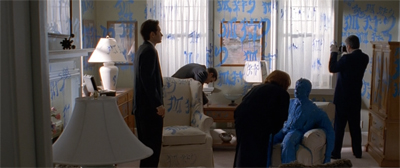
Painting the town...

Painting the town…

However, Kitsunegari proves to be a surprisingly joyless experience. The script hinges on incredibly coincidence and contrivance, everything feels a little too familiar, and even Robert Wisden seems relegated to a small supporting role. (It is telling he earns an “and” credit instead of heading the guest cast.) Kitsunegari has a host of memorable set-pieces and effective visuals, but it feels curiously hollow. It feels like a script going through the motions, rather than trying to say something new or intriguing.

Then again, there is a sense that this is the point. Kitsunegari plays beautifully as a self-aware critique of soulless sequels, of half-hearted follow-ups and cash-ins on popular monsters and villains. Kitsunegari is almost an ingenious parody of these conventions, teasing the viewer with what it might look like if The X-Files began to eat itself. It teases the audience with a trashy sequel to a classic episode, and then delivers exactly that. Kitsunegari does not just demonstrate the law of diminishing returns, it practically revels in it.
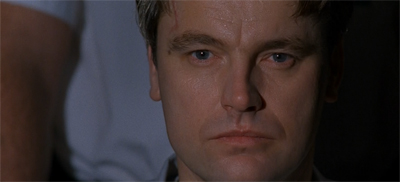
Pushing the Pusher...

Pushing the Pusher…

After all, Pusher was an episode about a man with complete control of his own story. Robert Patrick Modell was able to change the world using nothing more than mere words, crafting a new identity and persona for himself, casting himself in role of a criminal mastermind pursued by dogged investigators. It is no wonder that Kitsunegari portrays Modell as exhausted and strung out. Kitsunegari is essentially a story about how Modell has lost control of the narrative, how it has begun to control him. In a way, he gives voice to the same concerns that haunt The Post-Modern Prometheus.

Of course, all this postmodern self-awareness is ingenious, but it still leaves one sizable problem with Kitsunegari. Kitsunegari is so effective at mimicking a soulless sequel that is almost indistinguishable from the real thing. The result is a well-constructed and clever little episode, but one that is not particularly enjoyable or fun.
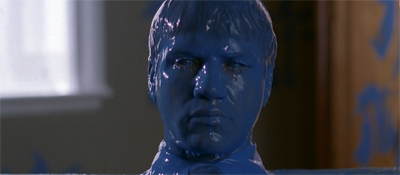
"I'm blue, dabba-dee-dabba-di."

“I’m blue, dabba-dee-dabba-di.”

Continue reading

The X-Files (Topps) #35-36 – N.D.E. (Review)

This May and June, we’re taking a trip back in time to review the fifth season of The X-Files and the second season of Millennium.

N.D.E. is a nice clever character-driven story, one that perhaps suggests a direction that John Rozum might have taken the monthly tie-in comic.

Ten Thirteen had made it quite clear that they did not want long arcs or ambitious storytelling from their licensed comic books. They wanted reliable straight-down-the-middle storytelling, with none of the playful self-awareness and meta-narratives that drove Stefan Petrucha and Charles Adlard’s work on the title. As a result, the comic has been rather more conservative in approach since John Rozum took over. His time on the title has not produced anything as cynical or grim as One Player Only or Home of the Brave.

Healing palm...

Healing palm…

While Rozum is undoubtedly limited by constraints imposed by Ten Thirteen, there is something disappointing about his run on the comic. Rozum has tended to favour done-in-one stories, single issue adventures that wrap up everything quite neatly within twenty-four pages. Rozum has grown quite efficient at this, but there is little room for nuance in stories like The Kanishibari, Silver Lining, Crop Duster or Soma. Rozum’s stories tend to work better when stretched out a little, with Be Prepared and Remote Control allowing room for nice character moments.

N.D.E. is another two-part story that takes advantage of that additional space to tell a story about Scully. N.D.E. has a fascinating central idea, and a number of clever twists, but it also allows room to explore Scully’s character and philosophy in more depth than the comic has really afforded her. N.D.E. is perhaps a bit clunkier than Be Prepared or Remote Control, but it is the strongest story of Rozum’s final year on the title. Looking at how well this approach works in those stories, it is a shame that Rozum did not employ it more frequently.

You can play the theme to The X-Files in your head if it helps...

You can play the theme to The X-Files in your head if it helps…

Continue reading