• Following Us

  • Categories

  • Check out the Archives


  • Awards & Nominations

The X-Files – Eve (Review)

The X-Files owes a conscious debt to Twin Peaks, in quite a few ways. David Lynch’s landmark television series perfectly blended the mundane with the surreal, creating a world that managed to be both incredibly familiar and hauntingly ethereal. One of the hallmarks of Lynch’s approach to Twin Peaks – and of his work in general including, most obviously, Blue Velvet and Dumbland – was the sense that there was something quite horrid and rotten lurking beneath the flowerbeds and picket fences of those lovely suburban houses.

Eve is the show’s first real exploration of suburbia, hitting on all manner of rich Cold War anxieties and fears lurking just behind those neatly-trimmed hedges.

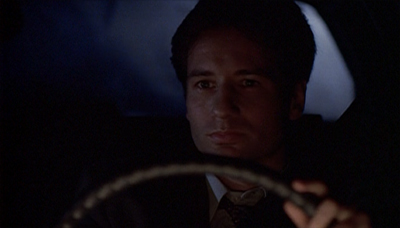
Breaking up families...

Breaking up families…

Continue reading

Agents of S.H.I.E.L.D. – 0-8-4 (Review)

The first few episodes of any show can be rough. It’s generally about learning to walk before you can run, drawing boundaries before you can cross them. The opening few episodes of a new television show often feel like a party full of people we’ve never met before – the first few hours are timid, awkward, probing. Hopefully, you get more comfortable and casual with the guests, you open up a bit – and before you know it, you’re having a great time. If things don’t seem to improve, you check out early.

Like The Pilot, Agents of S.H.I.E.L.D.’s second episode never feels like it’s straining too hard. Indeed, there’s a sense that we’re watching a show go through the motions. After all, Joss Whedon and his production posse are very familiar with constructing first seasons. There’s a sense that the team – led by Jed Whedon and Maurissa Tancharoen – have been given the keys to the most expensive car in the garage by Disney and ABC, and so the show feels more like a casual cruise than a pedal-to-the-metal joy ride.

0-8-4 does very little wrong. In fact, it does a lot of smart stuff, essential stuff, homework stuff. Still, it lacks any real sense of fun or joy – there’s no real suggestion that the show is giddily playing with the toys locked away in this particular toy chest. Appropriately enough, given the title, it feels a bit by the numbers.

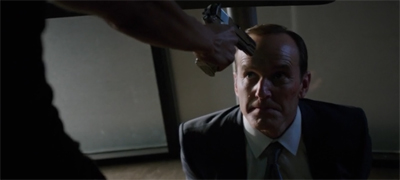
When it comes to ranking the cast, Coulson is number one with a bullet...

When it comes to ranking the cast, Coulson is number one with a bullet…

Continue reading

The X-Files – Conduit (Review)

The X-Files is somewhat fascinating as a historical artifact, a prism through which the viewer might explore the United States in that gap of time between the end of the Cold War and the start of the War on Terror. The show serves as something of a travelogue through the American subconscious, a vehicle for the nation’s fear and anxieties. It might be quaint now to look back on the show’s depiction of mobile phones and the internet, but The X-Files offers a snapshot of an America just on the cusp of that technological revolution, when there were still dark shadows and corners of the continent to be probed and explored.

One of the more interesting aspects of The X-Files is the way that it deals with faith in the nineties. Scully’s attempts to reconcile her religious beliefs with a rational approach to the universe are surprisingly insightful and nuanced, but Mulder’s belief system also offers a vehicle to explore the form that faith might take. “I want to believe,” Mulder confesses at the end of Conduit, with the iconic poster turning the sentiment into a motto. It doesn’t matter that Mulder chooses to invest his faith in aliens or conspiracies, The X-Files is still an exploration of what faith meant in the nineties.

Why is Mulder so driven?

Why is Mulder so driven?

Continue reading

Star Trek: Deep Space Nine – Cardassians (Review)

Star Trek: Deep Space Nine is twenty years old this year. To celebrate, I’m taking a look at the first and second seasons. Check back daily for the latest review or retrospective.

Cardassians suffers a bit from the same problems that haunt Invasive Procedures. Here’s another solidly constructed piece of world-building featuring a wonderful guest cast and an intriguing high concept. However, in the midst of all this, it seems like the human (er, Cardassian) element gets a bit lost. It’s great to have Garak and Dukat back on the show, and it’s great to deal with more fallout from the Occupation, but Cardassians never makes the emotional connection that a story about war orphans probably should.

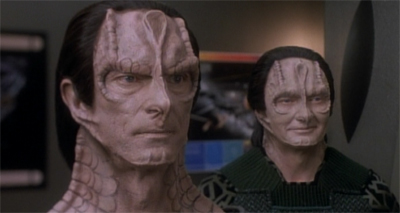
Keeping up with the Cardassians...

Keeping up with the Cardassians…

Continue reading

Star Trek: Myriad Universes – Echoes and Refractions: The Chimes at Midnight by Geoff Trowbridge (Review)

This August, to celebrate the upcoming release of Star Trek: Into Darkness on DVD and blu ray, we’re taking a look at the Star Trek movies featuring the original cast. Movie reviews are every Tuesday and Thursday.

We’ll be supplementing our coverage of the movies with tie-ins around (and related to) the films. We’ll be doing one of these every week day. This is one such article.

The death of Spock at the climax of Star Trek II: The Wrath of Khan is one of the definitive Star Trek moments. Pop culture has assimilated the moment, to the point where any half-decent nerd will identify “the needs of the many…” or “I have been and always shall be…” or maybe even “of all the souls I encountered…” It’s an absolutely massive moment for the franchise, where the film series dared to kill off the show’s most iconic and best-loved character.

It’s no wonder that the moment is such a strong focal point for those seeking to explore Star Trek. Star Trek: Into Darkness riffs mercilessly on that iconic scene, inverting it and counting on the iconography to generate enough emotional resonance for the film to get away with a fairly half-hearted homage. (The effects of The Wrath of Khan last until Star Trek III: The Search for Spock, while the consequences of the climax of Into Darkness don’t even last until the closing credits.)

So that famous sequence serves as an effective focal point of Geoff Trowbridge’s The Chimes at Midnight, which offers a parallel continuity of the Star Trek films in a universe where Spock died after the events of Yesteryear.

st-myriaduniverses

Continue reading

Civil War: Wolverine (Review)

To celebrate the release of The Wolverine later in the month, we’re taking a look at some classic X-Men and Wolverine comics every Monday, Wednesday and Friday here. I’m also writing a series of reviews of the classic X-Men television show at comicbuzz every weekday, so feel free to check those out.

A lot of the recent big Marvel events, stretching from Brian Michael Bendis’ Avengers Disassembled through to at least Avengers vs. X-Men, can be read as commentaries on post-9/11 America. In particular, they focus on questions the relationship between the power and trust held by various authorities, and how those are earned or abused. Perhaps Civil War was the most overt of these, with the conflict in the comic coming down to the clash between the demands of liberty and security.

So, I suppose, at least Marc Guggenheim’s Wolverine tie-in to the event is explicit about what it’s trying to do. It’s any even more explicit 9/11 parable, casting the famous mutant as an investigator looking for his own kind of justice in the wake of a horrifying terror attack.

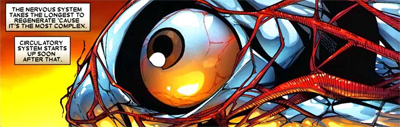
Talk about seeing eye-to-eye...

Talk about seeing eye-to-eye…

Continue reading

Star Trek – This Side of Paradise (Review)

To celebrate the release of Star Trek: Into Darkness this month, we’ll be running through the first season of the classic Star Trek all this month. Check back daily to get ready to boldly go. It’s only logical.

Star Trek always had a curious relationship with the hippie movement in the late sixties. On a surface level, you’d assume that the series would have a great deal of empathy for the idealistic and pacifist movement. After all, the show embraced counter-culture in a fairly significant way, offering none-too-subtle criticisms of American foreign policy in episodes like A Taste of Armageddon, and harbouring some very serious concerns about authority in adventures like Dagger of the Mind. What was The Naked Time but an embrace of fin de siècle anxiety mere months before “the summer of love”? After all, the nineteenth century European fin de siècle period had produced Der Wandervogel, considered one of the predecessors to the hippie movement.

And yet the show never seemed entirely comfortable with the youth movement. This would be much more obvious third season’s dire The Way to Eden, but the show’s sense of unease is quite palpable here, as Kirk finds himself trying to deal with a crew that have sampled some mind-altering vegetation and are now embracing free love.

Flower power...

Flower power…

Continue reading

My 12 for ’12: The Master & The American Century

I’m counting down my top twelve films of the year between now and January, starting at #12 and heading to #1. I expect the list to be a little bit predictable, a little bit surprising, a little bit of everything. All films released in the UK and Ireland in 2012 qualify. Sound off below, and let me know if I’m on the money, or if I’m completely off the radar. And let me know your own picks or recommendations.

This is #6

It’s very weird being a popular culture nerd who lives outside the United States. A significant portion of pop culture is exported directly from the United States. I grew up on Star Trek and Batman, two iconic American franchises. I probably know more about American history – filtered through feature films, television shows and other popular forms of entertainment – than school taught me about the origins of my own nation. Even then, it still feels a little strange to watch American film makers commentating on American situations, and to not only recognise but almost understand how those references work within the American subconscious.

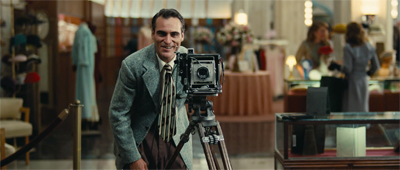
The Master is a fascinating exploration of post war America, the period where America well and truly emerged as the defining global power, where the country embraced economic prosperity and manifest destiny no longer referred to expansion out west, but a bold adventure into a promising future. In an article published shortly before America entered the Second World War, Henry R. Luce argued that the twentieth century was “the American century.” If it seemed that way before the conflict, it was all but certain afterwards. Of course, economic prosperity does not always bring with it a sense of peace and tranquillity, and The Master explores the sense of existential ennui that took root in a way that is, if you’ll pardon the pun, masterful.
themaster2

Continue reading

The Spirit Archives, Vol. 25 (Review/Retrospective)

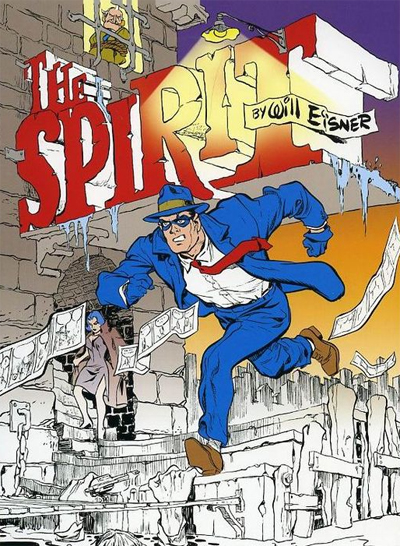
DC have done a tremendous job with their Spirit Archives collection. Twenty-four volumes collecting the twelve years of the Sunday strip is quite an accomplishment, and they’d be forgiven for stopping there. No other character in DC’s back catalogue has such a consistent collection of their early years. (Batman and Superman might have similar volumes of material collected, but somewhat haphazardly.) It’s to the company’s credit that they decided to close out their collections of Eisner’s work on the character with what might be considered two appendices. The next collection will include most of Eisner’s post-1952 work on the character, but this hardcover collects each and every daily Spirit strip published between 1941 and 1942. While it might not be the most essential collection every published (whether in terms of the character or in the history of daily newspaper strips), but it’s still nice to see it collected with the rest of Eisner’s work.

Continue reading

The Spirit Archives, Vol. 24 (Review/Retrospective)

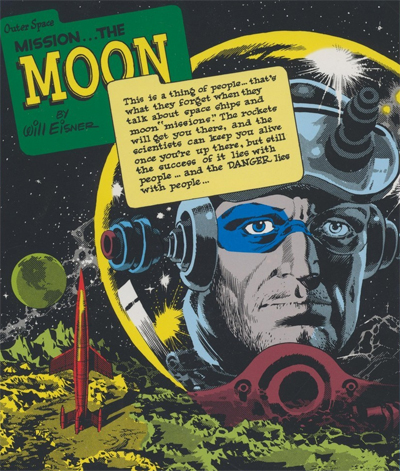
And so, the end is near. The Spirit Archives, Vol. 24 is a bumper-sized edition, collecting every Spirit weekly strip published in 1952, from January through to October. It’s nice of DC to put out a slightly larger collection to finish out the weekly strip, rather than breaking the final year of the comic into two smaller (possibly more profitable) volumes. This collection devotes its cover to The Outer Space Spirit, but that storyline only emerges towards the end of the book. Given how much attention Wally Wood and Jules Feiffer’s reinvention of the masked crimefighter has generated, it’s interesting that it’s actually a fairly small contribution in terms of page count. Still, reading those adventures now, it’s easy to see why the storyline has attracted such a strong following, even if you practically see the weekly strip dwindling as you approach the final pages.

And we're flying to the moon and back...

And we’re flying to the moon and back…

Continue reading