• Following Us

  • Categories

  • Check out the Archives


  • Awards & Nominations

Star Trek: Deep Space Nine – A Man Alone (Review)

Star Trek: Deep Space Nine is twenty years old this year. To celebrate, I’m taking a look at the first season. Check back daily for the latest review or retrospective.

To be fair to Star Trek: Deep Space Nine, it’s clear that the show’s heart is in the right place. After all, a Star Trek television show isn’t quite the gambit that it was in 1987. The producers expect that the series will be going for quite some time. After all, the regulars signed six-year contracts, one of the reasons that the show managed to make it to its penultimate season without losing a primary cast member.

As such, a lot of the early episodes of Deep Space Nine seem prudent – they effectively amount to good housekeeping. While Star Trek: The Next Generation got its cast together and couldn’t wait to start telling bold Star Trek stories, you can see that Deep Space Nine is laying a lot of groundwork. The ensemble doesn’t gel instantly. Episodes are devoted to little more than set-up for something that will pay off over the coming year. A vast supporting cast is systematically established.

This is world-building, and it’s world-building to a purpose, even if Deep Space Nine doesn’t seem to really know what that purpose is yet. So it’s quite hard to fault these early episodes, even if they feel more like set-up for delayed pay-off.

The writing's on the wall for Odo...

The writing’s on the wall for Odo…

Continue reading

Star Trek: Deep Space Nine – Past Prologue (Review)

Star Trek: Deep Space Nine is twenty years old this year. To celebrate, I’m taking a look at the first season. Check back daily for the latest review or retrospective.

Past Prologue is a pretty decent second episode of Star Trek: Deep Space Nine. It does what it needs to do, serving primarily to build the world of Deep Space Nine just a little bit. After all, a story like this was inevitable with a character like Kira in the main cast, so it’s probably for the best that the show deals with it so early. It’s not a classic episode by any means, feeling as if the show was obligated to tell this particular story. Then again, I suppose that’s what the first season of any television show is for. Set up and development.

Past Prologue continues to hint at the strengths of Deep Space Nine, investing considerable effort in crafting a tangible setting for the series. However, there’s also a hint of the weaknesses of the first season to be found here. Like just about any of the Star Trek spin-offs, Deep Space Nine is going to spend its first year searching for its identity. While Past Prologue indicates the series is looking the right direction, it hasn’t quite found its footing.

Los cannon...

Los cannon…

Continue reading

Star Trek: Early Voyages #12-15 – Futures, Parts I, II, III & IV (Review)

To celebrate the release of Star Trek: Into Darkness this month, we’ll be running through the first season of the classic Star Trek all this month. Check back daily to get ready to boldly go. It’s only logical.

We’ll be supplementing our coverage of the episodes with some additional materials – mainly novels and comics and films. This is one such entry.

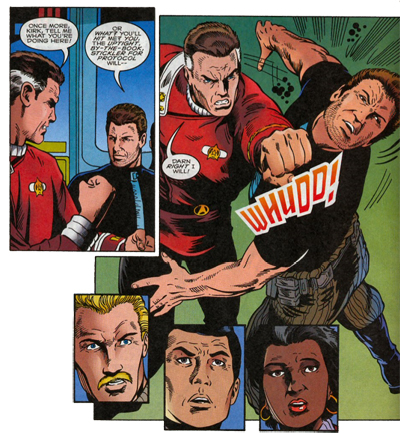
As we discussed before, Star Trek: Early Voyages is about as close to a series starring Christopher Pike as we are ever likely see. A monthly comic book running for about a year-and-a-half, told by Dan Abnett and Ian Edginton, the book followed the adventures of Christopher Pike’s Enterprise, a prelude to the classic Star Trek television show, filling some gaps left by The Cage and The Menagerie. However, the comic had the benefit of being told after a lot of Star Trek had aired.

First published in 1997, it hit stands after the big-screen adventures of the Kirk era had officially wrapped up in Star Trek: Generations, and long after Star Trek: The Next Generation had gone off the air. Even Star Trek: Deep Space Nine was more than half way through its run. This puts Early Voyages in an interesting place. It is set in the past, but knows how the future plays out. The epic four-part Futures storyline plays with this concept, offering us a glimpse of an imperfect future where Captain Kirk is a rogue running a cargo ship, the Klingons have annexed considerable portions of the Federation and are on the verge of war…

Oh, and Christopher Pike is happy. That’s how you know it’s a flawed universe.

"And THAT is for stealing my show!"

“And THAT is for stealing my show!”

Continue reading

Star Trek – Miri (Review)

To celebrate the release of Star Trek: Into Darkness this month, we’ll be running through the first season of the classic Star Trek all this month. Check back daily to get ready to boldly go. It’s only logical.

It is amazing how Star Trek manages to deftly balance the absurd with the horrific, the bizarre with the terrifying and the camp with the truly haunting. It’s something that’s really unique to the first iteration of the show, that deft ability to go completely for broke, willing to look completely ridiculous without any hint of embarrassment or modesty. Any of the spin-offs would be too conservative and too dignified to attempt anything quite as insane as Miri, with the failure of episodes like Move Along Home demonstrating that it’s impossible to replicate the freedom and the enthusiasm of the original show.

As a result, Miri is a wonderfully weird hour of television, one which is – on just about any level – incredibly wacky. And yet, despite that truly “out there” approach, it’s also a strangely compelling and engaging example of Star Trek.

Feels like going home...

Feels like going home…

Continue reading

Non-Review Review: Epic

Epic looks stunning. While it doesn’t necessarily push the envelope in terms of 3D rendering or animation, it’s often quite beautiful to watch. Even in 3D, the vibrant greens radiate off the screen, with the characters having a pleasant elasticity to them. The action sequences are well-staged and the choreography is generally impressive. However, despite this, Epic winds up feeling rather shallow. Perhaps it’s a result of the decision to develop the world as a priority, rather than the characters inhabiting it.

The story is more a collection of familiar tropes and set-pieces than a compelling narrative, and none of the lead characters are ever developed beyond basic archetypes. There’s the plucky heroine, the roguish hero, the gruff mentor, the free-spirited wise oracle, the drôle accented bad guy, the comic relief and even the kooky dad. None feel of any real substance, which is a problem when you’re executing a plot as straight-forward as this.

It's a slug's life...

It’s a slug’s life…

Continue reading

Star Trek – The Enemy Within (Review)

To celebrate the release of Star Trek: Into Darkness this month, we’ll be running through the first season of the classic Star Trek all this month. Check back daily to get ready to boldly go. It’s only logical.

One thing that I don’t think the original Star Trek gets nearly enough credit for is the quality of the writers that Gene Roddenberry recruited to contribute scripts. Television obviously operated under a different model at the time, but there’s an impressive selection of science-fiction literary giants who contributed scripts to the show. More than that, it’s impressive how many of those stories became truly iconic Star Trek stories.

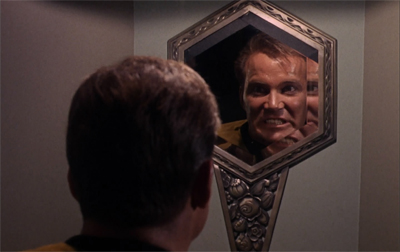
The Enemy Within is the work of author Richard Matheson, best known for stories like I Am Legend or What Dreams May Come. It’s very much a high-concept science-fiction story, but it’s also notable because it establishes two of what would become the show’s favourite tropes: transporter accidents and evil duplicates. Indeed, the two devices would be reunited in the following season’s Mirror, Mirror. These narrative elements even featured in the last season of Star Trek: Enterprise to air, in episodes like Daedalus and In a Mirror, Darkly.

Perhaps it’s a demonstration of how important these outside writers were to the development of Star Trek as a franchise that Matheson would effectively codify two stock narrative devices that would still be in use four decades later.

Mirror, mirror...

Mirror, mirror…

Continue reading

Star Trek – Mudd’s Women (Review)

To celebrate the release of Star Trek: Into Darkness this month, we’ll be running through the first season of the classic Star Trek all this month. Check back daily to get ready to boldly go. It’s only logical.

I think it’s fair to say that Star Trek had some gender issues. I say that as a fan of the show, and as a person with an immense fondness for the ensemble. It’s tempting to write off those sexist moments and decisions as attitudes that were socially acceptable at the time. After all, the sixties are almost half a lifetime away at this point. However, that doesn’t account for the fact that many of the same gender issues plagued Star Trek: The Next Generation in the late eighties, which lost two of its three female leads in its first season, and opened its second year by subjecting the remaining female lead to The Child.

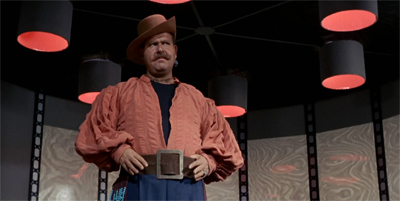
Even disregarding that, though, there comes a point where even the time when a work was produced can’t excuse certain attitudes or approaches. Star Trek doesn’t feature too many strong female characters, relegating recurring female characters like Uhura and Janice Rand to the background. This is dodgy enough, but the show’s problems with gender become a lot more obvious when a show throws sexuality into focus. Mudd’s Women is such a show. It famously introduced one of the few recurring non-crewmember characters, and it plays into the “Star Trek as space western” theme, but it is also very sexist. Very, very sexist.

Mudd-ying the waters...

Mudd-ying the waters…

Continue reading

Star Trek: The Next Generation – Encounter at Farpoint (Review)

To celebrate the twenty-fifth anniversary of Star Trek: The Next Generation, and also next year’s release of Star Trek: Into Darkness, I’m taking a look at the recent blu ray release of the first season, episode-by-episode. Check back daily for the latest review.

It is very hard to believe that it has been a quarter of a century since Star Trek: The Next Generation first appeared on our screens. It is actually quite nice that Paramount and CBS are using the opportunity to give the series a bit of a visual overhaul, going back to the original films and special effects and updating them for high definition. This is not the same approach adopted by George Lucas with his remastering of the original Star Wars trilogy.

Instead, the aim of these high definition re-releases is to bring what was already there up to modern standards, rather than to retroactively re-do the special effects. The project is being overseen by the wonderful Mike and Denise Okuda, and Mike has argued that this restoration is a very bold endeavour, suggesting, “it’s the largest – as far as we know – the largest project of its kind that has ever been attempted.”

And I am proud to support it. In a large way, my interest in this high definition release is in large part grounded in recognition of the scale of the work involved. Because, let’s face it, the first season of Star Trek: The Next Generation is a solid contender for the worst year of Star Trek ever produced for television.

“Let’s see what’s out there…”

Continue reading

Annihilators (Review/Retrospective)

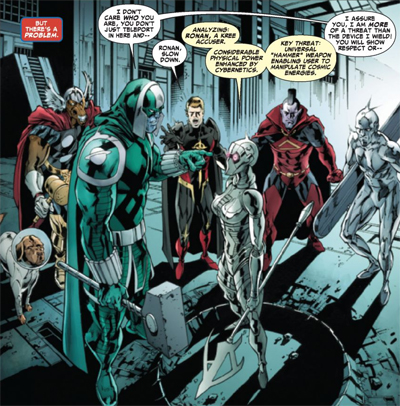
It’s a bit of a shame that Dan Abnett and Andy Lanning’s run on Marvel’s “cosmic” comics ended up ending like this – whimpering away rather than finishing with a bang. The pair have been responsible for one of the most cohesive and entertaining aspects of Marvel’s publishing line over the past half-decade, producing some of the best events in recent years, and even providing the Guardians of the Galaxy run that will (apparently) inspire the upcoming blockbuster. I sincerely hope to see an omnibus collection of that run. However, Lanning and Abnett seem to fade from the scene, following up the climax to their cosmic events, The Thanos Imperative, with two Annihilators miniseries, the second of which didn’t sell well enough to merit a hardcover collection.

It’s a bit of a shame because, despite some admittedly serious flaws, their Annihilators four-issue miniseries actually has a lot of promise, and is something I wouldn’t have objected to seeing extended past the two miniseries.

Talk about an Ikon-oclast…

Continue reading

Non-Review Review: Sky Captain and the World of Tomorrow

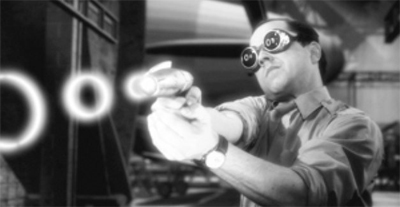
Sky Captain and the World of Tomorrow evokes pulp science-fiction cinema with an earnestness and an eagerness that is endearing, if not infectious. Although the special effects have dated significantly in the time since the movie’s release, it’s hard not to admire director Kerry Conron’s use of computer graphics to forge a connection to classic cinema. However, one senses that Conron might have been better suited to emulate the mood, rather than merely the appearance, of these old adventure serials. The problem is that despite its rather wonderfully crafted appearance, there’s never anything in Sky Captain and the World of Tomorrow to really get excited about. And that’s a shame.

A ray of hope?

Continue reading