• Following Us

  • Categories

  • Check out the Archives


  • Awards & Nominations

The X-Files Polls Results

A quick thanks to all who voted in our big X-Files poll to wrap up our coverage of the classic era of the show – from The Pilot up through The X-Files: I Want to Believe. I was very pleased with the response the poll got, with over 100 votes cast. (101, in total.) The results are below, but first two quick housekeeping announcements:

a.) we’ll be covering the modern era of the show (the IDW comics and the six episodes) sometime later in the year, probably around the DVD/blu ray release when things in my personal life are less hectic; part of that hecticness is because…

b.) I’ve written an unauthorised and unofficial critical history of The X-Files that is going to print at the end of the month; I’ll publish more details closer to publication, but it’s very much a refinement of everything that’s been put on the blog, with better research, more detail and a clearer narrative throughline; there is one really cool detail: the introduction is very kindly being written by the wonderful Kumail Nanjiani.

Anyway, enough housekeeping. Let’s get to the results!

xfilespoll15

Continue reading

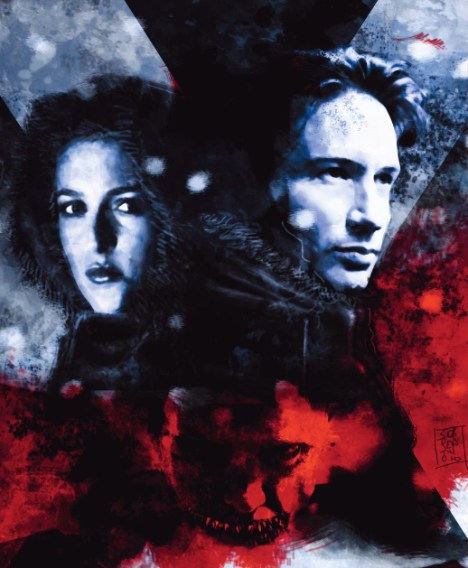
The X-Files/30 Days of Night (Review)

This January, to prepare for the release of the new six-part season of The X-Files, we’re wrapping up our coverage of the show, particularly handling the various odds and ends between the show’s last episode and the launch of the revival.

The X-Files/30 Days of Night is the most satisfying X-Files story of the interregnum between The Truth and My Struggle I.

The comic book miniseries is notable for a number of reasons. It is the simultaneously the last X-Files comic to be published by Wildstorm and the first X-Files comic to be published by IDW. It is the first comic book crossover between X-Files characters and another established comic book franchise, and it crosses over directly through Mulder and Scully rather than using the Lone Gunmen to insulate the franchise. It is also the first X-Files comic to be illustrated by Tom Mandrake, who would later work with Joe Harris.

Darkness falls...

Darkness falls…

There are other reasons that The X-Files/30 Days of Night stands out. The comic is the work of a creative team (much) more strongly associated with 30 Days of Night than The X-Files, and there is a sense the comic services that franchise more than The X-Files. Barring the first twelve-issues of Stefan Petrucha and Charles Adlard’s Topps run, which was really more of a series of shorter interlocking stories, The X-Files/30 Days of Night is also the longest single X-Files comic book story published to this point in the franchise’s history.

It is also just really good.

Due North...

Due North…

Continue reading

The X-Files (Wildstorm) #5-6 – Dante’s Muse (Review)

This January, to prepare for the release of the new six-part season of The X-Files, we’re wrapping up our coverage of the show, particularly handling the various odds and ends between the show’s last episode and the launch of the revival.

And Wildstorm’s X-Files comic dies a quiet death.

The seven-issue (six monthly issues and a special “zero” comic) miniseries is an oddity. These seven comics tell four self-contained mysteries that stand quite separate from another, even as they echo the show’s creative peak. These four self-contained stories are credited to three different writers; the first two stories are written by producer and writer of the classic show, while each of the final two stories is credited to an established industry veteran with a long history working at DC comics.

THE TRUTH IS OUT THERE

THE TRUTH IS OUT THERE

Still, the miniseries feels like something of a damn squib. Barring that X-Files/30 Days of Night crossover, these seven issues represent everything that Wildstorm chose to do with the license. It certainly pales in comparison to the more comprehensive and thorough exploitation of the property by previous owner Topps and future owner IDW. While part of that is likely down to the simple fact that Wildstorm was in its extended death throes, perhaps it also speaks to where The X-Files was at that point in time.

Perhaps there simply was not that big a market for The X-Files in late 2008 and into 2009. Perhaps the memory of the show’s final season lingered too strongly in the cultural memory, or perhaps the cultural remembrance of show had faded entirely. The spark of nostalgia that would resurrect the show half a decade later had yet to be kindled. For whatever reason, it seemed like The X-Files was not quite ready to return to the popular consciousness.

EVERYTHING DIES

EVERYTHING DIES

Continue reading

The X-Files (Wildstorm) #3-4 (Review)

This January, to prepare for the release of the new six-part season of The X-Files, we’re wrapping up our coverage of the show, particularly handling the various odds and ends between the show’s last episode and the launch of the revival.

Frank Spotnitz could not stick around forever.

The veteran X-Files writer and producer could not stick around for even half a year. These days, it is customary for “big name” authors to commit to a very short run of comic book issues before jumping off; while comic book veterans like Marv Wolfman or Chuck Dixon or Chris Claremont would have committed to years on a particular title during the seventies and eighties, it became increasingly common for higher profile writers to enjoy shorter stints. While this is the case for high-profile industry veterans like Warren Ellis, it is particularly true of celebrity authors.

THE TRUTH IS OUT THERE

THE TRUTH IS OUT THERE

Brad Meltzer wrote thirteen issues of Justice League of America. Kevin Smith wrote eight (and a bit) issues of Daredevil and fifteen issues of Green Arrow. Richard Donner wrote seven issues of Action Comics, and contributed a short story to the anniversary special. Sam Hamm wrote three issues of Detective Comics. While these creators might have had great stories to tell with these characters, they were also not necessarily comfortable with committing to a month schedule indefinitely. (They also had careers outside the medium, to be fair.)

Still, there is something quite jarring about Frank Spotnitz’s departure from Wildstorm’s X-Files comic book after only three issues. Spotnitz barely had time to define what the comic was supposed to be, beyond a glimpse into a weird alternate universe where Mulder and Scully are trapped in a perpetual 1998. It is debatable whether a licensed tie-in really needs anything more than that, given the tendency to treat such tie-ins as little more than a supplement to a more mainstream iteration of the same basic product.

DECEIVE INVEIGLE OBFUSCATE

DECEIVE INVEIGLE OBFUSCATE

At the same time, it feels like Spotnitz’s departure leaves an already confused monthly series with no strong identity of its own. Quite pointedly, Spotnitz’s name still appears on the full cover to the first issue written by Marv Wolfman; whether this suggests that Spotnitz was intended to write the issue or simply the result of a rush to press is unclear. As a result, Wildstorm ended up passing its X-Files monthly series from one writer to another, with industry (and DC comics) veterans Marv Wolfman and Doug Moench each handling a two-part story.

The results are intriguing, if not particularly compelling. Wildstorm’s X-Files comics are most remarkable for its sense of detachment from anything and everything. It is “unstuck” in a way that none of the franchise’s other flirtations with comic book storytelling are not. In its own way, this feels entirely appropriate; this is The X-Files as published by one of the two most largest and most iconic comic book publishers. Continue reading

The X-Files (Wildstorm) #0 (Review)

This January, to prepare for the release of the new six-part season of The X-Files, we’re wrapping up our coverage of the show, particularly handling the various odds and ends between the show’s last episode and the launch of the revival.

The X-Files: I Want to Believe marks a point of transition for The X-Files.

It seems to represent the point at which The X-Files truly stops its forward momentum; the point at which the show embraces its status as an artifact of the nineties rather than a living (and evolving) entity. There had been indications of this with the release of Resist or Serve, a video game which seemed to treat the seventh season as the “end” of The X-Files, but I Want to Believe embraced it on a much larger scale and on a much larger platform. The X-Files was not so much pushing forward as looking backwards.

THE TRUTH IS OUT THERE

THE TRUTH IS OUT THERE

This reality was reflected in a number of ways. The importance of the eighth and ninth seasons was consciously downplayed, to the point where a gag in I Want to Believe hinges on the audience forgetting that both Mulder and Scully had worked at the FBI during the Bush administration. Doggett and Reyes were consigned to a blu ray bonus feature, an evolutionary branch of The X-Files to be cut off for the sake of convenience. I Want to Believe even took Mulder and Scully back to snowy Vancouver, a literal journey backwards.

The Wildstorm comic book pushes this reconceptualisation of the show to its logical conclusion, as if imaging some alternate world where The X-Files‘ so-called “golden age” of the second through fifth seasons had somehow lasted over a decade. The Wildstorm comics tease a glimpse of The X-Files frozen in amber, trapped for an eternity.

I WANT TO BELIEVE

I WANT TO BELIEVE

Continue reading

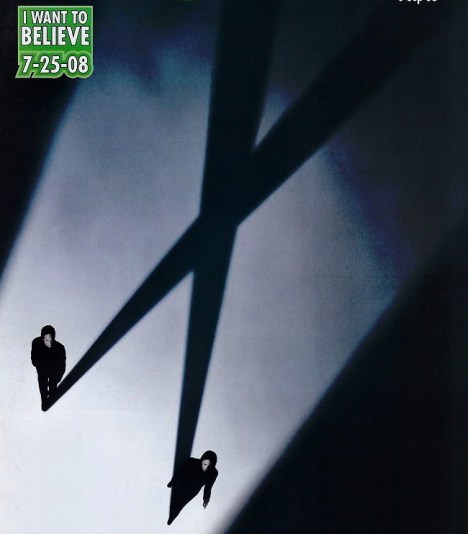
Non-Review Review: The X-Files – I Want to Believe

This January, to prepare for the release of the new six-part season of The X-Files, we’re wrapping up our coverage of the show, particularly handling the various odds and ends between the show’s last episode and the launch of the revival.

The plan was always to transition The X-Files from television to film, but fans change.

Following the success of The X-Files: Fight the Future, there had been some mumblings about the possibility of releasing a film in the summer of 2000. Given that The X-Files was a cultural property rooted in the nineties, it seemed like a big screen adventure would have been the perfect way to bring Mulder and Scully into the twenty-first century. After all, the original plan was that the show would retire in its seventh season. (The network even had a bespoke successor selected in Chris Carter’s Harsh Realm.)

Gotta have faith...

Gotta have faith…

However, this was not to be. It turned out that Fight the Future represented the cultural peak of The X-Files, the moment of maximum pop culture saturation. Almost immediately upon the production team’s move to California at the start of the sixth season, the show’s rating began their slow (and then not so slow) decline. The seventh season was itself hampered by behind-the-scenes drama, with David Duchovny suing Chris Carter and Fox over syndication. At the same time, Fox’s “worst season ever” meant that the broadcast could not afford to cancel The X-Files.

So, understandably, the sequel to Fight the Future was postponed and put on the long-finger. As the show came to an end in its ninth season, the subject of a second X-Files feature film arose again. Still, there was a debate to be had about whether the world really wanted a second X-Files film. While the sixth and seventh seasons had slowly eroded the show’s popularity and appeal, the ninth completely collapsed it; through the combination of bad storytelling decisions and the broader shift in the political mood, The X-Files felt like a spent cultural force.

"Platonic", eh?

“Platonic”, eh?

Ultimately, that was not to be either. The production history of The X-Files: I Want to Believe often recalls the mythology at the heart of The X-Files, with the project constantly shifting and changing as outside forces intervene. I Want to Believe arrived in cinemas in July 2008, a full decade after Fight the Future and more than six years after the broadcast of The Truth. The finished product is radically different from what anybody might have imagined in the immediate aftermath of Fight the Future, its design often surreal and awkward.

If I Want to Believe would have been a strange choice for an X-Files film release in July 2000, it seemed downright perverse in July 2008.
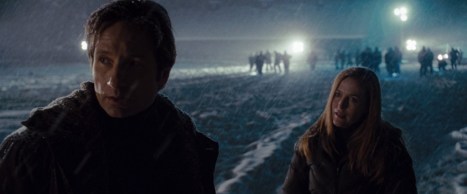
The truth is out there. Way out there.

The truth is out there. Way out there.

Continue reading

Night Stalker – Three (Review)

This January, to prepare for the release of the new six-part season of The X-Files, we’re wrapping up our coverage of the show, particularly handling the various odds and ends between the show’s last episode and the launch of the revival.

Three is an interesting episode of Night Stalker, representing a threat that certainly feels less generic than that proposed by episodes like The Five People You Meet in Hell or Burning Man.

Three is the story of a house that is haunted by “the ghost of an emotion.” Given the fact that this is very much a horror show, and the themes already outlined in The Pilot and The Five People You Meet in Hell, it makes sense that the emotion in question is “fear.” Opening with a hazing ritual conducted by a secret society inside a derelict house, Three confronts the guest characters with their greatest fears. It is a very direct way addressing the underlying themes of Night Stalker, the fear and disconnect of modern urban living.

Top of the world...

Top of the world…

However, despite a good premise and solid execution, Three demonstrates the difficulties that Night Stalker is having finding its own unique voice. Three makes a conscious effort to flesh out its main characters, giving its central players personal conversations and introducing a new recurring character to help Kolchak in his investigations. However, this focus on character only emphasises how generic the show’s ensemble is. It is unfair to blame the cast and crew for something as intangible as the lack of chemistry, but it remains an issue for the series.

Three gives Stuart Townsend and Gabrielle Union banter, but it only serves to demonstrate that they lack the palpable chemistry that David Duchovny and Gillian Anderson had. The script slots Jain into the role of comic relief, but this raises questions about what exactly his function in all of this is meant to be. The central characters seem lost in the episode’s shuffle, with Three demonstrating that a solid monster-of-the-week can only really succeed when built on a firm foundation.

Hide and seek...

Hide and seek…

Continue reading

The X-Files – Resist or Serve (Review)

This January, to prepare for the release of the new six-part season of The X-Files, we’re wrapping up our coverage of the show, particularly handling the various odds and ends between the show’s last episode and the launch of the revival.

The X-Files disappeared rather quietly from television.

Despite the talk of launching a film series, the franchise was allowed to lie fallow for a couple of years. There were a number of reasons for this. Immediately following the broadcast of The Truth, Chris Carter disappeared out into the world. The creator and executive producer had worked for almost a decade without any real break. It made sense for the writer to avail of the opportunity to get away from it for an extended period of time. A breather felt more than justified after overseeing more than two hundred episodes of television.

Game on...

Game on…

The band broke up. Members of the production team took jobs elsewhere. Frank Spotnitz and Vince Gilligan worked with veteran director Michael Mann on Robbery Homicide Division. John Shiban joined the writing staff on the second season of Star Trek: Enterprise. There was a sense that The X-Files had faded into the ambient background radiation of popular culture, its constituent elements – whether writers or directors or even themes or storytelling techniques – ready to flavour a new generation of television production.

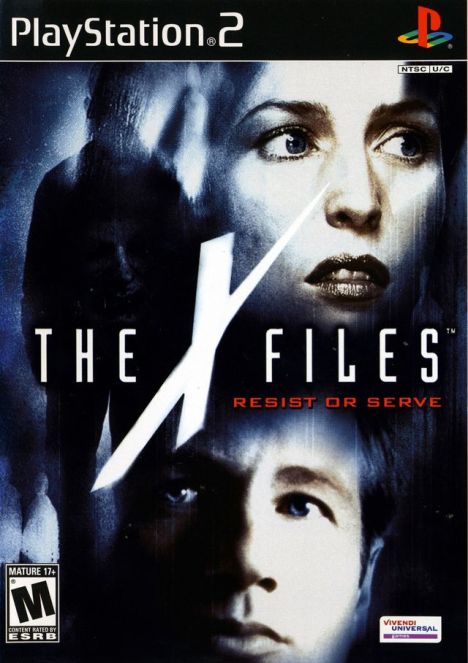
However, there were signs that the show might linger on. Even if the sequel to The X-Files: Fight the Future had yet to materialise, it lurked just over the horizon. Critical and fan consensus was starting to form around the show. Although The X-Files might have been finished, its legend was still being solidified. Resist or Serve is very much a part of this process. Released on Playstation 2 in March 2004, Resist or Serve was a very disappointing video game. However, it was also a very instructive insight into just how the legend of The X-Files was shaping up.

Feels like going home...

Feels like going home…

Continue reading

Roy Thomas’ Run on The X-Files: Season One (Topps) (Review)

We’ve recently finished our reviews of the nine seasons of The X-Files. Along the way, we tried to do tie-ins and crossovers and spin-offs. However, some of those materials weren’t available at the right time. So this week will be spent finishing Topps’ line of “Season One” comics, published during the fifth season in the lead up to The X-Files: Fight the Future.

It is hard to figure out what exactly the point of the Season One line was meant to be.

In a very superficial way, the point was obvious. The intent was to add a second regular series to Topps’ line of comics based around The X-Files. Even during the comic book bubble burst of the mid- to late-nineties, The X-Files was a good seller for the company. The monthly book sold well enough that Topps’ eagerly supplemented it. New stories were published as Digest editions, published alongside the less successful Ray Bradbury comics. Annuals were published alongside the monthly book. Collections were published frequently.

xfiles-beyondthesea13

However, this was not enough to satisfy market demand. Topps wanted to publish more X-Files material with greater frequency. However, Ten Thirteen were less interested with the supervision that the line required. A compromise seemed in order. Rather than creating a new original series of comic books, they flooded with market with new adaptations of existing X-Files media. Writer Kevin J. Anderson and artist Gordon Purcell offered a four-part comic book miniseries adapting Anderson’s Ground Zero prose novel.

The publisher also decided to put out a series of adaptations of classic first season episodes, released once every two months. These would be adaptations of stories that had already been properly vetted by Ten Thirteen, having been produced in-house. The trick would simply be translating them into comic books.

Burn with me.

Continue reading

The X-Files: Season One (Topps) #9 – Shadows (Review)

We’ve recently finished our reviews of the nine seasons of The X-Files. Along the way, we tried to do tie-ins and crossovers and spin-offs. However, some of those materials weren’t available at the right time. So this week will be spent finishing Topps’ line of “Season One” comics, published during the fifth season in the lead up to The X-Files: Fight the Future.

And, with Shadows, the Season One line comes to a close.

Although The X-Files was at the very peak of its popularity between the fifth and sixth seasons, the Topps line of comics was winding to a close. Although Topps had turned a very tidy profit on the line, Ten Thirteen had been less enthused by the relationship. The production company decided not to renew their contract with Topps, and so the X-Files line of comics was quietly retired. Shadows was published in July 1998, a month following the release of The X-Files: Fight the Future.

A shadow of itself...

A shadow of itself…

It was not the last X-Files comic book to be published by Topps. The company would release one more issue of the regular series – Severed – shortly before the start of the sixth season. There was little indication that Topps expected the contract to come to an end; the publisher had actually solicited two further issues of the Season One line beyond Shadows, adaptations of The Jersey Devil and Ghost in the Machine. These were somewhat lackluster first season episodes, but episodes with the sort of impressive visual ideas that might translate well to the comic book medium.

An adaptation of The Jersey Devil and Ghost in the Machine would certainly have made for a more visually satisfying final issue than an adaptation of Shadows.

What we do in the shadows...

What we do in the shadows…

Continue reading