• Following Us

  • Categories

  • Check out the Archives


  • Awards & Nominations

Doctor Who: Night Terrors (Review)

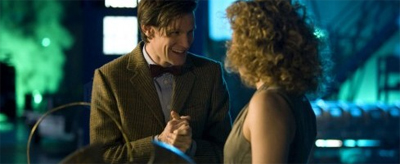
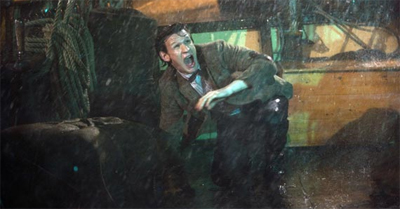
I’ve really liked Mark Gatiss’ contributions to Doctor Who. While not amongst the very best the series has to offer, The Unquiet Dead and The Idiot’s Lantern were both very solid monster-of-the-week episodes with clever concepts, a huge amount of energy and a sharp wit. Night Terrors shares all these attributes with those two earlier of Gatiss’ stories, but benefits from a wonderfully endearing sense of nostalgia and a very effective urban setting we really haven’t seen since the end of the Davies era.

George needs professional help…

Continue reading

Doctor Who: Let’s Kill Hitler (Review)

To celebrate the fiftieth anniversary of the longest-running science-fiction show in the world, I’ll be taking weekly looks at some of my own personal favourite stories and arcs, from the old and new series, with a view to encapsulating the sublime, the clever and the fiendishly odd of the BBC’s Doctor Who.

Let’s Kill Hitler originally aired in 2011.

You’ve got a time machine, I’ve got a gun. What the hell. Let’s kill Hitler.

– Mels drops a title

Well, Steven Moffat made it quite clear from the outset that he was going to play with the structure of his second season as executive producer. The show was split and broadcast in two blocks, straddling the summer. It opened with a rather epic two-part adventure that seemed to show us the end of the Doctor’s journey. Let’s Kill Hitler is positioned in a very strange way. It is simultaneously the light and quirky opening episode of the season’s second block, and also the hour devoted to resolving a lot of the lingering questions overshadowing the arc-driven sixth season of the revived Doctor Who.

It is, in short, a mess. It’s a confident and occasionally brilliant mess, but a mess nonetheless.

Crashing the Nazi Party…

Continue reading

Doctor Who: A Good Man Goes to War (Review)

To celebrate the fiftieth anniversary of the longest-running science-fiction show in the world, I’ll be taking weekly looks at some of my own personal favourite stories and arcs, from the old and new series, with a view to encapsulating the sublime, the clever and the fiendishly odd of the BBC’s Doctor Who.

A Good Man Goes to War originally aired in 2011.

Demons run when a good man goes to war.

Night will fall and drown the sun, when a good man goes to war.

Friendship dies and true love lies,

Night will fall and the dark will rise,

When a good man goes to war.

Demons run but count the cost.

The battle’s won, but the child is lost.

A Good Man Goes to War is pretty much the epitome of Moffat’s “let’s cram as much as possible into forty-five minutes” approach to Doctor Who. This is the episode directly following Matt Smith’s last proper two-part adventure, and it firmly sets the status quo for the rest of the Eleventh Doctor’s tenure. Moffat doesn’t opt for two-parters after this point, and you can see the roots of the “blockbuster” approach he adopted for the show’s fiftieth season.

A Good Man Goes to War has enough crammed into it to sustain a bombastic Russell T. Davies season finalé. There’s character arcs, betrayal, redemption, heroism, continuity, twists and radical game-changers – all bursting at the seams of this episode. There’s a staggering amount of ambition powering A Good Man Goes to War, and even attempting to do all this in the course of a single episode earns Moffat a significant amount of respect.

What’s even more impressive is that A Good Man Goes to War manages to carry it all off.

The Doctor goes with the flow…

Continue reading

Doctor Who: The Doctor’s Wife (Review)

“Are all people like this?”

“Like what?”

“So much bigger on the inside.”

– TARDIS and the Doctor

That was awesome. Neil Gaiman’s Doctor Who episode, The Doctor’s Wife, was perhaps the strongest stand-alone episode the series has had in quite some time – packed to the brim with wonderful and cheeky and clever concepts, executed in wonderful style. It had just about everything, from small fanboy-ish references (“the old control room”) through to clever explorations of the ideas the show takes for granted, managing to fit perfectly with what had come before and suggest some new takes on classic concepts at the same time.

The Smith-en young couple...

Continue reading

Doctor Who: The Curse of the Black Spot (Review)

Arriving just in time for the latest Pirates of the Caribbean movie (On Stranger Tides), Doctor Who has decided to go all pirate on us – even adopting the episode title The Curse of the Black Spot, to mirror The Curse of the Black Pearl. What we get feels genuinely like “Old School” Doctor Who, with the action confined to a very tight remote location, some corny (but effective) special effects and advanced technology masquerading as superstition. I suppose it was inevitable that a “monster of the week” episode would feel like a bit of a letdown after the superb Day of the Moon, but – while fun – The Curse of the Black Spot never really feels essential.

Not quite a wash-out...

Continue reading

Doctor Who: Day of the Moon (Review)

“No, it’s not Apollo 11. That would be silly. It’s Neil Armstrong’s foot.”

– The Doctor discusses his secret weapon

Well, that was fun. Reportedly, Steven Moffat stated that he wanted the season-opening two-parter to feel like a big season finale, with epic scale, huge stakes and genuine consequences, and – to be frank – I think he accomplished it. Perhaps Day of the Moon leaves just a little bit too much hanging for my own personal taste, but it’s still an exciting and fun conclusion to this story arc.

Spaced out...

Continue reading

Doctor Who: The Impossible Astronaut (Review)

To celebrate the fiftieth anniversary of the longest-running science-fiction show in the world, I’ll be taking weekly looks at some of my own personal favourite stories and arcs, from the old and new series, with a view to encapsulating the sublime, the clever and the fiendishly odd of the BBC’s Doctor Who.

The Impossible Astronaut originally aired in 2011.

Rory, would you mind going with her?

Yeah, a bit.

Then I appreciate it all the more.

– The Doctor and Rory

While Steven Moffat’s first season as showrunner followed the same basic format as the seasons run by Russell T. Davies, his second up-ends that. Viewers had become so conditioned to that structure that The Impossible Astronaut proves quite a shock. Far from an accessible and enjoyable romp in the style of Rose or New Earth or Smith & Jones or Partners in Crime or The Eleventh Hour, The Impossible Astronaut jumps right into the middle of things.

Taking advantage of the fact that this is the first time since New Earth (and only the second time in the revival) that a season premiere hasn’t been burdened with the weight of introducing a new Doctor or companion, Moffat is able to really mess up the structure of the season. Indeed, you might go so far as to suggest that he’s reversed it. Moffat’s second season ends with a one-part adventure that introduces us to a new era and new mission statement, but opens with a bombastic two-part climax.

It’s certainly ambitious.

Cowboys and aliens…

Continue reading

Doctor Who: A Christmas Carol

Being honest, this Christmas special had me from the moment that Michael Gambon was announced. I might have been a little uncertain when it was stated that Stephen Moffat’s first Christmas episode would be essentially a re-telling of the Dickens classic A Christmas Carol, but I have to admit that I enjoyed it a great deal. That isn’t to pretend that it’s a perfect episode of Doctor Who or that there aren’t significant flaws with the hour of television, but it’s fairly entertaining, features fantastic performances and has a few clever concepts playing about – making it great for seasonal viewing.

The Ghost of Christmas past, present and future...

Continue reading

Sympathy for the Daleks: Steven Moffat & The Shifting Status Quo

I suppose you could bring them back, but I’d be slightly puzzled, because they were robots that went wrong. Generally speaking, and maybe Russell wouldn’t agree with a word I’m saying right now, but my favorite Doctor Who story is the one with brand new monsters that you see once and once only. The moment you start crowding the universe with familiar monsters, I think it’s less interesting. Two of the words that you could reasonably apply to the Daleks are ‘reliably defeatable.’ You know those guys are going to lose at the last minute anyway, and you always know what they’re up to, so the best bit about bringing back old monsters is the reveal. After that, it’s all downhill. It’s like Agatha Christie deciding that the butler should always do it, because it was successful in the last book, so that’s not my favorite kind of Doctor Who story. I like brand new monsters.

– Steven Moffat

That answer comes from an interview he gave waaaay back in 2006 – about the time he was writing The Girl in the Fireplace, his second story for the relaunched Doctor Who. I don’t know if he knew then that he was heir apparent to the throne and would succeed Russell T. Davies, but I wonder if being positioned as showrunner has somewhat changed his perspective. In his inaugural year running the show, we’ve already had the return of the Daleks, three episodes in with Victory of the Daleks, next week we’ll witness Moffat returning to one of his own monstrous creations in The Time of Angels and previews have already confirmed that the Cybermen themselves – foes dating from the show’s first leading actor – will be returning as well (with Roman centurians). I’m not complaining at all (a writer as talented as Moffat can do pretty much whatever he wants and I’ll trust him), but I can’t help wondering if perhaps Moffat is playing his own long game with the franchise in his opening season.

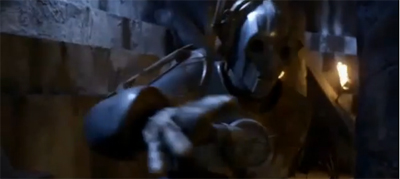
Don't worry, this Cyberman is mostly 'armless...

Note: This article contains spoilers for the end of this week’s episode, The Victory of the Daleks, so those who haven’t caught it yet might want to look away or come back to this when they’ve seen the episode. You’ve been warned, so you have.

Continue reading