• Following Us

  • Categories

  • Check out the Archives


  • Awards & Nominations

Star Trek: Deep Space Nine – Fascination (Review)

This September and October, we’re taking a look at the jam-packed 1994 to 1995 season of Star Trek, including Star Trek: Deep Space Nine and Star Trek: Voyager. Check back daily for the latest review.

Well, that could have been much more unpleasant than it ultimately was.

Yes, that’s damning with faint praise, but Fascination feels like a long sigh of exhaustion after what has been a tough run of episodes. The last episode of Star Trek: Deep Space Nine to air in 1994, Fascination came at the end of a production crunch that had seen the show desperately grasping for time. Quite a few of the first ten episodes of the season had been rushed through, with varying results – from Second Skin to Meridian.

So the fact that Fascination is not a massive soul-destroying screw-up on the scale of Meridian is a good thing, even if the episode’s plot does smell a little bit of desperation.

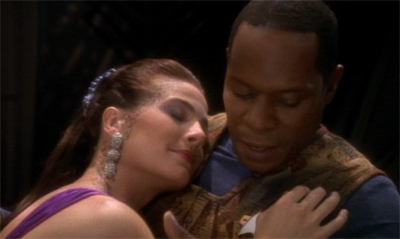
Dax can be quite touchy...

Dax can be quite touchy…

Continue reading

Star Trek: Deep Space Nine – Defiant (Review)

The September and October, we’re taking a look at the jam-packed 1994 to 1995 season of Star Trek, including Star Trek: Deep Space Nine and Star Trek: Voyager. Check back daily for the latest review.

Defiant is a cheeky piece of work.

On the surface, it appears to be a rather lame bit of cross-promotion for the release of Star Trek: Generations. The first movie featuring the cast of Star Trek: The Next Generation had opened three-days before Defiant aired, and so it seemed like the perfect opportunity to get a nice cameo from a well-loved cast member and remind audiences that the film was currently in cinemas. Jonathan Frakes is a likeable actor, and Riker has been used as an ambassador for the series before. He appeared in Cybill, after all.

However, then Defiant takes one sharp left-turn, massively upsetting expectations and becoming something a lot more interesting than a cross-media tie-in.

Guess who's coming to Quark's...

Guess who’s coming to Quark’s…

Continue reading

Star Trek: Deep Space Nine (Malibu Comics) #29-30 – Sole Asylum (Review)

The September and October, we’re taking a look at the jam-packed 1994 to 1995 season of Star Trek, including Star Trek: Deep Space Nine and Star Trek: Voyager. Check back daily for the latest review.

Whatever happened to Thomas Riker?

Star Trek: Deep Space Nine receives a lot of credit for its move towards serialisation as a prime-time genre show. It wasn’t a pioneer in the same way that Babylon 5 was or even Murder One had been, but it was was definitely ahead of the curve. Deep Space Nine arguably holds up better today than any of the other Star Trek shows, and part of that is down to the way that the show leaned into serialisation. Actions had consequences, effects lingered after the credits.

Hostage of fortune...

Hostage of fortune…

The show was very much leaning that way in the second and third season, building up plot threads that would pay off down the line. The Dominion had been seeded in the show since Rules of Acquisition. The Romulan and Cardassian pre-emptive strike was foreshadowed by episodes like Defiant and Visionary. In the third season, it became clear that Deep Space Nine was ready to commit to some long-form storytelling, in a way that was unusual for a high-profile syndicated genre show in the nineties.

However, it is tempting to give Deep Space Nine a little bit too much credit. There were points where the show seemed to struggle with pay-off and arc-building. In Emissary, Sisko was tasked with bringing Bajor into the Federation; that never happened. After Battle Lines, Kai Opaka never appeared again. Characters who seemed important dropped into and out of the show at random; characters like Martok’s son Drex, Bajoran First Minister Shakaar Edon, Subcommander T’Rul… and Thomas Riker.

The welcome wagon...

The welcome wagon…

Continue reading

Star Trek: Deep Space Nine – Meridian (Review)

The September and October, we’re taking a look at the jam-packed 1994 to 1995 season of Star Trek, including Star Trek: Deep Space Nine and Star Trek: Voyager. Check back daily for the latest review.

Meridian is, to be frank, an absolutely abominable episode of Star Trek: Deep Space Nine. As a series, Deep Space Nine never really had a concentrated run of bad episodes, like the first and second seasons of Star Trek: The Next Generation or the second season of Star Trek: Enterprise or the third season of the original Star Trek. The first two seasons of Deep Space Nine might not be spectacular, but they are competently produced television – while there are a few scattered stinkers to be found, the bulk of the show comprises of mediocre and solid stories.

Instead, Deep Space Nine tended to pepper its weakest episodes throughout its run, perhaps a firm reminder that the show was never an entirely serialised experience. This wasn’t one story pushing forward, despite the presence of arcs and character development; Deep Space Nine was still prone to the pratfalls of episodic television. In this case, the pratfall was the necessity of churning out filler on a tight schedule and hoping to meet a deadline while pumping out two dozen episodes a year.

So we get unforgivably shoddy episodes like The Emperor’s New Cloak or Profit and Loss or Let He Who Is Without Sin mixed in with Deep Space Nine at the height of its form. The third season of Deep Space Nine lacks the highs of the later seasons, but that doesn’t mean it lacks the lows. Meridian stands out as the weakest episode of the season, and a serious competitor for one of the worst episodes of the show.

It appears that the toxic smell of the script is suffocating Terry Farrell...

It appears that the toxic smell of the script is suffocating Terry Farrell…

Continue reading

Star Trek: Deep Space Nine – Second Skin (Review)

The September and October, we’re taking a look at the jam-packed 1994 to 1995 season of Star Trek, including Star Trek: Deep Space Nine and Star Trek: Voyager. Check back daily for the latest review.

Second Skin continues the identity and reality themes running through the third season of Star Trek: Deep Space Nine. The Search revealed that the Dominion is led by shape-changing aliens who can impersonate anybody, after our heroes spend an episode in a virtual reality. House of Quark stemmed from lies Quark told about himself, only to discover that Klingon culture is not what it claims to be. Equilibrium revealed that Dax held secrets even from herself, having a whole other life. Second Skin confronts Kira with the idea that she may be everything she hates.

The theme will continue in the episodes ahead. The Abandoned is a rather cynical meditation on the nature-against-nurture debate. Civil Defense involves the Deep Space Nine crew discovering that the station itself is not as safe as they like to think. Meridian involves a subplot about Kira’s right to control her own body. Defiant is built around a crisis of identity for a doppelganger. Past Tense features Sisko stepping into the identity of a historical figure. And so it continues. Things are not what they appear to be; the truths we take for granted are not true.

Rewatching this first block of Deep Space Nine‘s third season, it’s amazing how cynical the show could be.

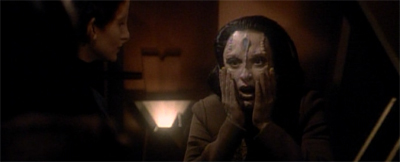
Face of the enemy...

Face of the enemy…

Continue reading

Star Trek: Deep Space Nine – Fearful Symmetry by Olivia Woods (Review)

The September and October, we’re taking a look at the jam-packed 1994 to 1995 season of Star Trek, including Star Trek: Deep Space Nine and Star Trek: Voyager. Check back daily for the latest review.

Fearful Symmetry had a long and painful history. The novel was originally scheduled for release April 2007. This would have seen the novel published about a year after the release of the previous Star Trek: Deep Space Nine relaunch novel, Warpath. The plan had been for new author Leanna Morrow to write the novel. When that proved impossible, Olivia Wood stepped in to rescue the assignment. Fearful Symmetry was eventually published in June 2008, over a year behind the initial schedule.

It’s interesting to speculate how that delay affected the Deep Space Nine relaunch. The next novel in the series, The Soul Key, would be the last published before the print Star Trek universe realigned as part of the Typhon Pact and The Fall, very much “event” books that served to relaunch the fictional universe. It is interesting to speculate whether the year between Warpath and Fearful Symmetry contributed to the decision to discontinue that particular iteration of the Deep Space Nine relaunch.

Still, whatever the reason, Fearful Symmetry is more interesting than successful. It is a book written with a number of great ideas, but some very flawed execution. It adopts a very “comic book” approach towards the Star Trek universe – featuring high concepts and crossovers and character who have been exaggerated slightly and distorted so as to fit the general perception of them rather than any consistent internal characterisation.

Fearful Symmetry is a bold and ambitious piece of work, particularly from a first time novelist. Unfortunately, it doesn’t work quite as well as it needs to.

ds9-fearfulsymmetry

Continue reading

Star Trek: Deep Space Nine – The Search, Part II (Review)

The September and October, we’re taking a look at the jam-packed 1994 to 1995 season of Star Trek, including Star Trek: Deep Space Nine and Star Trek: Voyager. Check back daily for the latest review.

In a way, The Search feels almost like a parody of the classic Star Trek season-bridging cliffhanger. It is a story told under the same title, but with both halves of the story feeling distinct enough to stand on their own two feet. Written by two different writers and directed by two different directors, it very much feels like two very different stories linked primarily by an efficient cliffhanger.

It’s not radically dissimilar to the two-parters from Star Trek: The Next Generation. Redemption and Descent come to mind, two-part adventures that very much feel like two different stories melded together rather than one single over-arching story. This disjointedness makes a great deal of sense, given the standard operating procedure when it came to Star Trek cliffhangers, as established by Michael Piller with The Best of Both Worlds, Part I. The logic is simple: write part one; go away for a few months; return and try to write part two.

Of course, The Search very clearly isn’t a season-bridging cliffhanger. It’s a season-opening two-parter. And it’s so cleverly and consciously structured as two very different episodes that it can’t help but feel like a sly nod at the inevitable outcome of that approach to writing – playfully self-aware of how disjointed the whole experience feels as a single story.

A whole new Vorta problem...

A whole new Vorta problem…

Continue reading

Mike W. Barr and Gordon Purcell’s Run on Star Trek: Deep Space Nine (Malibu Comics) (Review/Retrospective)

The September and October, we’re taking a look at the jam-packed 1994 to 1995 season of Star Trek, including Star Trek: Deep Space Nine and Star Trek: Voyager. Check back daily for the latest review.

The nineties comic book market was an interesting place. It enjoyed a huge boost due to the rise of speculation and collectors. The industry was massively successful in the early years of the decade, fuelled by high-profile artists, hype, and events. The industry imploded in on itself in the middle and towards the end of the decade, but it looked surprisingly profitable in the early years. Against that backdrop, Malibu Comics emerged.

Malibu had become the publisher of record for Image Comics in 1992. Image had been founded by a number of popular artists who had departed Marvel to set up their own shop and found their own company. Malibu distributed their comics for about a year, which gave Malibu access to a larger distribution platform. Although Image soon grew strong enough to publish its own comics, there was a point where Malibu had surpassed industry veteran DC Comics in the market place.
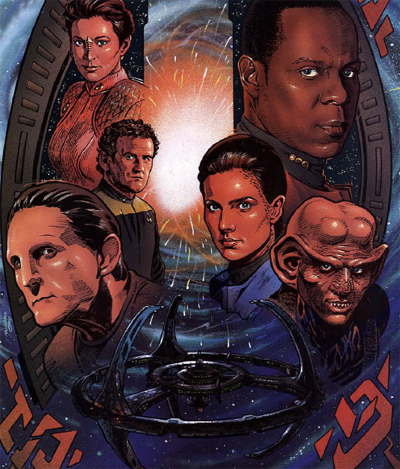
"Think of it—five months ago no one had ever heard of Bajor or Deep Space Nine. Now all our hopes rest here."

“Think of it—five months ago no one had ever heard of Bajor or Deep Space Nine. Now all our hopes rest here.”

Against this backdrop, Malibu secured the rights to publish comic books based on Star Trek: Deep Space Nine. Up until this point, DC comics had been publishing comics based on the original Star Trek and Star Trek: The Next Generation. Paramount’s decision to award the Deep Space Nine license to Malibu effectively split the comic book license up. DC Comics continued to publish comics based around the first two Star Trek shows, while Malibu had exclusive rights to the characters and world of Deep Space Nine.

As such, the decision to recruit writer Mike W. Barr and artist Gordon Purcell to write the first six issues of the comic was a pretty big deal. Barr and Purcell were incredibly associated with Star Trek comic books. The duo had done popular work on the movie-era comics, and had demonstrated an obvious and abiding affection for the franchise. Assigning these two creators to work on Deep Space Nine was a very clear message. Malibu were taking this license very seriously, indeed.

Triptych...

Triptych…

Continue reading

Star Trek – Debt of Honour (Review)

This June, we’re taking a look at some classic Star Trek movie tie-ins and other interesting objects. Check back daily for the latest reviews and retrospectives.

By all accounts, Debt of Honour should be an unqualified success.

It’s a prestige graphic novel from DC comics, produced around the twenty-fifth anniversary of Star Trek and the release of Star Trek VI: The Undiscovered Country. It is written by celebrated comic book scribe Chris Claremont, fresh off his career-defining stint on Uncanny X-Men. An avowed Star Trek fan and comic book veteran, this should be in his wheel house. The art is provided by Adam Hughes, one of the most celebrated and respected artists of his time.

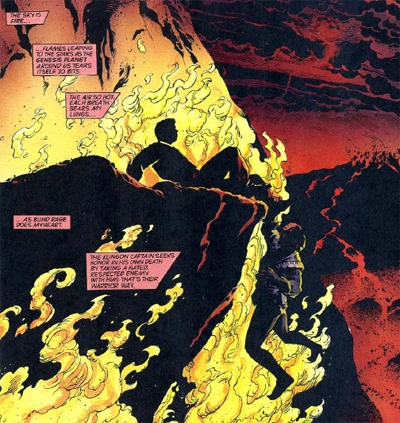
Talk about kicking off a comic...

Talk about kicking off a comic…

By any measure, Debt of Honour should count as some sort of hallmark for DC Comics’ Star Trek tie-ins. Unfortunately, that isn’t quite the case. A rather muddled storyline that is hopelessly devoted to Star Trek continuity while awkward interfacing with it,  Debt of Honour is just packed a little too tight. Charting a story from the earliest days of Kirk’s career to the aftermath of Star Trek IV: The Voyage Home, Claremont bites off more than he can chew.

Over the course of Debt of Honour, Claremont introduces a vague alien threat that has apparently been haunting Kirk for his entire career, a new arch-foe or love interest for Kirk, and even a supporting role for Kor. Along the way, he packs in cameos and shout-outs to various parts of Star Trek lore. He even explains why Klingons suddenly had ridges around the time of Star Trek: The Motion Picture. Ultimately, Debt of Honour is ambitious, but a little over-stuffed and quite over-cooked.

Warp speed ahead!

Warp speed ahead!

Continue reading

Star Trek – The 25th Anniversary (Review)

This June, we’re taking a look at some classic Star Trek movie tie-ins. Check back daily for the latest reviews and retrospectives.

Star Trek VI: The Undiscovered Country was released quite close to the twenty-fifth anniversary of Star Trek. With Star Trek: The Next Generation at the height of its popularity, the franchise was able to mark the occasion with a variety of celebrations. There were comic books and prose books celebrating the occasion. Both Spock and Scotty appeared on The Next Generation around the time of the anniversary.

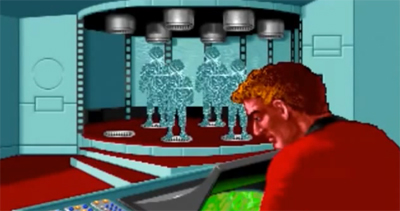
Perhaps the most obvious example was the release of Star Trek: The 25th Anniversary by Interplay. While it was not the first video game to be based on the Star Trek franchise, it was the first high profile release. It set the tone for commercial Star Trek video games, remaining one of the best-selling Star Trek video games ever produced. It paved the way for everything from Bridge Commander to A Final Unity to Elite Force.

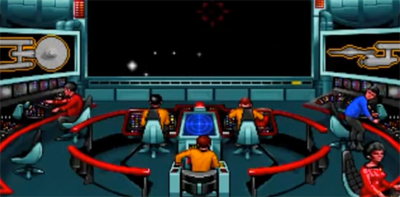
Ship shape...

Ship shape…

Released across multiple platforms and featuring seven episodic adventures structured like episodes of the classic television show, The 25th Anniversary set a dramatic and effective precedent for Star Trek video gaming. The CD-ROM edition of the game took things even further, featuring voice recordings of the show’s primary cast to help lend a sense of continuity and credibility to events. The 25th Anniversary is littered with easter eggs and in-jokes, and it’s constructed with the utmost love and affection.

However, perhaps what is most interesting about The 25th Anniversary is the way that it plays into all these established Star Trek clichés and tropes, but with a rather sophisticated outlook. It’s a wonderful example of how the original Star Trek show never stopped reinventing itself, only really reaching a truly idealised form long after it had been off the air.

Beam me up, Kyle!

Beam me up, Kyle!

Continue reading