• Following Us

  • Categories

  • Check out the Archives


  • Awards & Nominations

Star Trek: Deep Space Nine – Trials and Tribble-ations (Review)

Trials and Tribble-ations is a love letter to the franchise.

The thirtieth anniversary of Star Trek was a big deal. In many ways, the thirtieth anniversary celebration marks the end of the franchise’s cultural peak. Star Trek: The Next Generation is still fresh enough in the cultural consciousness that the anniversary is a big deal, even if the ratings on Star Trek: Deep Space Nine and Star Trek: Voyager are not necessarily what everybody would want them to be. The decline that would last through to the end of Star Trek: Enterprise only really comes into play in the wake of the big anniversary.
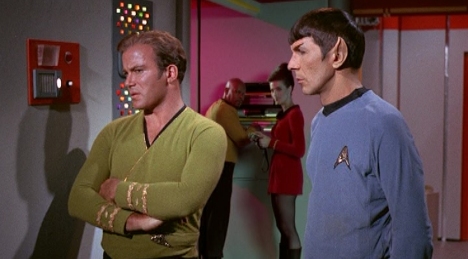
You know when you've been Gumped.

You know when you’ve been Gumped.

The thirtieth anniversary of the franchise was an embarrassment of riches, particularly from the perspective of a rather limp fiftieth celebration. Even the disappointment of Flashback was dwarfed by the abundance of affectionate homages and triumphant celebrations of a television series that had gone from a cult failure repeating endlessly in syndication to a pop cultural juggernaut with two television series and a successful film franchise running simultaneously. Trials and Tribble-ations was very much the cornerstone of all this.

Sure, there were other celebrations to mark the franchise’s big three-oh. While Flashback might of been a bit of a disappointment as a big anniversary special, Future’s End, Part I and Future’s End, Part II were a loving ode to Star Trek IV: The Voyage Home. Indeed, Star Trek: First Contact went even further and threw Star Trek II: The Wrath of Khan into the mix, blending the franchise’s most acclaimed and most financially successful films together for the occasion. Captain Janeway even crossed paths with the cast of Frasier to mark the occasion.
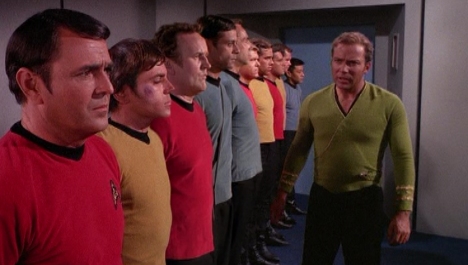
Quite the lineup.

Quite the lineup.

In spite of all of that, Trials and Tribble-ations stands quite apart from all the noise around it. There is a legitimate debate to be had about whether it is unequivocally the best of these productions, although it stands a very strong chance of winning that particular argument. However, there is no denying that it is the best celebration of the thirtieth anniversary. It is an adoring and affectionate love letter to the Star Trek franchise, one that seems to have been produced with giddy grin on its face and a skip in its step.

However, Trials and Tribble-ations works even beyond that. It is not simply a loving tribute to a monument of American popular culture, although that would be entirely justified. It is an acknowledgement to the decades of fandom that kept Star Trek alive during its occasional adventures in the wilderness.  Trials and Tribble-ations does not just praise Star Trek for surviving thirty years despite being cancelled after three seasons, but which captures the enthusiasm that sustained the series across those thirty years.
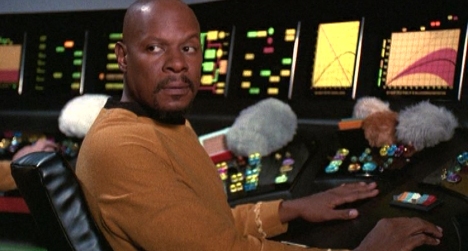
Doesn't scan.

Doesn’t scan.

It would be easy for a thirtieth anniversary special to treat the occasion as an act of cultural archeology, the careful and ritual unearthing of a popular artifact with all due reverence paid. Indeed, this was arguably the central problem with Flashback, an episode more interested in Star Trek as a memory and as a subject of nostalgia than a living breathing organism. Trials and Tribble-ations instead opts to treat Star Trek as a living and breathing organism, something tangible and material rather than abstract and ethereal.

Indeed, the episode ends with the revelation that the past is not another country. Sometimes you can bring something back. Even if that thing is a tribble.
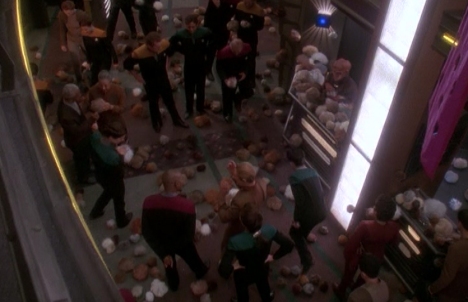
You can go home again...

You can go home again…

Continue reading

Star Trek: Deep Space Nine – The Assignment (Review)

The Assignment is perhaps the most conventional episode of the fifth season of Star Trek: Deep Space Nine. It is also one of the most disappointing.

The Star Trek franchise has long been fond of “possession” and “imitation” stories, dating back through Whom Gods Destroy and Turnabout Intruder to Lonely Among Us and Datalore and Power Play. It is easy to see the appeal of these stories from a production standpoint. An effective possession story can likely be filmed on standing sets and relies primarily upon an established member of the ensemble. For an actor, it provides an exciting opportunity to play against type, which is a great way to keep a weekly television series exciting.

O'Brien must suffer... through a terrible script.

O’Brien must suffer… through a terrible script.

However, it is very much a stock plot. There are only so many variations that a long-running franchise can put on the tried-and-tested formula before it begins to feel a little tired. Deep Space Nine has already had more than its fair share of “out of character” plots, from The Passenger to Dramatis Personae through to Crossover and all the other mirror universe episodes. It gets to the point where “there’s an evil alien inside Keiko O’Brien” feels like a fairly bland iteration of this particular type of Star Trek story.

In a season where Deep Space Nine spends so much time pushing the boundaries of Star Trek, it is frustrating to see the show offer up such a generic installment.

Rom is in a bit of a fix...

Rom is in a bit of a fix…

Continue reading

Star Trek: Deep Space Nine – … Nor the Battle to the Strong (Review)

“The world breaks everyone and afterward many are strong in the broken places.”

– Hemingway, A Farewell to Arms (1929)

Far a field.

Far afield.

Continue reading

Star Trek: Deep Space Nine – The Ship (Review)

It seems we’re approaching an impasse.

We’ve already arrived.

– Kilana and Sisko sum up the fifth season

Under siege.

Under siege.

Continue reading

Star Trek: Deep Space Nine – Apocalypse Rising (Review)

Apocalypse Rising stands quite apart from the other Star Trek: Deep Space Nine season premieres.

Most obviously, it the only single-part season premiere across the entire seven seasons of Deep Space Nine. Emissary and Way of the Warrior were two-hour television movies. The Homecoming fed into the franchise’s first official three-part story. The Search, Part I and The Search, Part II were obviously a two-part episode, while Image in the Sand and Shadows and Symbols provided a two-part introduction to the seventh season. A Time to Stand segued directly into Rocks and Shoals while also setting up a six-episode arc.

The times, they are a-changeling...

The times, they are a-changeling…

This is not to suggest that Apocalypse Rising is a more typical Star Trek season premiere. It is not a continuation of Broken Link in the same way that The Best of Both Worlds, Part II is a direct continuation of The Best of Both Worlds, Part I or that Basics, Part II is a direct follow-on from Basics, Part I. While Apocalypse Rising does resolve a cliffhanger left dangling by Broken Link, that cliffhanger was only really set up in the final two minutes of the episode. Indeed, the cliffhanger dangling from Broken Link recalls the endings of The Jem’Hadar or The Adversary.

Apocalypse Rising is also notable for being the first season premiere that is not positioned as a jumping on point, that is not intended to either expand the scope of the show or recruit new viewers. One of the luxuries of avoiding the traditional cliffhanger structures to bridge seasons was the freedom to begin each season with a relatively clean slate and introduce new elements. The Search, Part I and The Search, Part II introduced the Defiant and retooled the show to focus on the Dominion. The Way of the Warrior brought Worf over and shifted emphasis to the Klingons.

Klingon to the status quo...

Klingon to the status quo

While Apocalypse Rising does represent a slight shift in the tone of the show, it is not a radical new departure. More than that, it leans rather heavily on the show’s established mythology and in some ways indicates a desire to get the show back on track following an extended detour into war with the Klingons during the fourth season. Apocalypse Rising confirms what was made clear during the fourth season of the show, that Deep Space Nine has eventually evolved into its final form. Apocalypse Rising is a show so comfortable with itself that there’s no need to reinvent.

Although a little cramped and rushed in places, Apocalypse Rising represents a strong start to a stellar season. It is an efficient and effective piece of television, one that demonstrates the clarity of focus driving the season that will follow.

Drinking games...

Drinking games…

Continue reading

Star Trek – Season 3 (Review)

This July and August, we’re celebrating the release of Star Trek Beyond by taking a look back at the third season of the original Star Trek. Check back every Monday, Wednesday and Friday for the latest update.

The third season of Star Trek was always doomed.

NBC had wanted to cancel the show after the second season, but a massive outpouring of fan support (and no small amount of press coverage) convinced them to renew the series for a third year. However, this was not a pardon. It was at best a temporary reprieve. The budget was slashed. Key creative personnel were lost. Outsiders with minimal experience in science-fiction television were drafted. The show was exiled to the graveyard shift of late Friday nights, when its target audience would either be in bed or out on the town.

tos-turnaboutintruder41a

With all of that in mind, it is no wonder that history has been cruel to the third season. The third season is generally regarded as a massive step down in quality from the first two years of the series, and that is certainly true. Without a strong producer like Gene L. Coon or a quality script editor like Dorothy Fontana, Star Trek would struggle to match the consistency of those first two years. Even before factoring in budget cuts and other constraints, the third season cannot compete with the prior two seasons on an episode-to-episode basis.

However, there is also a recurring sense that the third season of Star Trek is odd. It feels tangibly different from the two seasons that came before it. However, it also feels markedly different from the twenty-four live action seasons that followed. There is a strange tone to the season, one that feels distinct from that of the larger Star Trek franchise. The third season is populated by ghost stories and dying worlds, by mythology and folklore. Repeatedly, the logic that drives plots seems more magical than rational.

tos-allouryesterdays48a

This lends the third season an almost mystical and irrational quality. While Star Trek has flirted with irrationality and dream logic before, most notably in the episodes credited to writer Robert Bloch and instalments like Shore Leave or The Immunity Syndrome, the third season grabs these concepts with both hands. There is a sense that all of the assumptions underpinning the Star Trek universe are up for grabs, that nothing can truly be known for certain, and that relaity itself is coming undone.

Coupled with a recurring motif of dying races and dead worlds, this irrationality serves to cast a shadow over the entirety of the third season. For all that the third season embraces the utopian ideals that would become a staple of the franchise, the third season is permeated by an apocalyptic dread. There is a sense that doomsday is approaching, that death is an inevitability, that all might be lost. In a very real way, this perfectly captures both the production realities of the third season and the general mood of the time around it.

tos-isthereintruthnobeauty28

Continue reading

Star Trek – Turnabout Intruder (Review)

This July and August, we’re celebrating the release of Star Trek Beyond by taking a look back at the third season of the original Star Trek. Check back every Monday, Wednesday and Friday for the latest update.

This is the end.

And what an ignominious ending it is. Turnabout Intruder is the last episode of the original Star Trek run, bringing down the curtain on three years of boldly going and bidding farewell to this cast… at least for the moment. It is also an infamously terrible episode of television, in which Captain Kirk finds himself swapping bodies with the psychotic scientist Janice Lester. Lester is repeatedly categorised as insane, but her primary motivation seems to be rebellion against Starfleet’s institutional sexism.

It's full of stars.

It’s full of stars.

Seen as this is a Gene Roddenberry story, Turnabout Intruder sides entirely with Starfleet on the matter. This was the same writer and producer who would later balk at The Measure of a Man because he thought that Data should willingly surrender himself to Starfleet experimentation. So, instead of becoming an exploration of sexism and discrimination, Turnabout Intruder instead becomes a vigorous defense of institutionalised misogyny. Of course Starfleet doesn’t allow women captains, the episode suggests, they could never handle the strain!

It is an episode that really puts paid to the show’s claims of liberal progressivism, credited to a writer who would in later years cultivate a mythology of himself as the architect of that liberal progressivism. Turnabout Intruder is just about the most damning argument against the franchise’s utopian idealism imaginable, which makes it particularly insulting as a series finale.

William Shatner did not react well to news of cancelation.

William Shatner did not react well to news of cancellation.

Continue reading

Star Trek – All Our Yesterdays (Review)

This July and August, we’re celebrating the release of Star Trek Beyond by taking a look back at the third season of the original Star Trek. Check back every Monday, Wednesday and Friday for the latest update.

It is almost as though the Star Trek franchise doesn’t want to end.

For a fifty-year-old franchise, Star Trek has a hilarious near-miss ratio when it comes to offering satisfying conclusions. There are exceptions, of course. The franchise seems quite good at closing smaller chapters while the rest of the property rattles on. Star Trek VI: The Undiscovered Country was the best place to leave the cast of the original show. The final season of Star Trek: Deep Space Nine might have been rocky, but What You Leave Behind bid an emotional farewell to the cast and crew. Beyond that? The franchise struggles.

A cold reception.

A cold reception.

It often seems like the ideal closing instalment is buried one or two stories shy of the actual ending. All Good Things… would have been a great place to leave the cast of Star Trek: The Next Generation, particularly since Star Trek: Nemesis wound up being such a damp squib of a conclusion. Demons and Terra Prime provided a satisfying conclusion to the final two years of Star Trek: Enterprise, only for These Are the Voyages… to air as the final episode of the franchise for well over a decade.

This is something that the franchise inherited from the original show. Star Trek was remarkably terrible at choosing a high (or even an appropriate) note on which to end. Although some of this can be down to the fact that sixties television seasons did not build to a finale in the way that modern television does, the three seasons of Star Trek all end in disappointing fashions. The City on the Edge of Forever would have been a great close to a first season that built incredible momentum across its run. Instead, the year ended on Operation — Annihilate!

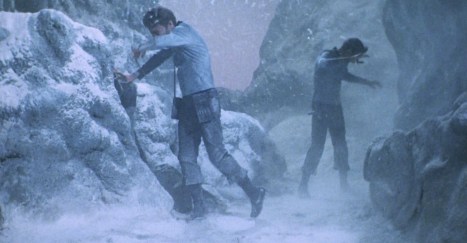
Snow escape.

Snow escape.

This was a bigger issue during the second season, when it was entirely possible that Star Trek would be cancelled. Ending on a strong note was imperative. Instead, Gene Roddenberry chose to give over the last broadcast and production slot of the season to Assignment: Earth, a thinly-disguised (and ultimately underwhelming) pilot for a series that never got off the ground. Even in terms of production, the penultimate episode of the season was Roddenberry’s vile passion project, The Omega Glory. (The Ultimate Computer would have made a much better ending.)

So it is with the third season. The last episode of the third season is an infamous disaster, Turnabout Intruder ranking as one of the very worst episodes of Star Trek ever produced. Even the misguided and mean-spirited cynicism of These Are the Voyages… has nothing on the rank sexism of Turnabout Intruder. It was an ignominious episode upon which to draw down the curtain, to wrap up three years and seventy-nine episodes of storytelling. It is hard to tell whether the episode is more or less awful than The Omega Glory or Assignment: Earth, but it is in contention.

Dying free(ze)...

Dying free(ze)…

This is all the more frustrating because a perfectly good alternative rests right along side it. All Our Yesterdays is a flawed and imperfect episode in some key ways, like many of the third season episodes around it. It is a story that flows on dream logic rather than rational plotting, relying on a bizarre fairy tale version of time travel and falling back on some of Fred Freiberger’s best-loved tropes. It is also a tough sell as a “final” episode, given that the series had not been cancelled by the point that the episode entered production, and it does not offer too much in the way of closure.

And yet. All Our Yesterdays feels like the culmination of the morose themes that have been building through the third season, all the dead worlds and the ghost stories and the doomed romances. It is a story about escaping to the past when there seems to be no future. It is populated by barren wastelands and death sentences, about the literal end of the world and survival beyond that point. It is a quiet and withdrawn affair, morbid and reflective more than heightened or action driven. It is a story about death, which feels entirely appropriate at this interval.

How BiZara...

How BiZara…

Continue reading

Star Trek – The Savage Curtain (Review)

This July and August, we’re celebrating the release of Star Trek Beyond by taking a look back at the third season of the original Star Trek. Check back every Monday, Wednesday and Friday for the latest update.

Gene Roddenberry returns to Star Trek, to put the show to rest.

Two of the final three episodes of this third season originated with Roddenberry, putting paid to the idea that the veteran executive producer was entirely absent from the year. Roddenberry had departed the show at the start of the season, after issuing NBC with an ultimatum regarding the scheduling of his series. He had moved out of the Star Trek production offices and across the lot to develop his own projects. The standard narrative of the third season suggests that Roddenberry was no longer around to keep the show on the rails.

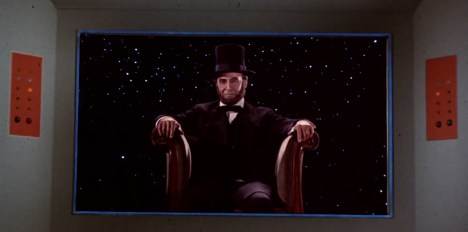
Holy space!Lincoln...!

Holy space!Lincoln…!

This is untrue, in a number of respects. Roddenberry was involved in the production of the third season, just not as actively as he had been. He was responsible for commissioning and championing a number of early third season episodes inherited by Fred Freiberger, including Elaan of Troyius and The Paradise Syndrome. He had even used his remaining leverage to shamelessly try to shoehorn merchandise into Spock’s Brain and Is There in Truth No Beauty? He was also drawing an executive producer salary and nabbed two late-season production slots.

Of course, this argument also relies on the assumption that Roddenberry understood Star Trek better than anybody else. Roddenberry had created Star Trek, but he was not the singular vision behind it. Writers like Dorothy Fontana and producers like Gene L. Coon were as responsible for shaping the show as Roddenberry in many respects. Roddenberry might have talked a good game, but he was also a producer who believed that The Omega Glory would have made a good pilot for the show.

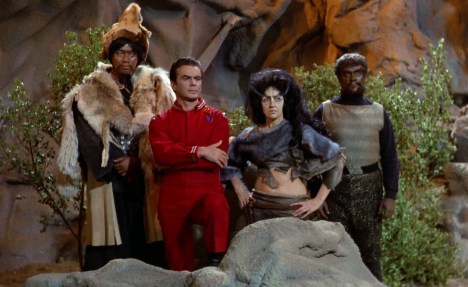
Legion of Doom!

Legion of Doom!

If anything, there is something faintly damning about Gene Roddenberry’s triumphant return to the series at the end of its third year. Neither The Savage Curtain nor Turnabout Intruder are good episodes. In fact, the best thing that can be said about Roddenberry’s two final contributions is that The Savage Curtain probably isn’t quite as bad as And the Children Shall Lead or The Way to Eden. Still, both episodes feel regressive and awkward. Roddenberry’s writing is a reminder of just how far the show had come in the care of other producers.

However, at least The Savage Curtain is memorable.

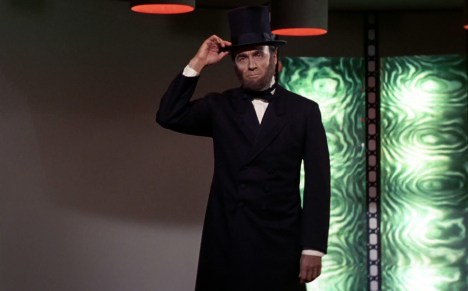
Topping it all off.

Topping it all off.

Continue reading

Star Trek – Requiem for Methuselah (Review)

This July and August, we’re celebrating the release of Star Trek Beyond by taking a look back at the third season of the original Star Trek. Check back every Monday, Wednesday and Friday for the latest update.

Requiem for Methuselah is a surprisingly quiet episode.

The basic premise of the episode suggests sound and fury. The crew of the Enterprise have been infected by a deadly illness. McCoy speculates that there are only four hours in which to save the crew. Desperately searching for a cure, Kirk leads an away team down to a planet rich in the necessary minerals. When a man claiming to be the planet’s sole inhabitant refuses to allow Kirk access to the mineral, there is a tense stand-off; Kirk threatens to have the Enterprise obliterate the man and take the compound by force.

"You know, falling in love with the surrogate daughter of the man who can save my ship might not be the best tactical move here. Particularly since I've known her all of two hours."

“You know, falling in love with the surrogate daughter of the man who can save my ship might not be the best tactical move here. Particularly since I’ve known her all of two hours.”

Despite this rather high-stakes set up, the rest of Requiem for Methuselah is rather low-key. Despite his initial hostility to the uninvited guests, the mysterious stranger invites Kirk and the away team to his home. The episode spares the audience the sight of crew members sick and dying, with Scotty and Uhura (and a “skeleton crew”) doing a respectable job of holding down the fort as the end approaches. Even when the first couple of attempts to manufacture a cure fall flat, McCoy and his colleagues remain professional and dignified through to the end.

In a way, this would seem to capture the tone of this stretch of the third season.

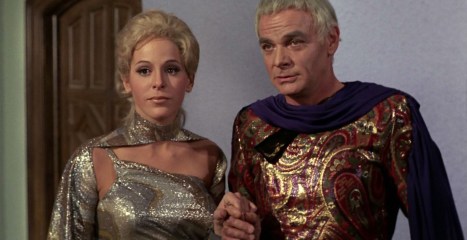
Our man Flint.

Our man Flint.

Continue reading