• Following Us

  • Categories

  • Check out the Archives


  • Awards & Nominations

Deep Space Nine at 25 – The Most Multicultural of (Star) Treks

Star Trek: Deep Space Nine is the first (and perhaps only) multicultural Star Trek.

Ironically, Deep Space Nine is often derided by traditionalist fans for eschewing core Star Trek principles. Deep Space Nine was the first (and only) Star Trek series to unfold on a space station rather than a space ship, boldly sitting rather than boldly going. More than that, Deep Space Nine was the first Star Trek series to embroil the Federation in an active war, notwithstanding the Klingon or Romulan Cold Wars nor the Cardassian Wars that retroactively took place during the early seasons of Star Trek: The Next Generation.

However, in a very real and substantial way, Deep Space Nine was also the Star Trek series that hewed most closely to the humanist principles of Gene Roddenberry’s Star Trek. It could reasonably be argued that Deep Space Nine simply made an effort to interrogate and to explore premises that Roddenberry never properly considered. At its core, Star Trek had always been about embracing the unknown with open arms and about learning that what was different was not always scary or monstrous. Deep Space Nine embraced that.

Deep Space Nine was not a series about a bunch of explorers looking “to boldly go” in any literal sense, but about a bunch of characters struggling to fundamentally understand “new life forms and new civilisations.” More than the other Star Trek series, Deep Space Nine was about embracing other cultures and values, about recognising that differences could enrich as much as divide, and that there was no single “right” way build a better world. Deep Space Nine is an ode to humanism and compassion, embodying many of the virtues other Star Trek shows nod towards.

Continue reading

Deep Space Nine at 25 – The Most Timeless of (Star) Treks

This may be the last time we’re all together. But no matter what the future holds, no matter how far we travel, a part of us – a very important part – will always remain here, on Deep Space Nine.

– Benjamin Sisko, What You Leave Behind

Star Trek: Deep Space Nine turned twenty-five this week.

Deep Space Nine is an important addition to the Star Trek canon in a number of respects. It was the only Star Trek series to air as a secondary series, its entire seven-season run coinciding with the broadcast of other weekly Star Trek series; its first two seasons overlapping with the final two seasons of Star Trek: The Next Generation and Star Trek: Voyager. It was also the last Star Trek series to air in syndication. It was arguably marked the point at which the viewing public lost interest in Star Trek during the nineties, the first Star Trek spin-off to lose its audience over its run.

However, Deep Space Nine was also memorable in other respects. It was the first Star Trek series not to take place on a ship named “Enterprise”, and the first not to take place on a ship at all. It was the first Star Trek series to embrace the possibilities of serialisation. It was the Star Trek cast with both the most diverse core cast and the widest ensemble, with an impressive collection of recurring actors and characters fleshing out the world. It was also arguably the only Star Trek series to truly embrace multiculturalism, with several episodes focusing exclusively on Klingon or Ferengi characters.

Still, the most enduring aspect of Deep Space Nine is how enduring it feels. At twenty-five years old, Deep Space Nine still feels fresh and relevant. It is a series that has a lot to say about the current moment, but it also had a lot to say about the moment before that. Deep Space Nine was undoubtedly a product of its time, but never feels as consciously wedded to its cultural context as the other Star Trek series. Ironically for the only Star Trek series to really engage with the idea of time, and the importance of forward movement through time for its character, Deep Space Nine is strangely timeless.

Continue reading

Star Trek: Deep Space Nine – Season 7 (Review)

The seventh season of Star Trek: Deep Space Nine is a remarkable accomplishment.

The seventh season is not perfect by any measure. Taken as a whole, it lacks the consistency that made the fifth season one of the best twenty-odd-episode seasons of television ever produced, particularly in a dire mid-season run of episodes that includes Prodigal Daughter, Field of Fire and The Emperor’s New Cloak. The fifth season (and even the sixth) never hit a run of three consecutive episodes that drag that hard. Similarly, there are moments when the production trips over itself during its epic run of ten closing episodes.

Similarly, it lacks the sheer quantity of all-time great episodes that made the sixth season so exciting and compelling, like that opening six-episode arc or Far Beyond the Stars or In the Pale Moonlight. However, the seventh season does quite well for itself; episodes like Treachery, Faith and the Great River, Once More Unto the Breach, The Siege of AR-558, It’s Only a Paper Moon, Chimera, Inter Arma Enim Silent Leges and Tacking Into the Wind are massively underrated and count among the best episode that the franchise ever produced.

However, the seventh season has a very clear sense of direction and purpose. After all seven years is a long time on television. By the time that the other Star Trek series hit that mark, there was a sense of exhaustion creeping in around the edges. The final season of Star Trek: The Next Generation often felt aimless and meandering, the production team waiting to transition to feature films. The final season of Star Trek: Voyager felt similarly worn out, a faded photocopy of an approach that had worked on the previous three seasons.

In sharp contrast, the seventh season of Deep Space Nine knows roughly where it is going. From the opening scenes of Image in the Sand, the production team are cognisant of the fact that the curtain will be coming down at the end of the season. As a result, the seventh season is written with an ending in mind. The writers might not have known that ending from the outset, and were still working on it even during the sprawling final arc at the end of the year, but they knew that it existed and was waiting twenty-six episodes in the future.

As a result, the seventh season of Deep Space Nine has a very strong sense of identity and compelling sense of urgency. These attributes distinguish the season the final years of The Next Generation and Voyager, but also mark it out as one of Deep Space Nine‘s (and the franchise’s) strongest years.

Continue reading

Star Trek: Deep Space Nine – What You Leave Behind (Review)

Ending a television series is always a daunting proposition, even with ten episodes allocated to that purpose.

There are very few “perfect” television finales, very few final episodes that perfectly encapsulate everything that made a television series great. Indeed, many popular television series end with underwhelming finales. Some are even retroactively tarnished by this legacy; The Finale for SeinfeldDaybreak for Battlestar GalacticaThe End for Lost. To its credit, the Star Trek franchise arguably has one perfect finale with All Good Things…, the final episode of Star Trek: The Next Generation.

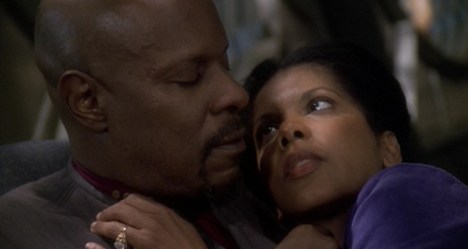
A touching conclusion…

It might have been greedy to ask for two such perfect finales, especially in such close proximity to one another. What You Leave Behind is not a perfect finale by any measure. It is clumsy in places, it makes bad choices in others. The audience can feel the budgetary constraints on the production team at certain points, and the time constraints on the writing team at others. Star Trek: Deep Space Nine does not end with a “perfect” two-part episode. It ends in a messy fashion.

Still, even if What You Leave Behind is not a perfect television finale, it is a good one. What You Leave Behind doesn’t do everything that it could do, but it does everything that it needs to. While clumsiness and awkwardness hold the episode back from perfection, they exist in such a way as to add to its charm. What You Leave Behind captures the spirit of Deep Space Nine, in its successes and its failures. What You Leave Behind is a finale that speaks to the core essence of its show, to its best and its worst selves in the same breath.

The big goodbye.

The result is a finale that feels satisfying and earned, despite its narrative miscalculations. What You Leave Behind is true to Deep Space Nine, and focuses primarily on trying to pay off seven years of character threads and two years of story. Its gravest mistakes are inherited, the result of decisions made more than a year earlier in episodes like Waltz or The Reckoning that were allowed to fester and grow over the following thirty-odd episodes. Even in its failures, What You Leave Behind is trying to do right by its story.

There is a large gulf in quality between All Good Things… and What You Leave Behind. However, that gap is smaller than the space that separates What You Leave Behind from Turnabout Intruder, Endgame or These Are the Voyages… For all its issues, there is something heartbreaking in What You Leave Behind. There is a sense that this is truly the end of the line, that things have changed and the world keeps right on spinning.

We all need a little space…

Continue reading

Star Trek: Deep Space Nine – The Dogs of War (Review)

The Dogs of War is the penultimate episode of Star Trek: Deep Space Nine.

As such, it has lots of important things to be doing. The episode’s primary function is to streamline the ongoing narratives so that they might all neatly feed into What You Leave Behind. The goal of any penultimate episode is to set up the shot so that the finale might punt the ball into the goal, in a manner that leads to a satisfying conclusion. Given that The Dogs of War is arriving towards the end of a seven-season series, a two-year war story, and a ten-episode closing arc, that is a lot of setting up to be done.

The best is Yates to come.

There is a lot of work to be done on paper. The plot thread focusing on the Pah-Wraiths has been dangling since When It Rains…, the Federation has not reengaged with the Breen since the disastrous encounter at the end of The Changeling Face of Evil, and Bajor hasn’t even mentioned the possibility of joining the Federation since Rapture or In the Cards. With that in mind, it makes perfect sense of The Dogs of War to focus on getting Bashir and Dax together while Quark thinks he is about to be Nagus as Damar is forced to hide in a cellar.

However, there is something inherently charming about how The Dogs of War chooses to prioritise threads over story beats that might seem more relevant or important, to dedicate a sizable chunk of the penultimate episode of Deep Space Nine to tying up a clumsy “will they?”/“won’t they?” romance and telling one last Ferengi story. The Dogs of War is an episode that speaks to what Deep Space Nine was, both in terms is esoteric plotting and its skewed-but-optimistic outlook. There might be better ways to wind down a series, but this is very Deep Space Nine.

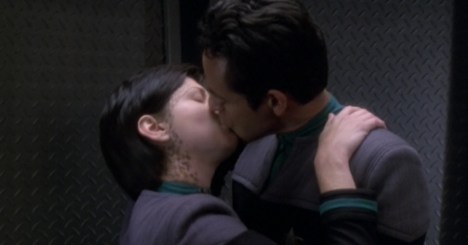
Love in a turbolift.

Continue reading

Star Trek: Deep Space Nine – Extreme Measures (Review)

Extreme Measures is the closest thing to a standalone story within this epic ten-part conclusion to Star Trek: Deep Space Nine.

All of the other episodes carry over plot threads and subplots that either develop existing narratives or set-up future twists. This is true even of the more self-contained chapters: When It Rains… and Tacking Into the Wind are something of a two-parter in the middle of the arc, but they pick up in the wake of The Changing Face of Evil; although The Dogs of War has a self-contained subplot focusing on the Ferengi, it deals with baggage from Extreme Measures while setting up What You Leave Behind.

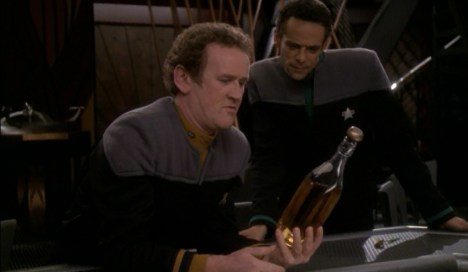
“Well, Miles. If you think it’ll make the episode go easier.”

In contrast, Extreme Measures is practically a bottle show. With the exception of a short one-scene appearance from Garak, Extreme Measures is devoid of the recurring guest stars that populate this final run of episodes. Although Damar and Martok are mentioned, neither Casey Biggs nor J.G. Hertzler appear. Perhaps glad of a week off before his double duty on The Dogs of War, Jeffrey Combs is entirely absent. There is no guest appearance from Louise Fletcher, Marc Alaimo, James Darren, Barry Jenner or Salome Jens.

Indeed, Extreme Measures is very precisely focused on the single story that it wants to tell. Most episodes in this final stretch of the final season have at least two or three plots running through them: Penumbra focuses on the loss of Worf, on Sisko’s retirement plans, on Damar’s growing unease; When It Rains… features the plotting of Dukat and Winn, the development of Damar’s rebellion, and the threat to the Alliance posed by Gowron; The Dogs of War witnesses Ferengi succession, the plan for the invasion of Cardassia, the implosion of Damar’s rebellion.

Journey to the Centre of Sloan’s Mind.

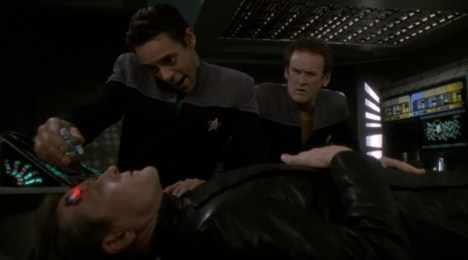
There is so much happening across these ten episodes that it feels strange that Extreme Measures can effectively call a timeout on these recurring plot threads. There are references to the Breen weapon and the Cardassian rebellion, to the ascension of Chancellor Martok and to Bashir’s lingering attraction to Ezri. However, Extreme Measures is an episode without a b-plot or a c-plot. The episode is driven entirely by its primary narrative, the story of how Julian Bashir and Miles O’Brien embark on one last adventure together.

There is something surreal, and almost endearing, about the fact that Deep Space Nine feels comfortable taking time out from its most ambitious experiment with serialisation to make the journey to the centre of Sloan’s mind.

“Julian, are you sure you haven’t been watching too much Star Trek: Voyager?”

Continue reading

Star Trek: Deep Space Nine – Tacking Into the Wind (Review)

Tacking Into the Wind might just be the last truly great episode of Star Trek: Deep Space Nine.

Of course, there are some very good episodes lying ahead. However, none of them hum as perfectly as Tacking Into the Wind does. The Dogs of War is fantastically constructed and does pretty much everything that a penultimate episode of a long running series needs to do, but it largely feels like a prelude episode to the grand finale. What You Leave Behind is a powerful and emotive piece of television, and an effective conclusion to seven years of storytelling, but it suffers from some pacing issues and some poor storytelling choices in its second half.

The end of an era.

However, Tacking Into the Wind is just brilliant. Deep Space Nine has produced more than its fair share of (relatively) standalone classic episodes: Duet, The WireThe Way of the Warrior, The Visitor, Trials and Tribble-ations, Far Beyond the Stars, In the Pale Moonlight. Even in the seventh season, there have been any number of episodes that work beautifully on their own terms: Treachery, Faith and the Great River, Once More Unto the Breach, The Siege of AR-558, Chimera. Even those tied into larger arcs like the Dominion War still worked as relatively standalone units of story.

However, Tacking Into the Wind is brilliant in a way that is very particular to this moment of Deep Space Nine. Perhaps the closest companion pieces are episodes like Call to Arms or Sacrifice of Angels, episodes that work well enough on their own terms, but become transcendental when approached as the culmination of long-running story threads that pay off months of storytelling decisions. Taking Into the Wind takes this approach and escalates it further. Taking Into the Wind is the culmination of a narrative that has been brewing for the better part of a decade.

Surviving by the skin of his teeth.

Tacking Into the Wind is an episode that could never have worked on Star Trek: The Next Generation or Star Trek: Voyager. It is too dependent on lingering narrative threads, on long-running arcs, on a grand and sweeping (and ironic) view of history. Tacking Into the Wind ties up the fate of the Klingon Empire, an institution that has been in decline since Heart of Glory and rotting from the inside out since Sins of the Father. It parallels that with a fundamental underlying shift in the Cardassian society introduced in The Wounded.

Tacking Into the Wind is an episode that could only possibly work as the pay off to serialised storytelling, and which demonstrates the power of a good dramatic pay-off almost a decade in the making. In many ways, Tacking Into the Wind is the perfect episode for this so-called “Final Chapter”, the perfect distillation of everything that the creative team have been trying to do with this ten-part sprawling epic.

Cloak of office.

Continue reading

Star Trek: Deep Space Nine – Strange Bedfellows (Review)

Three seems to be the magic number when it comes to long-form plotting in Berman era Star Trek.

Star Trek: The Next Generation arguably pulled off a three-consecutive-episodes arc with The Best of Both Worlds, Part I, The Best of Both Worlds, Part II and Family. Even the continuity-adverse Star Trek: Voyager managed something similar with Scorpion, Part I, Scorpion, Part II and The Gift. Star Trek: Enterprise tried a number of three-episode arcs in its final season, even if only The Forge, Awakening and Kir’Shara really worked; Borderland was a preamble to Cold Station 12 and The Augments, while The Aenar was a postscript to Babel One and United.
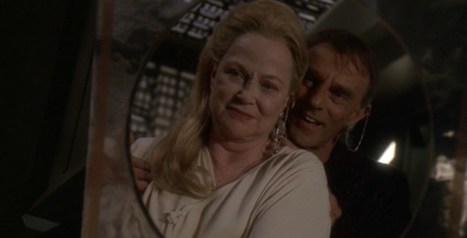
Super villain team-up.

Three episodes seems to work quite well for Star Trek: Deep Space Nine. The series’ second season premiere was the franchise’s first bona fides three-parter, The Homecoming, The Circle and The Siege. Even when it came to longer arcs, three consecutive episodes seemed be the limit; after Call to Arms, A Time to Stand and Rocks and Shoals, the arc opening the sixth season stumbled with Sons and Daughters before regaining its footing for Behind the Lines, Favour the Bold and Sacrifice of Angels.

As an aside, it also took three episodes for the alliance between the Dominion and Cardassia to properly integrate into the show’s mythology after the events of In Purgatory’s Shadow and By Inferno’s Light; the fifth season took a pause with Doctor Bashir, I Presume, A Simple Investigation and Business as Usual before beginning to unpack the consequences of that statusquo-shattering twist in Ties of Blood and Water.
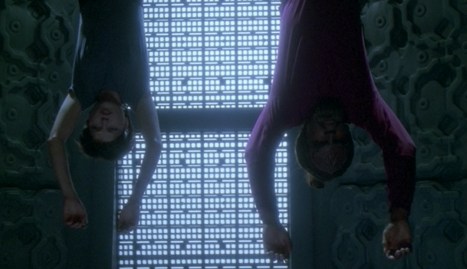
Hang loose.

There are any number of reasons why three works so well. Maybe three episodes allow for that classic three-act structure, the iconic storytelling template. Perhaps the production team on Deep Space Nine tended to work in chunks of three scripts at a time, with two or three subsequent scripts in development by the time that any given script was finished; if this was the case, it would mean that the production team was ready to start fresh with the fourth script. Whatever the reason, it is a familiar pattern.

Although “the Final Chapter” is nominally a ten-episode arc, counting What You Leave Behind as two distinct episodes, the plot beats tend to flow in discernible three-episode chunks. Ezri’s mission to rescue Worf plays out over Penumbra, ‘Til Death Do Us Part and Strange Bedfellows. Gul Rusot is introduced in The Changing Face of Evil, is built up in When It Rains…, and meets his end in Tacking Into the Wind. Bashir discovers that Odo is sick in When It Rains…, figures out Section 31 is responsible in Tacking Into the Wind, and recovers the cure in Extreme Measures.
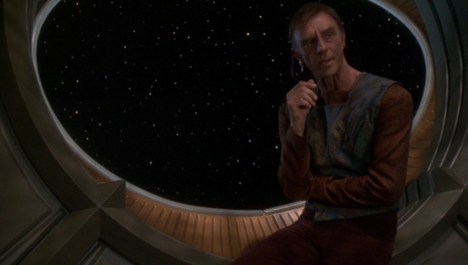
The window of opportunity is closing.

The opening salvo of this ten-episode arc was clearly intended as a three-part story. The original titles of the episodes were Penumbra, Umbra and Eclipse, suggesting an encroaching darkness that would cast a long shadow by the end of the third episode. Coincidentally or not, that would mark the end of the first third of the larger story arc. It suggests a very formal and careful structure, suggesting a three-act structure within the first act of a three-act structure. On paper, it is a very bold and ambitious piece of structuring from the Deep Space Nine writers.

However, the production struggle to maintain that structure. These ten episodes stumble when it comes to pacing and plotting. The weakest threads in this final run are those that feel either rushed or over-extended, which struggle to hit the right beats. Strange Bedfellows is an episode that struggles because it feels like its storythreads have either been stretched or compressed, the important events either pulled back into ‘Til Death to Us Part or pushed forward into The Changing Face of Evil. The result is an episode that feels stranded between bigger story beats.

No time for reflection.

Continue reading

Star Trek: Deep Space Nine – ‘Til Death Do Us Part (Review)

Perhaps more than any other Star Trek show, Star Trek: Deep Space Nine is an epic.

Sure, Star Trek: Voyager has more than a few characteristics of epic storytelling; it is a mythic journey, much like The Odyssey and The Iliad before it. In fact, several episodes of Voyager borrow quite heavily from those earliest of stories, with Favourite Son feature a planet for of sirens and Bliss finding the crew confronted with the deep space equivalent of lotus eaters. However, the storytelling on Voyager was always too small and too episodic to embrace the potential for a sprawling galactic epic.

Wedded bliss.

In contrast Deep Space Nine is a story with a lot of breadth. Of course, there are any number of isolated and standalone episodes within the seven-year run of Deep Space Nine, but there is also a strong sense that these one-hundred-and-seventy-plus episodes of television can be taken together and fashioned into a single cohesive narrative that runs from Emissary through to What You Leave Behind. There are undoubtedly bumps and inconsistencies along the way, strange shifts in direction and sharp left turns, but the series hangs together relatively well as a single narrative.

This is particularly true when it comes to the final ten episode of the series, which are very much intended to draw down the curtain on seven years of storytelling, while reinforcing the sense that this has truly been an epic narrative.

Feels like coming home…

Continue reading

Star Trek: Deep Space Nine – Penumbra (Review)

Penumbra represents the beginning of the end, kicking off the epic ten-episode conclusion to Star Trek: Deep Space Nine.

To be fair, Deep Space Nine had already embraced serialised storytelling, whether in the seeding of gradually-building plotlines or its long-term character development. The show was most serialised in the audacious six-episode arc that opened the sixth season; A Time to Stand, Rocks and Shoals, Sons and Daughters, Behind the Lines, Favour the Bold and Sacrifice of Angels. In some ways, the ten-episode closing arc is ultimately an extension of that basic idea. However, it is also something more complex.

When the moon is in the seventh house in the Kendra Province…

In some ways, this last narrative experiment would be the boldest creative decision of the entire seven year run. The production team had strained a little bit in structuring and pacing those six linked episodes; Sons and Daughters was notably the runt of the litter, telling a relatively standalone story about Worf while essentially repeating Kira’s character arc from Rocks and Shoals in a much less effective manner. As such, trying to tie ten hours of television together into a single cohesive narrative was a bold move. Then again, Deep Space Nine had never been short of ambition.

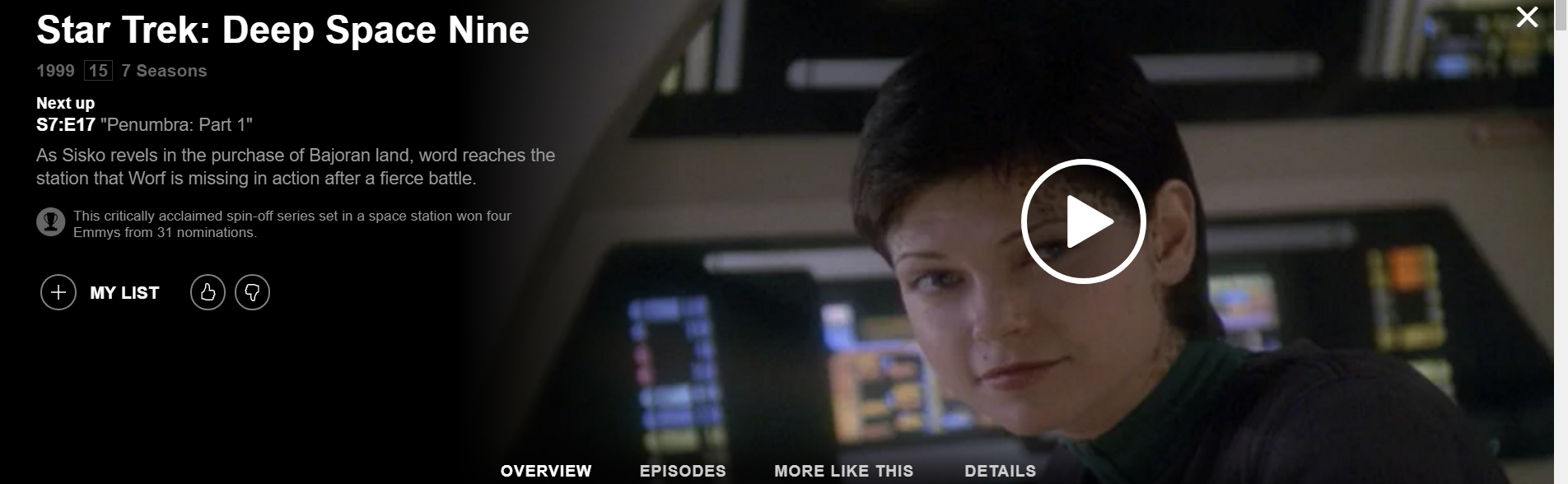
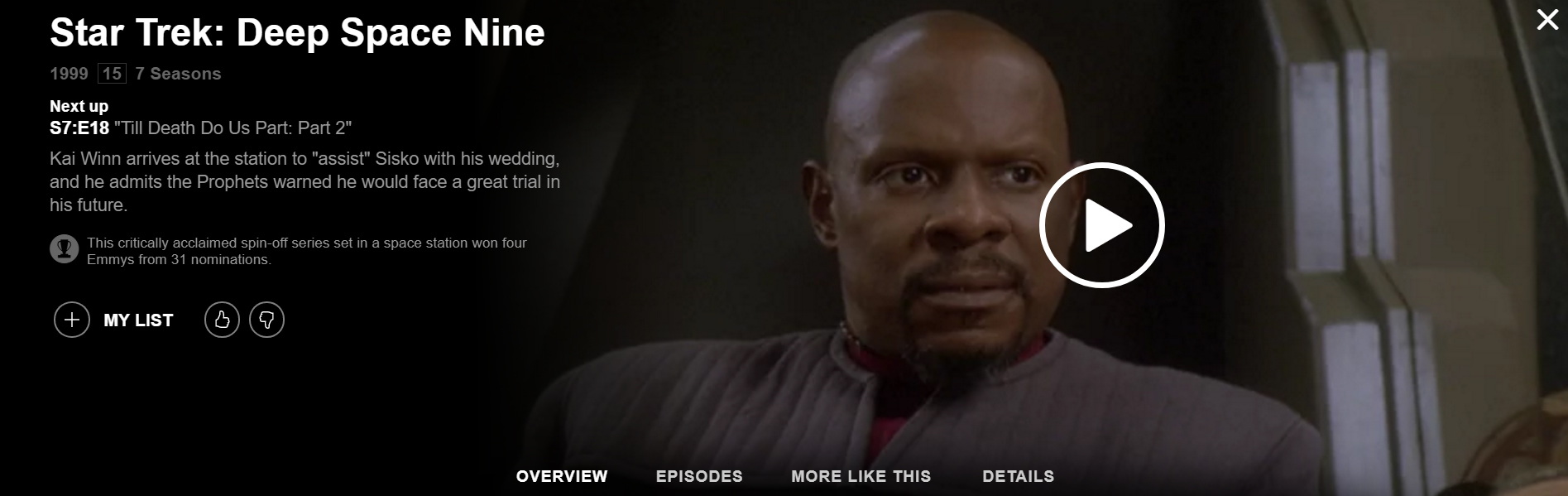
It is tempting to treat this ten-episode run as a single story, and it kinda is; Netflix labels the forty-five minute episodes as “Part 1”, “Part 2”, “Part 3”, “Part 4”, “Part 5”, “Part 6”, “Part 7” and “Part 8.” However, the run can also be broken down into smaller chunks. ‘Til Death Do Us Part and Strange Bedfellows were originally titled Umbra and Eclipse, suggesting a three-parter. In contrast, TV Guide listed the first four episodes in the run as a four-parter. When It Rains… and Tacking Into the Wind are definitely a two-parter. Extreme Measures is practically standalone.

Build a final arc.

Admittedly, the storytelling falters in places, as the production team’s reach occasionally exceeds their grasp. Some of these issues are outside the control of the production team, such as the budgetary concerns that hinder Extreme Measures. Some of these issues are entirely within the control of the production team, such as the pacing of the subplot with Winn and Dukat that leads to the most transparent stalling tactic in When It Rains…. Individual story choices are occasionally misguided, such as the emphasis on the Breen or the Pah-Wraiths.

Nevertheless, these ten episodes hang together surprisingly well. There is a sense of purpose and momentum running through these episodes that strengthens even the weaker hours. More than that, this ten-part saga includes some of the strongest episodes in the entire franchise, with episodes like When It Rains… and Tacking Into the Wind feeling like the culmination of more than nine years of storytelling across two different series. Though individual elements of this sprawling epic might miss the mark, the whole is greater than the sum of its parts.

The Dukat is of Bajor…

Continue reading