• Following Us

  • Categories

  • Check out the Archives


  • Awards & Nominations

Star Trek: Deep Space Nine – Defiant (Review)

The September and October, we’re taking a look at the jam-packed 1994 to 1995 season of Star Trek, including Star Trek: Deep Space Nine and Star Trek: Voyager. Check back daily for the latest review.

Defiant is a cheeky piece of work.

On the surface, it appears to be a rather lame bit of cross-promotion for the release of Star Trek: Generations. The first movie featuring the cast of Star Trek: The Next Generation had opened three-days before Defiant aired, and so it seemed like the perfect opportunity to get a nice cameo from a well-loved cast member and remind audiences that the film was currently in cinemas. Jonathan Frakes is a likeable actor, and Riker has been used as an ambassador for the series before. He appeared in Cybill, after all.

However, then Defiant takes one sharp left-turn, massively upsetting expectations and becoming something a lot more interesting than a cross-media tie-in.

Guess who's coming to Quark's...

Guess who’s coming to Quark’s…

Continue reading

Star Trek: Deep Space Nine (Malibu Comics) #29-30 – Sole Asylum (Review)

The September and October, we’re taking a look at the jam-packed 1994 to 1995 season of Star Trek, including Star Trek: Deep Space Nine and Star Trek: Voyager. Check back daily for the latest review.

Whatever happened to Thomas Riker?

Star Trek: Deep Space Nine receives a lot of credit for its move towards serialisation as a prime-time genre show. It wasn’t a pioneer in the same way that Babylon 5 was or even Murder One had been, but it was was definitely ahead of the curve. Deep Space Nine arguably holds up better today than any of the other Star Trek shows, and part of that is down to the way that the show leaned into serialisation. Actions had consequences, effects lingered after the credits.

Hostage of fortune...

Hostage of fortune…

The show was very much leaning that way in the second and third season, building up plot threads that would pay off down the line. The Dominion had been seeded in the show since Rules of Acquisition. The Romulan and Cardassian pre-emptive strike was foreshadowed by episodes like Defiant and Visionary. In the third season, it became clear that Deep Space Nine was ready to commit to some long-form storytelling, in a way that was unusual for a high-profile syndicated genre show in the nineties.

However, it is tempting to give Deep Space Nine a little bit too much credit. There were points where the show seemed to struggle with pay-off and arc-building. In Emissary, Sisko was tasked with bringing Bajor into the Federation; that never happened. After Battle Lines, Kai Opaka never appeared again. Characters who seemed important dropped into and out of the show at random; characters like Martok’s son Drex, Bajoran First Minister Shakaar Edon, Subcommander T’Rul… and Thomas Riker.

The welcome wagon...

The welcome wagon…

Continue reading

Star Trek: Deep Space Nine – Meridian (Review)

The September and October, we’re taking a look at the jam-packed 1994 to 1995 season of Star Trek, including Star Trek: Deep Space Nine and Star Trek: Voyager. Check back daily for the latest review.

Meridian is, to be frank, an absolutely abominable episode of Star Trek: Deep Space Nine. As a series, Deep Space Nine never really had a concentrated run of bad episodes, like the first and second seasons of Star Trek: The Next Generation or the second season of Star Trek: Enterprise or the third season of the original Star Trek. The first two seasons of Deep Space Nine might not be spectacular, but they are competently produced television – while there are a few scattered stinkers to be found, the bulk of the show comprises of mediocre and solid stories.

Instead, Deep Space Nine tended to pepper its weakest episodes throughout its run, perhaps a firm reminder that the show was never an entirely serialised experience. This wasn’t one story pushing forward, despite the presence of arcs and character development; Deep Space Nine was still prone to the pratfalls of episodic television. In this case, the pratfall was the necessity of churning out filler on a tight schedule and hoping to meet a deadline while pumping out two dozen episodes a year.

So we get unforgivably shoddy episodes like The Emperor’s New Cloak or Profit and Loss or Let He Who Is Without Sin mixed in with Deep Space Nine at the height of its form. The third season of Deep Space Nine lacks the highs of the later seasons, but that doesn’t mean it lacks the lows. Meridian stands out as the weakest episode of the season, and a serious competitor for one of the worst episodes of the show.

It appears that the toxic smell of the script is suffocating Terry Farrell...

It appears that the toxic smell of the script is suffocating Terry Farrell…

Continue reading

Star Trek: Deep Space Nine – Civil Defense (Review)

This September and October, we’re taking a look at the jam-packed 1994 to 1995 season of Star Trek, including Star Trek: Deep Space Nine and Star Trek: Voyager. Check back daily for the latest review.

Civil Defense is an episode that really worked a lot better than it should have. The third season of Star Trek: Deep Space Nine hit a bit of a stumbling block in the early part of the third season. Indeed, Second Skin had been shot from what was pretty much Robert Hewitt Wolfe’s first draft of a teleplay. The Abandoned felt like a good premise pushed in front of the camera too early. Civil Defense was similarly rushed into production, with very little turn around from the production staff.

However, despite these production concerns, Civil Defense turns out to be an enjoyable pulpy adventure. The production team wouldn’t royally screw up until the next episode. The biggest problem with the script is that it feels like we’re seeing it far too late in the show’s run. Civil Defense is a fun third season episode, but it would have been a spectacular first season adventure.

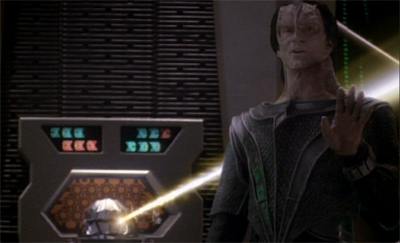
"Free dissident suppression system with every purchase over twelve bars!"

“Free dissident suppression system with every purchase over twelve bars!”

Continue reading

Star Trek: Deep Space Nine – Fearful Symmetry by Olivia Woods (Review)

The September and October, we’re taking a look at the jam-packed 1994 to 1995 season of Star Trek, including Star Trek: Deep Space Nine and Star Trek: Voyager. Check back daily for the latest review.

Fearful Symmetry had a long and painful history. The novel was originally scheduled for release April 2007. This would have seen the novel published about a year after the release of the previous Star Trek: Deep Space Nine relaunch novel, Warpath. The plan had been for new author Leanna Morrow to write the novel. When that proved impossible, Olivia Wood stepped in to rescue the assignment. Fearful Symmetry was eventually published in June 2008, over a year behind the initial schedule.

It’s interesting to speculate how that delay affected the Deep Space Nine relaunch. The next novel in the series, The Soul Key, would be the last published before the print Star Trek universe realigned as part of the Typhon Pact and The Fall, very much “event” books that served to relaunch the fictional universe. It is interesting to speculate whether the year between Warpath and Fearful Symmetry contributed to the decision to discontinue that particular iteration of the Deep Space Nine relaunch.

Still, whatever the reason, Fearful Symmetry is more interesting than successful. It is a book written with a number of great ideas, but some very flawed execution. It adopts a very “comic book” approach towards the Star Trek universe – featuring high concepts and crossovers and character who have been exaggerated slightly and distorted so as to fit the general perception of them rather than any consistent internal characterisation.

Fearful Symmetry is a bold and ambitious piece of work, particularly from a first time novelist. Unfortunately, it doesn’t work quite as well as it needs to.

ds9-fearfulsymmetry

Continue reading

Star Trek: Deep Space Nine – House of Quark (Review)

The September and October, we’re taking a look at the jam-packed 1994 to 1995 season of Star Trek, including Star Trek: Deep Space Nine and Star Trek: Voyager. Check back daily for the latest review.

House of Quark is a delightful episode that probably does a better job of setting the tone for the third season of Star Trek: Deep Space Nine than The Search. As much as the Dominion were introduced as “a big deal” and clearly intended to change the show’s status quo, the third season does very little with them. There are a few mentions here and there, a late-season two-parter, two scattered episodes looking at aspects of the Dominion, and a series finalé, but they don’t drive the third season as much as one might expect, or as much as they drive the fifth through seventh seasons.

In contrast, House of Quark is a decidedly irreverent look at the world of Star Trek, a decidedly cynical perspective on one of the franchise’s sacred cows – a downright subversive exploration of something that the franchise takes for granted.

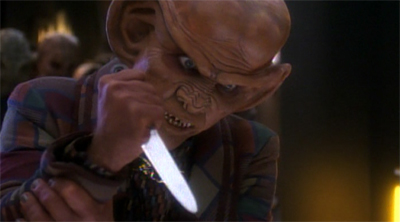
A knife story, there, Quark...

A knife story, there, Quark…

Continue reading

Star Trek: Deep Space Nine – The Search, Part II (Review)

The September and October, we’re taking a look at the jam-packed 1994 to 1995 season of Star Trek, including Star Trek: Deep Space Nine and Star Trek: Voyager. Check back daily for the latest review.

In a way, The Search feels almost like a parody of the classic Star Trek season-bridging cliffhanger. It is a story told under the same title, but with both halves of the story feeling distinct enough to stand on their own two feet. Written by two different writers and directed by two different directors, it very much feels like two very different stories linked primarily by an efficient cliffhanger.

It’s not radically dissimilar to the two-parters from Star Trek: The Next Generation. Redemption and Descent come to mind, two-part adventures that very much feel like two different stories melded together rather than one single over-arching story. This disjointedness makes a great deal of sense, given the standard operating procedure when it came to Star Trek cliffhangers, as established by Michael Piller with The Best of Both Worlds, Part I. The logic is simple: write part one; go away for a few months; return and try to write part two.

Of course, The Search very clearly isn’t a season-bridging cliffhanger. It’s a season-opening two-parter. And it’s so cleverly and consciously structured as two very different episodes that it can’t help but feel like a sly nod at the inevitable outcome of that approach to writing – playfully self-aware of how disjointed the whole experience feels as a single story.

A whole new Vorta problem...

A whole new Vorta problem…

Continue reading

Star Trek: Deep Space Nine – The Search, Part I (Review)

The September and October, we’re taking a look at the jam-packed 1994 to 1995 season of Star Trek, including Star Trek: Deep Space Nine and Star Trek: Voyager. Check back daily for the latest review.

The Search, Part I is interesting. It is an episode that, in effect, serves as something of a second pilot for the show. It’s an episode that re-conceptualises the show, while taking a great deal of trouble to ensure that any new viewers will be brought up to speed. In fact, The Search is a rather disjointed two-parter as a whole. The first part feels like a lot of set-up with a cliffhanger tacked on to the end of the episode, while the second part is very clearly its own story.

It makes sense. At this point, Star Trek: Deep Space Nine is the only Star Trek on television. It’s a period that doesn’t last, and which is really just a scheduling fluke. The show’s second season continued on past the airing of All Good Things…, the final episode of Star Trek: The Next Generation. The third season began broadcasting before the airing of Caretaker, the pilot of Star Trek: Voyager. Star Trek: Generations was released somewhere in the middle. So the stretch where Deep Space Nine was “the only Trek on television” feels largely illusory.

Still, The Search, Part I feels like a conscious attempt to welcome any wayward Star Trek fans. Including, appropriately enough, new staff writer Ronald D. Moore.

Staring into space...

Staring into space…

Continue reading

Mike W. Barr and Gordon Purcell’s Run on Star Trek: Deep Space Nine (Malibu Comics) (Review/Retrospective)

The September and October, we’re taking a look at the jam-packed 1994 to 1995 season of Star Trek, including Star Trek: Deep Space Nine and Star Trek: Voyager. Check back daily for the latest review.

The nineties comic book market was an interesting place. It enjoyed a huge boost due to the rise of speculation and collectors. The industry was massively successful in the early years of the decade, fuelled by high-profile artists, hype, and events. The industry imploded in on itself in the middle and towards the end of the decade, but it looked surprisingly profitable in the early years. Against that backdrop, Malibu Comics emerged.

Malibu had become the publisher of record for Image Comics in 1992. Image had been founded by a number of popular artists who had departed Marvel to set up their own shop and found their own company. Malibu distributed their comics for about a year, which gave Malibu access to a larger distribution platform. Although Image soon grew strong enough to publish its own comics, there was a point where Malibu had surpassed industry veteran DC Comics in the market place.
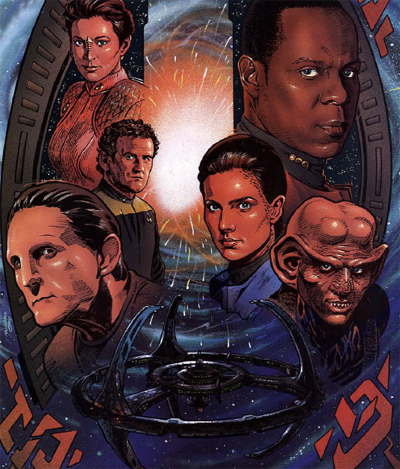
"Think of it—five months ago no one had ever heard of Bajor or Deep Space Nine. Now all our hopes rest here."

“Think of it—five months ago no one had ever heard of Bajor or Deep Space Nine. Now all our hopes rest here.”

Against this backdrop, Malibu secured the rights to publish comic books based on Star Trek: Deep Space Nine. Up until this point, DC comics had been publishing comics based on the original Star Trek and Star Trek: The Next Generation. Paramount’s decision to award the Deep Space Nine license to Malibu effectively split the comic book license up. DC Comics continued to publish comics based around the first two Star Trek shows, while Malibu had exclusive rights to the characters and world of Deep Space Nine.

As such, the decision to recruit writer Mike W. Barr and artist Gordon Purcell to write the first six issues of the comic was a pretty big deal. Barr and Purcell were incredibly associated with Star Trek comic books. The duo had done popular work on the movie-era comics, and had demonstrated an obvious and abiding affection for the franchise. Assigning these two creators to work on Deep Space Nine was a very clear message. Malibu were taking this license very seriously, indeed.

Triptych...

Triptych…

Continue reading

Star Trek: The Next Generation – Season 3 (Review)

This January and February, we’ll be finishing up our look at the second season of Star Trek: The Next Generation and moving on to the third year of the show, both recently and lovingly remastered for high definition. Check back daily for the latest review.

The third season is on a very short list of contenders for “the best season of Star Trek ever produced.” Maybe one or two other Star Trek: The Next Generation seasons make the list, maybe the first two seasons of the original Star Trek and maybe two seasons of Star Trek: Deep Space Nine. From beginning to end, the third season of The Next Generation hangs together remarkably well, churning out consistently entertaining adventures and several runs of truly classic episodes.

There are two main stretches in the season where the show produces episodes that could legitimately be ranked as the best of The Next Generation. The first comes around the midpoint of the season, from Yesterday’s Enterprise through to Sins of the Father, all episodes that would not look out of place on a “top ten episodes of The Next Generation” list. The second runs from Tin Man through to Sarek. And that’s ignoring the wonderful gems scattered throughout the season, from The Defector and The Hunted through to The Best of Both Worlds.

Of course, one of the most impressive aspects of the third season is the fact that the consistent quality visible on the television screen belies the chaos unfolding behind the scenes. The third season was a deeply troubled year of television, with plenty of unfortunate conflicts and moments of sheer desperation from the creative team. Perhaps the most wonderful demonstration of how far the show has come is obvious in the consistent professional quality of the output.

tng-bestofbothworlds1n

Continue reading