• Following Us

  • Categories

  • Check out the Archives


  • Awards & Nominations

Star Trek – Journey to Babel (Review)

The first Star Trek pilot, The Cage, was produced in 1964. To celebrate its fiftieth anniversary, this December we are reviewing the second season of the original Star Trek show. You can check out our first season reviews here. Check back daily for the latest review.

Journey to Babel is pretty influential, as episodes of Star Trek go. It is an episode that really cements idea of the Federation that came to be at the heart of the franchise, suggesting that the organisation really is a diverse intergalactic alliance of diverse alien species, rather than a union between Earth and Vulcan. More than that, the episode suggests that the individual members of the Federation might not exist in perfect harmony with one another, but may each operate with their own agenda and motivations.

However, what is really remarkable about Journey to Babel is how much of this unfolds in the background. All this world-building and -embellishing is very much a secondary concern for writer D.C. Fontana. Despite its scale and its scope, Journey to Babel is a decidedly personal story about a family in crisis. It works remarkably well, offering viewers a bit more insight into Spock as a character and where he came from.
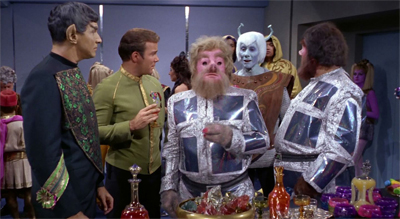
Party on, Gav...

Party on, Gav…

Continue reading

Star Trek – Bread and Circuses (Review)

The first Star Trek pilot, The Cage, was produced in 1964. To celebrate its fiftieth anniversary, this December we are reviewing the second season of the original Star Trek show. You can check out our first season reviews here. Check back daily for the latest review.

Bread and Circuses is not subtle. Then again, that is the point.

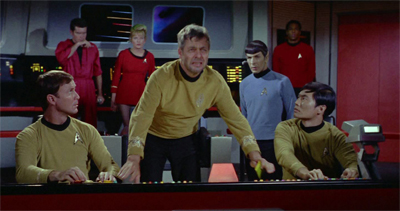
There’s a lot of interesting stuff happening in Bread and Circuses, the fourteenth episode produced for the second season, but the last to air. There’s the idea of a world dominated by “a twentieth century Rome”, a rogue captain, a Prime Directive dilemma and a scathing indictment of modern television. Not only is it one of the last episodes with a “produced by Gene L. Coon” credit, it is also an episode co-written by Roddenberry and Coon. It is also the episode of Star Trek that endorses Christianity most explicitly and heavily.

"Wait, we're only getting it in black and white?"

“Wait, we’re only getting it in black and white?”

Bread and Circuses is a bold and audacious piece of television, full of venom and righteous anger, rich in satire and cynicism. It’s a plot so ridiculously over-stuffed with good ideas that viewers are liable to forgive the show’s somewhat cop-out ending where Kirk and his away team beam back to the Enterprise and continue on their merry way as though little has actually happened. Bread and Circuses feels like it uses every minute of its fifty-minute runtime wisely, balancing character with world-building.

It is probably a little bit too messy and disjointed to be labelled a dyed-in-the-wool classic, particularly when compared to the shows produced around it. Nevertheless, it is a decidedly ambitious piece of work, and one that demonstrates what Star Trek could do when it sets its mind to something.

When in Rome...

When in Rome…

Continue reading

Star Trek (DC Comics, 1984) #9-16 – New Frontiers (aka The Mirror Universe Saga) (Review)

The first Star Trek pilot, The Cage, was produced in 1964. To celebrate its fiftieth anniversary, this December we are reviewing the second season of the original Star Trek show. You can check out our first season reviews here. Check back daily for the latest review.

Eight issues is a long time in the world of comic books, even by the standards of modern storytelling. Committing to the same story arc for two-thirds of a calendar year is a big decision, even moreso in December 1984. Nevertheless, DC comics committed to an eight-issue Star Trek story arc in the wake of Star Trek III: The Search for Spock, on throwing Kirk and the crew into a truly epic adventure with the fate of the Federation hanging on the line. It is no wonder that The Mirror Universe Saga remains the gold standard for Star Trek comic books, reprinted and repackaged repeatedly over the years.

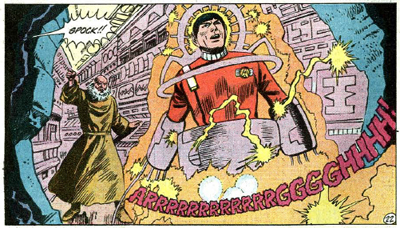
The Mirror Universe Saga is an epic in just about every sense of the word, spanning two universes and eight issues. Not only do writer Mike Barr and artist Tom Sutton find themselves handling the fallout from the last feature film, but they also dabble in an iconic piece of Star Trek history. The Mirror Universe Saga takes full advantage of its format to offer a spectacular and impressive adventure that would have been impossible to realise on film in 1984 – indeed, it is hard to imagine television or cinema doing justice to the scale of the adventure now.

Meeting of minds...

Meeting of minds…

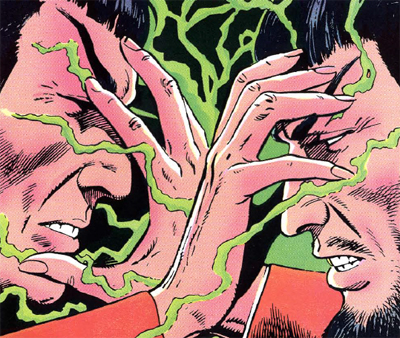
However, The Mirror Universe Saga succeeds on more than simply epic scale and meticulous attention to detail – although Barr and Sutton provide those with gusto. Despite everything going on around it, The Mirror Universe Saga largely works because it never loses track of the characters at the heart of the story. While the Terran Empire might be plotting an invasion in the midst of an internal revolution, the more powerful moments of The Mirror Universe Saga come from throwing the characters into contact with their alternate selves.

In 1984, it seems like The Mirror Universe Saga had figured out what would be the core ingredients for the most successful follow-ups to Mirror, Mirror. It deduced that the mirror universe could not just be playground where everything is gloriously and campily evil; it had to retain some level of emotional reality or connection. What good is a mirror if it is not reflecting anything?

Set course... for eeeevil!

Set course… for eeeevil!

Continue reading

Star Trek – The Deadly Years (Review)

The first Star Trek pilot, The Cage, was produced in 1964. To celebrate its fiftieth anniversary, this December we are reviewing the second season of the original Star Trek show. You can check out our first season reviews here. Check back daily for the latest review.

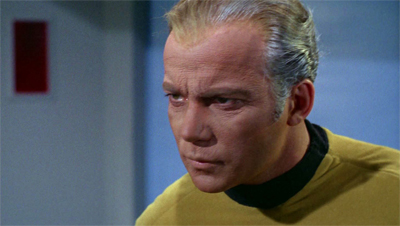
“Accelerated ageing” is one of those classic science-fiction tropes. It’s one of those stock element that can be easily baked into an episode – like “evil duplicate” or “body theft.” It instantly adds drama, gives the actors something to do, and offers a chance for the make-up team to work on something that might be considered a bit more prestigious than aliens. It pops up on shows as diverse as Stargate SG-1 and The X-Files.

Within the Star Trek franchise, the trope shows up a couple of times. The Deadly Years is the most obvious example, but it also shows up during the first two years of Star Trek: The Next Generation, when that show was trying hardest to channel its direct predecessor. Too Short a Season inverted the trope to give us “accelerated de-ageing”, while Unnatural Selection played it entirely straight.

A wrinkle in the timeline...

A wrinkle in the timeline…

The Deadly Years is an episode that doesn’t quite work as a cohesive whole, although if its populated with some intriguing moving parts. There is a sense that the writing staff are trying to plug perceived gaps in the story by throwing everything they have into the mix. Some of these are good ideas, some of these are already so familiar that they feel like Star Trek clichés at what marks the halfway point of the original production run.

There are several elements here that would arguably support their own episodes. On top of the idea of the crew ageing rapidly, we get the wonderful dramatic hook of Spock trying to prove Kirk unfit for command – a plot point that never feels like it gets enough focus. However, we also get another “incompetent/crazy/stupid senior official” plot heaped on top to provide a suitably dramatic climax to the episode. And the Romulans return, albeit as generic heavies. The Deadly Years is a mixed bag at best.

"She's... well, you get the idea..."

“She’s… well, you get the idea…”

Continue reading

Star Trek – Mirror, Mirror (Review)

The first Star Trek pilot, The Cage, was produced in 1964. To celebrate its fiftieth anniversary, this December we are reviewing the second season of the original Star Trek show. You can check out our first season reviews here. Check back daily for the latest review.

Mirror, Mirror is rightfully iconic.

It is a Star Trek episode that spawned sequels on Star Trek: Deep Space Nine and a prequel on Star Trek: Enterprise. It codified the whole idea of a “mirror universe” in popular culture, to the point where audiences readily accept the idea of an entire world populated with evil (and possibly sexy) counterparts to our characters. Shows as diverse as Doctor Who and South Park have played with the concept. Indeed, “evil alternate universe doppelganger has a goatee” is a recognisable trope.

... And that was the last time Koenig tried to upstage Shatner...

… And that was the last time Koenig tried to upstage Shatner…

There is a strange irony to all this. The mirror universe is an absurd concept for a number of reasons, and that absurdity is only heightened when it becomes more and more iconic. Turning the idea into a recognisable television cliché inevitably simplifies it. Although Mirror, Mirror is very camp – in the same way that a lot of classic Star Trek is camp – it is a story that has a lot of interesting and clever things to say. These tend to get sanded off through imitation and repetition. (For example, despite wearing the “evil goatee”, mirror!Spock is “a man of integrity.”)

And yet, behind the striking iconic production design and the admittedly absurd premise, Mirror, Mirror ranks as one of the best and most insightful scripts of classic Star Trek. It represents a cautionary tale and critical examination of some of the show’s core tendencies.

Bringing the pain...

Bringing the pain…

Continue reading

Star Trek (DC Comics, 1984) #43-45 – The Return of the Serpent! (Review)

The first Star Trek pilot, The Cage, was produced in 1964. To celebrate its fiftieth anniversary, this December we are reviewing the second season of the original Star Trek show. You can check out our first season reviews here. Check back daily for the latest review.

One of the benefits of a franchise as old and as diverse as Star Trek is the opportunity it provides for introspection and reflection. Star Trek has existed for almost fifty years. In those fifty years, the franchise has been written by a lot of different people at a lot of different points in time. As such, it makes sense that viewpoints shift and core principles are questioned. One of the more intriguing aspects of watching Star Trek grow older is watching the franchise question some of its earlier decisions and opinions.

The Return of the Serpent plays very much as a criticism of The Apple, a three-issue storyline dedicated to exploring just how wrong Kirk was to impose his own attitudes and beliefs upon the people of Gamma Trianguli VI. In some ways it can be see as both a spiritual successor to Star Trek II: The Wrath of Khan and a precursor to the Star Trek: Deep Space Nine episode Crossover, in that it is a story based significantly around critiquing a moral judgement made by James Tiberius Kirk and endorsed by the show.

Shocking twists!

Shocking twists!

The Return of the Serpent is an interesting story, because it consciously problematicises a story from the original Star Trek television show. It is essentially a story about how Kirk made a terrible decision that cost countless lives. This criticism is voiced more explicitly that the criticism of Kirk in The Wrath of Khan and half-a-decade before Crossover would make it to air. This is a very bold and brave tie-in from DC comics. It is hard to imagine a story like The Return of the Serpent being published during Richard Arnold’s tenure overseeing Star Trek tie-ins.

That said, Mike Carlin’s script is not without its own problems. For all that it challenges a decision that Kirk made during the original run of the series, the ending rather consciously avoids the implications of that decision. The Return of the Serpent seems to assume that Kirk can just reverse the damage he has caused by flicking a switch – by going back and repairing the original mistake. For all that The Return of the Serpent cleverly interrogates Kirk’s decisions and motivations, it is undermined by a rather clean and convenient resolution.

Into the belly of the beast...

Into the belly of the beast…

Continue reading

Star Trek – The Doomsday Machine (Review)

The first Star Trek pilot, The Cage, was produced in 1964. To celebrate its fiftieth anniversary, this December we are reviewing the second season of the original Star Trek show. You can check out our first season reviews here. Check back daily for the latest review.

The Doomsday Machine is another Star Trek classic.

Much like Amok Time directly before it, The Doomsday Machine is a piece of Star Trek that works both as powerful drama and clever allegory. It is an episode that has had a tremendous influence on the franchise. The “planet killer” has become a staple of Star Trek tie-in fiction, and even the franchise itself has kept the episode’s legacy alive, with the son of Commodore Decker originally planned as a regular in Star Trek: Phase II and eventually appearing in Star Trek: The Motion Picture.

All hands on Decker...

All hands on Decker…

The Doomsday Machine is at once a beautifully tragic character study and a potent cautionary tale for the atomic age. The episode the first example of “Star Trek does Moby Dick”, a story template that would become popular enough to sustain another episode in the same season, quite a few later Star Trek episodes across the franchise and no fewer than two of the franchise’s trips to the big screen. In many ways, The Doomsday Machine sets the template for Star Trek engaging with classic literature, building off The Conscience of a King.

It’s also beautifully produced, right down to the creature that Spinrad himself described as “a windsock dipped in cement.”

A commandeering presence...

A commandeering presence…

Continue reading

Star Trek – Amok Time (Review)

The first Star Trek pilot, The Cage, was produced in 1964. To celebrate its fiftieth anniversary, this December we are reviewing the second season of the original Star Trek show. You can check out our first season reviews here. Check back daily for the latest review.

Amok Time was the fifth show produced for the second season of Star Trek, but was the first show to air. This isn’t unusual. The production and broadcast order of various Star Trek episodes have not necessarily matched up. On shows like Star Trek: The Next Generation or Star Trek: Deep Space Nine, this was usually due to production delays or changes on specific episodes. On Star Trek: Voyager, the first and second seasons produced episodes that would not be aired until the other side of summer.

However, on the original Star Trek, the production and broadcast order of the episodes is radically different. For example, Friday’s Child was the third episode of the second season produced, but the eleventh broadcast. This makes watching the show in production order on blu ray a delightfully frustrating experience. The first five episodes produced for the second season are split across three different discs.

Good wholesome family fun...

Good wholesome family fun…

Sometimes the changes in production order were purely practical. For example, The Man Trap was the first episode of Star Trek to air because it happened to be the most suitable of the episodes that had been produced to that point. The broadcast order of the first season introduced all manner of production and continuity glitches, with uniforms and cast changing seemingly randomly. Still, The Man Trap was felt to be, effectively, the least bad option to introduce new audiences to Star Trek.

Amok Time, the second season premiere, was an entirely different kettle of fish. This was easily the strongest of the three Star Trek season premieres, and there’s a sense that the production team knew this going into the episode. Designed to ruthlessly capitalise on the popularity and success surrounding the character of Spock, the episode was very clearly intended to put the show’s best foot forward for audiences returning to watch the second season. The result is one of the best episodes the franchise ever produced.

Spock remains as sharp as ever...

Spock remains as sharp as ever…

Continue reading

Star Trek – Spock’s World by Diane Duane (Review)

The first Star Trek pilot, The Cage, was produced in 1964. To celebrate its fiftieth anniversary, this December we are reviewing the second season of the original Star Trek show. You can check out our first season reviews here. Check back daily for the latest review.

One of the more interesting aspect of Star Trek tie-in media during the eighties was the sense of freedom enjoyed by those working on the line.

One of the more infamous examples concerned DC’s attempts to publish a monthly comic during the release cycle of Star Trek II: The Wrath of Khan, Star Trek III: The Search for Spock and Star Trek IV: The Voyage Home. The three films tended to build off one another, forming a tight continuity, but that did not stop the comic book company from trying to build off the ending of each of the films, leading to a variety of weird continuity hijinks. Spock left to work on a Vulcan ship; Kirk took command of the Excelsior; a Klingon joined the crew.

Writers working on the tie-in novels enjoyed a similar amount of freedom. By the time that Spock’s World was published in 1989, Diane Duane had been able to firmly establish her own supporting cast of characters in her various tie-in novels. Spock’s World includes appearances from Duane regulars like K’s’t’lk and Harb Tanzer, introduced in The Wounded Sky; even Lia Burke from My Enemy, My Ally puts in an appearance. It really feels like Duane has carved out her own space within the larger Star Trek universe.

However, perhaps that freedom finds its strongest expression in the fact that Duane was able to map an entire cultural and social history unto the planet Vulcan. Spock’s World reads almost like a biography of a fictional planet – charting the history of Vulcan from the planet’s earliest days through to the twenty-third century. It is a delightfully bold and intriguing Star Trek book, one utterly unlike any other tie-in ever published.

Continue reading

Star Trek – Friday’s Child (Review)

The first Star Trek pilot, The Cage, was produced in 1964. To celebrate its fiftieth anniversary, this December we are reviewing the second season of the original Star Trek show. You can check out our first season reviews here. Check back daily for the latest review.

Errand of Mercy was a highlight of the first season. A wry script from producer Gene L. Coon introduced the Klingons as an antagonist for the Federation. Made up to look like space!Mongols, the Klingon Empire was presented as an imperial force hell-bent on expanding its sphere of influence. In case the parallels were a little too subtle, they were locked in a Cold War with the Federation. As such, they were the perfect stand-ins for Communist aggressors trying to undermine American foreign policy.

Of course, Errand of Mercy was brutally cynical in its depiction of the Federation. The episode suggested quite heavily that the Federation was just as imperialist and adversarial as the Klingons. They might couch their foreign policy in friendly language and polite overtures, but their end goals are quite similar. Smaller political entities are nothing but pieces shuffled around a board in a deadly game of chess. Errand of Mercy was not flattering in its portrayal of Kirk, presenting him as little more than a warmonger.

"Damn dirty Klingon!"

“Damn dirty Klingon!”

Errand of Mercy was a massive success. It remains a fan favourite to this day. In some respects, that is due to the introduction of the Klingons, but it is also an exceptional hour of scripted science fiction. So it makes sense that the show would return to the Klingons when it was renewed for a second season. Friday’s Child was the third episode produced during the second season, and returns to quite a few themes hit on by Errand of Mercy. Those themes would recur.

Friday’s Child demonstrates the obvious risks of an episode like Errand of Mercy. It’s an episode that essentially takes the “Klingons as space!Communists” seriously.

We come in peace...

We come in peace…

Continue reading