• Following Us

  • Categories

  • Check out the Archives


  • Awards & Nominations

Space: Above and Beyond – Eyes (Review)

This November (and a little of December), we’re taking a trip back in time to review the third season of The X-Files and the first (and only) season of Space: Above and Beyond.

Eyes is perhaps the most ambitious that Space: Above and Beyond has been to this point in the season.

Eyes develops scraps hinted at in The Pilot and The Farthest Man From Home into a complex web of intrigue, with an assassination plot playing out against all sorts of institutionalised prejudice and suggesting sinister conspiracies at work behind the horrific war that drives the show. The last episode of Space: Above and Beyond credited to Glen Morgan and James Wong in 1996, the episode feels like it is solidifying the series. Six episodes in, enough foundations have been laid that development can begin.

An unstoppable killing machine.

An unstoppable killing machine.

Eyes is rather epic in scale, and massive in scope. It is a story about politics and scheming, unfolding quite far away from the front lines. In episodes like The Pilot, The Farthest Man From Home and even Ray Butts, it often felt like our lead characters were quite divorced from the big decisions. It seemed like the show was very much preoccupied with a day in the life of a space marine, rather with the larger forces at play seen only in glimpses and shadows.

Eyes is a show that does a lot to build the world of Space: Above and Beyond, doing a much better job than The Dark Side of the Sun or Mutiny at giving a sense of this dark future. While the script is perhaps a little too cluttered for its own good, it is a very well-constructed paranoid conspiracy thriller.

That's not at all fascist.

That’s not at all fascist.

Continue reading

Space: Above and Beyond – Ray Butts (Review)

This November (and a little of December), we’re taking a trip back in time to review the third season of The X-Files and the first (and only) season of Space: Above and Beyond.

Ray Butts is a collection of familiar war movie clichés.

Space: Above and Beyond is effectively a gigantic Second World War movie in space, and Ray Butts allows creators Glen Morgan and James Wong to roll two of the most instantly recognisable war movie archetypes into a single character. The eponymous officer is at once a soldier traumatised by his past experiences and a tough new commander for a young unit. He is a source of friction on the show, kept ambiguous and mysterious for most of the episode’s runtime.

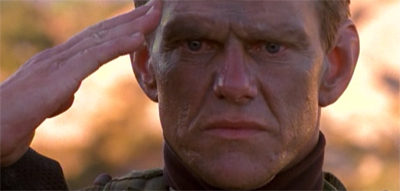
We salute you...

We salute you…

Ray Butts piles on the questions. The show doesn’t reveal his orders for quite a while, asking the audience to decide whether they trust the orders – let alone the man assigned to carry them out. The show also plays up questions around Butts himself; is Butts a man trying work through his own issues in his own way, or simply a risk-taking and borderline incompetent commanding officer? Ray Butts doesn’t have too many surprises, but it works because Morgan and Wong know how to structure an episode of television.

After the misfiring ambition of The Dark Side of the Sun, it feels almost like Ray Butts puts Morgan and Wong back in their element.

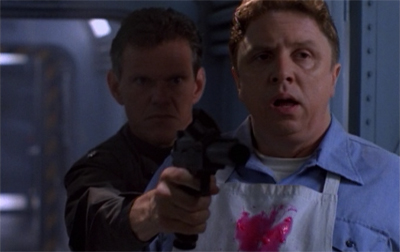
Don't shoot the chef!

Don’t shoot the chef!

Continue reading

Space: Above and Beyond – Mutiny (Review)

This November (and a little of December), we’re taking a trip back in time to review the third season of The X-Files and the first (and only) season of Space: Above and Beyond.

Nothing says “this is a militaristic science-fiction show!” quite like a mutiny episode.

When producing a show like Space: Above and Beyond, doing a show based around a mutiny in wartime is a given. It’s no surprise that Mutiny is the third regular episode of the show. Indeed, when Battlestar Galactica – a show that owes a sizeable debt to Space: Above and Beyond – wanted to establish its own militaristic science-fiction credentials, it produced Bastille Day as the third episode of its first season – another story about an uprising on a spaceship in a time of crisis.

His sister's keeper...

His sister’s keeper…

Mutiny is also notable as the first episode of the season not credited to the creative team of Glen Morgan and James Wong. Of course, as executive producers, Morgan and Wong would have had a massive impact on the development and the writing of Mutiny. Stephen Zito is credited as the writer on the show. Zito is a veteran television writer and producer, working in the industry since the late eighties. He departed Space: Above and Beyond halfway through the first season, moving on to a long run on J.A.G.

Mutiny is far from perfect – indeed, it is often quite clunky in places. At the same time, it is a lot more comfortable in its skin than The Dark Side of the Sun was.

Watching like a Hawkes...

Watching like a Hawkes…

Continue reading

Space: Above and Beyond – The Dark Side of the Sun (Review)

This November (and a little of December), we’re taking a trip back in time to review the third season of The X-Files and the first (and only) season of Space: Above and Beyond.

Space: Above and Beyond is half-way between an epic space opera and a wartime saga.

The Dark Side of the Sun confirms something suggested as early as The Pilot. While creators Glen Morgan and James Wong have a firm grasp of the war story aspect of the show, they are a bit less comfortable with the science-fiction elements. While The Farthest Man From Home was a solid old-fashioned “love in wartime” epic, The Dark Side of the Sun is steeped in stock science-fiction elements and interesting ideas, but seems to falter in the execution.

Wild cards...

Wild cards…

It feels very much like Morgan and Wong are trying to push the show’s science-fiction elements to the fore, but aren’t entirely comfortable with those elements. The result is a curious little episode, one that does a decent amount of character and world-building, while also baking some intriguing ideas and concepts into this potential future for mankind. At the same time, there’s an awkwardness to it all, as if The Dark Side of the Sun is trying to establish the show’s sci-fi credentials and can’t quite figure how everything fits together.

The Dark Side of the Sun is a show that feels like it could have used a bit more time and another draft or two, perhaps a reminder that Morgan and Wong are still relatively new at this sort of thing.

Cold dead eyes...

Cold dead eyes…

Continue reading

Space: Above and Beyond – The Farthest Man From Home (Review)

This November (and a little of December), we’re taking a trip back in time to review the third season of The X-Files and the first (and only) season of Space: Above and Beyond.

Due to network anxiety about the investment in Space: Above and Beyond, The Pilot had a very clear three-act structure building to a very explicit resolution. Not only did The Pilot figure the beginning of the war with the aliens, it also featured a crucial moral-boosting victory. It ended with the squad fully-formed and ready for action. It packed a lot of stuff in, and worked quite well as its own self-contained story; even if it left a host of broad narrative threads for the rest of the series to follow.

The Farthest Man From Home is pretty solid as far as first standalone episodes go. Free from the constraints of having to work as a potential movie-of-the-week, The Farthest Man From Home is free to do a little development and foreshadowing, but doesn’t have to wrap up everything in a neat bow by the time that the closing credits role. It’s also spared a lot of the exposition that made The Pilot feel so heavy – Hawkes’ status as an InVitro is fleetingly mentioned, and the Silicates don’t come up.

It's a wasteland out there...

It’s a wasteland out there…

Instead, The Farthest Man From Home is free to focus on the story that it wants to tell, and in marking out narrative space  for the development of both the larger war arc and West’s own personal journey. The Farthest Man From Home is a rather loose episode, but it’s loose in a way that makes sense for a second episode. It eases the audience into the world of Space: Above and Beyond a lot more fluidly than The Pilot did.

That said, there’s still an awkwardness here as Morgan and Wong struggle to figure out what the show is about and the form that it will eventually take. Examined in hindsight, while The Farthest Man From Home establishes a lot of important stuff for the show, it is also clearly a work in progress for the series – an early iteration of a show that would grow and change over the course of its first season. This is perhaps the second draft of Space: Above and Beyond, a solid base to build on for what lies ahead.

Tag it and move on...

Tag it and move on…

Continue reading

Space: Above & Beyond – Pilot (Review)

This November (and a little of December), we’re taking a trip back in time to review the third season of The X-Files and the first (and only) season of Space: Above and Beyond.

Space: Above and Beyond made a great deal of sense in the context of the mid-nineties. Fox had begun its life as a scrappy little network that had trouble producing seven nights of broadcasting, but had rapidly solidified itself into a credible alternative to the big three networks. There were lots of reasons for this. The X-Files was one reason, but the network had also solidified itself with a slate of popular young dramas like Beverly Hills 90210, Melrose Place and Party of Five. Securing the NFL rights in 1993 didn’t hurt.

By late 1995, Fox was largely past the growing pains stage of its evolution. The network had been announced in late 1985, and first hit the airwaves in late 1986. It was approach the end of its first decade by the time Space: Above and Beyond was broadcast. Fox was no longer a small network fighting for scraps, but a viable challenger to the so-called “big three.” This change in outlook would lead to great success in the twenty-first century, but would also lead to change in how Fox did business.

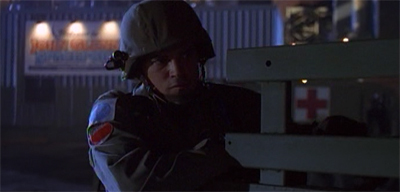
Everything burns...

Everything burns…

The X-Files had been the right show at the right time in a number of ways. It landed at the perfect point to speak to a generation that grew up in the shadow of Watergate, but also to tap into millennial anxieties and insecurities. From a commercial perspective, The X-Files launched towards the end of the period where Fox could take chances on young shows struggling to find an audience. The first season of The X-Files was a cult hit, but not a breakout success story. The network had faith in the show, and that faith paid off.

It is interesting to wonder whether The X-Files would have received a second season if it débuted even two years later. After all, Fox would develop a reputation as a network with a ruthless tendency towards cancellation and plug-pulling. If The X-Files had first appeared in September 1995, would it have enjoyed the same fate as Space: Above and Beyond?

Distant sands...

Distant sands…

Continue reading