• Following Us

  • Categories

  • Check out the Archives


  • Awards & Nominations

Space: Above and Beyond – The Farthest Man From Home (Review)

This November (and a little of December), we’re taking a trip back in time to review the third season of The X-Files and the first (and only) season of Space: Above and Beyond.

Due to network anxiety about the investment in Space: Above and Beyond, The Pilot had a very clear three-act structure building to a very explicit resolution. Not only did The Pilot figure the beginning of the war with the aliens, it also featured a crucial moral-boosting victory. It ended with the squad fully-formed and ready for action. It packed a lot of stuff in, and worked quite well as its own self-contained story; even if it left a host of broad narrative threads for the rest of the series to follow.

The Farthest Man From Home is pretty solid as far as first standalone episodes go. Free from the constraints of having to work as a potential movie-of-the-week, The Farthest Man From Home is free to do a little development and foreshadowing, but doesn’t have to wrap up everything in a neat bow by the time that the closing credits role. It’s also spared a lot of the exposition that made The Pilot feel so heavy – Hawkes’ status as an InVitro is fleetingly mentioned, and the Silicates don’t come up.
It's a wasteland out there...

It’s a wasteland out there…

Instead, The Farthest Man From Home is free to focus on the story that it wants to tell, and in marking out narrative space  for the development of both the larger war arc and West’s own personal journey. The Farthest Man From Home is a rather loose episode, but it’s loose in a way that makes sense for a second episode. It eases the audience into the world of Space: Above and Beyond a lot more fluidly than The Pilot did.

That said, there’s still an awkwardness here as Morgan and Wong struggle to figure out what the show is about and the form that it will eventually take. Examined in hindsight, while The Farthest Man From Home establishes a lot of important stuff for the show, it is also clearly a work in progress for the series – an early iteration of a show that would grow and change over the course of its first season. This is perhaps the second draft of Space: Above and Beyond, a solid base to build on for what lies ahead.
Tag it and move on...

Tag it and move on…

Continue reading

The X-Files – Paper Clip (Review)

This November (and a little of December), we’re taking a trip back in time to review the third season of The X-Files and the first (and only) season of Space: Above and Beyond.

And now we return to your scheduled viewing.

In many respects, Paper Clip feels like the real third season premiere. It establishes a lot of the recurring themes and ideas for the mythology of the season, from Krycek-on-the-run through to collaboration in the wake of the Second World War. It builds on the successful multi-part formula established by episodes like Ascension or End Game during the show’s second season. It moves things along in a way that The Blessing Way simply refused to. (It even resolves the cliffhanger from the last episode on screen.)

The light at the end of the tunnel...

The light at the end of the tunnel…

Paper Clip demonstrates the strengths of the third season of The X-Files. The third season was the point at which the show really pushed the mythology out, building on earlier implications that there was form to be found in the shadows. The third season also looked to the second season to determine what had worked and what had not worked. Paper Clip is very clearly modelled on the successful aspects of second parts like Ascension or End Game.

It moves. The power of Paper Clip comes from an incredible forward momentum that allows the show to maintain tension and excitement while refusing to allow the audience to catch their breath. Instead of resolving the bigger plot threads from the first episode, questions and hints are thrown out with reckless abandon as the script just drives through set pieces and emotional beats and suspenseful sequences. It is a very meticulously, very cleverly constructed piece of television.

Watching the skies...

Watching the skies…

Continue reading

Space: Above & Beyond – Pilot (Review)

This November (and a little of December), we’re taking a trip back in time to review the third season of The X-Files and the first (and only) season of Space: Above and Beyond.

Space: Above and Beyond made a great deal of sense in the context of the mid-nineties. Fox had begun its life as a scrappy little network that had trouble producing seven nights of broadcasting, but had rapidly solidified itself into a credible alternative to the big three networks. There were lots of reasons for this. The X-Files was one reason, but the network had also solidified itself with a slate of popular young dramas like Beverly Hills 90210, Melrose Place and Party of Five. Securing the NFL rights in 1993 didn’t hurt.

By late 1995, Fox was largely past the growing pains stage of its evolution. The network had been announced in late 1985, and first hit the airwaves in late 1986. It was approach the end of its first decade by the time Space: Above and Beyond was broadcast. Fox was no longer a small network fighting for scraps, but a viable challenger to the so-called “big three.” This change in outlook would lead to great success in the twenty-first century, but would also lead to change in how Fox did business.

Everything burns...

Everything burns…

The X-Files had been the right show at the right time in a number of ways. It landed at the perfect point to speak to a generation that grew up in the shadow of Watergate, but also to tap into millennial anxieties and insecurities. From a commercial perspective, The X-Files launched towards the end of the period where Fox could take chances on young shows struggling to find an audience. The first season of The X-Files was a cult hit, but not a breakout success story. The network had faith in the show, and that faith paid off.

It is interesting to wonder whether The X-Files would have received a second season if it débuted even two years later. After all, Fox would develop a reputation as a network with a ruthless tendency towards cancellation and plug-pulling. If The X-Files had first appeared in September 1995, would it have enjoyed the same fate as Space: Above and Beyond?

Distant sands...

Distant sands…

Continue reading

Non-Review Review: Fury

Fury is an apocalyptic glimpse of warfare.

Unfolding in the last days of the Second World War, as Allied forces pour into Germany from all sides, there’s a sense that this is the end. This is the abyss. As the introductory text explained, Hitler had declared a doctrine of “total war” against these invading forces. Every man woman and child was to be mobilised against the advancing armies, in the hope that it might somehow slow down the Allied war machine. If you throw enough people at it, you might do some damage – even if it is just clogging the gears.

He will strike down with Fury-ous anger...

He will strike down with Fury-ous anger…

A movie about a tank crew enduring these last few days, Fury gets considerable mileage out of that image – of human flesh falling before the unstoppable and inevitable machine. At a couple of points in the movie, characters die with their faces quite literally down in the mud. At other points, bodies are crushed beneath the tracks of the eponymous vehicle. Towards the climax, we encounter a body so thoroughly squashed beneath the weight of the Allied advanced that it seems like an empty uniform.

Fury is at its best when it captures the sheer unrelenting terror and horror of the advancing war machine – the nihilism of fighting a war that has already been decided, and the bleak inevitability of large-scale slaughter.

Fog of war...

Fog of war…

Continue reading

Non-Review Review: The Imitation Game

The Imitation Game is a solid and effective bio-pic elevated by a sharp script from Graham Moore, tight direction from Morten Tyldum and a superb central performance from Benedict Cumberbatch. There are points where the film seems to over-simplify its protagonist, trying to reduce his fascination with computers to a series of Freudian quirks, but the movie is held together by witty dialogue and a mesmerising turn from its lead actor.

theimitationgame

Continue reading

The X-Files – Død Kälm (Review)

This August (and a little of September), we’re taking a trip back in time to review the second season of The X-Files. In November, we’ll be looking at the third season. And maybe more.

Død Kälm is probably the most explicitly “science-fiction-y” premise that we’ve had in the show’s run to date. And by “science-fiction-y”, I don’t necessarily mean “anchored in any meaningful science.” After all, the amount of sense that Død Kälm makes is questionable at best. Instead, the term “science-fiction-y” means “most likely to pop up in a pulpy science-fiction television show.”

The past few episodes have seen the show on a bit of a science-fiction kick, with clones and colonists and invisible abducted zoo animals. However “accelerated aging” is such a science-fiction staple that it feels like The X-Files is enthusiastically embracing science-fiction conventions at this point in the second season.

Old school...

Old school…

Continue reading

Ultimate Origins (Review/Retrospective)

This May, to celebrate the release of X-Men: Days of Future Past, we’re taking a look at some classic and modern X-Men (and X-Men-related) comics. Check back daily for the latest review.

Ultimatum effectively brought an end to the first stage of life for Marvel’s Ultimate Universe. To be fair, Ultimate X-Men and Ultimate Fantastic Four had both cycled through multiple creative teams by that point, but Ultimatum was the book that effectively drew a line under a certain era of Marvel’s Ultimate Universe. Ultimate Spider-Man, Ultimate X-Men and Ultimate Fantastic four were all cancelled in the wake of the massive end, marking it as the end of an era.

As such, it made sense to go back to the start of the line – to task writer Brian Michael Bendis to craft an origin for this shared spin-off universe. With Ultimatum killing off so many characters and so radically altering the status quo, it made sense to go back to the beginning and offer a glimpse at the formative moments of this alternate universe. The Ultimate Universe had been built from the ground up, so it made sense that the continuity all fit together.

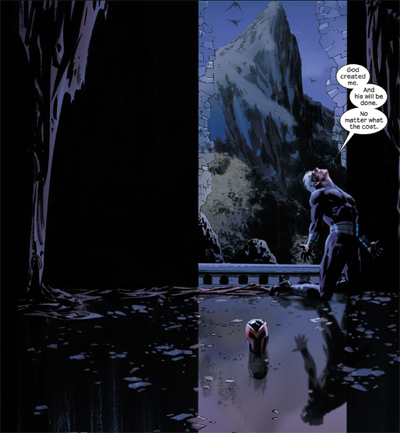
A Magnetic personality...

A Magnetic personality…

While Ultimate Origins offered a series of insights and revelations that radically altered (or expanded) the back story of almost every corner of the Ultimate publishing line, Brian Michael Bendis’ Ultimate Origins undoubtedly had the most profound implications for the characters of Ultimate X-Men. While the characters from Ultimate Spider-Man or The Ultimates could go back to something approximating business as usual, those characters would never be the same again.

Offering an explanation for the mutant genome that would alter the context of mutants and play into the climax of Ultimatum, Ultimate Origins represents something radical and distinct from mainstream Marvel publishing. In a way, it feels like it is playing into the mission statement of Ultimatum – redefining the Ultimate line so as to distinguish the Ultimate Universe from its mainstream counterpart. This is no long a streamlined and cleaned up alternative; it is something radically different.

Carry on...

Carry on…

Continue reading

Non-Review Review: The Wind Rises

Best known in Europe and America for beautiful animated fantasies like Ponyo, Howl’s Moving Castle or Spirited Away, Hayao Miyazaki has opted for something a little bit different with his final – heavily publicised as “farewell” – film. The Wind Rises has touches of fantasy and looks absolutely beautiful, it represents a different sort of animated film. More of a historical drama and romance than an escapist fantasy, The Wind Rises is a thoughtful exploration of Japan in the lead-up to the Second World War.

Focusing on Mitsubishi aircraft designer Jiro Horikoshi, the film is a lavish animated period drama about the construction of the infamous Japanese “Zero Fighter” – the A6M Zero. The fighter of choice during the Second World War, The Wind Rises notes that the pilots flying those planes never came back as the film reflects on the social context of Japan’s march towards war, and the characters caught in the middle like an umbrella trapped in a strong wind.

thewindrises3

Continue reading

Red Skull: Incarnate (Review/Retrospective)

This March, to celebrate the release of Captain America: The Winter Soldier, we’ll be taking a look at some classic and not-so-classic Avengers comic books. Check back daily for the latest updates!

Incarnate is something of a companion piece to Greg Pak’s Testament. Testament was a miniseries following the life of a young boy named Erik during the Holocaust. Of course, Erik would grow up to become the supervillain known as Magneto, but Pak was more fascinated in the history surrounding the character – his origins as a Holocaust survivor. The series was beautifully written and well received, prompting Marvel to hire Pak to produce a companion piece.

Incarnate is effectively the origin story of the Red Skull, Captain America’s arch-enemy and a character Pak himself describes in the afterword as “the Marvel Universe’s most evil villain.” Setting the story in late twenties and thirties Germany, Pak sets the character’s origins against the rise of Nazism and the decline of the Weimer Republic.

A slice of life...

A slice of life…

Continue reading

Non-Review Review: Wakolda (aka The German Doctor)

This film was seen as part of the Jameson Dublin International Film Festival 2014.

Wakolda is a good old-fashioned pulpy pot boiler. The latest film from writer and director Lucia Puenzo, adapted from her own novel, is set in Argentina in 1960. Given the title, it’s easy enough to predict which direction Puenzo’s piece of historical fiction will be going. The history of the Nazis who sought refuge in South America following the Second World War is pretty compelling stuff, and Puenzo skilfully builds off this basic premise.

As much as popular history likes to paint the Second World War as an epic conflict of good against evil that neatly tidied itself up, there were lots of lingering threads – lots of loose ends dangling from the edge of this historical tapestry. The flight from justice, the protection that these people were afforded, and the desperate desire to bring these criminals to justice makes for a gripping pulpy narrative – but there’s also something more unsettling at work.

After all, acknowledging that the history of Nazi war criminals does not end after the signing of the German surrender means confronting the reality that such beliefs and philosophies cannot be vanquished with the stroke of a pen. Darkness still lurks in the wider world.

wakolda

Continue reading