• Following Us

  • Categories

  • Check out the Archives


  • Awards & Nominations

Star Trek: Voyager – The 37’s (Review)

This September and October, we’re taking a look at the jam-packed 1994 to 1995 season of Star Trek, including Star Trek: Deep Space Nine and Star Trek: Voyager. Check back daily for the latest review.

The 37’s did not close out the first broadcast season of Star Trek: Voyager, as the producers had intended. The last episode produced in the first season run, it was held back in the schedule into the second season – a decision made by UPN to allow Voyager to get an early start the following autumn. Still, the decision to reposition The 37‘s as the premiere of the broadcast season is quite telling.

Airing ahead of the three episodes produced before it, and ahead of any episodes produced specifically for the second season, there’s a sense that the production team intend The 37’s to be an important episode. After all, the season premiere is just as important as the season finalé in the basic structure of a broadcast season. The finalé serves as a capstone for what has come before, while (hopefully) indicating what might follow. The premiere is a way of setting up what is yet to come.
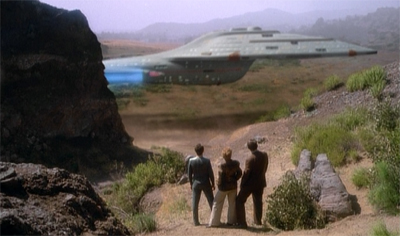
We have lift-off...

We have lift-off…

So the positioning on The 37’s is interesting, because it indicates just how much the production team had invested in the episode. This is a big episode of Voyager, this is an important episode of Star Trek. As such, it makes for a completely unsatisfying experience. The 37’s isn’t a bad episode by any measure – it has a few interesting ideas and a few memorable elements – but it’s not ambitious. It doesn’t radically change Voyager, but it also doesn’t distil it. It doesn’t offer the sense of purpose lacking for morst of the first season.

The 37’s just sort of is. It’s an episode that would be functional shuffled into the middle of a season – a few episodes earlier or later than broadcast. However, it simply doesn’t work when scheduled into a high-profile slot, particular when it has been moved so consciously and so purposefully.
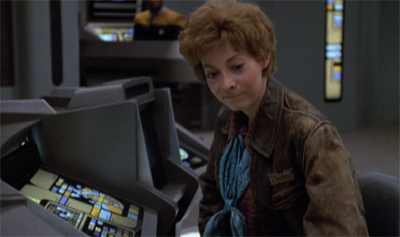
A second pilot?

A second pilot?

Continue reading

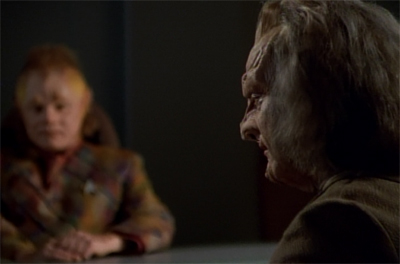
Star Trek: Voyager – Jetrel (Review)

This September and October, we’re taking a look at the jam-packed 1994 to 1995 season of Star Trek, including Star Trek: Deep Space Nine and Star Trek: Voyager. Check back daily for the latest review.

Jetrel is an interesting episode for a number of reasons. It’s another example of how the first season of Star Trek: Voyager seems anchored in the aftermath of the Second World War. The episode exists primarily as a meditation on guilt over the use of atomic weapon, with the Metreon Cascade attack on Rinax standing in for the dropping of the atomic bomb on Hiroshima and Negaska in 1945. Jetrel aired three months shy of the fiftieth anniversary of the bombing, and amid a national period of reflection about the morality of Harry S. Truman’s actions.

Whatever the context of Jetrel in 1995, it serves as another example of how Voyager seems like a relic from a bygone age, a snapshot of atomic age science-fiction. Cathexis was the show doing Invasion of the Body Snatchers. Faces was an old-fashioned monster movie. Jetrel wasn’t even the first time that the first season had traded in atomic imagery. The aftermath of the polaric detonation in Time and Again was very clearly designed to evoke the aftermath of an atomic blast.

The devil in the pale moonlight...

The devil in the pale moonlight…

Even without all this baggage, Jetrel still feels like a mess of an episode. The heart of the story finds a member of the ensemble confronting a former war criminal while dealing with issues of war guilt and responsibility – a structure that evokes Duet the penultimate episode of the first season of Star Trek: Deep Space Nine. While that episode worked brilliantly, there’s a sense that Jetrel is burdened a little bit trying to offer a two-hander about guilt while tackling the issue of the atomic bomb.

The problem is compounded by a somewhat messy final act that eschews all the episode’s heavy character-based drama in favour of a contrived techno-babble climax that involves a lot of characters spouting nonsense while playing with light-emitting diodes. Jetrel begins as the strongest and boldest episode of the show’s first season, but ends as one of the prime examples of Voyager‘s preference for techno-babble over character work.

Burn with me...

Burn with me…

Continue reading

Star Trek: Deep Space Nine – Through the Looking Glass (Review)

This September and October, we’re taking a look at the jam-packed 1994 to 1995 season of Star Trek, including Star Trek: Deep Space Nine and Star Trek: Voyager. Check back daily for the latest review.

It’s very tempting to write off the problems with the mirror universe episodes of Star Trek: Deep Space Nine as diminishing returns – the idea that repeated exposure to what was once novel robs that item of its novelty. It is possible to become immune to the charms of camp, dulled to absurd space opera, and just worn out by watching the cast play “space pirates meet Star Wars.”

However, this does a bit of a disservice to the mirror universe as a concept. As iconic as it has become, Mirror, Mirror worked very well as a piece of introspection for the original Star Trek. Crossover stands out as one of the strongest episodes in the first two years of Deep Space Nine, because it manages to capture the thoughtful-yet-campy self-criticism of Mirror, Mirror.

Let's face it, after what O'Brien's been through, nobody would be surprised if he snapped...

Let’s face it, after what O’Brien’s been through, nobody would be surprised if he snapped…

In contrast, Through the Looking Glass marks the point at which the mirror universe really ceases to be a clever concept, and becomes something that is simply kept around because it’s old and because the production team like the idea of playing “roguish rebels and evil empires” in a way that’s impossible in the mainstream Star Trek universe.

While the episode does have an interesting central premise and is nowhere near as weak as some of the mirror universe episodes ahead, Through the Looking Glass is the moment where the mirror universe seems to get away from Deep Space Nine.

They really nailed Rom to the wall...

They really nailed Rom to the wall…

Continue reading

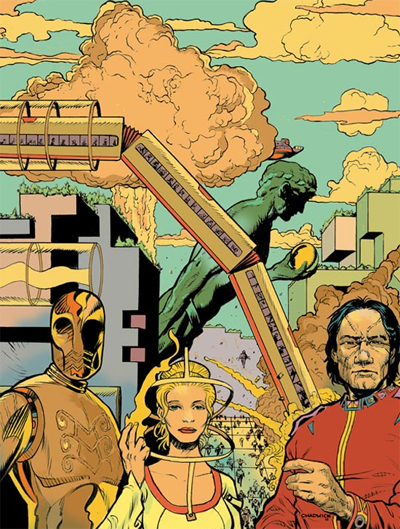
Harlan Ellison’s 7 Against Chaos (Review)

This June, we’re taking a look at some classic Star Trek movie tie-ins and other interesting objects. Check back daily for the latest reviews and retrospectives.

Star Trek: The Motion Picture went through a variety of iterations before settling on the version finally produced – a revised version of In Thy Image, the proposed pilot for the aborted Star Trek: Phase II television series. The story was devised by noted science-fiction author Alan Dean Foster, who had enjoyed a long relationship with the franchise – novelising episodes of Star Trek: The Animated Series earlier in the decade. Decades later, he would novelise the JJ Abrams films.

However, Foster was not the only noted science-fiction author who consulted on the development of what would become The Motion Picture. Theodore Sturgeon, who had contributed to the show, was among those contributing. Ray Bradbury, who Roddenberry had pursued to write for the show on several occasions but never did, also pitched. However, one of the more interesting ideas came from Harlan Ellison.

Ellison is a writer who will forever be associated with the franchise. He contributed the original teleplay for The City on the Edge of Forever, but was infamously displeased with how the episode turned out. He and Roddenberry had an acrimonious relationship after that point, with both sides prone to make cutting remarks and accusations across the aisle at one another. Roddenberry was fond to exaggerating or lying about Ellison’s original script, while Ellison was quite candid about his opinion of Roddenberry as a writer.

7againstchaos7

Continue reading

Non-Review Review: The Edge of Tomorrow

As with Oblivion, the last “Tom Cruise in the future” blockbuster, The Edge of Tomorrow feels like a gigantic big-budget episode of The Outer Limits. It’s low on character and high in concept. The film moves fast enough to gloss over the assorted problems that come with a typical time travel narrative. The script is witty enough to keep the audience engaged, and Tom Cruise is solid enough leading man to hold it all together.

The Edge of Tomorrow is wonderfully enjoyable high-concept thrill ride, and one of the stronger offerings of the summer so far.

It's not the end of the world...

It’s not the end of the world…

Continue reading

Non-Review Review: Divergent

As far as adaptations of popular young adult novels go, Divergent lacks the strong charismatic lead of The Hunger Games or even the campy pleasure of The Mortal Instruments. Working with a premise that feels like it would have made for a delightfully cheesy piece of sixties socially-conscious science-fiction, Divergent proceeds to take absolutely everything far too seriously. Cliché moments play to an over-the-top soundtrack, terrible dialogue is delivered with earnest profundity, the movie failing to take any joy in anything that it does.

There’s a sense of cynicism in Divergent, with the sequels already mapped out, and the studio committed to their release. The result is a movie that never feels compelled to rush, instead spending most of its runtime spinning its wheels, covering familiar ground. It’s over-long and poorly paced, with the first two acts often feeling like a hyper-extended training montage, meaning that by the time anything starts happening the audience can’t wait for it to end. The result is a heavy-handed and over-cooked attempt at social commentary, one reeking of anti-intellectualism and simplistic pandering.

Don't worry, her training covers this...

Don’t worry, her training covers this…

Continue reading

Star Trek: The Next Generation – Tin Man (Review)

This January and February, we’ll be finishing up our look at the second season of Star Trek: The Next Generation and moving on to the third year of the show, both recently and lovingly remastered for high definition. Check back daily for the latest review.

Tin Man is an interesting piece of science-fiction situated towards the end of the third season of Star Trek: The Next Generation. Michael Piller’s focus on character general shifted the show a little bit away from science-fiction high-concepts, with Tin Man feeling like something of a companion piece to the science-fiction mystery of The Survivors. It’s a story about the wonders of the universe, a rather eloquent (and underrated) celebration of the limitless potential that exists out in the cosmos.

This no the Tam or the place...

This no the Tam or the place…

Continue reading

Non-Review Review: The Last Days on Mars

This film was seen as part of the Jameson Dublin International Film Festival 2014.

There’s very little original to be found in The Last Days on Mars. Ruarí Robinson has constructed a gigantic homage to science-fiction horror, taking great pride in setting up the familiar clichés and working through the obligatory tropes. There are any number of shout-outs and references built into The Last Days on Mars, so much so that the film seems to struggle to stand on its own two feet.

At the same time, there’s an undeniably trashy charm to The Last Days on Mars. There’s a sense of Robinson’s abiding affection and enthusiasm for the conventions he evokes, the movies he homages. Nobody watching the film will confuse it for a trailblazing or original piece of work; however, it works surprisingly well as a gigantic tribute to pulpy science-fiction B-movies.

thelastdaysonmars

Continue reading

Star Trek: The Next Generation – A Matter of Perspective (Review)

This January and February, we’ll be finishing up our look at the second season of Star Trek: The Next Generation and moving on to the third year of the show, both recently and lovingly remastered for high definition. Check back daily for the latest review.

A Matter of Perspective is a bit of a disappointment. However, it’s a disappointment for the same reason that The High Ground is a disappointment. The third season of Star Trek: The Next Generation is at least trying new things, and playing with big ideas for a syndicated television science-fiction show in the late eighties and early nineties. There is some charm to the episode’s basic premise (Rashomon in space… with the holodeck!”), but the script never quite manages to deliver on that wonderful set up.

Instead, we end up with a show that lacks the nuance to follow through on its central themes, and a mystery that confuses techno-babble for a satisfying solution.

Painting a pretty picture...

Painting a pretty picture…

Continue reading

Star Trek: The Next Generation – The Price (Review)

This January and February, we’ll be finishing up our look at the second season of Star Trek: The Next Generation and moving on to the third year of the show, both recently and lovingly remastered for high definition. Check back daily for the latest review.

Well, the streak had to end some time. After seven episodes ranging from “flawed but still interesting” to “pretty great”, the third season of Star Trek: The Next Generation hits a bit of a snag. The Price is the weakest episode of the show’s third season to this point, and confirmation that the writers really have no idea how to write for Deanna Troi. It’s still the best episode to focus on the ship’s half-Betazoid counsellor, but being better than Haven or The Child is hardly an accomplishment for the ages.

All that glitters...

All that glitters…

Continue reading