• Following Us

  • Categories

  • Check out the Archives


  • Awards & Nominations

Sympathy for the Other: The Science-Fiction Horror Film in the Brexit/Trump Era

It’s not over. It’s just not yours any more.

– Melanie, The Girl With All the Gifts

exmachina

Note: This post contains minor spoilers for the reboot of Westworld and major spoilers for the endings of The Girl With All the Gifts and Ex Machina. Consider yourself warned. Continue reading

Non-Review Review: High-Rise

This film was seen as part of the Audi Dublin International Film Festival 2016.

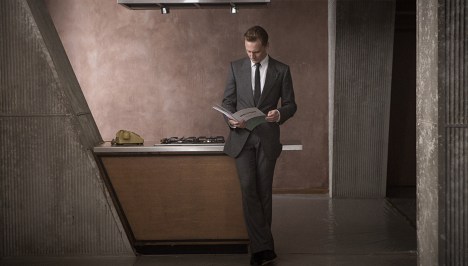
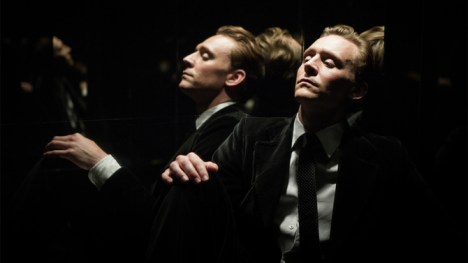
Ben Wheatley’s High-Rise is a beautiful ugly film.

An adaptation of J. G. Ballard’s surrealist novel, High-Rise fits rather comfortably within Wheatley’s aesthetic. There is an apocalyptic paranoia running through the film, which charts the social decay of the eponymous building over a three-week period. Class warfare is rendered literal in multiple senses, as the lower classes visit violence upon the wealthier inhabitants of the tower block. Even during the most peaceful and serene sequences of the movie’s first half, there is an underlying anxiety and dread bubbling just beneath the surface.

highrise3

High-Rise is disjointed and uneven, but that would seem to be something of the point. Amy Jump’s screenplay and Ben Wheatley’s direction eschew conventional pacing, with the world collapsing more in fits and starts than in a steady decline. Wheatley and Jump also edit the film, emphasising the chaotic nature of this collapse through jumps and montages that document the erosion of social order in a manner that ebbs and flows. It is disorientating and occasionally even frustrating, but one senses that this is meant to be the point.

High-Rise is a messy piece of work. But then, as the movie seems to suggest, things get messy when life is forced into a neatly delineated box.

HR_0430_tiff.tif

Continue reading

Harsh Realm – Reunion (Review)

This November, we’re taking a trip back in time to review the seventh season of The X-Files and the first (and only) season of Harsh Realm.

So that in the first place, I put for a general inclination of all mankind a perpetual and restless desire of Power after power, that ceaseth only in Death. And the cause of this is not always that a man hopes for a more intensive delight than he has already attained to, or that he cannot be content with a moderate power: but because he cannot assure the power and means to live well, which he hath present, without the acquisition of more.

– Thomas Hobbes, Leviathan, The First Part, Chapter XI

Reunion continues the sense that Chris Carter envisioned Harsh Realm as something of an allegorical episodic adventure series through a post-apocalyptic reflection of contemporary America.

Carter quite clearly wanted to use Harsh Realm as a vehicle to explore and comment upon certain aspects of the American experience. Inga Fossa touched on the links between projected masculinity and violence; Cincinnati will find Santiago’s “manifest destiny” brushing up against the country’s Native American population. Even scripts like Three Percenters and Manus Domini feel tied into Carter’s large oeuvre, touching on the writer’s recurring fascination with homogeneity and spirituality in the modern world.

Things come to a head...

Things come to a head…

Reunion is very consciously a critique of excessive and abusive capitalism, presenting a vision of America built upon the economics of slave labour reinforced by the rhetoric of freedom and competition. In some respects, Reunion feels like Harsh Realm is channelling the spirit of classic science-fiction television like Star Trek or The Twilight Zone. Its central allegory is hardly subtle, but there is a goofy charm in carrying these ideas well past their logical extremes. The vision of labour presented in Reunion is grotesque and exaggerated, but it is not completely fantastical.

Reunion also reaffirms the link that exists between the digital world and the real world, suggesting that perhaps the world that we inhabit is not as far removed from the horrors of the virtual reality as might hope.

Family matters...

Family matters…

Continue reading

Star Trek: Enterprise – Countdown (Review)

Next year, Star Trek is fifty years old. We have some special stuff planned for that, but – in the meantime – we’re reviewing all of Star Trek: Enterprise this year as something of a prequel to that anniversary. This August, we’re doing the third season. Check back daily for the latest review.

Star Trek: Enterprise spent a lot of the final stretch of the third season playing at being Star Trek: Deep Space Nine. There are a number of episodes that provide a direct parallel with stories from that earlier underrated Star Trek show. Damage riffs on In the Pale Moonlight. is very much Children of Time. More than that, the moral ambiguity and the long-form storytelling that define the third season of Enterprise also owe a very conscious debt to the work done on Deep Space Nine.

However, the final two episodes of the third season drift away from the ethical uncertainties and moral quagmires that defined a lot of the year’s stories. The Council effective resolved the big thematic questions hanging over the third season, allowing Archer the chance to propose a diplomatic solution to the Xindi crisis. This allows Countdown and Zero Hour to go about the task of providing a suitably impressive action climax to this twenty-four-episode season-long arc. There is precious little soul-searching here; instead, there is one big race against time.

The life aquatic...

The life aquatic…

In that respect, the last two episodes of the third season hark back to a more traditional form of Star Trek storytelling. In particular, Countdown and Zero Hour feel like an old-school blockbuster two-parter, in the style of Star Trek: The Next Generation or Star Trek: Voyager. In fact, with Archer’s fate in question and a hostile unstoppable force invading the solar system only to be destroyed in orbit of Earth, Countdown and Zero Hour play like an extended homage to The Best of Both Worlds.

While one of the most frequent criticisms of Enterprise is the sense that the writing staff are simply regurgitating classic Next Generation and Voyager plots, this feels almost earned. The third season has largely been about the show’s journey back to the heart of the Star Trek franchise, a trip that concluded with Archer embracing traditional Star Trek values in The Council. But what fun is that journey if you don’t get to celebrate it with an epic high-stakes world-ending rollercoaster ride?

"We cool?" "We cool."

“We cool?”
“We cool.”

Continue reading

Star Trek: Enterprise – Hatchery (Review)

Next year, Star Trek is fifty years old. We have some special stuff planned for that, but – in the meantime – we’re reviewing all of Star Trek: Enterprise this year as something of a prequel to that anniversary. This August, we’re doing the third season. Check back daily for the latest review.

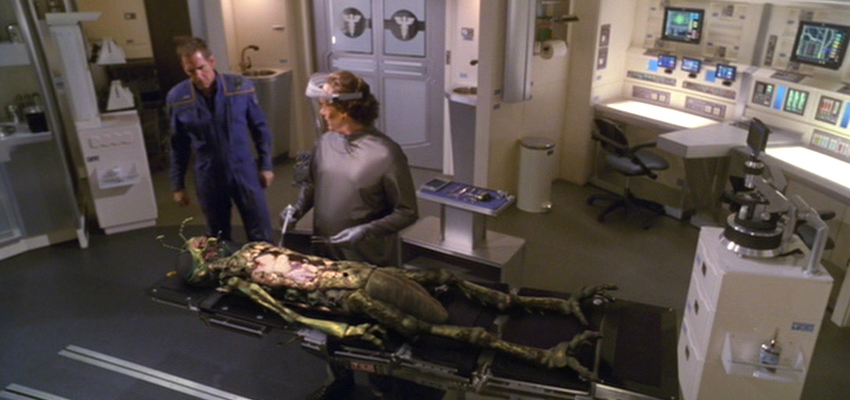
Hatchery is a very odd episode.

On the one hand, it feels like another irrelevant detour on the path to Azati Prime. It is a standalone episode about a wacky adventure that the crew have upon discovering a crashed ship on the surface of a dead world, playing with the standard Star Trek tropes about mind control and possession. This is not the first time that a Star Trek character has had their behaviour dramatically altered by an alien compound, and it does seem a bit distracting to tell this story at this point in this season, even in the aliens in this case are insect!Xindi.

Slice o' life...

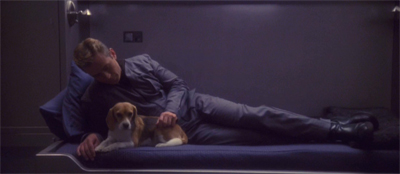
Slice o’ life…

At the same time, it does feel like an important episode thematically. The third season of Star Trek: Enterprise is packed with all manner of existential explorations of what it means to be Star Trek. What are the essential ingredients of the franchise? How far can you wander off the template without breaking it? What does Star Trek even mean in a post-9/11 world? There are aspects of Hatchery that deal with these questions rather directly, as the episode explores the consequences of putting a bunch of marines on a Star Trek ship.

It just feels rather surreal that “Archer goes crazy from bug spray” should be the jumping-off point for that particular story.

"Hey there, little fella..."

“Hey there, little fella…”

Continue reading

Star Trek: Enterprise – Similitude (Review)

Next year, Star Trek is fifty years old. We have some special stuff planned for that, but – in the meantime – we’re reviewing all of Star Trek: Enterprise this year as something of a prequel to that anniversary. This August, we’re doing the third season. Check back daily for the latest review.

It is hard to talk about Similitude without talking about Manny Coto.

It is quite easy to get distracted from the episode itself, which is a sublimely moving piece of working with skilled direction from LeVar Burton and a beautiful central performance from Connor Trinneer. More than that, Similitude is very much pure Star Trek. It is a metaphor about the human condition, wrapped up in a morality play fashioned from some admittedly questionable science-fiction. This good old-fashioned allegorical science-fiction in a style that really works, capitalising on the status quo of the third season of Star Trek: Enterprise to tell a moving story.

Send in the clones...

Send in the clones…

And, yet, despite all that, this is the point at which Manny Coto arrives. Much like it is impossible to talk about The Bonding without talking about Ronald D. Moore, it is impossible to talk about Similitude without talking about Manny Coto. Coto arrived on the show fresh from Odyssey 5, and quickly made himself invaluable and essential. While his scripts were quite hit-and-miss on an episode-by-episode basis, Coto demonstrated an aptitude for producing television in general and Star Trek in particular.

Indeed, Coto managed to climb the franchise rungs faster than any producer and writer since Michael Piller in the third season of Star Trek: The Next Generation. Piller had found himself running the show after Michael Wagner suddenly decided to step down only a few episodes into the season. Coto had a bit longer to get the lay of the land; he would have half of the third season to establish himself before being placed in charge of the writers’ room for the start of the show’s fourth year when Brannon Braga stepped back into a more supervisory role.

Genetically engineered engineer...

Genetically engineered engineer…

A number of factors helped to establish Coto as an almost mythical figure in Star Trek lore. The dramatic change in tone and style into the fourth year, which catered to a core group of Star Trek fans – including Coto himself – surely helped. The fact that Coto was succeeding Brannon Braga probably helped establish his credibility as well – a vocal section of fandom has complete disdain for Braga’s style. Despite the fact that Coto was only in charge for twenty-four episode, he made a surprisingly enduring contribution to the franchise as a whole.

Hindsight seems to suggest that Similitude was almost prophetic; it is the story of incredible growth and development over an incredibly short amount of time, making a deep and lasting impression.

Designer baby...

Designer baby…

Continue reading

The X-Files – Dreamland II (Review)

This July, we’re taking a trip back in time to review the sixth season of The X-Files and the third (and final) season of Millennium.

Morris Fletcher is (and remains) one of the more interesting aspects of the Dreamland two-parter.

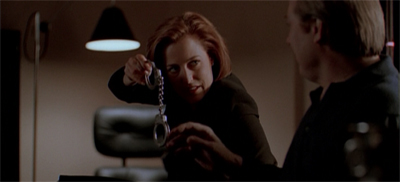
Fletcher would go on to become perhaps the most unlikely recurring character in the history of The X-Files. Michael McKean would reprise the role for a brief cameo in Three of a Kind at the end of the season. As with Kersh, he would disappear from the show’s world for the troubled seventh season, but would return the following year. He made a guest appearance in All About Yves, the finalé of The Lone Gunmen. Fletcher would then follow the Lone Gunmen back to The X-Files, appearing in Jump the Shark during the final season.
And the shippers went wild...

And the shippers went wild…

A large part of what makes Fletcher work is the wonderful guest performance of Michael McKean. McKean is a veteran actor with a long history of great work, dating back to his breakout role as Lenny (and Squiggy) on the sitcom Laverne and Shirley. Along with the move to Los Angeles, the sixth season of The X-Files began to drift away from Chris Carter’s initial reluctance to cast recognisable actors in significant roles. The X-Files: Fight the Future had featured guest appearances from Martin Landau, Blythe Danner, Armin Muller-Stahl and Glenne Headly.

The two-parter built around Michael McKean paves the way for appearances from Ed Asner, Lily Tomlin and Bruce Campbell. These are all superb guest performances, and consciously play into the idea that the sixth season of The X-Files has taken on a more playful or vaudevillian style. It is too much to describe these guest roles as “stunt casting” in the same way that putting Jerry Springer in The Post-Modern Prometheus or Burt Reynolds in Improbable was stunt casting, but the casting decisions are part of a broader change in the show.

Our man Morris...

Our man Morris…

On paper, Morris Fletcher could easily come off as a one-note creep. After all, he is a character who thinks nothing of using his body swap with Fox Mulder to cheat on his wife of twenty years. There is a creepy and pervy banality to his evil, one that mirrors that of Eddie Van Blundht in Small Potatoes. However, while Small Potatoes felt a little too sympathetic to pathetic Eddie Van Blundht, Dreamland strikes a better balance in its portrayal of Morris Fletcher. McKean plays Fletcher as a very human character, but one who is no less creepy for his well-practiced charm.

It goes almost without saying that Michael McKean’s guest performance is a major reason why Dreamland (mostly) works.
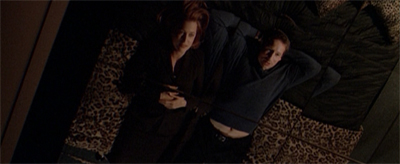
Not particularly reflective...

Not particularly reflective…

Continue reading

The X-Files – Kill Switch (Review)

This May and June, we’re taking a trip back in time to review the fifth season of The X-Files and the second season of Millennium.

On the surface of it, William Gibson seems a strange fit for The X-Files.

He certainly seems like a more eccentric choice than Stephen King. King was a writer famed for his horror stories, with a fascination for small-town life and an interest in guilt as a legacy of American history. On paper, King should have been the perfect “special guest writer” for the show, able to churn out a script that would resonate perfectly with the larger themes of The X-Files while still sitting comfortably within his own oeuvre. While Chinga is not a bad episode, it is not an exceptional episode by any measure. It feels perfectly adequate.

Well, that's going in the DVD menu.

Well, that’s going in the DVD menu.

As such, Kill Switch seems like a story that could go horribly wrong. Gibson is a writer most famous for his work in defining and popularising “cyberpunk”, a science-fiction subgenre that is far removed from the horror trappings generally associated with The X-Files. Gibson was a writer who tended to explore the possible future development of cyberspace and associated issues, while Carter worked very hard to anchor The X-Files in the now. Gibson’s stories seemed to take place in the not-too-distant future; Carter grounded The X-Files in a very particular now.

However, Kill Switch works. It works phenomenally well. It is an episode that feels markedly different from everything else around it, while still feeling like it belongs to The X-Files. The clash of styles is evident in Kill Switch, as writers William Gibson and Thomas Maddox find themselves adapting their themes and ideas to a completely different aesthetic. That is perhaps part of appeal. While Chinga made it look quite easy to construct a solid Stephen King story that was also a solid episode of The X-Files, Kill Switch is nowhere near as smooth. This is a different beast. And it is glorious.

"Woah, woah, woah. What happened to floppies?"

“Woah, woah, woah. What happened to floppies?”

Continue reading

The X-Files – Synchrony (Review)

This February and March, we’re taking a trip back in time to review the fourth season of The X-Files and the first season of Millennium.

Time travel is one of the great science-fiction tropes.

Although magical or metaphorical time travel has long been a part of literary tradition, pseudo-scientific or pseudo-rational versions of science-fiction really took root towards the end of the nineteenth century. Although H.G. Wells blazed a trail with The Time Machine, Edward Page Mitchell actually beat him to the punch – he published the short-story The Clock That Went Backward fourteen years before Wells wrote The Time Machine. Nevertheless, time travel quickly caught on as a literary device.

The hole in things...

The hole in things…

There are films, television show, novels, comics and songs all playing with the idea of moving through time. Although there is considerable debate about the feasibility of actually travelling backwards through time, time travel serves as a wonderful narrative device. It opens up all sorts of possibilities for structure and style; it provides some pretty heavy themes; it opens up a myriad of settings and possibility. It is no surprise that there have been so many variations and permutations based upon the idea of going backwards in time.

Indeed, it seemed like it was only a matter of time before The X-Files got around to telling its own time travel story. Synchrony was as inevitable as the decision to close the episode with a clumsy hint toward predetermination.

Ghosts of future self...

Ghosts of future self…

Continue reading

Star Trek – The Gamesters of Triskelion (Review)

The first Star Trek pilot, The Cage, was produced in 1964. To celebrate its fiftieth anniversary, this December we are reviewing the second season of the original Star Trek show. You can check out our first season reviews here. Check back daily for the latest review.

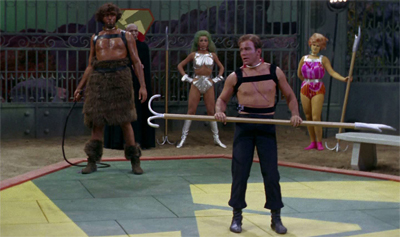
The Gamesters of Triskelion is not a great episode of Star Trek. Although filmed after Obsession, even if the production order lists it before that episode, The Gamesters of Triskelion feels like we’re watching producer John Meredyth Lucas finding his feet. It’s an episode that feels light and looks relatively cheap, formed from a collection of clichés that would already be familiar to Star Trek fans or fans of pulp science-fiction.

Perhaps the best thing that can be said about The Gamesters of Triskelion is that it has a decidedly pulpy charm to it. The entire episode looks like it was lifted from the cover to some trashy paperback, and the plot is recycled from stock science-fiction concepts and themes. While this isn’t enough to sustain an entire fifty minutes of television, it does allow the episode to feel a little distinctive and memorable… if not necessarily in a good way.

Shat happens...

Shat happens…

It is amazing how much of the franchise’s memorable iconography and imagery comes from weaker episodes of the classic Star Trek. It’s a testament to the show’s production design team, that could always find a way to make Star Trek look impressive, even on a tight budget and a short schedule. There’s also something enduring about the bizarre images that Star Trek could throw up on screen, even when the scripts were lacking; from space!Lincoln in The Savage Curtain to half-black/half-white racism in Let That Be Your Last Battlefield.

Of course, there are episodes that are both great and iconic at at the same time, like Mirror, Mirror. Still, rewatching the show, it is hard to believe just how much of the popular perception of Star Trek comes from episodes that are of… questionable quality. After all, The Gamesters of Triskelion seems to have made an impression. It seems to be a go-to reference for Matt Groening’s television shows.

Throwing a bit of stick about...

Throwing a bit of stick about…

Continue reading