• Following Us

  • Categories

  • Check out the Archives


  • Awards & Nominations

Star Trek: Deep Space Nine – In the Hands of the Prophets (Review)

Star Trek: Deep Space Nine is twenty years old this year. To celebrate, I’m taking a look at the first season. Check back daily for the latest review or retrospective.

Both Star Trek and Star Trek: The Next Generation allowed their first seasons to run an episode too long. The City on the Edge of Forever, the penultimate episode of the first ever season of Star Trek, is a genuine classic. I don’t envy any story that has to follow it, especially not something as mediocre as Operation — Annihilate! While Conspiracy, the second-to-last episode of the first season of The Next Generation, is hardly a classic in the same league, it does up the stakes on the show’s first year, and tie up a dangling plot thread. The Neutral Zone, on the other hand, is a bland return to form, with a particularly insufferable b-plot.

So the excellence of Duet might offer the viewer cause to worry. A penultimate first-season episode which is significantly above average? One would be forgiven for wondering if the first season might have been best served to wrap itself up at that point, going out in a high, safe in the knowledge that it had contributed one classic episode to the Star Trek mythos and with the potential to offer quite a few more. Quit while you’re winning, and don’t tempt fate with another superfluous episode.

In the Hands of the Prophets, however, puts those fears to rest. Serving as a companion piece to Duet, it’s another one of those “only on Deep Space Nine stories, closing out the first season with a reminder of what makes the show unique. In the Hands of the Prophets is another classic piece of Deep Space Nine. It might not pack quite the punch that Duet did, but it’s a compelling piece of drama which demonstrates just how much Deep Space Nine has to offer the Star Trek mythos.

Beyond belief...

Beyond belief…

Continue reading

Star Trek: Deep Space Nine – Duet (Review)

Star Trek: Deep Space Nine is twenty years old this year. To celebrate, I’m taking a look at the first season. Check back daily for the latest review or retrospective.

And here we hit the first truly classic episode of Star Trek: Deep Space Nine. Positioned almost at the very end of what has been a fairly uneven season of television, Duet firmly demonstrates that this spin-off can hold its head tall among the other franchise installments. Duet isn’t just a quintessential Deep Space Nine episode. It isn’t just a classic Star Trek episode. It is an absolutely beautiful piece of allegory, a stunning character study and a probing exploration of collective guilt and responsibility.

J'accuse...

J’accuse…

Continue reading

Star Trek: Deep Space Nine – The Forsaken (Review)

Star Trek: Deep Space Nine is twenty years old this year. To celebrate, I’m taking a look at the first season. Check back daily for the latest review or retrospective.

Following on directly from If Wishes Were Horses…, The Foresaken combines another bunch of familiar Star Trek clichés into a plot that fells like it has been elsewhere. To be fair, the “malfunctioning computer” plot is a plot that lends itself to a Star Trek setting, and the key is the execution of that most familiar set up. The franchise has done it quite well in the past. I’m fond of Star Trek: The Next Generation‘s foray into the subgenre with Disaster. Even Star Trek: Deep Space Nine would do a number of later episodes working quite well from this starting point – Civil Defense and Starship Down ranking quite highly.

The problem with The Foresaken, then, isn’t the fact that it falls back on a bunch of familiar Star Trek clichés, but it fails to use them to tell an especially compelling story.

Oh, what a world!

Oh, what a world!

Continue reading

Non-Review Review: Star Trek IV – The Voyage Home

This August, to celebrate the upcoming release of Star Trek: Into Darkness on DVD and blu ray, we’re taking a look at the Star Trek movies featuring the original cast. Movie reviews are every Tuesday and Thursday.

Up until the release of JJ Abrams’ Star Trek in 2009, Star Trek IV: The Voyage Home was the most successful of the Star Trek films. Indeed, it ranks alongside Star Trek II: The Wrath of Khan as the film which has most deeply dug itself into the popular consciousness. “I’m from Iowa; I only work in outer space” might not be as iconic a quote as “KHAAAAAAN!!!”, but a lot of people casually remember “the one with the whales.”

The fourth film in the series closes off an inter-connected trilogy of Star Trek films, wrapping up character development for the leads and tying up loose ends, but it’s also – somewhat paradoxically – the most accessible of the movies. If you’re looking for an introduction to Star Trek, it’s hard to think of a more welcoming entry than The Voyage Home. However, what’s really strangely charming about The Voyage Home is that it’s also probably the film truest to the franchise’s humanist values.

Ship off the starboard bow!

Ship off the starboard bow!

Continue reading

Non-Review Review: Elysium

Elysium is good old-fashioned high-concept science-fiction. With production design alternately evoking the seventies (the upper class satellite that gives the movie its name) and eighties (the apocalyptic wasteland of future Los Angeles), Elysium feels like a conscious attempt to evoke classic genre films. Blomkamp builds in a healthy amount of social commentary, and there’s something quite satisfying in seeing a large-scale science-fiction film that isn’t afraid of big bold ideas.

However, the execution feels just a little bit muddled. The plotting is a little convoluted, and the third act becomes incredibly messy. The characters inhabiting the world never seem organic, with their motivations and behaviour prone to change rapidly to meet the rapidly-changing demands of a very messy script.

In a bit of a fix...

In a bit of a fix…

Continue reading

Doctor Who: Doomsday (Review)

To celebrate the fiftieth anniversary of the longest-running science-fiction show in the world, I’ll be taking weekly looks at some of my own personal favourite stories and arcs, from the old and new series, with a view to encapsulating the sublime, the clever and the fiendishly odd of the BBC’s Doctor Who.

Doomsday originally aired in 2006.

Daleks, be warned. You have declared war upon the Cybermen.

This is not war. This is pest control.

We have five million Cybermen. How many are you?

Four.

You would destroy the Cybermen with four Daleks?

We would destroy the Cybermen with one Dalek. You are superior in only one respect.

What is that?

You are better at dying.

– the Cyberleader and Dalek Sec compete for the title of “bitchiest Doctor Who villain”

Part of my frustration with Doomsday is the same problem that I have with the rest of the second season’s weaker episodes. Like Fear Her or Rise of the Cybermen, the second season finalé lacks ambition. It feels complacent, it feels comfortable. It feels like putting the Daleks and the Cybermen together in one episode is enough to merit attention, without anything more than exchanging pithy one-liners. It feels like the separation of the Doctor and his companion is the biggest and most important thing in the universe, without really convincing us that this isn’t the best possible outcome. It feels like the easiest way to make these threats palpable is to set them in modern London, without any real sense of consequence or scale.

The tears of a Time Lord...

The tears of a Time Lord…

Continue reading

Doctor Who: The Green Death (Review)

To celebrate the fiftieth anniversary of the longest-running science-fiction show in the world, I’ll be taking weekly looks at some of my own personal favourite stories and arcs, from the old and new series, with a view to encapsulating the sublime, the clever and the fiendishly odd of the BBC’s Doctor Who.

The Green Death originally aired in 1973.

Where are you off to?

To pack a suitcase.

Oh, good. Give me a couple of minutes and we’ll be off.

Off? Off where?

Well, Metebelis III, of course.

I’m not going to Metebelis III.

Why? Where are you thinking of going to?

Well, South Wales, of course. Llanfairfach.

– the Doctor and Jo discuss travel plans… why would you want to go to Metebels III when you can visit South Wales?

The Green Death is a great example of the Jon Pertwee era. It offers a pretty solid showcase of the best of the era, along with the glaring structural and thematic weaknesses that the show never really tackled head-on. It’s a great yarn, an affectionate run-around. There is a reason, after all, that the overgrown maggots have managed to wedge themselves in British popular consciousness. There’s a conscious sense that The Green Death is a season finalé, in the biggest and boldest terms possible.

In an era where television wasn’t really structured in that way, you can trace a pretty clear line between The Green Death and the big epic series finalés of the Russell T. Davies era of Doctor Who.

And the Beatz go on...

And the Beatz go on…

Continue reading

Doctor Who: Army of Ghosts (Review)

To celebrate the fiftieth anniversary of the longest-running science-fiction show in the world, I’ll be taking weekly looks at some of my own personal favourite stories and arcs, from the old and new series, with a view to encapsulating the sublime, the clever and the fiendishly odd of the BBC’s Doctor Who.

Army of Ghosts originally aired in 2006.

How long are you going to stay with me?

Forever.

– the Doctor and Rose tempt fate

It’s only logical that anybody diving head-first into a fifty-year-old television show is going to have an opinion that radically diverges from the fandom consensus on a couple of stories. So, for example, I’ll concede that I like The Talons of Weng-Chiang, but less than most. However, the biggest divide – and the point on which I feel furthest from consensus – comes with Army of Ghosts and Doomsday, Russell T. Davies’ massive farewell to Rose Tyler, the companion he introduced all the way back in Rose. It’s generally acknowledged as one of the high points of Davies’ tenure and one of the truly great Tenth Doctor stories.

I am far from convinced.

The cracks are starting to show...

The cracks are starting to show…

Continue reading

Doctor Who: The Hand of Fear (Review)

To celebrate the fiftieth anniversary of the longest-running science-fiction show in the world, I’ll be taking weekly looks at some of my own personal favourite stories and arcs, from the old and new series, with a view to encapsulating the sublime, the clever and the fiendishly odd of the BBC’s Doctor Who.

The Hand of Fear originally aired in 1976.

Come on, where are we?

We’re in a quarry.

Yes, I know we’re in a quarry, but where?

Well, how do I know? I don’t know all the quarries that–

– the Doctor and Sarah Jane get a bit meta

The Hand of Fear is odd, because it’s the end of an era – but it’s not the end of the era for the rather obvious reason that it bids farewell to one of the franchise’s best-loved companion character. The Hand of Fear is best known as the final story to feature Sarah Jane Smith. Indeed, the DVD comes with a helpful sticker informing any potential purchasers of the story’s significance.

However, watching The Hand of Fear with the benefit of hindsight, it isn’t Sarah Jane’s departure that is the most striking part of the show.

Keep it handy...

Keep it handy…

Continue reading

Doctor Who: The Sea Devils (Review)

To celebrate the fiftieth anniversary of the longest-running science-fiction show in the world, I’ll be taking weekly looks at some of my own personal favourite stories and arcs, from the old and new series, with a view to encapsulating the sublime, the clever and the fiendishly odd of the BBC’s Doctor Who.

The Sea Devils originally aired in 1973.

If Horatio Nelson had been in charge of this operation, I hardly think that he would have waited for official instructions.

Yes, a pretty impulsive fellow, if one can believe the history books.

History books? Captain Hart, Horatio Nelson was a personal friend of mine. Come on, Jo.

– Namedropping? The Doctor? Never!

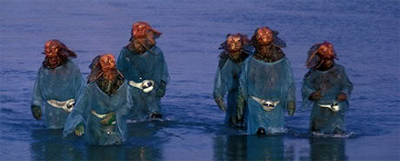
When it comes to Doctor Who, “sequel” stories get a bit of a hard time from fandom. It seems to be easy to dismiss Snakedance in favour of Kinda, and to praise Spearhead from Space at the expense of Terrors of the Autons and even elevate The Daleks above The Dalek Invasion of Earth. It seems that time, and conventional wisdom, tend to favour the original serials. Of course, there are undoubtedly examples where follow-up scripts have disappointed (the ridiculously padded The Monster of Peladon following The Curse of Peladon). Still, for my money, The Sea Devils represents a tighter, complimentary and ambitious sequel to Doctor Who and the Silurians, easily one of the most highly regarded adventures of the seventies. It’s a fairly impressive accomplishment, but The Sea Devils is more than up to it.

Everybody out of the water!

Continue reading