• Following Us

  • Categories

  • Check out the Archives


  • Awards & Nominations

Non-Review Review: The Monuments Men

If you tried to take an Indiana Jones film and turn it into a meditation on the scale and conflict of the Second World War, you would end up with The Monuments Men. That is to say, if you sucked all the fun out of it while trying to balance a pulpy tone with a more weighty reflection on the cultural responsibilities that came with winning the Second World War. The movie is just as tone deaf and ill-judged as that description seems to imply – having a lot of clever things to say, but never being quite sure how to say them.

There is a good film to be found in The Monuments Men, if one looks hard enough. One can imagine writer, director and actor George Clooney chipping away at the story trying to find that good movie, like one of those artists whose work was rescued by this band of merry men. You get a sense that Clooney can see the angel in here somewhere; he’s just not sure how to set it free.

The art of the chase...

The art of the chase…

Continue reading

Non-Review Review: The Lego Movie

The Lego Movie is – as one might expect – a wonderfully well-constructed family film. Following a construction worker repeatedly described as “normal” or “average” – but, one colleague hastens to add, “not normal like us” – named Emmet, the movie is structured as a conventional “special one” narrative. However, veteran directors Phil Lord and Christopher Miller stir things up just enough to keep it interesting.

With a wry sense of humour and an acute awareness of the clichés of a typical “hero’s journey” narrative, Lord and Miller have actually managed to tap into the core essence of Lego – if a massive multi-platform brand name empire can be distilled to a “core essence.” It’s a story about the magic of playing with toys and the necessity of throwing away the instructions every once in a while.

The ensemble fits together perfectly...

The ensemble fits together perfectly…

Continue reading

Star Trek: The Next Generation – The Ensigns of Command by Melinda Snodgrass (Review)

This January and February, we’ll be finishing up our look at the second season of Star Trek: The Next Generation and moving on to the third year of the show, both recently and lovingly remastered for high definition. Check back daily for the latest review.

We’ll be supplementing our coverage of the episodes with some additional materials – mainly novels and comics and films. This is one such entry.

One of the benefits of the internet age is the wealth of material that it makes available with comparative ease. Interviews are widely distributed, clips are circulated, and it’s often not too hard to find primary or well-sourced secondary materials available with a simple search. As such, it’s a lot easier to pry into the history and legacy of cult film and television than it has ever been before. Leaping back in Star Trek: The Next Generation more than two decades after it originally aired allows the viewer more insight than they would ever have had back then.

The third season of The Next Generation is widely (and rightly) regarded as one of the strongest seasons in the history of the franchise. Only the first two seasons of the original Star Trek, a few more seasons of The Next Generation and couple of years of Star Trek: Deep Space Nine can claim to compete on a level of quality and consistency with this twenty-six episode rejuvenation of the series that had faltered in its first two years.

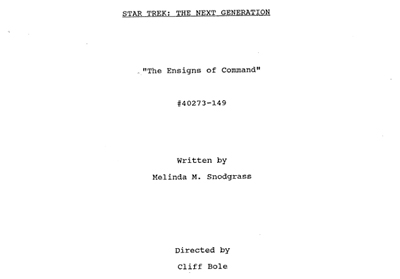
Watching The Ensigns of Command, it’s hard to fathom how deeply troubled the production was. The episode was plagued by problems from scripting through to post-production. Writer Melinda Snodgrass has made no secret of her dissatisfaction with the episode. Although her name appears on the finished script, the episode had been heavily re-written. Snodgrass has made her original script available on-line via her website, and it makes for an interesting glimpse at what might have been.

tng-theensignsofcommand22

Continue reading

Non-Review Review: Mr. Peabody & Sherman

Mr. Peabody & Sherman is solid family entertainment. Too scattershot and inconsistent to really rank among the best of the Dreamworks animated feature films, it does benefit from an endearing energy and momentum – as well as a charming central performance from Ty Burrell as the eponymous super-inventor dog genius. It’s perfectly inoffensive fun that manages to get quite a few laughs, even if it doesn’t tug the heart strings quite as well as it might want to.

A dog and his boy...

A dog and his boy…

Continue reading

Non-Review Review: Inside Llewyn Davis

Inside Llewyn Davis is great examination of a singer drifting through American music scene in the sixties, starting in Greenwich before embarking on a cross-country tour and then ending up right back where he started.

One of the nicer cinematic tricks employed by the Coen Brothers is a delightful sense of deja vu at the end of the movie. There’s a step backwards in time towards the start of the film, but also a sense that it’s so subtle you might be forgiven for missing it. After all, it doesn’t matter too much. The eponymous Llewyn Davis is an artist caught in a particular groove, stuck on repeat; despite his protestations to the contrary, he is a performing monkey who ultimately only knows one or two numbers that seem to resonate with the audience.

Inside Llewyn Davis is a melancholy examination of personal and professional failure, delivered in the Coens’ trademark tragicomic style. There’s a sense that the world itself has a cruel sense of humour, structuring a joke at the expense of Llewyn. The film doesn’t rank among the Coen Brothers’ best work, and it’s certainly not an instant classic, feeling too disconnected and occasionally too cynical to rank with with the best of their output. At the same time, a middle-tier Coen Brothers’ film is still well worth a look.

Sing when you're winning... ... or when you're not...

Sing when you’re winning…
… or when you’re not…

Continue reading

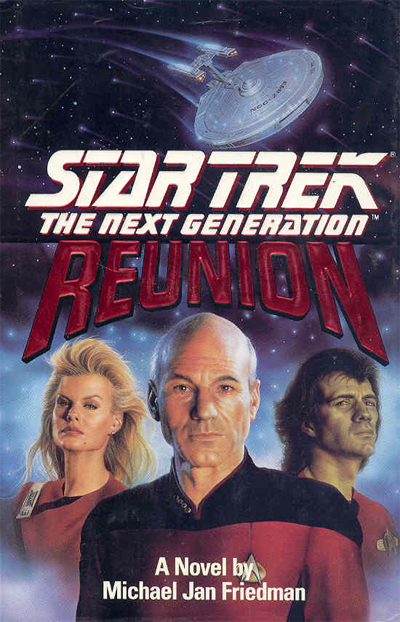
Star Trek: The Next Generation – Reunion by Michael Jan Friedman (Review)

This January and February, we’ll be finishing up our look at the second season of Star Trek: The Next Generation and moving on to the third year of the show, both recently and lovingly remastered for high definition. Check back daily for the latest review.

We’ll be supplementing our coverage of the episodes with some additional materials – mainly novels and comics and films. This is one such entry. This is actually supplementary to the first season of the Next Generation, specifically the episode The Battle.

The Star Trek expanded universe is so large and so expansive that it has its own particular phases of history, its own important and divisive figures, its own grand context for things. With the announcement of Star Trek: The Next Generation in the late eighties, the focus of expanded universe shifted a bit. Ever since the original Star Trek had gone off the air, novelists like John Ford, Vonda McIntyre, Diane Carey and Diane Duane had been free to carve out their own little corners of the shared universe.

There was a sense that the novels existed to expand the Star Trek universe outwards, with certain authors even developing their own recurring casts and delving into the history and culture of various fictional races in a way that simply wasn’t possible as part of a television episode or feature film. In the late eighties, this changed rather dramatically, with Richard Arnold becoming something of a “gate-keeper” of the expanded universe.

Although Diane Carey would write the first Next Generation tie-in novel, Ghost Ship, this represented something of a changing of the guard. The focus of the novels became a bit different, and the authors driving the line began to change. Michael Jan Friedman’s first published Star Trek novel was Double, Double in April 1989. Since than, he has written more than thirty different Star Trek tie-in novels, a few short stories and ninety-one issues (including annuals and specials) of the nineties Next Generation tie-in comic.

In terms of influence in the Star Trek expanded universe of the nineties, Michael Jan Friedman is a defining figure.

tng-reunion

Continue reading

Non-Review Review: The Wolf of Wall Street

In 1987, Oliver Stone’s Wall Street was arguably too subtle in its criticisms of the Wall Street mentality – the philosophy that “greed, for lack of a better word, is good” or that enough can never really enough. After all, the film apparently inspired a whole generation of stock brokers and investment managers, with quite a few aspiring to be their generation’s Gordon Gekko – when the movie’s central point was that Gekko was hardly an idol to worship.

This would seem to explain the rationale of Scorsese’s The Wolf of Wall Street, a film that makes Stone’s brutal evisceration of Wall Street excess seem positively mild-mannered. Indeed, the film all but directly acknowledges this fact in an early scene where a “hatchet job” of an article from Forbes (the same article that would lend Belfort his sobriquet “Wolfie!”) prompts a massive upsurge in job applications for Belfort’s Stratton Oakmont.

The money shot...

The money shot…

So, understanding the need to go a bit bigger and larger, The Wolf of Wall Street introduces us to its protagonist, Jordan Belfort, snorting cocaine out of the bodily orifices of a prostitute, and yet somehow descends deeper and deeper into acts of debauchery and excess. It’s an unrelenting and energetic film, that is exhausting and exhilarating. It’s less of a structured story and more a three-hour laundry-list of depravity.

While the last hour of the film (the inevitable “it all comes tumbling down… or does it?” act) can’t maintain the forward moment that make the first two so exhilarating, The Wolf of Wall Street remains proof that Scorsese is an incredible film maker with an almost impossible vigour and enthusiasm for the medium.

Drinking it in...

Drinking it in…

Continue reading

Non-Review Review: Devil’s Due

The single biggest problem with Devil’s Due is that it’s boring.

There are a lot of other flaws. It’s really creepily xenophobic. It has little interest in the female character carrying this baby. It is completely uninterested in the “found footage” thing, but still commits to using it. It is really just a bunch of clichés that we’ve seen done much better elsewhere. Its protagonists rank incredibly low on the intelligence scale for horror movies, which sets a pretty low baseline to begin with.

However, the most frustrating flaw with this reproductive horror is the fact that it’s just deathly dull.

The belly of the beast...

The belly of the beast…

Continue reading

Non-Review Review: Delivery Man

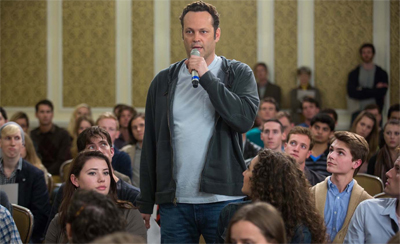
Delivery Man works surprisingly well. Like something of a throwback to the nineties “overgrown manchild” comedy about slackers honestly trying to pull their lives together, Vince Vaughn’s latest effort is disarmingly sincere. It isn’t plotted particularly well, and there are points where Delivery Man threatens to unspool if you think about it too much, but this adaptation of Canadian comedy Starbuck has its heart in the right place and manages to deliver a nice sentimental comedy without every becoming overwrought or overly earnest.

Cue a tonne of "who's your daddy?" jokes...

Cue a tonne of “who’s your daddy?” jokes…

Continue reading

Non-Review Review: Barbaric Genius

Barbaric Genius has a fascinating subject. Writer John Healy was responsible for The Grass Arena, generally regarded as one of the most searingly and brutally honest depictions of life on the streets published during the eighties. However, despite the fact that The Grass Arena became a touchstone for an entire generation and that it was so successful that it was developed into a film, Healy faded rather quickly from view. Despite writing consistently over the years that followed, none of Healy’s work was published for more than two decades following the 1988 release of The Grass Arena.

It’s an intriguing mystery, and Barbaric Genius does a thorough job exploring it, but the documentary suffers a bit as it tries to bring its subject into focus, often feeling like director/producer/narrator Paul Duane is having difficulty getting the necessary distance between himself and the film.

barbaricgenius

Continue reading