• Following Us

  • Categories

  • Check out the Archives


  • Awards & Nominations

Non-Review Review: The Wedding Ringer

The bromantic wedding comedy is a fairly reliable comedy subgenre; but it is also one that requires a great deal of care. Producing a comedy about weddings can be something of a minefield; it is very easy to play into the familiar gendered stereotypes the controlling fiancée or the disengaged husband-to-be. The Wedding Ringer is an addition to the rapidly-growing subgenre that focuses on a stereotypically masculine perception of “the big day” – wondering what the groom makes of festivities.

The Wedding Ringer comes packed with awkward gender truisms. At one point, professional best man Jimmy Callahan (head of “TBM – The Best Man Inc.”) is confronted by his assistant Doris Jenkins. Doris explains to Jimmy that male and female relationships work differently; that it is tough for men to acknowledge emotion and to connect with one another. This is perhaps the most dialogue that The Wedding Ringer affords any female character in any one scene.

theweddingringer5

“Weddings are for the woman,” Jimmy assures his client, Doug Harris, in one scene. It seems like a stock stereotype that the movie is setting up to subvert – that Jimmy and Doug will eventually learn (in a “knowing is half the battle” sort of way) that marriage is a two-person enterprise that becomes shared at the moment of union. Instead, The Wedding Ringer never shifts its position. The Wedding Ringer sticks to its guns, hitting all the plot beats that one might expect from a movie espousing that philosophy.

Kevin Hart works the material as best he can, and The Wedding Ringer works best when it allows itself to drift from its central premise. However, it is weighed down by a clunky script and a decidedly mean-spirited world-view.

theweddingringer1 Continue reading

Non-Review Review: Inherent Vice

In many ways, Inherent Vice resembles its central character – former-hippie-turned-private-investigator Larry “Doc” Sportello.

Inherent Vice is prone to ramble and meander, stumbling across its central conspiracies as much by fate as by actual investigation. The logic is fuzzy, but the genius is clear. Navigating a complex web of seventies paranoia, it often seems as if Inherent Vice is playing a game of free association between its themes, stumbling upon some higher meta-physical plane where all the evils of the world (or, at least, Los Angeles) are connected by threads almost imperceptible.

Bad trip...

Bad trip…

Both Inherent Vice and Doc are hooked on their own particular drugs. Over the course of Inherent Vice, Doc makes it quite clear that heroine is just about the only dope he won’t take into his body. Inherent Vice itself is drawn the delightfully trippy far-out prose of Thomas Pynchon, with Paul Thomas Anderson’s script pausing intermittently to dump large quantities of existential musing on to the market. If Pynchon’s prose didn’t flow eloquently from actresses like Katherine Waterston and Jeannie Berlin, the audience might complain.

Running almost two-and-a-half hours, Inherent Vice is more than a little indulgent. Luckily, it is more than a little brilliant as well.

Lawyer up...

Lawyer up…

Continue reading

Non-Review Review: Selma

Selma is a fascinating look at the Civil Rights Movement, and at the life and times of the Reverend Martin Luther King Junior.

Adopting the increasingly common approach of narrowing its focus to a rather tight sequence of events, Selma offers an interesting and insightful glimpse at the protest in Selma, Alabama – culminating in a planned march from Selma to Montgomery in March 1964. That was a pivotal moment for the Civil Rights struggle, as the cameras of the nation focused on the brutally wielded by local authorities against those marching peaceably. Selma focuses on that national moments as a vehicle to explore the Civil Rights movement as a whole.

selma3

To be fair, Selma does have its problems. There is a sense that the film is perhaps too concerned with the character of Lyndon B. Johnson, even ultimately affording him something of a heroic moment at the climax. The carefully-maintained period feel is undermined by the decision to dub Yesterday Was Hard On All Of Us by Fink over a crucial moment. In contrast, the period-specific (or close enough) songs by Otis Redding, the Impressions or Duane Eddy add context and texture to the film; the tracks by The Fink and Common (featuring John Legend) feel superficial.

However, these are minor problems. Selma features a tight script, solid direction and a host of fantastic central performances. Eschewing the sentimentality or softness associated with these sorts of prestige pictures, Selma deserves to be considered among the best of the awards season prestige pictures. Its diminished presence on Academy Awards ballots seems sadly telling.

selma1 Continue reading

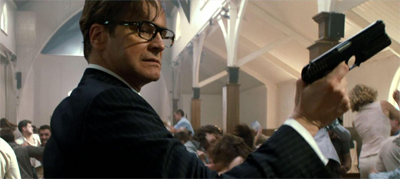
Non-Review Review: The Kingsman

The creators of The Kingsman either really love or really hate the classic Roger Moore Bond films. Probably both.

Another creative collaboration between Matthew Vaughn, Jane Goldman and Mark Millar, The Kingsman is just as juvenile, crass and ultimately charming as Kick-Ass. There is a sense of mischievous and cheeky fun to this classic spy film homage. It is effectively an update of those seventies and eighties spy films with a more cynical and self-aware attitude. There is a sense that The Kingsman is simply more transparent than its inspirations in its infectiously juvenile and borderline offensive sensibilities.

Sound and Firthy...

Sound and Firthy…

It is hard to tell how much of this homage is genuine nostalgic affection, and how much is witty subversion. The Kingsman is a spy film that not only uses outdated (and occasionally insensitive) spy movie tropes, it practically revels in them. Although the third act occasionally feels a little too mean-spirited in its riff on classic Bond sensibilities, The Kingsman has enough boundless energy and raw enthusiasm to keep the audience watching. The script is well-observed and the direction is tight. A superb central cast helps to anchor the film.

The Kingsman is an odd beast. It is that rare homage that seems quite likely to shock and offend many fans that otherwise share its nostalgic inclinations. However, those willing to be a bit more adventurous will find much to love in this updated spy caper.

Matthew Vaughn's fingerprints are all over this...

Matthew Vaughn’s fingerprints are all over this…

Continue reading

Star Trek: Alien Spotlight – Tribbles (Review)

The first Star Trek pilot, The Cage, was produced in 1964. To celebrate its fiftieth anniversary, this December we are reviewing the second season of the original Star Trek show. You can check out our first season reviews here. Check back daily for the latest review.

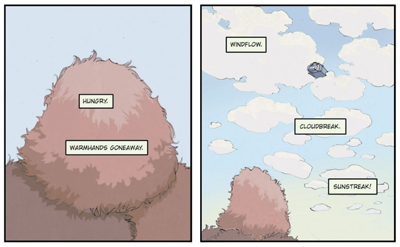
There is something delightfully gonzo about trying to write a comic book from the perspective of a bunch of Tribbles.

IDW’s Alien Spotlight series did not always work as well as it might, but the delightful done-in-one format of stand-alone stories told from the perspective of iconic Star Trek aliens allowed for a bit more versatility and flexibility than the line was normally afforded. Alien Spotlight: Cardassians was set after the end of Star Trek: Deep Space Nine. Alien Spotlight: Borg featured a delightfully clever logical paradox and a Borg invasion. Alien Spotlight: Klingons allowed Keith R.A. DeCandido to work his magic with the Klingons. Alien Spotlight: Romulans served as a springboard for John Byrne towards his Romulans saga.

You think you've got tribbles?

You think you’ve got tribbles?

There were more than a few disappointments along the way, but the Alien Spotlight series stands as one of the highlights of IDW’s Star Trek licensing. Alien Spotlight: Tribbles is a very odd piece of work. It is the kind of high-concept story that might feel like a gimmick and feels stretched over a single issue, let alone an arc. However, it is just silly enough that it works. Telling the story of a conflict between a bunch of Klingons and a human freighter crew through the eyes of the Tribbles is a fascinating idea.

While there is a sense that writer Stuart Moore occasionally has to stretch to get the story to where it needs to go, but Alien Spotlight: Tribbles is a delightfully charming (if perhaps a little too light) Star Trek diversion.

Laugh it up, fur ball...

Laugh it up, fur ball…

Continue reading

Non-Review Review: Night at the Museum III – Secret of the Tomb

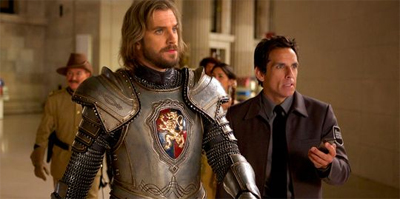
Night at the Museum III: Secret of the Tomb is fairly inoffensive family fare. It largely sets out to do what it wants to do – providing a sense of closure to the hits series while encouraging its all-star cast to have a bit of family-friendly fun together. The movie is hardly the most compelling adventure; it never manages to generate substantial stakes, it introduces a convenient third-act villain as the plot demands, it is frequently distracted by individual set pieces. At the same time, it feels like the movie largely hits the targets that it sets for itself.

Knight at the Museum...

Knight at the Museum…

Continue reading

Non-Review Review: Unbroken

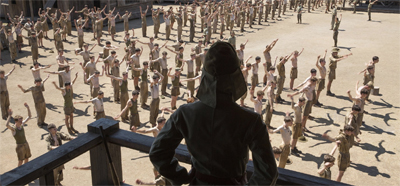
The true story of Louis Zamperini is absolutely fascinating. It lends itself to this sort of big spectacle. It has everything you need for a movie that might clean up during awards season: a historical setting; a war; a sporting story about triumph of adversity; incredible physical transformations from the cast; a character enduring incredible hardship and coming out the other side. These are the sorts of ingredients that make a Best Picture contender. Unbroken just heaps more and more on top of these already alluring elements.

It isn’t the terrible and messy script that ultimately defeats Unbroken, with beloved filmmakers Joel and Ethan Cohen at the top of the bill. It isn’t the pedestrian unchallenging direction, either. It isn’t Alexandre Desplat’s condescending and patronising score, that doesn’t trust the audience to determine what they should be feeling from one moment to the next. It is not even the cynical Coldplay song playing over the closing credits, to put a pleasant life-affirming spin on events.

The Oscar race is on...

The Oscar race is on…

The detail that really shatter Unbroken is the fact that all of this has been very carefully and meticulously calibrated to check off the requisite items on the big Oscar check list. Unbroken is just as mechanical and lifeless a production as Transformers 4, but it happens to be built for a different purpose. There is no energy here, no enthusiasm, no emotion. It is just a bunch of things that have been successful in other stories heaped on top of one another, hoping to hit the high score on that fateful morning in January 2015.

Despite managing to eat up an incredible amount of attention and discussion in the larger Oscar race – taking attention off far more deserving contenders – Unbroken is a complete and utter misfire.

"This is what happens to anybody who suggests Merry Christmas Mister Lawrence is a better Japanese prisoner of war film."

“This is what happens to anybody who suggests Merry Christmas Mister Lawrence is a better Japanese prisoner of war film.”

Continue reading

Non-Review Review: The Hobbit – Battle of the Five Armies

It has become a stock criticism to suggest that Peter Jackson did not need a full trilogy to adapt The Hobbit for the big screen. That said, The Hobbit: The Desolation of Smaug was an unexpected pleasure – a movie not all hindered by the pacing concerns of the trilogy and instead interested in its own central narrative. You could cut the opening scene from The Hobbit: Battle of the Five Armies onto the end of The Desolation of Smaug and you would have pretty much everything that you need.

While this approach benefited The Desolation of Smaug, it puts Battle of the Five Armies at something of a disadvantage. It is debatable whether there was enough material to support three full films based on The Hobbit – even drawing from other sources in the Tolkien canon – but this is clearly not the best way of structuring those three films. There is a sense that Battle of the Five Armies suffers from the decision to extend the planned duology into a full-blown trilogy.

The not-so-magic dragon...

The not-so-magic dragon…

To be fair to Peter Jackson, he does avoid the ending issues that haunted The Lord of the Rings: The Return of the King. However, he does that by editing Battle of the Five Armies as a brief epilogue to the previous two films, following by a massive battle sequence. This is quite impressive from a technical standpoint, but there is a sense of fatigue to it all. As the title implies, this is a five-way battle involving thousands of participants; both organic and computer-generated. A lot gets lost in the shuffle, and the plot – as it stands – could be explained in two sentences.

More than that, Battle of the Five Armies is hindered by its status as a prequel. The fact that everybody in the audience has likely seen The Lord of the Rings: The Fellowship of the Ring means that they know all this spectacle is really for nothing. The first two films in the trilogy largely avoided the problem by pitching the story as a working-class version of The Lord of the Rings, allowing characters to engage in quests that are deeply personal even as they ripple to larger events.

A messed-up character orc...

A messed-up character orc…

Continue reading

Non-Review Review: Foxcatcher

Foxcatcher is exhausting.

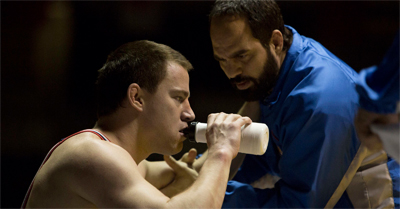
Director Bennett Miller’s account of the relationship between billionaire John “Eagle” DuPont and the Schultz brothers is a draining experience. Beautiful performances, stunning cinematography and a minimalist script create an uncomfortable and looming sense of dread. Even those unfamiliar with the story DuPont’s sponsorship of the United States Olympic Wrestling Team cannot help but feel tragedy bearing down. Foxcatcher is a heartbreaking and harrowing piece of work, an affecting and unsettling tale of power, desperation and loneliness.

Wrestling with demons...

Wrestling with demons…

Foxcatcher is beautifully crafted. Every element of the production is carefully and meticulously put together. Steve Carell transforms himself to play the role of DuPont, assisted by superb make-up overseen by Bill Corso and his team. Every frame of the movie looks crisp, the blues and reds and yellows popping out of the screen; Greig Fraser’s cinematography effectively captures the starkness of the Pennsylvanian landscape across the seasons. Miller is comfortable enough to let Foxcatcher unfold at its own pace, never rushing.

The result is a compelling and grimly fascinating story, told elegantly. There are points when Foxcatcher perhaps seems a little too distant and clinical, but the three lead performances help to keep the film firmly grounded.

To catch a fox...

To catch a fox…

Continue reading

Non-Review Review: Exodus – Gods and Kings

Exodus: Gods and Kings might be more traditional in structure and execution than the year’s other big biblical epic, but it shares a lot of the same core sentiments of Noah. Both films posit the Old Testament God as a primordial and almost unfathomable force, transforming biblical parables in epic horror stories. Both accept the divine as inhuman, almost by definition; both offer harrowing and unsettling depictions of stories that many viewers will know from childhood or have heard dozens of times before.

Exodus: Gods and Kings suffers a bit with its pacing, trying to boil the core Moses stories down into a single two-and-a-half hour narrative. The film runs through a check list of iconic moments, struggling to squeeze so much in that the story of the reed basket is mentioned only in passing. Instead, the film moves from Moses’ relationship with Ramses II through to his exile through to his epiphany through to his military rebellion through to the plagues through to the exodus.

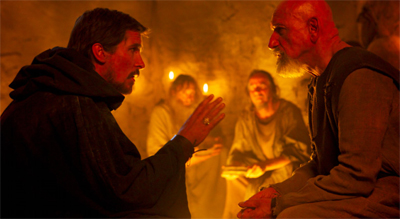
"Well, I got back to Gotham in six days, I think I can get us to the Promised Land."

“Well, I got back to Gotham in six days, I think I can get us to the Promised Land.”

It is an epic story in almost every sense of the word, and Exodus: Gods and Kings struggles to contain it all. Often key elements are only present for moments before the film has to hurry along – the burning bush lingers in the background; the golden calf is glimpsed only from the distance. So much ground is covered that it is occasionally difficult to maintain focus, as Moses seems to lose and gain families with each passing act break. Exodus: Gods and Kings holds itself together under the pressure, but the strain can be felt.

Nevertheless, Exodus: Gods and Kings largely works. Feeling more like Kingdom of Heaven than Gladiator, the movie does a wonderful job of building a massive and sprawling (and foreign) world. Exodus: Gods and Kings looks and feels like a more traditional biblical epic than Noah, and Scott’s efforts to ground the film in a tangible reality only serves to enhance the awe-inspiring scale of the horror on display here. Exodus: Gods and Kings is an exploration of faith and devotion, asking uncomfortable questions and leaving the answers to the audience.

"Let us sit upon the ground and tell sad stories of the death of kings..."

“Let us sit upon the ground and tell sad stories of the death of kings…”

Continue reading