• Following Us

  • Categories

  • Check out the Archives


  • Awards & Nominations

Non-Review Review: Filmworker

This film was seen as part of the Audi Dublin International Film Festival 2018.

What must it be like to surrender a life in service of somebody else pursuing their dreams? It is a challenging and provocative question; very few people are willing to risk everything to chase their own dreams, so what level of devotion must be required to do that in service of somebody else’s aspirations?

This is the central question of Filmworker, the documentary charting the life and times of Leon Vitali, who essentially surrendered his life to director Stanley Kubrick, to help the director fulfill his creative vision and realise his dreams on celluloid. The opening voiceover, lifted from Matthew Modine’s diaries working on Full Metal Jacket, likens Leon Vitali to a moth drawn to Stanley Kubrick’s flame. It’s an apt metaphor, one that plays through Filmworker.
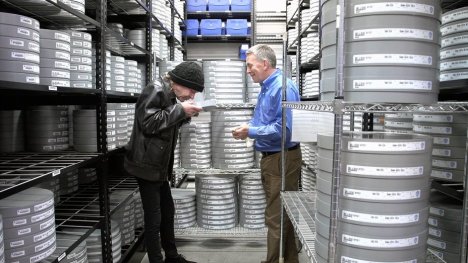
For years, Leon Vitali was Stanley Kubrick’s right-hand man, the film offering varying labels; some call him an “assistant”, others a “factotum”, while Leon’s own official classification of his job for paperwork and applications was “filmworker.” Whatever title might have been applied to Leon, the man did everything did everything. The jack-of-all-trades coached actors, he oversaw casting, he restored negatives, he documented decisions, he engaged with distribution. He was essential to the operating of Kubrick’s creative machine, yet he remains mostly anonymous.

Filmworker engages with this relationship, with the sacrificing of an individual’s autonomy to enable another’s creative vision. The film is refreshing frank in some respects about the demands of such a life, of the temperamental impositions made by such artists of these devotees. The film captures the romance of working with genius, but also the toll that it exacts.

Continue reading

Non-Review Review: Red Sparrow

This film was seen as part of the Audi Dublin International Film Festival 2018.

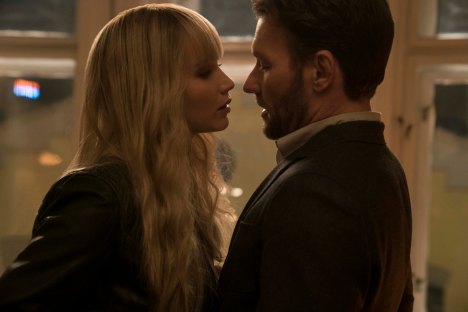
Red Sparrow puts a tacky (and tame) erotic sheen on a tepid (and tawdry) espionage story.

Red Sparrow has an interesting premise, both in terms of history and in terms of genre. It is a spy film structured around one of the more unsettling and uncomfortable aspects of the Cold War, the use of espionage agents to harvest information through sexual means. It is also a premise that could serve as a fascinating deconstruction of the tropes that audiences have come to expect of such films, a timely exploration of how issues of consent apply in the sorts of deception-laden love scenes that populate the genre. Red Sparrow could be James Bond as a sexual horror story.

However, Red Sparrow is far too tame to deliver on either premise. The film is too devoted to the conventional structure and dynamics of an espionage thriller to upset the audience in the way that any meaningful exploration of this history of sexual exploitation would, and is too comfortable with the rhythms and beats of the genre to offer a searing deconstruction of how its characters frequently leverage sex as just another weapon.

As a result, Red Sparrow is a meandering and uneven example of the espionage, trapped between two stools. The film is not sordid enough to excel as a visceral thriller in its own right, and not committed enough to offer a sobering examination of its themes.

Continue reading

Non-Review Review: Isle of Dogs

This film was seen as part of the Audi Dublin International Film Festival 2018.

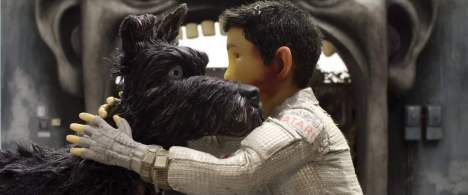
Isle of Dogs is a beautiful piece of work, in every sense of the word.

The obvious point of comparison is The Fantastic Mister Fox, Wes Anderson’s previous stop-motion adventure. Isle of Dogs and The Fantastic Mister Fox are certainly of a piece with one another even beyond the wonderful production design, featuring meditative canines engaged in existential struggles. However, Isle of Dogs represents an extension and deepening of the work that Anderson did with The Fantastic Mister Fox.

Isle of Dogs reflects the more daring formal experimentation that made Grand Budapest Hotel such a treat, trusting the audience to accept and even embrace Anderson’s consciously hyperstylised approach to storytelling. In a strictly logical or rational manner, almost every major creative decision in Isle of Dogs seems to have been made to remind the audience that they are watching something constructed and crafted, the film consciously and artfully heightened so as to remind the audience of the remove that exists between them and the film they are watching.

Although Anderson has come to be known for this conscious and playful aesthetic, it is not his greatest accomplishment as a director. The most wonderful and beautiful thing about Isle of Dogs is that the film is so lovingly and carefully crafted that repeatedly drawing the audience’s attention to the artifice of it renders it no less real and no less moving.

Continue reading

Non-Review Review: Dawson City – Frozen Time

This film was seen as part of the Audi Dublin International Film Festival 2018.

In 1978, the city of Dawson was demolishing an old ice rink to make room for a new recreational centre. During the demolition, the construction crews stumbled on something remarkable. Reels and canisters of films buried in the old swimming book, sealed away and forgotten about. This was a treasure trove for cinema historians, the unearthing of a collection that included films that had been presumed lost to history. It represented a tangible and literal connection to the rich history of cinema and – through that – to the history of American popular culture.

Bill Morrison’s Dawson City: Frozen Time is a documentary looking at this archeological discovery, but it is also so much more. Using footage taken from the recovered films, and from other contemporaneous materials, Morrison takes the audience on a trip through the cultural history of the eponymous settlement, from its origins at the end of the nineteenth century through to the unearthing of these nitrate film reels in the late seventies. The result is a beautiful and compelling exhumation of something much more than those invaluable and long-considered lost silent films.

Morrison weaves a fascinating and compelling narrative that seems to tie all of this together into a convincing and expansive social history. The result is a documentary with startling ambition and scope, in some ways reflecting the approach taken by those earliest of settlers panning for gold in the Yukon territory. Dawson City follows both the social evolution of the settlement and occasionally digresses to follow some of its most important inhabitants. Some of these digressions introduce players who will return to the narrative later in the film, both others suggest a broader social context for the film.

Dawson City is occasionally just a little bit too unfocused for its own good, casting its net just a little bit too wide to bring everything back together for an otherwise satisfying finale. Nevertheless, Dawson City is a powerful ode to a community and to cinematic history, one with big ideas and provocative insights.

Continue reading

Non-Review Review: Marlina the Murderer in Four Acts

This film was seen as part of the Audi Dublin International Film Festival 2018.

Marlina the Murderer in Four Acts is a tough film to classify.

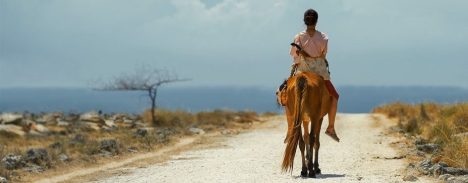
Visually and narratively, Marlina the Murderer in Four Acts feels very much like a western. Writer and director Mouly Surya crafts a story that is recognisable as a classic western tale. The eponymous lead character lies alone in a remote part of Sumba, managing a farm following the death of her husband. When bandits arrive to raid the property, Marlina finds herself forced to embark on a journey across the region in search of justice – or maybe just even peace. Along the way, there is violence, retribution and reconciliation.

Director Mouly Surya and cinematographer Yunus Pasolang tell the story using the visual language of the western. The film features any number of striking and beautiful compositions, the camera taking in the sparse beauty of the Indonesian countryside in rich browns and yellows, the deep blue of the ocean occasionally visible in the distance or the background. Marlina the Murderer in Four Acts even includes sequences of its protagonist riding on horseback, hoping to deliver a bounty to the forces of justice in a seemingly lawless land.

However, these trappings serve to provide a framework for a much more compelling and fascinating character study. Marlina the Murderer in Four Acts is a quiet and introspective film, one that finds a strange warmth in the quiet resolve of its central character.

Continue reading

Non-Review Review: The Ballad of Lefty Brown

This film was seen as part of the Audi Dublin International Film Festival 2018.

The Ballad of Lefty Brown is an undeconstructed and unreconstructed western of the kind that they don’t make any more.

And for good reason.

Continue reading

Non-Review Review: Paradox

This film was seen as part of the Audi Dublin International Film Festival 2018.

The obvious point of comparison for Paradox is Taken.

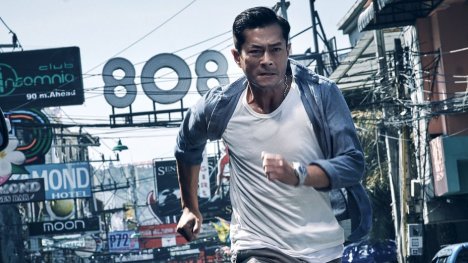
Of course, Taken is so archetypal an action film that it has become a stock point of comparison for any gritty action movie with a paternal protagonist. However, the similarities to Paradox are quite apparent. Both Paradox and Taken are the stories of fathers who discover that their daughters have been kidnapped while holidaying abroad, and who inevitably use their investigative skills (and their capacity for violence) in order to track down their lost loved one while venturing into a disturbing subculture that exists for the gratification of the rich and the privileged.

Paradox follows veteran Hong Kong police negotiator Lee Chung-Chi when his daughter is kidnapped in Thailand. It quickly becomes clear that the girl has been targeted by illegal organ dealers to provide a heart transplant for the corrupt local mayor, meaning that the father is caught in a desperate race against time to pull back the layers of corruption and indifference that serve to insulate those responsible. Along the way, he teams up with local police inspector Tsui Kit to crack the case.

However, much like the obvious comparison to Taken, the simple plot description does not do justice to the weirdness and tonal awkwardness of Paradox. It is perhaps most accurate to describe Paradox as a film quite like Taken, if Taken featured a scene in which one character dangles another off the roof by their penis.

Continue reading

Non-Review Review: You Were Never Really Here

This film was seen as part of the Audi Dublin International Film Festival 2018.

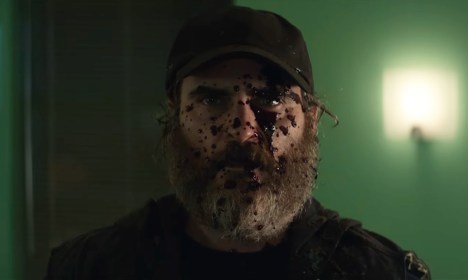
“Close your eyes,” the vigilante “Joe Rogers” advises the Nina Votto as he takes the ball hammer to the naked man standing in the doorway. The camera remains focused on Nina, foregrounding her as Joe goes to work. The audience knows what is happening, even if they only see it out of focus and in the background. This small moment is indicative of how You Were Never Really Here has chosen to approach its subject matter. Director Lynne Ramsay cannily keeps most of its violence off-screen.

Ramsay does this in a number of interesting ways. Part of this is through the skilful editing of Joe Bini, who pieces together fragmented flashbacks that suggest unfathomable horror without ever feeling gratuitous or grotesque; leaving a tangible feeling of unease without ever feeling voyeuristic or intrusive. Part of this is down to how Ramsay chooses to place the camera during acts of violence, while keeping the acts themselves very abrupt and brief; characters are frequently thrown through doorways, for example. Part of this is simply cutting around the violence, exploring its aftermath.

The result is intriguing. Appropriately enough, given its title, You Were Never Really Here is defined more by what it isn’t (or what it consciously chooses not to be) rather than what it actively is. The concept of the film would seem to suggest some brutal seventies vigilante extravaganza, revelling in the righteous violence of a man who hunts paedophiles and exacts a terrible vengeance upon them. However, You Were Never Really Here instead opts to be something a lot quieter and a lot more considerate; a film about violence that refuses to linger upon or indulge in that violence.

There is something very effective in all of these choices, both as a response to how such violence is typically portrayed in cinema and on their own merits. Perhaps the most striking of these choices is the manner in which Ramsay chooses to approach this story from the perspective of a child, through the eyes of the victim rather than the archetypal hero. It is a bold and provocative choice, one that elevates the material.

Continue reading

Non-Review Review: The Bookshop

This film was seen as part of the Audi Dublin International Film Festival 2018.

The Bookshop opens with the cinematic equivalent of that frustrating modern home decoration trend of shelving books with the spines facing inwards so as to ensure something approaching uniformity of style while denying anything resembling individual identity.

This is perhaps the perfect encapsulation of The Bookshop then.

Continue reading

Non-Review Review: Revenge

This film was seen as part of the Audi Dublin International Film Festival 2018.

What if Nicolas Winding Refn directed a Blumhouse film?

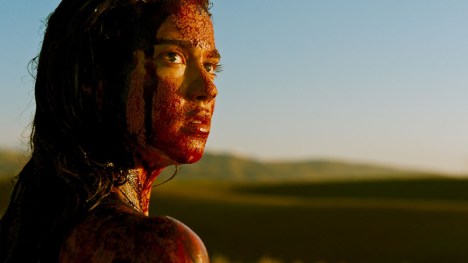
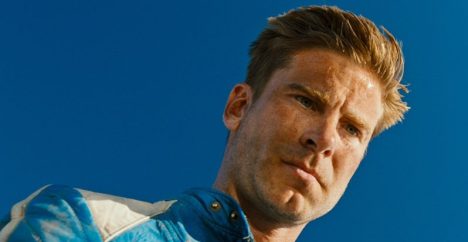
Revenge is a neon-drenched and synth-saturated exploitation flick that takes some of the most familiar conventions of the survival horror genre and executes them with incredible style. Revenge puts a beautiful sheen on a very ugly film, constructing an effective revenge narrative full of striking imagery. As realised by director Coralie Fargeat, Revenge is a visceral experience. The film’s violence is almost tangible, the audience feeling every act of brutality inflicted upon the bodies of its cast.

A lot of this is down to the craft of those involved, working under Fargeat’s direction. Jérôme Faurel’s sound design ensures that the audience hears every drip of blood, every splash on every surface. Cinematographer Robrecht Heyvaert and colourist Frédéric Savoir play up the contrast in the compositions, so the blood seems to burst off the screen against the bright yellows and the deep blues. Make-up effects artists Laetitia Quillery ensures that the cast carry every scar with them as the movie puts them through an endurance nightmare.

This attention to pure craft elevates Revenge above so many of its genre contemporaries. Revenge is undoubtedly trashy piece of cinema, but is never ashamed of what it is or apologetic for what it does. Instead, the film commits itself with an engaging and exhilarating enthusiasm. Revenge never views its genre as a limitation to transcend, but instead as a field in which to excel. And it certainly does.

Continue reading