• Following Us

  • Categories

  • Check out the Archives


  • Awards & Nominations

Non-Review Review: Rampage

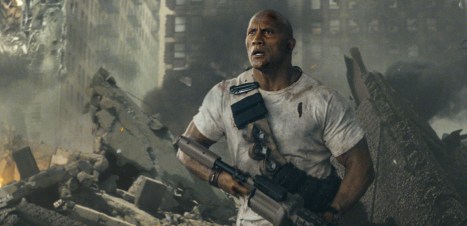
Rampage suffers from some pretty severe tonal issues. The video game adaptation starts and ends as a spiritual companion to Kong: Skull Island, but takes a detour into the last American Godzilla movie during its extended climax.

The results are jarring, creating a more dissonant movie than either of its obvious monster-movie forebearers. Rampage is goofy enough that its urban carnage feels out of place, and brutal enough that some of its cheekier decisions feel mean-spirited and vindictive. The result is very much a curate’s egg, to the point that it occasionally feels like Rampage escaped its creators in the edit room.

Going ape.

There is a lot to like in Rampage, particularly its weird committed earnestness when it comes to dealing with the friendship between a primatologist and his gigantic albino gorilla. Rampage skirts the line, occasionally embracing the camp absurdity of muscle-bound Dwayne Johnson’s deep-seated emotional attachment to a computer-generated rampaging “gene-edited” monster. Rampage understands the absurdity of the set-up, but makes a convincing sell of it nonetheless.

Unfortunately, Rampage‘s human characters are never as interesting, which creates a problem when the climax attempts to shift gears into a sprawling urban destruction epic. Rampage feels as much a product of careful and outrageous engineering as the creatures at its core. However, as with those creatures, it never feels quite like those doing the engineering had a clear design in mind.

“I sure picked a bad day to move George to the Metropolis Zoo.”

Continue reading

Non-Review Review: Blockers

Blockers is a lot funnier and a lot more endearing than its two-line synopsis might suggest.

The premise of Blockers is the stuff of stock teenage sex comedies, right down to the branding on the poster. As if worried that audiences might not get the substance of the comedy, advertising for Blockers prominently features the silhouette of a rooster above the title of the film, as if to assure potential viewers exactly what type of blocking is taking place. Blockers positions itself very candidly and very bluntly as a broad and old-fashioned story about teenagers having sex.

Prom here to eternity.

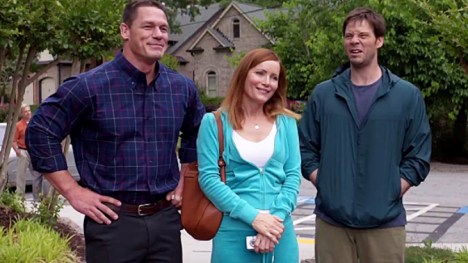
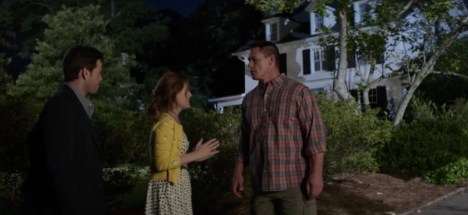
The basic plot of Blockers finds three parents discovering that their daughters have made a pact to lose their virginity on prom night. These three parents then embark upon an odyssey to prevent the planned sexual intercourse from occurring. As one might expect, all manner of complications and hijinks ensure, with the canny children struggling to stay one step ahead of their determined (and occasionally resourceful) pursuer. It is hardly the most innovative of concepts, even if it is a sturdy framework for comedic set pieces and humour concerning bodily functions.

However, what is most remarkable about Blockers is the way in which it uses this familiar framework to engage with its premise in a surprisingly nuanced and insightful way, avoiding (and even directly rebuffing) the reactionary attitudes baked into the core concept. The result is perhaps the most sincere and endearing film ever to include the phrase “butt-chugging.”

Taking the Cena-ic route.

Continue reading

Non-Review Review: Michael Inside

From writer and director Frank Berry, Michael Inside is harrowing, emotional and earnest look at cycles of incarceration affecting young Irish men from marginalised communities.

The plot of Michael Inside is fairly straightforward. As the title implies, the movie centres upon a young man named Michael who finds himself arrested in possession of drugs with a street value of two thousand euro. Receiving a custodial sentence, Michael finds himself incarcerated for three months. Michael must learn to navigate prison life, while his grandfather struggles to keep himself above ground on the outside. However, prison exerts a gravity, and escape is not as simple as release.

Inside, he’s dancing.

Michael Inside is an intense and claustrophobic experience. Asked early in the film if he suffers from any preexisting conditions, Michael responds, “Anxiety.” Shooting primarily in close-up with a hand-held camera, Michael Inside skillfully replicates that sensation. The characters constantly seem trapped and boxed in. Even before Michael is taken into custody, scenes are framed and blocked so as to suggest that he is trapped; the wire frame on crosswalks, the windows of the house, the bars of a fence. Michael Inside suggests that prison is more than just a physical construct.

Michael Inside is occasionally a little too earnest in its exploration of these vital and important themes, sometimes feeling more like an abstract civics lesson than an organic story. Still, there is no denying the raw emotional power of Michael Inside, particularly when director Frank Berry brings all the threads together at the climax of the story.

Everything, gone in a flash.

Continue reading

Non-Review Review: A Quiet Place

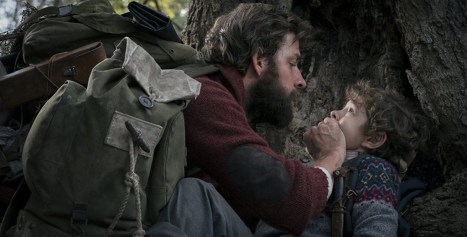
A Quiet Place is the latest entry in a string of contemporary high-concept postmodern horrors, very much of a piece with films like It Follows, Don’t Breathe or Lights Out.

These movies are largely predicated upon the internal logic of the horror movie, often incorporating and literalising fundamental parts of the horror movie experience into their conceptual frameworks. It Follows is obsessed with the rules that govern its unstoppable supernatural force, with the teen protagonists seeking to exploit and manipulate them. Lights Out focuses on a creature that can only really move when it is unseen, weaponising the audience’s impulse to look away or cover their eyes when presented with horrific images within the film.

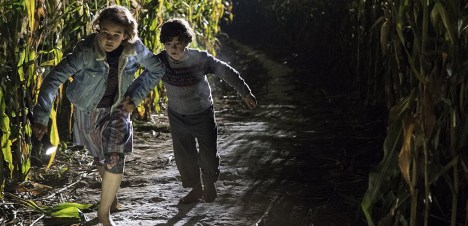
Maize runners.

A Quiet Place builds on the same horror movie anxiety as Don’t Breath – the audience’s urge to gasp or to scream in response to the events on the screen. A Quiet Place unfolds in a world dominated by monsters that hunt based on sound, creating an environment where the human cast members have to remain as quiet as possible in order to survive. No matter what happens, the characters cannot scream. Given that they are starring in a horror movie, that is quite the challenge.

A Quiet Place is a lean and effective piece of filmmaking from director John Krasinski, who also worked on the script written by Scott Beck and Bryan Woods. As one might expect given the premise, A Quiet Place is a horror movie that often feels quite minimalist; twenty minutes of set-up giving way to seventy minutes of sustained climax. The results are invigourating, a horror movie worth shouting about.

Children should be seen and not heard.

Continue reading

Non-Review Review: Ready Player One

Don’t hate the player, hate the game.

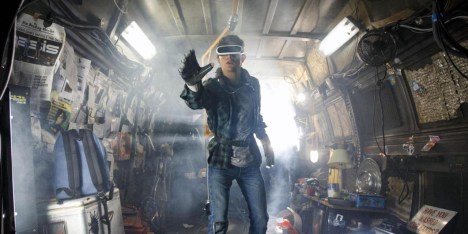
Reader Player One is a very curious piece of cinema. It is an incredibly flawed piece of work, with a lot of its flaws so fundamental that they are threaded into the very architecture of the film. Screenwriter Zak Penn has offered a very thorough and involved reinvention of Ernest Cline’s source novel, a ground-up renovation of Cline’s catalogue of popular culture references and collection of narrative tropes. Indeed, Penn’s screenplay improves a great deal on the novel that inspired it; junking and reworking entire sequences, bulking up supporting characters, trying to find a beating human heart.

Worlds apart.

More than that, Ready Player One provides Spielberg with the opportunity to go “all out.” There is a sense watching Ready Player One that Spielberg has approached the film not as a collection of popular culture references and in-jokes, but instead as an attempt to reconnect with a younger audience. Whether or not Reader Player One is the right source material for such an attempt, there is no denying Spielberg’s energy and vigour. Ready Player One is a dynamic piece of film, Spielberg demonstrating all the technique for which he is known, but with an enthusiasm that puts younger directors to shame.

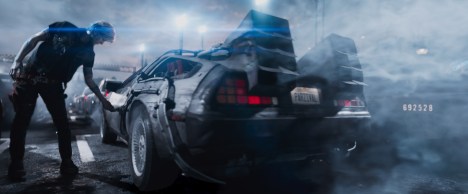
However, there is no escaping the biggest issue with the film remains its source material. The problem with Ready Player One as a film is that it is an adaptation of Ready Player One as a novel.

Back to the past.

Continue reading

Non-Review Review: Twin Peaks – The Missing Pieces

It says a lot about Twin Peaks: Fire Walk With Me that there were enough deleted scenes that they could be structured into a ninety-minute feature film. It says even more that the resulting feature film is almost coherent.

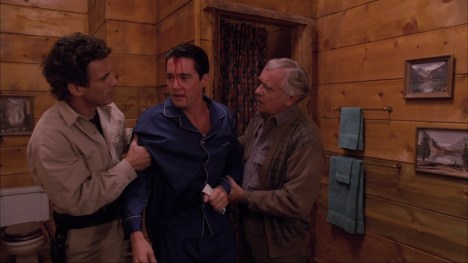
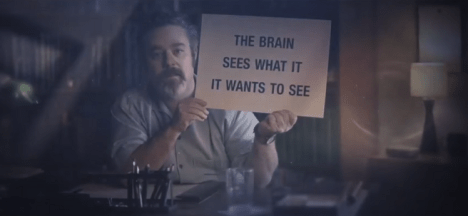
Twin Peaks: The Missing Pieces is a strange piece of work, essentially a narrative film stitched together from the cast-offs of a theatrical release two decades earlier. It is a collection of deleted scenes, but deleted scenes that have taken on an uncanny importance. These deleted scenes have been edited together into something approaching a linear narrative by David Lynch, the director who shot them in the first place. They even come packaged with an introduction and a set of closing credits. They are vitally important to the revived television series. They are, in other words, like a real movie.

“Yeah, he’s going to need about twenty five years to recover.”

Some of this is because Fire Walk With Me is a notoriously inscrutable and abstract film, one defined by strange choices and bizarre imagery. David Lynch is a surrealist, and Fire Walk With Me reflects this; it is full of odd cul-de-sacs and strange segues. Fire Walk With Me was also a film heavily cut before its release, which accounts for why it feels like a film defined by what is absent so much as what is present. The incomplete nature of Fire Walk With Me makes the incomplete nature of The Missing Pieces more understandable. They fit together like the two pieces of Laura Palmer’s heart-shaped necklace.

However, The Missing Pieces is illuminating for more than just the little details of continuity and the appearances of familiar faces. It is a film that in some ways shades Fire Walk With Me, existing as a remainder of the absences carved from that earlier film. The Missing Pieces defines Fire Walk With Me through contrast, revealing the elements of Fire Walk With Me that were deemed inessential to the theatrical release. In keeping with Lynch’s recurring fascination with doppelgangers and doubles, The Missing Pieces illuminates Fire Walk With Me by presenting an alternative; it is what Fire Walk With Me chose not to be.

Past prologue.

Continue reading

Non-Review Review: Twin Peaks – Fire Walk With Me

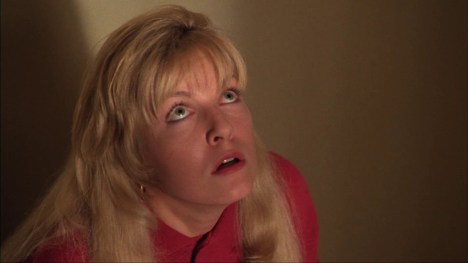
Twin Peaks: Fire Walk With Me is a fascinating piece of work, in no small way due to how it has been re-evaluated and reclaimed since its premiere.

Despite the urban legend, Fire Walk With Me was not booed on its premiere at Cannes. Nevertheless, the widely-reported rumour that it was says a lot about the film’s reception and the ensuing mythology around it. Young provocateur Quentin Tarantino even took the opportunity for a pot shot at David Lynch, lamenting that the director had disappeared so far up his own ass.” The film earned just over four million dollars at the United States box office. Those watching at the time would (fairly, in context) have deemed the film’s failure as the end of the line for Twin Peaks.

In darkness…

Of course, hindsight has reversed a lot of these opinions. Critics like Mark Kermode are willing to make impassioned arguments in support of Fire Walk With Me, and the tone of coverage of the film leading into the television revival two decades later was largely positive. Modern reviews tend to speak about Fire Walk With Me as a “harrowing tour de force”, and as a key part of both Lynch’s evolving filmography and in the development of what Twin Peaks could be. It is an impressive reversal of public opinion, in a relatively short amount of time. (Lynch’s in-between success with Mulholland Drive might have helped.)

It is possible to see both of those films wrestling within the finished product, to understand how the film could once be a provocative disappointment and an insightful statement. In some ways, this wrestling match within Fire Walk With Me feels entirely appropriate with the themes of both the film itself and the series leading into it. Lynch’s oeuvre is populated with doppelgangers and twisted reflections, and it feels strangely appropriate that Fire Walk With Me should exist as its own shadow self.

A singular maniac.

Continue reading

Non-Review Review: Ghost Stories

Ghost Stories is an existential horror dramedy, and gets that unique cocktail to work much better than it really should.

Ghost Stories is adapted by Jeremy Dyson and Andy Nyman from their stage play of the same name. The play premiered in Liverpool in 2010, to rave reviews. Interestingly, Dyson and Nyman worked hard to preserve the mystery and ambiguity around their production, publicising the show with shots of terrified reactions from the audience and asking those who had seen the film not to discuss its twists and turns with those people who had not. As such, Ghost Stories became something of a cult stage phenomenon.

Black mirror.

With this in mind, adapting a play like Ghost Stories to the big screen presents its share of challenges. Not only does a feature film demand more publicity and more conversation than a stage play, having a much higher profile and a much larger distribution mechanism, it also involves a delicate process of translation. Ghost Stories was a concept very firmly anchored in its format, wedded to the conventions of stage shows. Finding a way to preserve the heart of the play within the framework of a motion picture was always going to be tricky.

Ghost Stories works well, although it arguably works better as a psychological meditation on mankind’s relationship with the supernatural than as a horror anthology in its own right. Ghost Stories is a clever and canny piece of work, one undercut slightly by some clumsy narrative choices in the final act. Still, even in its weakest moments, Ghost Stories is a compelling and engaging little film.

Cue, card.

Continue reading

Form a Square For That Purpose: Kubrick’s “Barry Lyndon” and the Illusion of Civility

In some respects, Barry Lyndon is seen as an outlier in Stanley Kubrick’s filmography.

The film is a lush and extended period drama, adapted from a nineteenth century novel set in the eighteenth century. It arrives in the middle of an acclaimed run of films from director Stanley Kubrick: Doctor Strangelove; Or How I Learned to Stop Worrying and Love the Bomb, 2001: A Space Odyssey, A Clockwork Orange, The Shining and Full Metal Jacket. By all appearances, Barry Lyndon stands apart from these films. “Period piece” is obviously a film genre unto itself, but it is not as heightened as the bigger and bolder films around it.
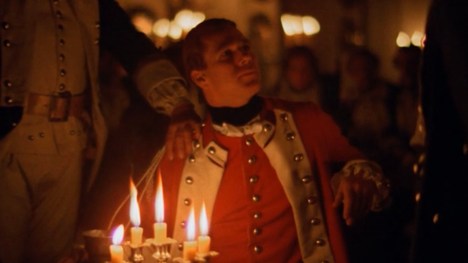
Arresting imagery.

Barry Lyndon is arguably Kubrick’s only “period film” outside of Spartacus, which the director famously disowned and is arguably seen as a film more overtly influenced by its leading man than its director. Of course, some of Kubrick’s films move backwards and forwards in time; Full Metal Jacket takes place in the late sixties, while the prologue to 2001: A Space Odyssey is set at “the dawn of man.” Nevertheless, for many casual film fans approaching Barry Lyndon, the film’s period trapping stands out from the surrounding films, which are largely set near the present and into the future.

Indeed, it could be argued that this difficulty that casual observers have in positioning Barry Lyndon within the Kubrickian canon accounts for some of the controversy around the film’s place in the director’s larger filmography. Upon release, the film was largely met with confusion and disinterest, critics often struggling with what to make of the finished product. For his part, Kubrick dismissed the idea of critics forming a consensus on a film like Barry Lyndon after just one viewing.
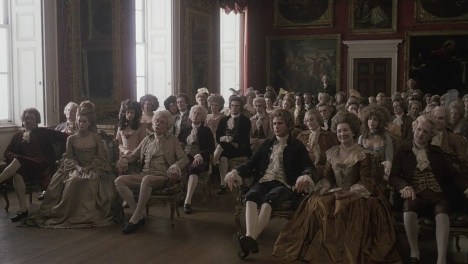
Initial audiences weren’t enamored with the film.

Of course, this is arguably par for the course with Kubrick films, particularly those towards the end of his career. Many Kubrick films opened to a divided critical opinion before slowly solidifying their popular reputations over time; 2001: A Space Odyssey, A Clockwork Orange, The Shining. However, Barry Lyndon seems to be a special case. Debate was still raging over the critical merits of the film after Kubrick’s death, even in letter columns of newspapers like The New York Times. Even the release of remastered editions forty years later find proponents arguing the film is undervalued or underrated.

However, watching Barry Lyndon, the film never really feels like an outlier in terms of Kubrick’s filmography. Indeed, in some respects, it feels like a culmination of many of the director’s recurring themes and fascination. Barry Lyndon is perhaps the clearest articulation of some of the key themes within Stanley Kubrick’s larger body of work, in particular through its engagement with the Enlightenment as a window through which he might explore the human concept of “civilisation.”
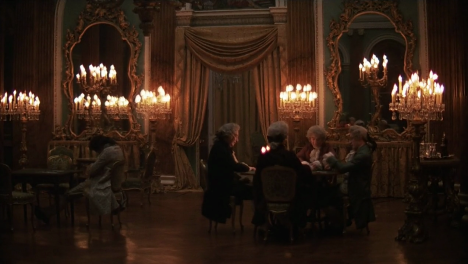
Drawing to a close.

Repeatedly over the course of his filmography, Kubrick engages with the idea of civilisation and order, the structures that mankind imposes upon the world in order to provide a sense of reason or logic to a chaotic universe. Repeatedly in his movies, Kubrick suggests that “civilisation” is really just a veneer that masks the reality of the human condition, providing a framework for acts of violence and self-destruction that seem hardwired into the human brain. Kubrick suggests that “civilisation” is a fragile construct, and one that occasionally seems hostile to the nature of those who inhabit it.

Unfolding against the rigid social mores of the eighteenth century, Barry Lyndon allows Kubrick to construct the starkest and most literal example of that theme.

Soldiering on.

Continue reading

Non-Review Review: Damo & Ivor – The Movie

This film was seen as part of the Audi Dublin International Film Festival 2018.

In the spirit of The Hardy Bucks Movie before it, Damo & Ivor: The Movie takes a popular Irish television series and weds it to the formula of the road movie to provide a theatrical adaptation.

This is not a bad approach in principle. The road movie is a versatile template, and one that provides a solid template for bringing television characters to the big screen; it provides a clear plot, an opportunity for new viewers to get to know the characters, and the chance to show off a greatly expanded budget. It is no coincidence that even larger American television-to-cinema adaptations have followed this approach, most notably The Muppet Movie.

Indeed, The Hardy Bucks Movie took advantage of the opportunities afforded by this template to take its characters beyond Ireland, allowing them to visit the continent. This was something that would have been impossible on the budget of an Irish television show, and demonstrated an ambition in taking a broad and popular television comedy to the multiplex. In contrast, Damo & Ivor is decidedly more tempered in its ambitions. It is a road movie, but one the confines itself to Ireland. There is little here that could not have been accomplished in a television special.

This much sets the tone for Damo & Ivor: The Movie, which very much aspires to a “good enough” aesthetic in its production. Damo & Ivor is not a film that is enticed to take chances on jumping to the multiplex, instead relaxing casually into formula. Damo & Ivor doesn’t exactly fail, but only because it never really tries.

Continue reading