• Following Us

  • Categories

  • Check out the Archives


  • Awards & Nominations

The X-Files – The Sixth Extinction (Review)

This November, we’re taking a trip back in time to review the seventh season of The X-Files and the first (and only) season of Harsh Realm.

The fate of individual human beings may not now be connected in a deep way with the rest of the universe, but the matter out of which each of us is made is intimately tied to processes that occurred immense intervals of time and enormous distances in space away from us. Our Sun is a second- or third-generation star. All of the rocky and metallic material we stand on, the iron in our blood, the calcium in our teeth, the carbon in our genes were produced billions of years ago in the interior of a red giant star. We are made of star-stuff.

– Carl Sagan’s Cosmic Connection

Sea of blood...

Sea of blood…

Continue reading

Harsh Realm – Leviathan (Review)

This November, we’re taking a trip back in time to review the seventh season of The X-Files and the first (and only) season of Harsh Realm.

The first three episodes of Harsh Realm are an interesting combination, and not just because they were the only three episodes of the show to air before cancellation.

All three episodes are written by Chris Carter. The first two are directed by Daniel Sackheim. Taken together, they form a loose triptych. They are effectively three separate stories that come together to form a three-part pilot for the show. It is only by the end of Inga Fossa that Thomas Hobbes (and the audience) fully accept the virtual world into which they have been placed, embracing the hero’s journey that lies ahead. It isn’t until Kein Ausgang that the show really offers the audience a sense of how it might work on a weekly basis.

Fading out...

Fading out…

This is not to suggest that the events of The Pilot flow elegantly into Leviathan, nor that the events of Leviathan bleed over into Inga Fossa. All three episodes of television are discreet and individual; foreshadowing the format that the show would take in its relatively brief life. Interestingly, Carter does not take advantage of the show’s video game structure to enforce more rigid serialisation. If anything, most the nine episodes (particularly the back six) are rigidly episodic.

Leviathan is particularly relaxed in its structure. The Pilot offered all the spectacle and exposition necessary to establish Harsh Realm. In contrast, Leviathan is a bit more focused on mood and atmosphere. There is an impressive action sequence to close out the episode, but there is a larger sense that Leviathan is about establishing what day-to-day existence must be like in this virtual world.

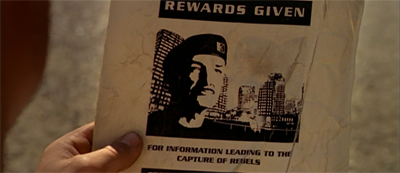
General problems...

General problems…

Continue reading

Harsh Realm – Pilot (Review)

This November, we’re taking a trip back in time to review the seventh season of The X-Files and the first (and only) season of Harsh Realm.

Hereby it is manifest, that during the time men live without a common Power to keep them all in awe, they are in that conditions called Warre; and such a warre, as is of every man, against every man.

– Thomas Hobbes, Leviathan, The First Part, Chapter XIII

Harsh Realm is essentially a war story, or a collection of war stories.

To be fair, there are other themes that bleed through the show’s short nine-episode run; a critique of late-stage capitalism, a healthy dose of Chris Carter’s patented nineties existential spirituality, an exploration of American masculinity. The show plays on all sorts of genres across its short lifespan, from horror story to western to modern noir film. However, all of these unfold against the backdrop of a world locked in total warfare. The opening scenes of The Pilot unfold against the Siege of Sarajevo, setting the tone for the rest of the series.

Tom's not here, man...

Tom’s not here, man…

Carter tends to wear his cinematic and televisual influences on his sleeves. The X-Files was a spiritual successor to Kolchak: The Night Stalker, with a little bit of The Parallax View and The Silence of the Lambs thrown in for good measure. Millennium launched in 1996 and owed a lot to the look and feel of David Fincher’s work on se7en. Harsh Realm owes a lot to the resurgence in war movies towards the end of the twentieth century, coming less than a year after Saving Private Ryan and The Thin Red Line both scored Best Picture nominations.

On the commentary for The Pilot, Chris Carter notes that the show’s protagonist was named for the philosopher Thomas Hobbes. Carter cites that Hobbes’ most famous observation is that life is “solitary, poor, nasty, brutish, and short.” The same might be said of the life of Harsh Realm.

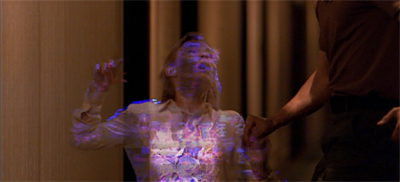
Fading out...

Fading out…

Continue reading

Star Trek: Enterprise – Chosen Realm (Review)

Next year, Star Trek is fifty years old. We have some special stuff planned for that, but – in the meantime – we’re reviewing all of Star Trek: Enterprise this year as something of a prequel to that anniversary. This August, we’re doing the third season. Check back daily for the latest review.

Chosen Realm is Manny Coto’s second script for Star Trek: Enterprise.

His script for Similitude marked Coto as something of an old-fashioned Star Trek writer. It was clear that Coto harboured a great deal of affection for the source material, and Similitude was structured in the style of a classic Star Trek morality play. It was a story about the circumstances in which “the needs of the many outweigh the needs of the few… or the one.” There is a reason that Star Trek fans are so very fond of Similitude, particularly given its position in the middle of a rather polarising and provocative season.
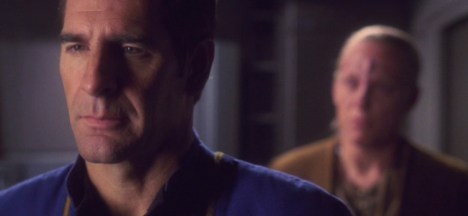
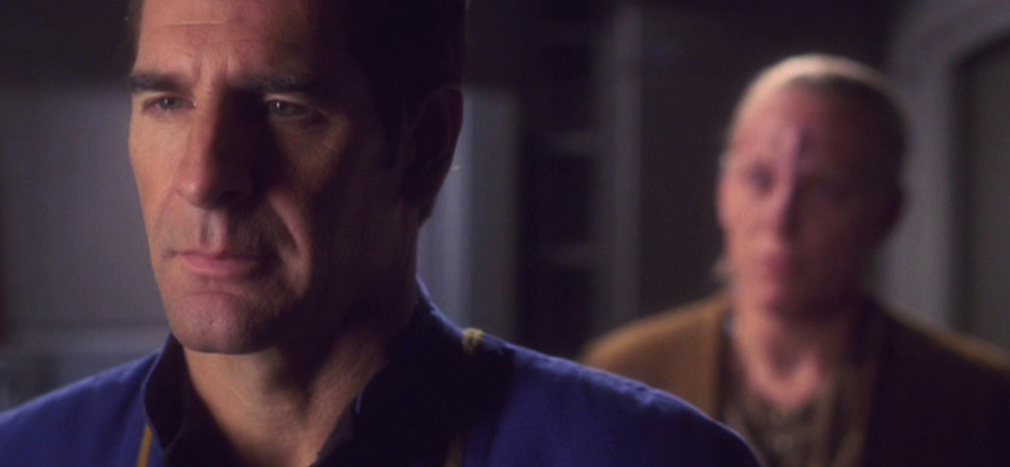
Archer encounter an enemy with faith of the heart...

Archer encounter an enemy with faith of the heart…

However, it was not entirely clear just how traditional Manny Coto was in his approach to Star Trek until the broadcast of Chosen Realm. If Similitude felt like a classic Star Trek morality play, then Chosen Realm literally was a classic Star Trek morality play. A commentary on religious fanaticism and zealotry, Chosen Realm was very much an update of the iconic Let That Be Your Last Battlefield. Coto is quite explicit about this, rather blatantly borrowing the emotive (and poignant) ending from that episode.

Although it aired in the much-maligned third season, and has no shortage of its own problems, Let That Be Your Last Battlefield is an instantly recognisable Star Trek allegory. Casual fans – and even those with a passing familiarity with the franchise – remember “the one with the aliens who are half-black and half-white who are racist against the aliens who are half-white and half-black.” It is not a subtle or nuanced allegory, but it doesn’t really need to be. It is not as if the sort of blatant racism against which the Civil Rights movement fought was a grey area.
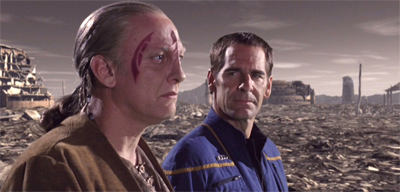
"I think I've seen this before..."

“I think I’ve seen this before…”

Unfortunately, Chosen Realm chooses to apply this simplistic metaphor to a complicated issue. In keeping with the War on Terror metaphor running through the third season, Chosen Realm explicitly ties religion into the larger arc. Archer finds his ship hijacked by a bunch of religious suicide bombers actively intent on turning Enterprise into a weapon that can be deployed against those who believe differently than they do. This is a very classic Star Trek morality tale – the “religion is bad” theme dating back to Who Mourns For Adonais? or The Apple.

Religion is undoubtedly an element of the War on Terror, but it is not the only issue or an issue that exists in isolation. Islamic extremism (as Chosen Realm never seems particularly interested in the trope of Christian extremism) is rooted in more than simply faith. There are political and economic factors at play that are just as vital to understanding why things happen in the way that they happen. Chosen Realm is uninterested in any of this, structuring itself as Richard Dawkins rant in science-fiction form.
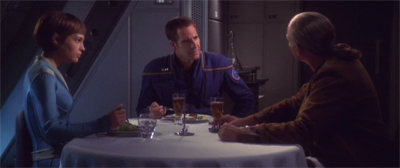
What was that about politics or religion?

What was that about politics or religion?

Continue reading

Millennium – Seven and One (Review)

This July, we’re taking a trip back in time to review the sixth season of The X-Files and the third (and final) season of Millennium.

Seven and One is the last episode of Millennium to be written by Chris Carter and Frank Spotnitz.

That is a pretty big deal. Frank Spotnitz had been a vital part of Ten Thirteen since the second season of The X-Files. He had also been the only X-Files writer apart from Chris Carter, Glen Morgan and James Wong to cross over to work on Millennium. He would become one of Carter’s most trusted associates, also contributing scripts to Harsh Realm and The Lone Gunmen. When The X-Files: Fight the Future took Carter’s attention away from Millennium in its second season, he proposed Spotnitz to run the show in his stead.

Here's Frankie!

Here’s Frankie!

Chris Carter had created Millennium, and it was clearly a show that meant a lot to him. While The X-Files was populist and accessible, Millennium always felt like more of an auteur project. It was solemn, abstract, contemplative. There is a sense that he was quite disappointed when his attention was diverted away from the show in its second year. Carter has talked time and time again about how he created Millennium as an examination of evil in the world. Appropriately enough, Seven and One finds him circling back around to that idea right before the show concludes.

Seven and One might be the most overtly religious script that Carter and Spotnitz have ever written. It seems to foreshadow the closing themes of Carter’s script for The Truth, the final episode of The X-Files. It emphasises just how essential religious themes are to Carter’s work.

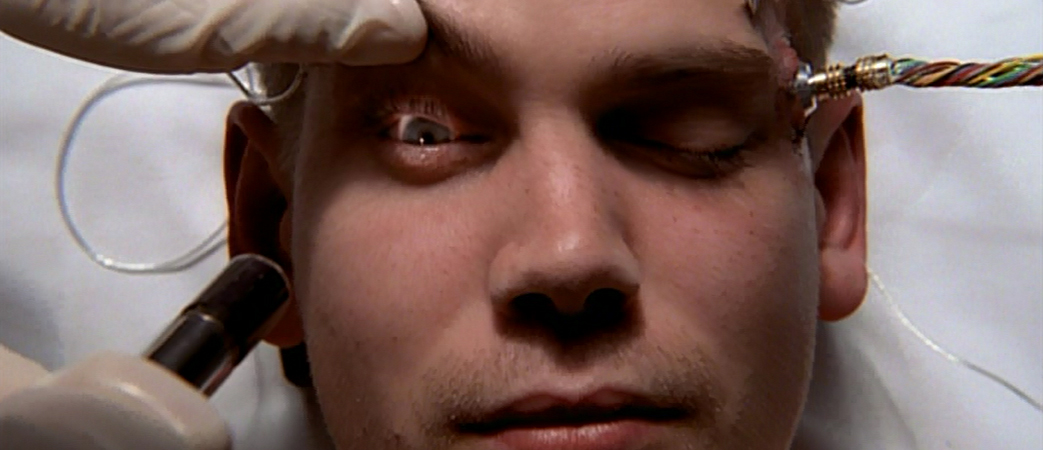
Eye spy...

Eye spy…

Continue reading

Millennium – The Time is Now (Review)

This May and June, we’re taking a trip back in time to review the fifth season of The X-Files and the second season of Millennium.

The second season of Millennium holds together very well as a season of television.

It is arguably more cohesive in terms of plotting and theme than any individual season of The X-Files, with the possible exception of the eighth season. Ideas, characters and themes are all set up early in the season so that they might pay-off at the climax. Watching The Fourth Horseman and The Time is Now, it is very hard to believe that the season could have ended any other way. That is a tremendous accomplishment on the part of Glen Morgan and James Wong, who steered the second season as Chris Carter brought his focus back to The X-Files.

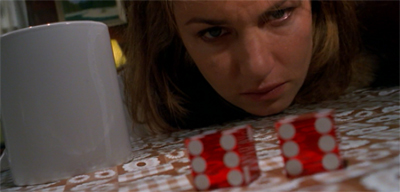
Dicey proposition...

Dicey proposition…

The attention to detail is staggering. There are lots of little touches, from the way that the use of chickens in The Fourth Horseman calls back to the story that bookends Monster to the reference to the fate of Brian Roedecker to the quick shot of Frank placing the statue of the angel on his father’s grave. Glen Morgan has repeatedly stated that the character of Lara Means was introduced in Monster knowing her fate in The Time is Now, and that seems to be true of most of the character and plot arcs over the stretch of the second season.

However, what is truly touching about the second season of Millennium is the way that the show manages to remain deeply personal and emotional, despite the scale of what is unfolding.

Shattered mirror...

Shattered mirror…

Continue reading

The X-Files – All Souls (Review)

This May and June, we’re taking a trip back in time to review the fifth season of The X-Files and the second season of Millennium.

There are a lot of aspects of The X-Files that mark it as an artifact of the nineties.

It is easy to point to all the visual cues and indicators – the mobile phones, the suits, the cars. The political elements are all in play as well – the unquestioned assumption that the United States is the global superpower, the indulgence in a paranoia that exists in sharp contrast to the material prosperity surrounding it. There are even any number of pop cultural references buried within episodes themselves – from Byers and Frohike joking about Bill Clinton’s haircut in Fearful Symmetry to Scully quoting Babe in Home.

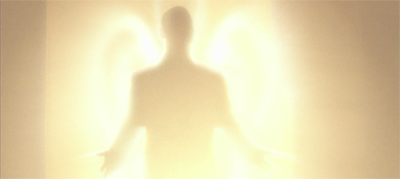
Angels in America...

Angels in America…

However, perhaps the most obvious indicator of the nineties is the way that The X-Files seems to fetishise absolute and unquestioning faith. Through episodes like Miracle Man, RevelationsAll Souls and Signs and Wonders, there is the recurring sense that giving oneself over absolutely and completely to religious faith is a sign of strength and certainty. At times, it seems like the writers are almost envious of those who have unwavering conviction in their beliefs amid the wry cynicism of the nineties.

The X-Files finds something romantic in such pure and uncompromised faith. After all, Gethsemane had proved that even Mulder has his doubts. This fixation on unquestioning religious belief made a great deal of sense against the backdrop of nineties disillusionment, but it a lot more uncomfortable when examined in hindsight through the prism of the early twenty-first century.

Scully has seen the light...

Scully has seen the light…

Continue reading

Millennium – Goodbye Charlie (Review)

This May and June, we’re taking a trip back in time to review the fifth season of The X-Files and the second season of Millennium.

Goodbye Charlie is an interesting oddity at this point in the season. It is the closest thing that the show has done to an old-fashioned “serial killer” story in quite some time, while still remaining quite unique and bizarre. It is a story about a man who may (or may not) be a serial killer, opening with shots of that (possible) killer serenading his victims with a dodgy karaoke version of the already dodgy Seasons in the Sun. It is memorable and striking, a strange hybrid of familiar trappings and completely bonkers absurdity.

There are points where Goodbye Charlie does not work. There are moments when the script seems a little too knowing or a little too heavy-handed. However, there moments are generally fleeting. When Goodbye Charlie falters, it is only a slight misstep; there is never a sense that it might implode in the same way that Sense and Antisense or A Single Blade of Grass threaten to collapse in on themselves. More than that, as with a lot of the bumps in the road during the second season, the show is generally ambitious and energetic enough that it’s hard not to get drawn in despite the flaws.

Sing with me now...

Sing with me now…

There are two elements of Goodbye Charlie that really sell it. The first is Richard Whiteley’s script. It is perhaps a little stilted in places – most notably in the way that it awkwardly plays up the ambiguity around the case by having Frank and Lara repeatedly draw attention to the ambiguity around the case – but it is clever, fast and witty. The episode also benefits from the casting of Tucker Smallwood as Steven Kiley, who turns in one of the best one-shot guest appearances of the season as a character who might be an altruistic helper or a manipulative sociopath.

Goodbye Charlie is perhaps a little too uneven to count among the very best of the season, but it is a fascinating little episode. It is also perhaps an indication of how profoundly the show has changed over this half-season that Goodbye Charlie manages to feel like one of the more conventional episodes of the year.

Nuts to that...

Nuts to that…

Continue reading

Millennium – Jose Chung’s “Doomsday Defense” (Review)

This May and June, we’re taking a trip back in time to review the fifth season of The X-Files and the second season of Millennium.

Well, all’s well that ends well. Though that’s easy for Shakespeare to say – he’ll be around for another millennium. But what of our own millennium? Will it all end well? No one of course can know, but that of course doesn’t stop anyone from guessing. And the nature of these predictions always revolve around the usual suspects: salvation and/or self–satisfaction. With that in mind, I humbly add my own prophecy of what the dawn of the new millennium shall bring forth: one thousand more years of the same, old crap.

– Jose Chung

The write stuff...

The write stuff…

Continue reading

The X-Files – Redux II (Review)

This May and June, we’re taking a trip back in time to review the fifth season of The X-Files and the second season of Millennium.

Redux II would be a lot better if the audience believed anything that the episode was saying.

In fact, Redux II would be a lot better if it seemed like the show itself believed anything that the episode was saying.

"Hm. That resolution is unsatisfying. Deeply unsatisfying."

“Hm. That resolution is unsatisfying. Deeply unsatisfying.”

Continue reading