• Following Us

  • Categories

  • Check out the Archives


  • Awards & Nominations

Star Trek – The Gamesters of Triskelion (Review)

The first Star Trek pilot, The Cage, was produced in 1964. To celebrate its fiftieth anniversary, this December we are reviewing the second season of the original Star Trek show. You can check out our first season reviews here. Check back daily for the latest review.

The Gamesters of Triskelion is not a great episode of Star Trek. Although filmed after Obsession, even if the production order lists it before that episode, The Gamesters of Triskelion feels like we’re watching producer John Meredyth Lucas finding his feet. It’s an episode that feels light and looks relatively cheap, formed from a collection of clichés that would already be familiar to Star Trek fans or fans of pulp science-fiction.

Perhaps the best thing that can be said about The Gamesters of Triskelion is that it has a decidedly pulpy charm to it. The entire episode looks like it was lifted from the cover to some trashy paperback, and the plot is recycled from stock science-fiction concepts and themes. While this isn’t enough to sustain an entire fifty minutes of television, it does allow the episode to feel a little distinctive and memorable… if not necessarily in a good way.

Shat happens...

Shat happens…

It is amazing how much of the franchise’s memorable iconography and imagery comes from weaker episodes of the classic Star Trek. It’s a testament to the show’s production design team, that could always find a way to make Star Trek look impressive, even on a tight budget and a short schedule. There’s also something enduring about the bizarre images that Star Trek could throw up on screen, even when the scripts were lacking; from space!Lincoln in The Savage Curtain to half-black/half-white racism in Let That Be Your Last Battlefield.

Of course, there are episodes that are both great and iconic at at the same time, like Mirror, Mirror. Still, rewatching the show, it is hard to believe just how much of the popular perception of Star Trek comes from episodes that are of… questionable quality. After all, The Gamesters of Triskelion seems to have made an impression. It seems to be a go-to reference for Matt Groening’s television shows.
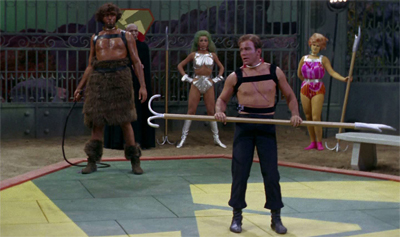
Throwing a bit of stick about...

Throwing a bit of stick about…

Continue reading

Star Trek (Marvel Comics, 1980) #4-5 – The Haunting of Thallus!/The Haunting of the Enterprise! (Review)

The first Star Trek pilot, The Cage, was produced in 1964. To celebrate its fiftieth anniversary, this December we are reviewing the second season of the original Star Trek show. You can check out our first season reviews here. Check back daily for the latest review.

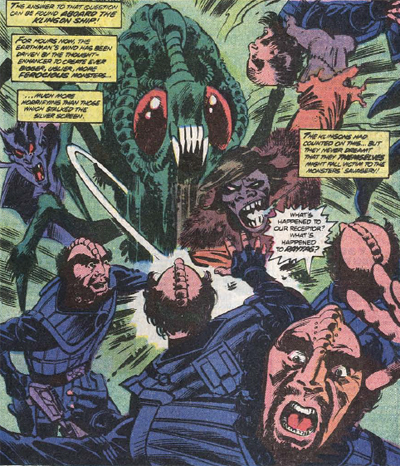
Marvel certainly had an unconventional approach to publishing Star Trek.

The company had licensed the comic book rights following the release of Star Trek: The Motion Picture. They had released a successful adaptation of the film as part of their Marvel Super Special line and had re-package the three-part adaptation as the first three issues of an on-going Star Trek comic book. Written by Marv Wolfman and illustrated by Dave Cockrum, it was clear that Marvel had big plans for Star Trek. However, it also quickly became clear that they had no idea where they wanted to go with the comic.

Here there be monsters...

Here there be monsters…

After all, they immediately followed up the big three-issue opening arc with a comic where the Enterprise discovered a haunted house floating in space. While it was certainly a catchy image, it wasn’t exactly a quintessential Star Trek premise. It seemed that Marvel had no idea what to do with the comic. Writer Marv Wolfman wrote the first of the two issues comprising the storyline, handing the second issue over to Mike W. Barr. He would only stick around for two issues before handing the comic over to Tom DeFalco. DeFalco wrote a single issue before moving on.

It is a rather disjointed comic book, one which lacks the strong narrative voices that DC would give to their late-eighties licensed Star Trek comics. Then again, it is probably easy enough to deduce all of this from the fact that the first original Star Trek storyline published by Marvel featured a haunted house floating in space.

In space, everyone can hear you scream...

In space, everyone can hear you scream…

Continue reading

The X-Files – Pusher (Review)

This November (and a little of December), we’re taking a trip back in time to review the third season of The X-Files and the first (and only) season of Space: Above and Beyond.

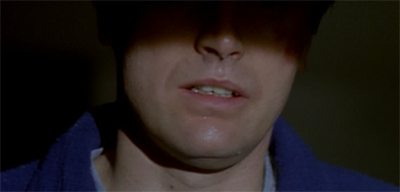
Pusher is perhaps one of the most effective stand-alone “monster of the week” stories that the show ever did.

It is no wonder that the episode is frequently cited among the best episodes of The X-Files ever produced, but it is telling that it was identified by Slate as the perfect “gateway” episode of the show. If you want to give someone a taste of The X-Files without burdening them with continuity or back story, this is a good choice. It may not be the best episode that Vince Gilligan ever wrote, and it may not even be the best episode of the third season, but it is one the strongest demonstrations of what the show does on a weekly basis.

Mano a mano...

Mano a mano…

Pusher is the first episode that Vince Gilligan wrote after joining The X-Files writing staff. It is the only episode credited to Gilligan in the show’s third season. He had been offered a position on staff after turning in Soft Light at the end of the second season, but had hesitated before accepting the job. When he did accept the job, he came down with a dose of infectious mononucleosis. As a result, Gilligan only wrote one script for the third season, despite becoming one of the show’s most prolific writers.

Pusher is a pulpy delight, a spectacularly constructed standalone that perhaps points the way to Gilligan’s later work.

Gift of the gab...

Gift of the gab…

Continue reading

Star Trek: Deep Space Nine – Through the Looking Glass (Review)

This September and October, we’re taking a look at the jam-packed 1994 to 1995 season of Star Trek, including Star Trek: Deep Space Nine and Star Trek: Voyager. Check back daily for the latest review.

It’s very tempting to write off the problems with the mirror universe episodes of Star Trek: Deep Space Nine as diminishing returns – the idea that repeated exposure to what was once novel robs that item of its novelty. It is possible to become immune to the charms of camp, dulled to absurd space opera, and just worn out by watching the cast play “space pirates meet Star Wars.”

However, this does a bit of a disservice to the mirror universe as a concept. As iconic as it has become, Mirror, Mirror worked very well as a piece of introspection for the original Star Trek. Crossover stands out as one of the strongest episodes in the first two years of Deep Space Nine, because it manages to capture the thoughtful-yet-campy self-criticism of Mirror, Mirror.

Let's face it, after what O'Brien's been through, nobody would be surprised if he snapped...

Let’s face it, after what O’Brien’s been through, nobody would be surprised if he snapped…

In contrast, Through the Looking Glass marks the point at which the mirror universe really ceases to be a clever concept, and becomes something that is simply kept around because it’s old and because the production team like the idea of playing “roguish rebels and evil empires” in a way that’s impossible in the mainstream Star Trek universe.

While the episode does have an interesting central premise and is nowhere near as weak as some of the mirror universe episodes ahead, Through the Looking Glass is the moment where the mirror universe seems to get away from Deep Space Nine.

They really nailed Rom to the wall...

They really nailed Rom to the wall…

Continue reading

Non-Review Review: Mars Attacks!

I have a genuine affection for Mars Attacks! It’s certainly not Tim Burton’s best work, but it’s also miles above some of his more disappointing output. It feels like an affectionate homage to Ed Wood, putting together the kind of movie that the old B-movie director would have approved of, except with the judgement to play it as a comedy rather than entirely straight (although Wood’s filmography is typically “so bad it’s good“, one could scarcely accuse the director of being in on the joke), and made with a more significant budget. Seen in that light, it’s hard to resist the movie’s (admittedly uneven) charms.

The chances of anything coming from Mars are a million to one, they say...

Continue reading

Wednesday Comics: Sgt. Rock & Easy Co.

Earlier this week I reviewed Wednesday Comics, a rather spanking anthology from DC Comics. I kinda figured, however, it might be worth my while to break out some of those fifteen stories on their own (but not all of them) and discuss them, as it’s easy to lose sight of a particular writer/artist’s work in an anthology. Now we’re going back to a “new” old bunch of pulp characters.

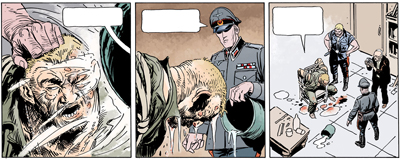
Sgt. Rock & Easy Co. is an interesting choice for the anthology. Although it’s a war comic, it was only introduced in 1959, long after the end of the conflict and in the twilight days of the newspaper strips that this anthology is meant to reproduce. It’s inclusion arguably speaks more to the desire by DC to create a nostalgia for a long legacy that never quite existed than it does to the character’s popularity or place within DC continuity. Sgt. Rock & Easy Co. is one of only three non-superhero strips included – the post-apocalyptic adventures of Kamandi and the Strange Adventures strip, following Adam Strange: Space Hero – and it seems a logical fit if the goal was to create the impression of a large interconnected tapestry of DC history. After all, the only thing as pulpy as a superhero story is good old fashioned war yarn.

That's the closest you'll come to a splash page in this storyline...

Continue reading

Non-Review Review: Dick Tracy

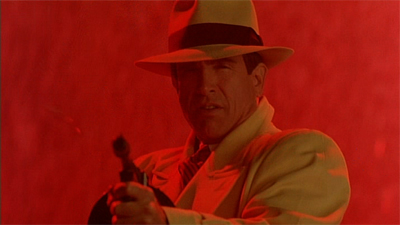
There’s a good movie somewhere inside Dick Tracy. It’s hidden pretty deep inside, but I’m sure it must be there somewhere. All the trappings – costume design, set design, make-up and even some of the direction – run the gamut from good to great, but the movie is hampered by terrible performances and a really awful script. Seriously, it seems like the move was written on crayon in bright colours, which might fit well with the aesthetic that Beatty was going for – but does not a good film make.

Quit Dickin' around...

Continue reading