• Following Us

  • Categories

  • Check out the Archives


  • Awards & Nominations

Right Here, Right Now: Thoughts on Kathryn Bigalow’s Osama Bin Ladin Project…

It’s interesting that the piece of news which grabbed me most coming out of the whole news cycle around the assassination of Osama Bin Ladin by US troops in Pakistan wasn’t any of the discussion over the legality of the act, nor the debate over whether assassination is now an acceptable tool of foreign policy. It was the near-instantaneous announcement that Kathryn Bigalow would be working on a feature film adaptation of the killing, an adaptation that reportedly has a mostly finished script and a lead actor already. Perhaps it’s a stunning illustration of just how quick the news and media cycle is, but I wonder how quick we feel the need to turn history into cinema.

Continue reading

Non-Review Review: Wall Street – Money Never Sleeps

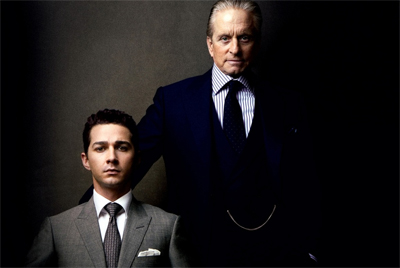
The words “too big to fail” are, understandably, bandied around quite a bit over the course of Oliver Stone’s Wall Street: Money Never Sleeps. While they refer, of course, to the bloated financial institutions holding the world’s democracy to ransom, it’s hard not to get a sense that they could also apply to Stone’s film. The financial crisis continues to prove that Stone’s original Wall Street was a powerful condemnation of all-consuming unchecked capitalism, and one might assume that the timing is right for a sequel. Indeed, Stone’s attempts to make his movie reflect on the harsh economic climate are admirable – but one gets the sense that the director is unable to decide where to focus the camera. As a result, the film loses a lot of its punch as it jumps around from macro-economics to personal tragedies without thinking too much of the gap between them.

Family fortunes?

Continue reading

Non-Review Review: Wall Street

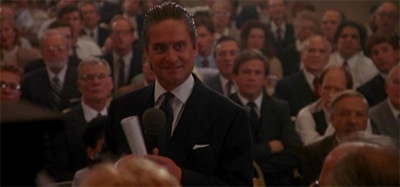
It’s interesting that Wall Street, a movie set in the time that it was made, begins with a titlecard reminding the audience that it’s 1985. Maybe it’s because director Oliver Stone realised that the movie would be dated almost as swiftly as it had been released – financial services are very much a product of their time, anchored in a specific moment. “By four o’clock, I’m a dinosaur!” one character exclaims over the phone as he tries to get information – information that will be redundant if he waits too long. However, I don’t think Wall Street is in anyway redundant. The current financial crisis suggests that – if anything – the original film is as relevant now as when it was released (and is the only reason I am not flat-out dreading the release of Wall Steet: Money Never Sleeps). No, I think that it is because, even in the midst of the decade that it was produced, Stone could see the movie would perfectly capture that moment in time. Seriously, despite the fact that its core ideas are as insightful as they were twenty-five years ago, the movie itself feels like the pure essence of the eighties distilled into a two-hour film. That titlecard isn’t there to remind viewers that this is a dated film, it serves as a stamp or a label. Not to say “this is set in 1985”, but “this is 1985″.

Gordon takes stock...

Continue reading

Non-Review Review: W.

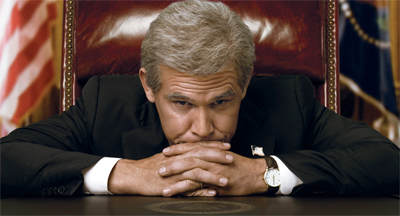
Oliver Stone famously rushed just about every aspect of this production in order to get it into cinemas before last year’s November election. Does that affect the movie? It does and it doesn’t. It doesn’t in that Stone seems to have a clear image of the President in his head and it’s perfectly captured on screen. It does affect the movie in that Stone has to choose an arbitrary cutoff point for his movie, since he can’t end it with the end of Bush’s presidency. So he chooses the re-election of George W. Bush in 2004 to serve as the film’s ending. That point arguably suits the central thesis of Stone’s psychological profile of the man, butit also serves to make that thesis seem heavy-handed or forced. The other side of that coin is that I doubt the Stone would have been able to market and sell the film for a few years after the end of the Bush administration, and the fact that so vintage a diretcor as Stone can still make such a raw and energetic film is a testament to his abilities (that some of us may have doubted after World Trade Centre and Alexander).

bush

Misunderestimate at your peril...

Continue reading

The Love of Richard Nixon…

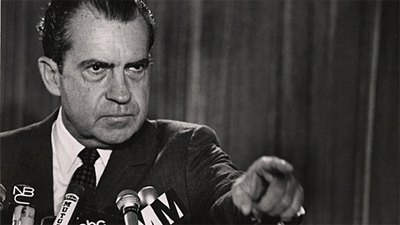
I’m not American, but I feel a strange fascination with Richard Milhouse Nixon. He’s a figure of almost Shakespearean complexity, driven to phenomenal heights and fantastic accomplishments, but never able to do enough to placate the insecurity gnawing at him. I had the pleasure of reading Conrad Black’s rather even-handed summary of his life and career last summer, and he seems as much a mystery as ever. The recent news item about another of his paranoid ramblings has grabbed media attention, but I’m amazed that there doesn’t seem to be much debate over the true impact of Nixon’s Presidency beyond the obvious shadow cast by Watergate. What is the American fascination with painting Nixon as a villain or a fiend? Why can he not embody something just a tad more complex?

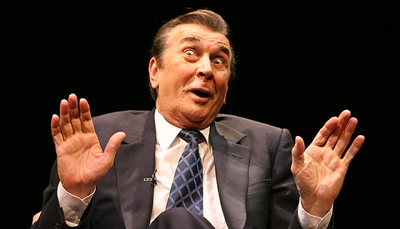
Richard Nixon unsuccessfully attempts to distract from the Watergate scandal by declaring "It's behind you!" during a Press Conference...

Richard Nixon unsuccessfully attempts to distract from the Watergate scandal by declaring "It's behind you!" during a Press Conference...

Continue reading

Who Am I to Argue with History?

What do Hollywood film makers owe to history? I’ve had this question on my mind because I’ve been seeing quite a few historical films lately – The Reader, Chaplin, and Frost/Nixon will hopefully be arriving in my mailbox today – and I just wondered how faithful it was reasonable to expect a Hollywood film to be to real life events.

Contrary to popular belief, the missing 18 minutes from the Watergate tapes do not feature Richard Nixon practicing jazz hands...

Contrary to popular belief, the missing 18 minutes from the Watergate tapes do not feature Richard Nixon practicing jazz hands...

Continue reading