• Following Us

  • Categories

  • Check out the Archives


  • Awards & Nominations

Daredevil – New York’s Finest (Review)

This month, we’re doing daily reviews of the second season of Daredevil. Check back daily for the latest review.

The stock comparison for the first season of Daredevil was Batman Begins. There were certainly plenty of reasons. The yellow-ish colour scheme. The non-linear superhero origin story focusing on a protagonist who subsumes his anger into something greater. The erosion of the existing organised crime framework, replaced by something altogether weirder. The ninjas who plot to smuggle a potentially dangerous (and pseudo-mystical) weapon into the heart of the city through th docklands. It was a good comparison, and it served Daredevil well.

As such, it makes sense that the second season of the show would desperately want to be The Dark Knight.

That'll make a nice logo...

That’ll make a nice logo…

Continue reading

Daredevil – Bang (Review)

This month, we’re doing daily reviews of the second season of Daredevil. Check back daily for the latest review.

The Marvel Universe has a strong attachment to New York City.

There are any number of examples that might be cited, from the lighting of the Empire State Building in blue and red to celebrate the release of The Amazing Spider-Man to J. Michael Straczynski’s cringe-inducing issue of The Amazing Spider-Man where megalomaniac (and occasionally mass murdering) supervillain Doctor Doom cries in the rubble of the World Trade Centre. The company and its characters have a long and rich history that is intertwined with the city itself.

Church Devil.

Church Devil.

At the same time, certain titles and characters have stronger attachments to particular areas and eras of the city. Spider-Man will always be rooted in Manhattan. The X-Men are symbolically tied to Westchester. Daredevil might be connected with Hell’s Kitchen, but he is anchored in a very particular version of Hell’s Kitchen; the gritty version of Daredevil pioneered by Frank Miller is tied to the dangerous neighbourhood as it existed against the backdrop of the seventies and eighties. (The Punisher is similarly rooted in seventies and eighties New York.)

Of course, Hell’s Kitchen has changed in the intervening years. It is no long as run down as it once was, subject to the forces of gentrification and modernisation. The first season of Daredevil touched on this idea, using the Chitauri attack from The Avengers to explain why the neighbourhood had been set back a few decades and turned into an urban hellhole. Wilson Fisk was suggested to be plotting a gentrification that had already taken place in the real world, casting out working-class inhabitants in order to remodel the area.

In with a shot...

In with a shot…

The second season of Daredevil adopts something of a different approach, which makes sense given the transition from producer Steven DeKnight to Doug Petrie and Marco Ramirez. Although there are fleeting references to “the Incident” later in the season, the invasion is no longer used to explain the urban nightmare of Hell’s Kitchen. Instead, the season adopts an approach akin to a stylistic period piece. Although Daredevil is still unfolding in the present day, the series is populated with markers that place it in an earlier context.

Bang seems to suggest that Daredevil is unfolding a version of New York anchored in the summer of 1977.

Don't leave us hanging...

Don’t leave us hanging…

Continue reading

Jessica Jones – AKA Sin Bin (Review)

Kilgrave lies.

To be fair, that much should be obvious. Kilgrave is a character whose power hinges upon his ability to manipulate people using words. Of course he lies. Even his name is a lie. He lied to Jessica about the effectiveness of his powers, revealing that his decision not to control Jessica against her will wasn’t really a decision. He lies to everyone about his past, painting his concerned parents as cliché monsters. He lies to himself about his motivations, genuinely believing he is a victim in all of this.

jessicajones-sinbin19a

He also lies to the audience about his character, as AKA Sin Bin reveals Kilgrave is not a tragic and sympathetic antagonist with an explanatory childhood trauma after all. He is not the archetypal sympathetic bad guy whose actions can be explained away as the result of the horrible things that happened to him when he was a child. He is not the version of Wilson Fisk presented in Shadows in the Glass, a man who might have been a hero under other circumstances. Kilgrave is an unrepentant self-serving sociopath.

One of the joys of Jessica Jones is that the revelation that Kilgrave is unquestioning evil does not in any way make him a less complicated or compelling character.

jessicajones-sinbin3a

Continue reading

Jessica Jones – AKA Top Shelf Perverts (Review)

Generally, Jessica Jones is quite optimistic in its portrayal of responses to trauma.

In AKA It’s Called Whiskey, Will Simpson tried to murder Trish Walker with his own hands; by half-way through AKA The Sandwich Saved Me, the two are involved in an energetic and fulfilling sexual relationship. In AKA Top Shelf Perverts, Malcolm helps to dispose of the body of Ruben before engaging in a half-season long deception of Robyn about the fate of her brother; but AKA Take a Bloody Number, it seems like there might be romance in the air. In AKA You’re a Winner!, Jessica reveals that she killed Luke Cage’s wife; by AKA Smile, they have reconciled.

jessicajones-topshelfperverts25

As a rule, Jessica Jones suggests that trauma is not defining or delimiting. Trauma damages a person, but it does not necessarily break them. Jessica Jones never avoids exploring the consequences of abuse – particularly long and sustained abuse – but it also refuses to let its characters be trapped by those experiences. Trish’s abuse at the hands of her mother might have led her to build a fortress, but she still puts herself out in the world. Jessica has been abused by Kilgrave, but she still wants to save Hope. AKA Top Shelf Perverts is the exception that proves the rule.

After the events of AKA You’re a Winner!, Jessica spirals into truly self-destructive behaviour. In many ways, AKA Top Shelf Perverts serves as an effective contrast to the rest of the season, demonstrating how functional Jessica was up to this point. As with AKA The Sandwich Saved Me, the episode suggests that Jessica is not solely defined by her traumas; that she is not broken by her experiences with Kilgrave. AKA Top Shelf Perverts does this by teasing the audience with glimpses of what a truly broken Jessica might look like.

jessicajones-topshelfperverts32 Continue reading

Jessica Jones – AKA Ladies’ Night (Review)

“New York may be the city that never sleeps, but it sure does sleep around,” explains grizzled private detective Jessica Jones, the first line of Jessica Jones.

The line establishes two key themes going forward, running through the first season of the show. The more subtle theme is that of New York itself. Like Daredevil before it, Jessica Jones is rooted in a particular vision of New York; in its imagery and iconography. While Daredevil was arguably rooted in a version of Hell’s Kitchen that no longer existed, Jessica Jones seems at least a little more modern and more relevant. In AKA Ladies’ Night, and across the season, street names serve as an emotional anchor to the eponymous private eye. They are real and tangible places.

jessicajones-ladiesnight7

The second theme is more immediately pronounced. Jessica Jones might just be the most sex-positive aspect of the shared Marvel Universe. Although the usual limitations on nudity are in effect, Jessica Jones seems far more comfortable with human sexuality and sexual dynamics than any of the studio’s earlier output. AKA Ladies’ Night sets the tone for the season, opening with an awkward sequence of quick and grotty sex in (and around) a parked car. The show starts as it means to go on, embracing sex as a part of the human condition.

AKA Ladies’ Night does an effective job of setting the tone for what will follow. It is an effective introduction to the world of Jessica Jones.

jessicajones-ladiesnight12 Continue reading

Harsh Realm – Camera Obscura (Review)

This November, we’re taking a trip back in time to review the seventh season of The X-Files and the first (and only) season of Harsh Realm.

And so, with Camera Obscura, it seems that Harsh Realm comes to an end

The show had been developed as a television series for the new millennium; all involved had great plans for it. Fox had made no secret of the fact that they planned for Harsh Realm to take pride of place in their schedule going forward. The assumption was that it would replace The X-Files after that juggernaut was retired. There was a lot of hype around the development, a lot of excitement about the new show from producer Chris Carter. Harsh Realm was to be the first of many new shows developed by the producer as part of a highly lucrative contract with Fox.

Burning down the House (of God)...

Burning down the House (of God)…

Sadly, it did not work out that way. Harsh Realm had premiered to low ratings. Fox shuffled it off the schedule after only three episodes, which seemed a knee-jerk response given the talent involved in the show’s production. The six remaining episodes were locked away from the light of day, relegated to premiering on FX at the tail end of that season of television. For all that everybody involved had hoped that Harsh Realm would be a breakout hit, it ended up little more than a footnote.

Here, it dies. After nine episodes aired across two channels over seven months, the curtain comes down on Harsh Realm. It ends not with a bang, but a whimper.

Time for reflection...

Time for reflection…

Continue reading

Non-Review Review: The Drop

It is suggested that hell is other people. Perhaps not so much. Perhaps hell is the absence of other people. Towards the end of The Drop, a character ruminates on the idea of eternal damnation – suggesting that hell is nothing but eternal emptiness, a cosmic echo chamber where the damned are left with nothing but their own sense of isolation. Maybe that is what damnation is, nothing but an individual’s own loathing and self-doubt reflected back them, amplified through the darkness.

The Drop is a tense and claustrophobic thriller. The bulk of the action unfolds around the small world as Bob knows it. Bob is a simple man. He works at a small dive, “Cousin Marv’s Place.” When asked tough questions, he simply answers, “I just tend bar.” As Bob explains, the dive bar occasionally serves as a “drop” for all the money laundered through local crime. Bob doesn’t know where it comes from or where it goes. He is only aware of it when it comes into his care and when it leaves.

It's a dog's life...

It’s a dog’s life…

The Drop is a story about isolation and loneliness. Characters reflect on their place in the world, trying to make sense of what unfolds around them. Most are unknowable to each other, mysteries and enigmas. Asked a personal question, Bob replies, “That’s my business.” When his friend Nadia asks why Bob never inquired about her own very obvious scars, Bob simply answers, “I figure that’s your business.” The world as Bob knows it is a small place. Maybe it’s constantly getting smaller.

Adapted by Dennis Lehane from his own short story Animal Rescue, The Drop wallows in its own sense of lost direction and impending doom. Michaël R. Roskam’s direction never rushes the story or the actors, allowing the film time to take in the emptiness and hollowness in this small world that briefly intersects with something much bigger and more unpleasant. Perhaps a little too stately and relaxed in places, The Drop is nevertheless an atmospheric delight.
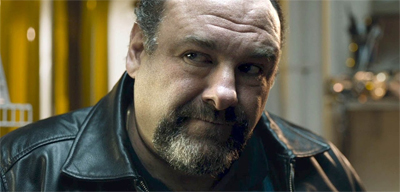
Just Cous...

Just Cous…

Continue reading

Greg Rucka and Marco Checchetto’s Run on The Punisher, Vol. 9 (Review)

This March, to celebrate the release of Captain America: The Winter Soldier, we’ll be taking a look at some classic and not-so-classic Avengers comic books. Check back daily for the latest updates!

The Punisher isn’t really a complex character.

Indeed, despite his popularity and appeal, there’s really only so much you can do with the character before it feels like you’re repeating yourself. He is a vigilante who brutally murders criminals, possibly because criminals killed his family. That’s part of the reason why Rick Remender’s Punisher run was so exhilarating. It genuinely felt unlike anything that had been done with the character before – even if Remender had to take Frank Castle off the reservation to do it.

Writer Greg Rucka and artist Marco Checchetto came up with their ingenious way of making the Punisher seem novel again. Realising that readers have probably become a little too over-familiar with Frank Castle and his world, Rucka and Checchetto shrewdly decide to look at Frank Castle from the outside, treating the Punisher as something like a force of nature, a terror glimpsed fleetingly as he stalks the concrete jungle.

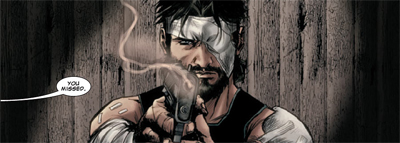
A smoking gun...

A smoking gun…

Continue reading

Agents of S.H.I.E.L.D – F.Z.Z.T. (Review)

F.Z.Z.T. is a reminder that Agents of S.H.I.E.L.D. is a genre show still in its first season. That might not sound like a good thing, and F.Z.Z.T. isn’t the strongest of the mediocre crop of episodes so far, but it does indicate that there is still potential. The Girl in the Flower Dress teased the possibility that Agents of S.H.I.E.L.D. might have settled into its own incredibly unambitious niche, and any evidence to the contrary should be welcomed.

F.Z.Z.T. is boring and generic, but at least it’s boring and generic in a way that is different from most of the boring and generic episodes so far. So that’s something.

A Gemma of an idea...?

A Gemma of an idea…?

Continue reading

Stan Lee & Jack Kirby’s Thor – The Might Thor Omnibus, Vol. 1 (Review/Retrospective)

To celebrate the release of Thor: The Dark World towards the end of next month, we’ll be looking at some Thor and Avenger-related comics throughout September. Check back weekly for the latest reviews and retrospectives.

I am a massive fan of The Mighty Thor. There’s just something so clever and playful about the idea of a classic Norse deity reimagined as a Marvel superhero, a self-aware take on the whole “modern myth” approach to American comic book storytelling that it’s hard not to love. Indeed, I would rank portions of Lee and Kirby’s work on Thor among the best of their output from the Silver Age, a truly epic large-scale epic fantasy narrative that isn’t anchored or tethered to any limitations beyond the imaginations of those working on it.

While The Fantastic Four is a lot more consistent and a lot more important in the grand scheme of comic book history, Thor is a bit rockier. It took Lee and Kirby a considerable amount of time to find their creative voice on Thor – a difficulty compounded by the fact that heavy work loads on other Marvel often forced the duo to delegate the early issues of the book to other writers and artists. As a result, this mammoth tome of Thor serves more as a learning curve, building towards a point where the duo will have figured out quite how to tell compelling and exciting stories featuring the God of Thunders.

Taking the hammer for a spin...

Taking the hammer for a spin…

Continue reading