• Following Us

  • Categories

  • Check out the Archives


  • Awards & Nominations

Brian Michael Bendis’ Avengers – New Avengers Vol. 3-4 (Hardcover) (Review/Retrospective)

This is the eighth in a series of comic book reviews that will look at the direction of Marvel’s continuity (and, in particular at their “Avengers” franchise) over the past five or so years, as they’ve been attempting to position the property at the heart of their fictional universe. With The Avengers planned for a cinematic release in 2012, I thought I’d bring myself up to speed by taking a look at Marvel’s tangled web of continuity.

And now we’re entering a continuity-heavy area. You have been warned. As if we’ve been in a continuity-free zone for the past couple of weeks, remarks you, trusted reader. This is where my little experiment to venture deep into the heart of Marvel’s comic book continuity becomes a little bit more complicated and a little bit more difficult. Whereas the first part of Bendis’ run on New Avengers was relatively stand-alone (while still drawing on decades of events and continuity), it’s at this point the series becomes irrevocably intertwined with the on-going events at the heart of the Marvel Universe. It’s been described as “a spine”, and that’s pretty much exactly what it is: it’s a support structure which ties together the big Marvel events year-on-year, a thread that joins events like Civil War and Secret Invasion and Siege to each other and the greater fictional universe.
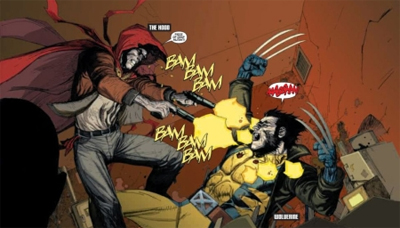
Wolverine learns the hard way not to bring claws to a gun fight...

Continue reading

House of M (Review/Retrospective)

This is the third in a series of comic book reviews that will look at the direction of Marvel’s “Avengers” franchise over the past five or so years, as they’ve been attempting to position the property at the heart of their fictional universe. With The Avengers planned for a cinematic release in 2012, I thought I’d bring myself up to speed by taking a look at Marvel’s tangled web of continuity. Get an overview of what I’m trying to take a look at here.

The X-Men represent the oddball of mainstream superhero comic books. In a genre and medium dedicated offering a static setup – things never really change or resolve – the X-Men are built upon the very idea of evolution. The whole basis of the franchise is the pursuit of equality by the genetically distinct mutant population, the idea that they and mankind can grow together. It has even been frequently suggested that these super-powered individuals represent out future or our replacements. However, the only way to actually tell a story like that is to follow it through to its logical conclusion – to let the ball roll and to let the world change. It feels a little counterproductive for Charles Xavier and his students to still be fighting for the same rights as everyone else nearly fifty years on – it might even seem a little stale. Grant Morrison’s superb New X-Men run offered a solution of sorts – it gave us a world where humanity would be extinct in a couple of generations and showed the growth and relationship between human and mutant subculture. Gone was the minority struggling against an oppressive majority – a more complex example of race relations had come into play with “mutant music” and “mutant slang” making their impression on the youth, amid a silent and almost invisible middle-class backlash. This was an ingenious approach which demonstrated the relevance of the franchise. Unfortunately, Marvel were not quite pleased with this – some people even, ridiculously, accused Morrison of telling all the remaining X-Men stories – and decided to set things right. They did that through House of M.

Dive in...

Continue reading

Brian Michael Bendis’ Avengers – New Avengers Vol. 1-2 (Hardcover) (Review/Retrospective)

This is the first in a series of comic book reviews that will look at the direction of Marvel’s “Avengers” franchise over the past five or so years, as they’ve been attempting to position the property at the heart of their fictional universe. With The Avengers planned for a cinematic release in 2012, I thought I’d bring myself up to speed by taking a look at Marvel’s tangled web of continuity. Get an overview of what I’m trying to take a look at here.

Alright. I figure I sound a bit hypocritical complaining about the impact of big events on Marvel’s storytelling continuity without reading said big events. Well, actually, I don’t think I’m a hypocrite – I think it’s perfectly reasonably that a reader should be able to pick up Ed Brubaker’s Captain America without having to worry about Mark Millar’s massive Civil War crossover which they either don’t know enough to care about or know enough not to care about. However, I feel like maybe – just maybe – I should try to ride this “cross-continuity” thing out just once and see if the story somehow justifies the damage it causes to the cohesion of individual runs.  Yes, I’m going to jump head-first into the event-populated minefield of continuity which is recent Marvel history, and I will be using New Avengers as a checklist to that. I’m going down the rabbit hole, following the arc from Civil War through to Siege.

Sentry is responsible for the Carnage in this run...

Continue reading

Ultimate Spider-Man Collection (Hardcover Volumes #1-3) (Review/Retrospective)

In 2000, Marvel did something genuinely bold with one of its pop culture icons. Of course, the early part of the last decade saw a breath of fresh air at the House of Ideas, with iconic and influential (and occasionally iconoclastic) runs on books like New X-Men, Fantastic Four, Amazing Spider-Man, X-Statix, Punisher and other titles like Daredevil or Alias. However, the formation of the Ultimate line of comics was perhaps the most significant creative gamble taken at the time. The idea was simple, and the timing perfect. With Sam Raimi’s Spider-Man around the corner, and Bryan Singer’s X-Men proving that superheroes were the stuff of summer blockbusters, it seemed like a perfect opportunity to launch a line of books that would be easily accessible to new readers, free from decades of tangled continuity and plot developments.

And, appropriately enough, the character chosen to spearhead this new line was arguably Marvel’s most iconic character, Spider-Man.

spidey

Continue reading