• Following Us

  • Categories

  • Check out the Archives


  • Awards & Nominations

Jessica Jones – AKA Crush Syndrome (Review)

The biggest problems with the first season of Jessica Jones are structural in nature.

Writing a season of television is tough. It is particularly tough when the season is heavily serialised, requiring the production team to break the story down into a distinct number of easily digestible chunks. It is especially tough when the season is going to be released all at once for public consumption, allowing the audience to watch as many episodes as they want as frequently as they want. Is a thirteen-episode drama released all at once effectively just a twelve-hour movie with conveniently timed bathroom breaks? Or is it the same as any other drama?

jessicajones-akacrushsyndromea

Jessica Jones struggles with this. It begins struggling with it quite early and continues struggling with it until the final couple of episodes. There is a sense that the production team are not entirely sure what the ideal mode of consumption is for Jessica Jones. Is the show supposed to gulped down in three or four marathon sessions, or is it meant to be savoured over a longer period of time? Do the episodes need to stand on their own or should they flow together? Do the team have to worry about repeating certain story beats (“capture and escape”) too close together?

Jessica Jones never quite answers this. The show has a strong enough cast of actors playing an interesting enough selection of characters that it is easy enough to forgive these problems. The world feels well-formed and the immediate story beats are generally interesting enough that the show never drags or feels repetitive. However, it does occasionally wander down certain storytelling dead ends. AKA Crush Syndrome and AKA It’s Called Whiskey take the show down its first such narrative cul de sac.

jessicajones-akacrushsyndrome20a

Continue reading

Netflix and Marvel’s Jessica Jones (Review)

Jessica Jones is a bold and ambitious piece of work.

In many ways, it takes what worked about Daredevil, and improves upon a lot of it. It offers a grounded take on the shared Marvel universe, one even further disconnected from the world of The Avengers. It offers a likable cast of actors playing a bunch of nuanced and well-developed characters, avoiding some of the stock comic relief that bogged down Daredevil at certain points in the series. It is smart and provocative in a way that many of Marvel’s more mainstream offerings are not, taking advantage of the relatively smaller platform to tell a more niche story.

jessicajones-sinbin28a

There are issues, of course. The biggest problem with Jessica Jones is that the series feels about four episodes too long for the format that it has adopted. While each of the episodes work as a distinct unit of story, Jessica Jones is much more of a single story than Daredevil was. The problem is that the story occasionally feels like it goes through narrative loops and down narrative cul de sacs to stretch out to the thirteen-episode order. While the more episodic structure of the first half of Daredevil was not ideal, it allowed for a smoother twelve-hour storytelling experience.

Still, this is a rather small problem. The world and characters of Jessica Jones are interesting enough to sustain interest even when it feels like the plot is stalling. Jessica Jones is clever, exciting and engaging.

jessicajones-ladiesnight7

Continue reading

Jessica Jones – AKA Ladies’ Night (Review)

“New York may be the city that never sleeps, but it sure does sleep around,” explains grizzled private detective Jessica Jones, the first line of Jessica Jones.

The line establishes two key themes going forward, running through the first season of the show. The more subtle theme is that of New York itself. Like Daredevil before it, Jessica Jones is rooted in a particular vision of New York; in its imagery and iconography. While Daredevil was arguably rooted in a version of Hell’s Kitchen that no longer existed, Jessica Jones seems at least a little more modern and more relevant. In AKA Ladies’ Night, and across the season, street names serve as an emotional anchor to the eponymous private eye. They are real and tangible places.

jessicajones-ladiesnight7

The second theme is more immediately pronounced. Jessica Jones might just be the most sex-positive aspect of the shared Marvel Universe. Although the usual limitations on nudity are in effect, Jessica Jones seems far more comfortable with human sexuality and sexual dynamics than any of the studio’s earlier output. AKA Ladies’ Night sets the tone for the season, opening with an awkward sequence of quick and grotty sex in (and around) a parked car. The show starts as it means to go on, embracing sex as a part of the human condition.

AKA Ladies’ Night does an effective job of setting the tone for what will follow. It is an effective introduction to the world of Jessica Jones.

jessicajones-ladiesnight12 Continue reading

Daredevil – In the Blood (Review)

To celebrate the launch of Marvel’s Daredevil and the release of Avengers: Age of Ultron, we are reviewing all thirteen episodes of the first season of Marvel and Netflix’s Daredevil. Check back daily for the latest review.

There is something very functional and formulaic about stretch of the season running from Rabbit in a Snowstorm through to Condemned.

After a great opening set of episodes, it feels like the show stalls a little. It pulls back, taking the time run through some stock superhero origin plot elements before pressing ahead. This might just be a result of the thirteen-episodes-in-one-go format of the series, or it could be a result of the transition from original showrunner Drew Goddard to new showrunner Steven DeKnight. Whatever the reason, it feels like the first season slows down its plotting for Matt Murdock so that it can catch up on developing Wilson Fisk – a character who spent the first two episodes of the season as a phantom.

daredevil-intheblood18

As a result, it is rather unsurprising that Fisk’s plot should be the most interesting part of In the Blood. This is the audience’s first extended encounter with the new crime boss of Hell’s Kitchen, as we join him on an awkward first date right before we are reminded of just how violence he can be. As ever, Daredevil provides a nice sense of contrast with its characters, offering a striking juxtaposition between the well-meaning and innocent version of Wilson Fisk presented to Vanessa Marianna and the brutal and violent version of Wilson Fisk who decapitates Anatoly Ranskahov with a car door.

The problem, then, is the plotting as it relates to Matt Murdock. While the show is making up for lost time by developing Wilson Fisk, it seems like Matt is relegated to level-grinding against the Russian mob. These are villains so generic that it seems like everybody in Hell’s Kitchen just refers to them as “the Russians.” To be fair, the teaser to In the Blood does give us some sense of back story for Vladimir and Anatoly Ranskahov, but they feel rather transparently like a stalling tactic designed to eat up time before the show can get to the interesting stuff.

daredevil-intheblood6

The situation is not aided by the decision to play out the cliché “attack the hero by targeting a female acquaintance” plot as the centrepiece of Matt’s arc in the episode. In the Blood cleverly underscores the parallels between Wilson Fisk and Matt Murdock by juxtaposing their relationships with Vanessa and Claire respectively, but this structural cleverness is undercut by the decision to reduce Claire to emotional leverage. Victimising a female character to drive a male character to action is also a risky plotting decision, but particularly so when it feels like the show is just marking time.

In the Blood is a perfectly functional episode, albeit one that works much better when it focuses on its villain than when it focuses on its hero.

daredevil-intheblood1

Continue reading

Daredevil – Cut Man (Review)

To celebrate the launch of Marvel’s Daredevil and the release of Avengers: Age of Ultron, we are reviewing all thirteen episodes of the first season of Marvel and Netflix’s Daredevil. Check back daily for the latest review.

If Into the Ring skilfully sets its tone in the opening teaser, telling the audience everything that they need to know about Daredevil before the first roll of the opening credits, then Cut Man saves its biggest and most defining moment for the closing seven minutes of the episode. It is almost impossible to talk about Cut Man without talking about the superb action sequence that closes out the episode – a single-take piece of stunt work that sees Matt Murdock tearing through an army of Russian mobsters in a way reminiscent of Oldboy.

That sequence is jaw-dropping, and possibly the visceral highlight of the thirteen-episode season. It is a very visceral demonstration of just what Daredevil can do. The technical skill on display in that seven-minute sequence rivals anything in the big-budget blockbuster Marvel movies. It eschews the clean-cut violence of something like the (also superb) elevator fight scene from Captain America: The Winter Soldier in favour of a more low-key and naturalistic vibe. Daredevil might not have the budget for monsters or armour suits, but it has a great stunt team.

daredevil-cutman11

In a way, the fact that Into the Ring is defined by its opening scene and Cut Man is defined by its closing scene feels appropriate. These are the only two episodes of the first season to be scripted by Drew Goddard, before he left the production and was replaced by Steven DeKnight. As such, these two episode have a tone that feels slightly distinct and removed from the episodes following on from this point. Although there is a very clear through line running from one end of the season to the other, Into the Ring and Cut Man feel like their own little part of the season.

These two episodes tidy away the broad strokes outline of Matt Murdock’s origin, to the point where the audience knows what they need to know before the actually story can kick in. The show will return to Matt’s early years in both Stick and Nelson v. Murdock, but Into the Ring and Cut Man represent the foundations of a superhero origin that will span the season.

daredevil-cutman13

Continue reading

Daredevil – Into the Ring (Review)

To celebrate the launch of Marvel’s Daredevil and the release of Avengers: Age of Ultron, we are reviewing all thirteen episodes of the first season of Marvel and Netflix’s Daredevil. Check back daily for the latest review.

Daredevil is an ambitious piece of work.

It represents an astonishing commitment from both Marvel and Netflix to realise a thirteen-episode run on a superhero character that will be produced and released in one big chunk. One of the unsung features of Netflix’s “full season” model is the fact that there is minimal room for course correction or reevaluation; there is no time for audience feedback or retooling. The model is all or nothing. Before the first episode has been released to the public, the last episode has already been cut and gone through post-production.

daredevil-intothering12

That is an impressive gamble, even in this day and age when Marvel has demonstrated that it can pull off almost anything that it wants to accomplish. Daredevil is part of the tapestry of interconnected continuity that forms the Marvel Cinematic Universe, a single unfolding narrative space that dates back to Jon Favreau’s Iron Man back in 2008. In the seven years once, one of the resounding (and effective) criticisms of Marvel’s creative model has been the sense that their projects are drowned in a “house style”, as if the individual works feel obligated to fit together.

These criticisms date back to the sense that Jon Favreau’s Iron Man 2 was smothered by its obligations to a shared universe, and was only fuelled by the high-profile departure of respected film-makers like Edgar Wright and Patty Jenkins from Marvel projects, citing a irreconcilable differences. To be fair, recent efforts like Iron Man 3, Captain America: The Winter Soldier and Guardians of the Galaxy have helped to add a great deal of diversity to the tapestry of the shared Marvel universe.

daredevil-intothering16

Into the Ring works hard to establish a clear and distinct mood for its own hero. Released on Netflix, it is not bound by the same set of constraints that hem in Agents of S.H.I.E.L.D. or Peggy Carter. The brutality on display in the teaser and at the climax is utterly unlike anything else produced under the banner of this shared universe; the montage at the end of the episode makes it clear that Matt Murdock exists in very different corner of the same universe. Child abductions and drug rings and white collar crime aren’t quite covered by Tony Stark or Steve Rogers.

Although there are a few bumps along the way, Into the Ring does a good job at setting the tone for what is to come.

daredevil-intothering6

Continue reading

Star Trek Special #1 (1994) – The Needs of the One (Review)

This August, to celebrate the upcoming release of Star Trek: Into Darkness on DVD and blu ray, we’re taking a look at the Star Trek movies featuring the original cast. Movie reviews are every Tuesday and Thursday.

We’ll be supplementing our coverage of the movies with tie-ins around (and related to) the films. We’ll be doing one of these every week day. This is one such article.

In many ways, the Star Trek movies feature more character development and exploration for the cast than the entire three seasons of the television show. Star Trek III: The Search for Spock and Star Trek IV: The Voyage Home are true ensemble pieces, but there’s also more of a sense that this is a family rather than a bunch of people who just hang out together. I’d argue that the cast of Star Trek: The Next Generation remain the tightest ensemble that the franchise has ever produced, but the first six movies portray the crew of the original Enterprise as a bunch of people who have been to hell and back together.

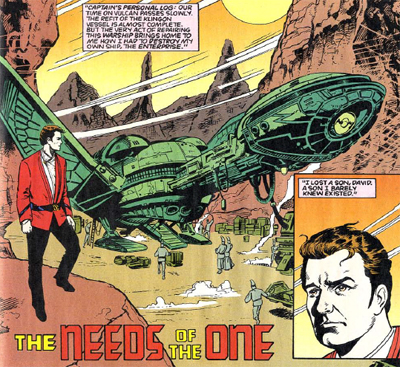
Michael Collins’ The Needs of the One represents a bit of an interlude between The Search for Spock and The Voyage Home, taking place during the crew’s three month “Vulcan exile.” While Collins’ script suffers from its inability to decide whether it’s a Spock-centric character drama or a day-in-the-life of the renegade crew, it’s a fascinating story situated in a lacuna of the movies’ chronology. It cements the idea that Spock has been radically altered over the course of the film series, and that his character arc spans the first four films.

Indeed, Collins’ opening sequence tying together his failure to achieve Kolinahr in Star Trek: The Motion Picture with his decision to once again rejoin the crew in The Voyage Home.

When all Kirk asked for was a tall ship, he probably should have been more specific...

When all Kirk asked for was a tall ship, he probably should have been more specific…

Continue reading

House of Cards (US, 2013): Chapter 5 (Review)

Friends make the worst enemies

– Frank Underwood

There is a sense now that House of Cards has figured out what it wants to be and how it wants to go about being that sort of thing. After the first three episodes were surprisingly non-committal, the fourth and fifth episodes make it clear that Frank has a plan for revenge against those who betrayed him, one that stretches a bit further than scuttling Michael Kern’s chance to be Secretary of State. There’s a wonderfully understated moment in the middle of this fifth episode where it looks like Frank has finally figured everything out, the pieces have aligned in such a way that he is positioned to speed up what is likely to be a pretty far-reaching payback scheme.

A name you can trust...

A name you can trust…

Continue reading

House of Cards (US, 2013): Chapter 4 (Review)

So you lied to his face?

No. I revised the parametres of my promise.

Which is lying.

Which is politics.

– Bob Birch and Frank Underwood

After spending three episodes lining everything up and getting all the plot points and characters to where they need to be, it looks like House of Cards is finally ready to kick into high gear. There’s still a sense that show isn’t as comfortable with its amoral and sociopathic lead character as it should be, but there’s finally a sense of what Frank Underwood is capable of. We’ve seen him topple the incoming Secretary of State using just a college article that the man didn’t write, but that sort of politicking should be second-nature to Underwood at this point. Here, Frank is a bit more ruthless, a bit less concerned about collateral damage.

That’s really the key here. House of Cards needs us to root for Frank despite his drive for power at all costs, without excusing it. It looks like we’re getting to where we need to be.

Speaking Frankly...

Speaking Frankly…

Continue reading

House of Cards (US, 2013): Chapter 3 (Review)

Dammit, Frank! You can’t just roll up on my property like you own it!

Oh but I can.

And we’re back to square one. I suppose this is inevitable in the transition to American television, but House of Cards is beginning to feel strangely episodic. The British version ran ran for four episodes, moving at an incredible pace as Francis Urquhart manipulated his way to the position of Prime Minister. The American version, running thirteen episodes, seems to be more about stopping and starting. Indeed, there’s relatively little traction here on the Secretary of State subplot, or Frank Underwood’s plan for political revenge against those who he feels wronged him.

Instead, this third episode feels like something of a breather episode, the kind of character-orientated piece that might have worked a bit later in the year, after the show had built up a decent momentum. Instead, it seems like we accelerated last time only to pump the breaks this time around.

Just peachy...

Just peachy…

Continue reading