• Following Us

  • Categories

  • Check out the Archives


  • Awards & Nominations

Space: Above and Beyond – Ray Butts (Review)

This November (and a little of December), we’re taking a trip back in time to review the third season of The X-Files and the first (and only) season of Space: Above and Beyond.

Ray Butts is a collection of familiar war movie clichés.

Space: Above and Beyond is effectively a gigantic Second World War movie in space, and Ray Butts allows creators Glen Morgan and James Wong to roll two of the most instantly recognisable war movie archetypes into a single character. The eponymous officer is at once a soldier traumatised by his past experiences and a tough new commander for a young unit. He is a source of friction on the show, kept ambiguous and mysterious for most of the episode’s runtime.
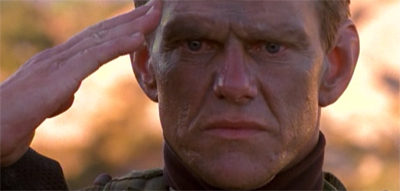
We salute you...

We salute you…

Ray Butts piles on the questions. The show doesn’t reveal his orders for quite a while, asking the audience to decide whether they trust the orders – let alone the man assigned to carry them out. The show also plays up questions around Butts himself; is Butts a man trying work through his own issues in his own way, or simply a risk-taking and borderline incompetent commanding officer? Ray Butts doesn’t have too many surprises, but it works because Morgan and Wong know how to structure an episode of television.

After the misfiring ambition of The Dark Side of the Sun, it feels almost like Ray Butts puts Morgan and Wong back in their element.
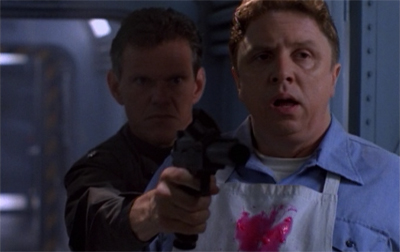
Don't shoot the chef!

Don’t shoot the chef!

Continue reading

The X-Files – D.P.O. (Review)

This November (and a little of December), we’re taking a trip back in time to review the third season of The X-Files and the first (and only) season of Space: Above and Beyond.

What is interesting about the third season of The X-Files is the way that everything seemed to click into place. After two years of figuring out how various parts of the show worked, the series was in a place where it worked like a finely-honed machine. The conspiracy episodes hit all the right boxes. The second season had demonstrated the show could do experimental or even humourous episodes. Even the standard “monster of the week” shows were delivered with more confidence and style.

While D.P.O. may not be the strongest episode of the third season, it is an example of how comfortable the show has become. It is an episode that move incredibly well, where the vast majority of the pieces click, and one which is fondly remembered by the fan base. There’s a very serious argument to be made that writer Howard Gordon was the best author of “monster of the week” scripts working on the show at this point, and D.P.O. demonstrates how well he crafts these sorts of stories.

Cooking up a storm...

Cooking up a storm…

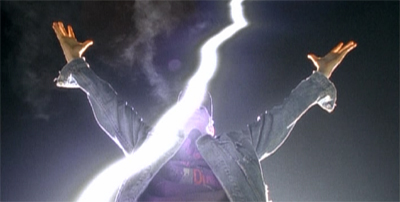
D.P.O. also benefits from any number of elements that make it seem memorable, even if it is “business as usual” after a massive three-part conspiracy epic. The opening sequence – featuring Ring the Bells by James – is one of the first times the show has so successfully integrated music into its action, something that would become a memorable part of later shows and even Millennium. The guest cast features Giovanni Ribisi and Jack Black. The episode also perfectly captures teen angst in an insightful manner.

The show was apparently drawn from an index card labelled “lightning boy”, which had been on Chris Carter’s white board since the first season. It’s very hard to imagine the show pulling off something like D.P.O. during its first season. While it might have worked towards the end of the second season, the start of the third season seems the perfect place for it.

Cloudy with a chance of angst...

Cloudy with a chance of angst…

Continue reading

Non-Review Review: Begin Again

Music is absolutely wonderful. It’s a method of communication that has the tremendous ability to bring people together, and to help set mood and tone. Of course, there’s all sorts of delightful complications to it – although songs may capture a particular moment in the life of the songwriter, as if trapping emotions in amber, they also capture particular moods and moments for the person listening to the music. A snippet of a song overhead faintly on a radio through an apartment wall can serve as a gateway back in time.

Although – speaking strictly scientifically – smell is the sense that leads most directly to memory, music has perhaps the strongest emotional resonance. Beloved songs provide a snapshot of something as transcendental as sensation and atmosphere. It is very hard to put these sentiments into words, to articulate through language. A guitar chord struck at the right time in the right rhythm, or a syllable stressed in one direction rather than any other, can say so much in such a small space.

Begin Again is a charming romantic ode to the power of music, beautifully and elegantly capturing the romance of song.

Playing along...

Playing along…

Continue reading

Star Trek: The Next Generation – The Ron Jones Project & The Best of Both Worlds OST (Review)

This January and February, we’ll be finishing up our look at the second season of Star Trek: The Next Generation and moving on to the third year of the show, both recently and lovingly remastered for high definition. Check back daily for the latest review.

We’ll be supplementing our coverage of the episodes with some additional materials – mainly novels and comics and films. This is one such entry.

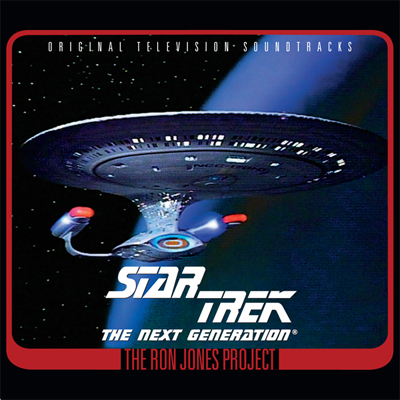
In 1991, The Best of Both Worlds got a CD soundtrack release. It was incomplete, running just under forty-seven minutes. (Five minutes music would be included on The Ron Jones Project and 2013 would see a release of a more complete two CD set running fifty-five minutes.) However, this was the first soundtrack album released for Star Trek: The Next Generation since Dennis McCarthy’s score to Encounter at Farpoint in 1988.

The music for The Best of Both Worlds is iconic. In the Regeneration documentary included with the blu ray release of the episode, Seth McFarlane jokes about hiring Ron Jones on the strength of that closing sting. The impressive orchestral score to The Best of Both Worlds remains one of the most instantly recognisable soundtracks in the Star Trek canon. And yet it was written by a composer who was on his way out the door.

Of the twelve discs in The Ron Jones Project soundtrack collection covering the episodes scored by Jones, only three include scores for episodes that aired after the second part of The Best of Both Worlds. (And the third-to-last disc only features one episode from the fourth season.) So, what happened?

tng-ronjones12

Continue reading

Non-Review Review: The Omega Man

The Omega Man remains, perhaps, the most high-profile adaptation of Richard Matheson’s genre-busting vampire sci-fi survivalist novel, I Am Legend. Of course, the film has little resemblance to Matheson’s truly iconic piece of literature, save for the basic premise. Charleton Heston is Robert Neville, the last man alive in a world of monsters. While I Am Legend is a bold and thought-provoking exploration of the implications of that idea, The Omega Man seems to have no loftier goal than simply telling an entertaining apocalyptic yarn. There’s nothing wrong with that, but – much like Robert Neville himself – The Omega Man is haunted by the ghost of what could have been.

Goodbye to all of that...

Goodbye to all of that…

Continue reading

Non-Review Review: Pitch Perfect

This movie was seen as part of Movie Fest, which is as much of a joy this year as it was last year.

Pitch Perfect seems like a recipe for a disaster. It’s a college pseudo-coming-of-age comedy set in the competitive world of acapella, with a women’s group fighting to break “the acapella glass ceiling.” (We’re told – by a commentator described as “a misogynist at heart” – that “woman are about as good at being acapella singers as they are at being doctors.”) However, the film is a joy to watch, a light feel-good film with a wonderful charm and a bright wit about it, brought to life by a fantastic cast working off a wry script. It’s never too heavy, and it never insists upon itself, but it’s engaging and fun in a way that makes it hard to resist.

Anna-phonic sound…

Continue reading

Lyrical Dissonance: Musical Musings…

I don’t normally write about music here… probably because I know next-to-nothing of music. I couldn’t pick most modern musicians out of a line-up. Not in a “modern musicians suck” sort of way, but in a “I don’t really listen to the radio, and therefore pop music” sort of way. So I’m actually even less qualified than a layman to talk of music and such. Still, I have to admit that I am fascinated at how so few people who rate so many classic songs so highly seem to be aware of what the song they’re listening to (or singing along to) is even about. While it isn’t anything that “grinds my gears”, I am still a little amused every time I hear Every Breath You Take played at a wedding, or Good Riddance (Time of Your Life) played at graduation.

Continue reading

Non-Review Review: Wild at Heart

I’ve always had a soft spot for David Lynch, if only because – much like David Cronenberg – you always got the sense that his artistic vision was pretty unfettered by concerns about broad appeal or studio policy or anything like that. There’s a wonderful sense of freedom, in how he works. There’s a great quote from the guys at Pixar that they don’t make movies for kids, they make movies for themselves – if other people happen to enjoy it, well… that’s great too. That sums up a lot of what I respect about Lynch. Wild at Heart isn’t perhaps one of those moments where Lynch’s interests manage to overlap with truly great cinema (as they do, I would argue, for Mullholland Drive, Blue Velvet and The Straight Story), but it isn’t so completely scattershot as to be impenetrable, either.

Dancing in the... highways?

Continue reading

Meme of the Moment: Desert Island CD’s

This blog post is part of “Desert Island CD’s”, a blogging event being hosted by those gents over at Anomalous Material as a sort of a spiritual successor to last year’s “Desert Island DVD’s”. Check out the link above for everybody else’s list.

Movie soundtracks are a strange beast. They say that memory is most strongly associated with the sense of smell, but – since I guess we can’t smell movies outside of Hans Laube’s somewhat misguided “Smell-O-Vision” – I am never less than amazed at the capacity of a piece of music to take me back to a film. Whether it’s a piece of an orchestra score, a pop song featured in the background, an original composition for the film or even a piece linked to a particular trailer, film music has a strong tie to my memory. To show you that I am not kidding, thanks to the following truly corny international trailer, I can’t hear The Sun Always Shines on TV without thinking of Slumdog Millionaire. You may think I’m bluffing, but skip to about a minute into it.

Continue reading

Jack L at the National Concert Hall

If ever there was a natural-born showman, Jack Lukeman (aka Jack L) is he. Taking to the stage in the National Concert Hall to perform any number of classics, forgotten album tracks and even some new material, the performer managed a two-and-a-half hour set list which even included an impromptu version of The Stranglers’ Golden Brown performed during the intermission. Yes, that’s right, Jack L sang his way through his own intermission.

For those foreign visitors who might not be familiar with the artist, I’ve embedded a version of Georgie Boy below, the crowd-pleaser that he used as the final song in his encore last night. It’s powerful stuff, even when not backed by an orchestra.

Continue reading