• Following Us

  • Categories

  • Check out the Archives


  • Awards & Nominations

“We Will Change You, Doctor Jones”: “Indiana Jones and the Kingdom of the Crystal Skull” and a Unified Theory of Indiana Jones…

Indiana Jones and the Kingdom of the Crystal Skull is a movie with very real and very tangible problems.

Part of the problem is one of simple aesthetics. The original trilogy were products of a very particular moment in the history of American cinema, spanning the eighties. Raiders of the Lost Ark was very much a rollercoaster of a movie, a showcase for practical effects and impressive stunt work. Indiana Jones and the Temple of Doom was built around impressive physical sets, model work and location work. Even Indiana Jones and the Last Crusade took a great deal of pride in how tactile this world felt.
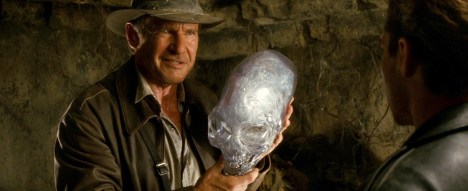
Crystal clear.

In contrast, Indiana Jones and the Kingdom of the Crystal Skull was a product of a transitional decade for Hollywood. It is no coincidence that the film opened in the same summer as blockbusters like Iron Man and The Dark Knight, which heralded a new future for crowdpleasing spectacle. While The Dark Knight made a conscious effort to ground its storytelling in practical effects, Iron Man signaled that the digital effects revolution was going to be the cornerstone of the superhero genre.

As such, Indiana Jones and the Kingdom of the Crystal Skull feels like a deliberate and conscious step into the uncanny valley. Many of the movie’s most decried action sequences are driven by green screen and computer-generated special effects, standing in start contrast to the weight and mass that defined the earlier set pieces. It’s unsettling and uncomfortable. The chase sequence in the Amazon is perhaps the most egregious example, but this detachment from reality is obvious from the early scenes inside the warehouse, as pixels guide our hero and his captors to their destination.

Blowing the roof off.

Indiana Jones and the Kingdom of the Crystal Skull exists in another uncanny space, most obviously through the introduction of the character of Mutt Williams. Part of this problem is undoubtedly Shia LeBeouf himself, who has been candid about his work on the film to the point of alienating director Steven Spielberg. Much like it’s easier to recognise the “pre-sequel” of Indiana Jones and the Temple of Doom as a prequel with the benefit of hindsight, it’s easier now to see Indiana Jones and the Kingdom of the Crystal Skull as a rough draft of a “legacyquel”, like Creed or Star Wars: Episode VII – The Force Awakens.

Of course, Indiana Jones and the Kingdom of the Crystal Skull is too clumsy to really work in that way. The film’s closing moments dare to tease the idea of Mutt Williams succeeding Indiana Jones, the wind blowing Jones’ iconic hat into Williams’ clutches. However, Indiana Jones and the Kingdom of the Crystal Skull lacks the courage of its commitment. Jones snatches the hat away at the last minute, prefiguring the way in which Star Wars: Episode IX – The Rise of Skywalker would retreat from the idea of passing Star Wars to a new generation.

It’s not the years, it’s the mileage.

There are other ways in which Indiana Jones and the Kingdom of the Crystal Skull feels like it is caught between two eras. The film’s structure arguably suffers from the production team’s famed attempts to preserve the secrecy of the plot, which even extended to a sting operation and a high-profile lawsuit. The publicity around the film reportedly considered keeping Karen Allen’s return a secret, and the film’s structure conceals the presence of Marion Ravenwood for an hour. It’s a choice that muddies the film’s handling of its themes, denying it the clarity of how Indiana Jones and the Last Crusade handled Henry Jones.

Still, accepting these issues as problems, there is a lot of interesting stuff happening beneath the surface of Indiana Jones and the Kingdom of the Crystal Skull. In particular, Indiana Jones and the Kingdom of the Crystal Skull feels like a very sincere and genuine effort on the part of everybody involved to figure out some grand unified theory of Indiana Jones, separated from the original three films by decades. What does it mean to look back on the trilogy? How has the world changed? How would the character wrap it all up?

It was admittedly a bit of a wash…

Continue reading

New Escapist Column! On How “The Green Knight” Deconstructs the Hero’s Journey…

I published a new In the Frame piece at The Escapist this evening. With the release of David Lowery’s The Green Knight on streaming, it seemed like a good opportunity to take a look at the director’s reimagining of classic Arthurian legend.

In particular, when is so fascinating about The Green Knight is the way that it takes a very classic and very conventional hero’s journey – the story of a character who embarks upon a quest that makes them better, stronger and wiser before returning home fundamentally changed by the experience – and gradually deconstructs it. Is a hero’s journey alone enough to make Gawain a great man? Can the adventure make him a different person? Is there a checklist of accomplishments that he must complete before he becomes a worthy knight? The Green Knight interrogates and explores these questions.

You can read the piece here, or click the picture below.

New Escapist Column! On Why the Mandarin from “Iron Man 3” Remains One of the Best Marvel Villains…

I published a new In the Frame piece at The Escapist this evening. With the release of Shang-Chi and the Legend of the Ten Rings next week, it seemed like a good opportunity to take a look back at Iron Man 3, and that movie’s attempt to update the Mandarin for the twenty-first century.

Long treated as Tony Stark’s arch-nemesis, the Mandarin is a complicated character with a very troubled history. The character is built around yellow peril stereotypes, and is easily recognisable as a classic Fu Manchu archetype. Part of what made Iron Man 3 so compelling and so interesting was the way in which the film wasn’t just built around the Mandarin as a character, but instead explored and interrogated the concept. It was a film about how pop culture, film and television, creates images of foreign enemies in service of the politic demands of the moment. Iron Man 3 explores that idea brilliantly.

You can read the piece here, or click the picture below.

Non-Review Review: Reminiscence

Reminiscence is an intriguing concept in desperate need of a stronger execution.

Reminiscence marks the feature film directorial debut of Lisa Joy, the co-creator of Westworld. In some ways, this is revealing. It often seems like the best version of Reminiscence might be a television pilot, a two-hour feature-length exploration of a futuristic dystopia that lays a lot of groundwork to be explored by later episodes and seasons. It’s very clear that Joy has put a lot of thought into the world of Reminiscence, about how it works and how it developed, and why it turned out the way it did. All of that work is either on-screen or blasted over the audio system via helpful voiceover exposition.

On the record.

Unfortunately, Reminiscence struggles to devote any real energy to its actual narrative or characters. Reminiscence is clearly constructed as an affectionate homage to classic film noir, in everything from its production design to its plot structure to its thematic concerns. However, it lacks the richness and the complexity that distinguishes the best of the genre. Instead, because so much time is spent explaining and re-explaining the mechanics of the world, everything else feels like a thinly-drawn sketch.

Reminiscence often feels like the faded memory of a much more engaging film.

Shining a light on it.

Continue reading

New Escapist Column! On How “The Suicide Squad” Uses Idris Elba…

I published a new In the Frame piece at The Escapist this evening. With the release of The Suicide Squad, it seemed like a good opportunity to take a look at one of the keys to the film’s success. James Gunn understands how to use Idris Elba as a leading man.

Movie stardom is a fascinating concept. So much of what makes a particular person a movie star is ineffable. It is hard to quantify or gauge. It can also be difficult to harness with intent and purpose. This is particularly true in an era where Hollywood seems to be moving away from movie stars, and films like Jungle Cruise seem to struggle against their leads’ screen personas. However, part of what makes The Suicide Squad so effective is that it understands exactly what makes Idris Elba so compelling as a screen presence, and finds a way to play into that to the movie’s benefit.

You can read the piece here, or click the picture below.

Non-Review Review: People Just Do Nothing – Big in Japan

People Just Do Nothing: Big in Japan has had an interesting journey to the big screen.

People Just Do Nothing began as an online video series, before transitioning to BBC Three and then to BBC Two. The mockumentary comedy accrued a cult following, and so it’s refreshing to see much of the cast and crew given the chance to take the concept to a cinematic adaptation. There’s something inherently charming in this comedy concept built around a bunch of unqualified (and perhaps even untalented) local pirate DJs getting to make their own feature film that takes the characters and the cast to Japan. (It is also, for example, fascinating to see the characters fronting an anti-piracy public service announcement.)

The band at a crossroads.

Big in Japan has a lot of work to do, both in appealing to fans of the series and in winning over potential new converts. The movie is designed to function both as a culmination of the characters’ journey and paradoxically as an introduction to the characters. It’s a lot to ask from a feature film, particularly a comedy, and Big in Japan occasionally stumbles under the weight of those competing demands. Big in Japan is at its weakest when it’s trying to craft a story that is at once a satisfying development for long-term followers these characters while also being universal enough to work for audiences new to this world.

Big in Japan works best in its smaller moments, when it commits to individual jokes rooted in particular character. It falters when it sacrifices those strengths in the hopes of advancing the big picture. Big in Japan is arguably at its best when it goes small, a lesson that the film tries to impart to its own characters.

Toasts of Tokyo.

Continue reading

Non-Review Review: Censor

Censor is a love letter to the era of so-called “video nasties” and an exploration of the moral panic that tends to encompass discussions of the genre.

Niamh Algar plays Enid, the eponymous moral guardian with a traumatic back story who has committed herself to protecting the nation’s sanity by watching and rating the low-rent horrors flooding the market. Over dinner conversation, Enid takes offense when her mother asks if she has seen any good movies recently. “It’s not entertainment, Mam,” Enid snaps. “I’m protecting people.” It’s very clear that Enid believes this, taking meticulous notes and engaging in rigorous debates about exactly how much eye-gouging the public can tolerate.

The Green Night.

On the surface, Censor is a movie with a plot that loosely suggests something akin to Hardcore or 8mm. Throughout the film, hints are dropped about Enid’s traumatic past, including the mysterious disappearance of her younger sister while the two girls were playing together. When the latest film from a provocative auteur named Frederick North crosses her desk, Enid seems to recognise one of the on-screen victims. Is her sister still alive? Has she been swallowed by this world of exploitation horror cinema? More to the point, can Enid finally rescue her and bring her home?

The beauty of Censor lies in how co-writer and director Prano Bailey-Bond plays with this familiar set-up, building a movie around the idea that horror movies are a form of escapism for moral guardians as much as the intended audience, a space into which these people can project their own nightmares and anxieties without ever having to confront the reality of the world around them.

Signalling concern.

Continue reading

Non-Review Review: The Last Letter From Your Lover

The Last Letter from Your Lover is an adaptation of Jojo Moynes’ breakout romantic novel of the same name, and it very much feels like a cinematic adaptation of a beloved novel.

The basic premise of The Last Letter from Your Lover is a nested love story. While working on a feature about another subject, an intrepid journalist named Ellie Haworth finds a mysterious love letter. This love letter suggests a secret affair in sixties high society. The letters are clearly addressed to Jennifer Stirling, a young woman trapped in a loveless marriage to a wealthy industrialist, who finds herself navigating her own past following an accident that leaves her with amnesia.

How I Met Your Lover.

It’s a solid set-up for a romantic drama, with The Last Letter from Your Lover paralleling both Ellie and Jennifer in their investigations into Jennifer’s mysterious past in an effort to explore and investigate the sordid affair that potentially could derail Jennifer’s entire life. The Last Letter from Your Lover benefits from two charming lead performances from Felicity Jones as Ellie and Shailene Woodley as Jennifer, along with strong direction from Augustine Frizzell.

Unfortunately, The Last Letter from Your Lover never feels like a convincing screen romance, but instead a shadow of a much more engaging love story on the page.

Letter be.

Continue reading

Non-Review Review: Profile

Profile is the latest entry in the so-called “Screen Life” series, produced by Timur Bekmambetov. It is also notable as the first entry in the series to be directed by Bekmambetov himself.

The “Screen Life” series is effectively a set of heightened genre movies that unfold through the screen of a laptop, narratives that unfold through chat boxes, Skype chats, playlists and file transfers. It’s an innovative and experimental approach to storytelling. While the results – Unfriended, Searching… and Unfriended: Dark Web – have varied in quality, the hook has always been fascinating. So much of modern life is navigated through screens that it is fascinating to see movies try to reflect that. Indeed, there’s an argument that movies like Unfriended play better on computer screens than they do in theatres or on televisions.

Translating the story to screen.

Profile adheres to the cinematic conventions of these sorts of stories, but it feels unnecessarily constrained in other ways. Each of the three previous films has been a genre exercise told through a computer screen. Unfriended and Dark Web are teenage horror movies, while Searching… is a delightfully schlocky nineties thriller reimagined through a web camera. In contrast, the subject matter of Profile is decidedly weighter. The film is based on the non-fiction book In the Skin of a Jihadist by Anna Ereklle, looking at online recruitment of young British girls by Islamic extremists.

This is an appreciably more grounded and more serious piece of subject matter than something like Unfriended or Searching…, and it’s interesting to see this cinematic language applied to this subject matter. After all, this is a digitally native story and a tale about the process of mediating the world through computer screens. However, Profiles suffers slightly from the need to frame this subject matter not through the lens of a web camera, but through the prism of genre, to transform something very real and very threatening into a heightened cartoonish thriller.

A new Skype of thriller…

Continue reading

New Escapist Video! “Jungle Cruise – Review”

I’m thrilled to be launching movie reviews on The Escapist. Over the coming weeks and months, I will be joining a set of contributors in adding these reviews to the channel. For the moment, I’m honoured to contribute a three-minute film review of Jungle Cruise, which is releasing theatrically and on Disney+ Premiere Access this weekend.