• Following Us

  • Categories

  • Check out the Archives


  • Awards & Nominations

Non-Review Review: The Walk

“It is not real,” Philippe Petit reflects quite early in The Walk.

Resting his chin against one of the steel supports running the height of the World Trade Centre, Philippe stares upwards into infinity. Up until that moment, the Twin Towers had existed as a conceptual object for the young French tightrope artist; he had only seen them in photographs and sketches, framed in comparison to the Eiffel Tower to afford them a sense of scale. Appreciating the majesty of the World Trade Centre in the flesh is almost too much to process. Making them more real has somehow made them less real.
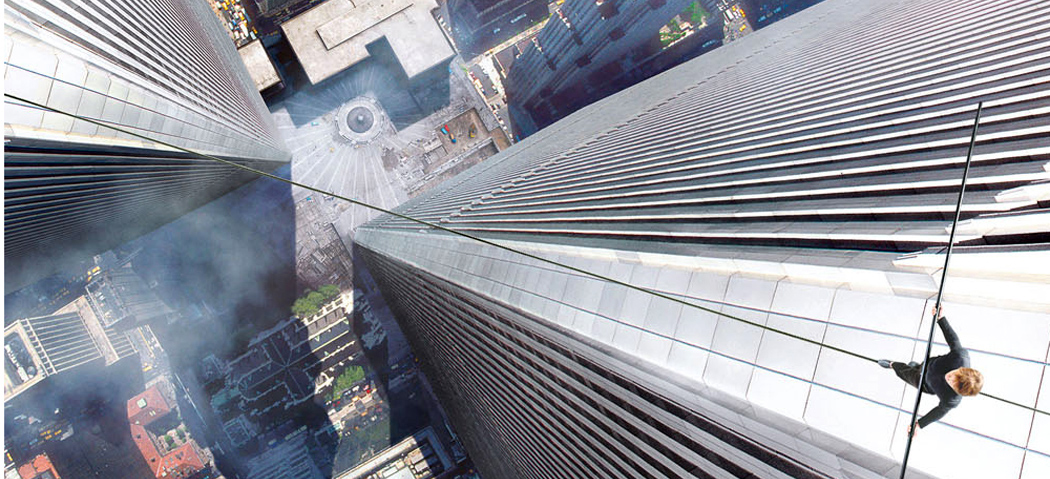
Walk on the wild side...

Walk on the wild side…

Philippe could just as easily be talking about the film that surrounds him. Director Robert Zemeckis might be best known for his work on Back to the Future, but a lot of his twenty-first century filmography has been fixated upon the unreal; Zemeckis has become known for his fascination with motion-capture and computer-generated imagery, the illusive pursuit of verisimilitude through the uncanny valley. The special effects used to realise The Walk are superb and top of the line, but there remains a feeling of unreality to the whole film.

It would be impossible to film The Walk in a real location using real stunts. The Walk is an ode to New York City, but to a version of New York City that no longer exists. Tourists cannot visit it, although perhaps it might be found on a postcard or trapped in a photo. The Walk cleverly and consciously refuses to downplay that feeling of unreality, feeling almost like a nostalgic memory recalled through the fog of time. Philippe Petit’s tightrope walk between the Twin Towers was so effective because it was real; The Walk is so effective precisely because it is unreal.
Stepping out...

Stepping out…

Continue reading

Non-Review Review: Ghosthunters on Icy Trails

Ghosthunters on Icy Trails is derivative as anything.

The movie walks a very thin line between knowing self-aware homage and cynical appropriation. The movie’s script draws attention to many of its influences and inspirations, but there is frequently a feeling that many of these ideas and images worked much better the first time around. There some nice gags in there, and two solid central performances from Milo Parker and Anke Engelke, but Ghosthunters on Icy Trails frequently feels like a featherweight imitation of much more entertaining family films.

Pass the popcorn...

Pass the popcorn…

Continue reading

Non-Review Review: The Martian

The beauty of The Martian lies in its relative simplicity. Although it runs a solid two-hours-and-twenty-minutes, the film seems a lot faster than many of its contemporaries because it keeps its eyes on a very simply central dynamic. Within the opening five minutes, the movie’s status quo is established with breathless efficiency; astronaut Mark Whatney is left for dead on the surface of Mars, and must struggle to survive as the entire planet figures out how to get him back alive.

The premise is very straightforward, and seldom gets more complicated than that. Mark tries to figure out how to stay alive as the greatest minds back home work on daring plans to establish communication and possible retrieve the lost astronaut. Along the way, both Mark and NASA suffer setbacks and reversals; complications abound and dilemmas present themselves. However, The Martian is always anchored in that very basic struggle against overwhelming odds and an indifferent universe.

Is there life on Mars?

Is there life on Mars?

The Martian is something of a genre cocktail. The movie’s tone and plot is perhaps best evoked by reference to Byron Haskin’s 1964 cult classic “Robinson Crusoe on Mars.” Mark’s plight is not too dissimilar to that of the Robert Lewis Stevenson protagonist, nor to that of Chuck Noland in Cast Away or the anonymous protagonist of All is Lost. However, the movie’s stellar setting serves as a gateway to a broader commentary on human codependency and association. Nobody gets there on their own; nobody gets back alone.

The Martian is a surprisingly heartwarming and life-affirming adventure, anchored in a charming central performance from Matt Damon and a very deep ensemble. Despite the massive sense of scale involved, Ridley Scott’s direction and Drew Goddard’s script work hard to keep it all personal. The Martian is a triumph.

Matt Damon was very excited about the film's release...

Matt Damon was very excited about the film’s release…

Continue reading

Non-Review Review: Life (2015)

The biggest problem with Life is that the film is largely lifeless.

Life is the story of the iconic photographs of James Dean taken by photographer Dennis Stock in the run-up to the release of East of Eden in March 1955. At that point, Dean was a young actor on the cusp of stardom. As the premiere of East of Eden approached, Dean still aspiring towards his definitive role in Rebel Without a Cause. Dennis Stock saw something in the young actor, believing he might capture a moment of cultural change in the brooding young actor.

"The coat, he borrowed from James Dean..."

“The coat, he borrowed from James Dean…”

Even if they didn’t make the cover of Life magazine, Stock’s photographs have come to define Dean in the popular memory. These photographs capture Dean at his most brooding and his most joyous, capturing the extremes of his experience. Snapping Dean walking through the rain in Times Square or reading comics with his brother, Dennis seemed to trap some of the essence of the actor in his work. Life centres on the complicated relationship that exists between the two men, as they attempt to get a read on one another and navigate the taut waters of celebrity.

However, for a film inspired by (and derived from) an instantly recognisable set of photos, there is something just a little bit too staid about Anton Corbijn‘s two-hour long character study. It feels like a loose selection of pop psychology strung around some faithful recreations, missing the vibrancy and the intimacy that made those shots so distinctive.

#HairRaising

#HairRaising

Continue reading

Non-Review Review: We Are Your Friends

Appropriately enough, We Are Your Friends feels like a selection of remixed samples of other movies.

The script for We Are Your Friends dutifully hits all the requisite beats from a coming of age story about a young man trying to find his way in the world; in this case, “the world” refers to “the San Fernando valley”, just over the Hollywood Hills. Appropriately enough, We Are Your Friends positions the valley (“the Valley”) as a sort of purgatory for those who want to get out towards better things; aspiring DJs and actors trapped in dull routine who must learn to stay true to themselves to attain meaningful (and not just material) success.

The beat goes on...

The beat goes on…

It is a very familiar story structure, one that lends itself to the sense of social striving associated with other (more substantial) films about life in Los Angeles. We Are Your Friends doesn’t have a story as much as it has an outline; the requisite steps that young would-be DJ Cole Carter must take on the path to stardom. There is an older mentor with feet of clay, a troubled love interest also looking for meaning in the world; there is the false promise of financial security, a tragic lesson about life lived to access.

However, all of this is drawn so broadly that We Are Your Friends is a tracklist rather than an album. Director Max Joseph brings commendable energy to the film, and Zac Efron is quite affable as a protagonist more cliché than character. Wes Bentley adds just a hint of flavour to an otherwise ambient film. We Are Your Friends is inoffensive, but ultimately more visually interesting than completely satisfying.

Hey, Mister DJ, put a record on...

Hey, Mister DJ, put a record on…

Continue reading

Non-Review Review: Hitman – Agent 47

Hitman: Agent 47 is not a good film, but it is bad in interesting ways.

The video game adaptation fad of the nineties has given way to a wave of blockbuster comic book movies. Those comic book adaptations have fared much better – both critically and commercially – than fare like Super Mario Brothers or Street Fighter or Mortal Kombat. As such, Hitman: Agent 47 feels like something of an outlier; it is a reboot of a video game property that already failed to take flight in a movie released eight years ago. Even if there is a resurgent interest in video game movies, it seems strange to return to this video game movie.

You know, that looks like a highly impractical way to hold those guns...

You know, that looks like a highly impractical way to hold those guns…

At the same time, there is something quite compelling about the structuring of Hitman: Agent 47. Perhaps inspired by the success of the relative fidelity of twenty-first century comic book adaptations, Hitman: Agent 47 struggles to provide a relatively faithful adaptation of the game-playing experience. Though the structure and tone of the movie might jar with the source material, director Aleksander Bach is careful to preserve as much of the game-play experience as possible. Extended sequences of Hitman: Agent 47 play as a walkthrough of a life-like video game.

Which, of course, only serves to make the film feel somewhat redundant; watching a bunch of actors play through scripted game-play-like scenarios might offer a faint echo of the thrill of playing a video game, but captures none of the investment.

Bloody mess...

Bloody mess…

Continue reading

Non-Review Review: Paper Towns

There is an irony at the heart of Paper Towns. In many ways, it is a typical teenage coming of age fantasy. Quentin is approaching the end of his high school life, which has been spent buried in books. One night, the girl next door sneaks into his bedroom and takes him on a whirlwind adventure through the Orlando nightlife. Reconnecting with the enigmatic Margo for the first time since childhood, old feelings are reignited; Quentin allows himself to feel excited and alive. However, the next morning, Margo is gone.

As Quentin begins a bizarre treasure hunt to track her down, he finds himself caught up in a dynamic adventure. Deciphering a series of clues that offer an indication of where Margo might have gone, Quentin discovers that there is more to life than his own narrow experiences to date. The pursuit of Margo allows Quentin to come out of his shell. “You’re cute when you’re confident,” Margo assures him at one point in the film. “Less so when you’re not.” Inevitably, Quentin learns that he has to venture outside of his shell and push past his comfort zone.

Dream girl...

Dream girl…

This is a classic teen movie trope, reinforcing the sense that key to adolescent (and even adult) fulfilment is comfort in your own skin. It’s a nice idea, because it is undoubtedly true. However, Paper Towns is not particularly convincing in its thesis statement. For a film about the need to be comfortable with your teenage self, Paper Towns tries very hard. There is a crispness and efficiency to Paper Towns that belies its big central idea, a sense that the film is urging its central character to try something it is not comfortable enough to do on its own terms.

The result is a film that is charming and witty on its own terms, but which occasionally feels just as illusory as any of the fictitious locales to which the title alludes.

Shopping for trouble...

Shopping for trouble…

Continue reading

Non-Review Review: Pixels

Pixels has a fun concept.

The idea of video game characters invading the world is a delightfully gonzo piece of pop culture nostalgia. It is easy to see why Sony picked up the option for Patrick Jean’s 2010 short film, even if the concept was not new. Neither version of Pixels can quite measure up to Raiders of the Lost Arcade, the short that aired as part of Anthology of Interest II during the third season of Futurama. That ten minute short story captured the sheer unadulterated joy of a world under siege from its juvenile obsessions.

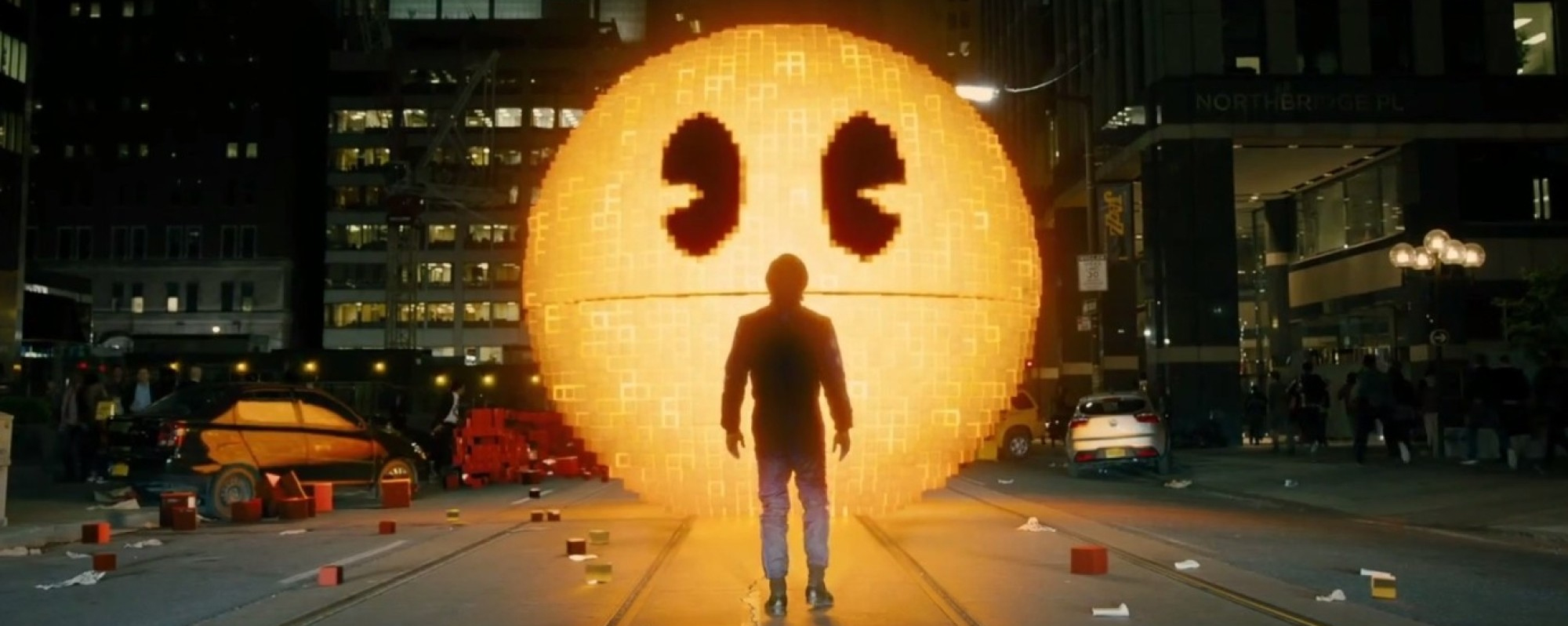
You are my sunshine...

You are my sunshine…

There are a lot of problems with Pixels. The most obvious is that it seems completely disinterested in its core concept as anything other than a vehicle for Adam Sandler. There is a lot of CGI and a number of recognisable pop culture references, but Pixels plays just like any other Happy Madison vehicle. It is an excuse to pair Adam Sandler up with a beautiful actress and pay for trips for friends and acquaintances around the world while making jokes that were tired when most of the audience was making them in the playground.

Pixels never embraces the goofy joy of an invasion of eighties video games, instead wallowing in the presence of washed up nineties hackery.

All the President's... People.

All the President’s… People.

Continue reading

Non-Review Review: Inside Out

Inside Out represents a glorious return to form for Pixar.

After several years of sequels and middling films, Inside Out feels like a breath of fresh air. Films like Cars 2 and Monsters University were very much safe bets for the company, a way to leverage return from existing (and well-loved) properties. Inside Out is something altogether stranger and more high-concept. It feels like the studio is getting back in touch with its original aesthetic. It is a concept that initially seems quite complex and esoteric, but quickly reveals itself to be a simple emotional fairytale.

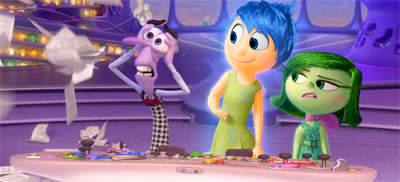
Memories are made of this...

Memories are made of this…

Wall-E might have been a half-silent science-fiction film, but it was also a very effective love story. Up might have been a wacky adventure about a flying house, but it was also an insightful meditation on grief and loss. Finding Nemo was populated with colourful fish, but it was also about the experience of watching a child venture into the world. Pixar established and developed a reputation as a studio that could produce films that were accessible and exciting to children, but also packed a more weighty and substantial punch for the parents in the audience.

Inside Out is perhaps the most high of Pixar’s concepts, but it ultimately boils down a very organic and instinctive story meditating on the studio’s core themes of emotional development and family metaphors.

An emotional journey...

An emotional journey…

Continue reading

Non-Review Review: Ted 2

Ted 2 is a Seth McFarlane movie that ends with an extended sequence set at New York Comic Con, that hub of nerd culture populated by people dressed like any number of iconic pop culture characters.

As such, it seems perfectly reasonable to describe Ted 2 as the quintessential McFarlane movie, for better or for worse.

Unbearable?

Unbearable?

Continue reading